


Imagine working at a startup for three years, helping the company grow and celebrating every small achievement. Along with your monthly salary, the company offers you Employee Stock Options (ESOPs), giving you a chance to own a small part of the business. Everything seems exciting until you receive a better job opportunity and decide to resign. Suddenly, you remember those stock options mentioned in your offer letter. Will you lose them after leaving the company? Can you still purchase shares? What happens if your employer terminates your services instead? These are common questions employees ask when planning their next career move.
ESOPs on resignation, termination and death are important because stock options can become a valuable financial benefit, especially when a startup grows successfully. However, receiving ESOPs does not mean employees immediately become shareholders. Their rights depend on vesting conditions, the exercise period, company policies and applicable legal requirements. In India, ESOPs are regulated under the Companies Act, 2013, the Companies (Share Capital and Debentures) Rules, 2014 and SEBI regulations, where applicable. Understanding these provisions can help employees protect their benefits and companies manage employee exits without unnecessary disputes.
What Are ESOPs and How Do They Work?
An Employee Stock Option Plan (ESOP) is a benefit offered by companies to eligible employees, allowing them to purchase company shares at a predetermined price after completing certain conditions. Companies generally introduce ESOPs to reward hardworking employees, encourage long-term commitment and give team members an opportunity to benefit from the company's future growth. This is especially common among startups because they may not always have enough funds to offer high salaries. Instead, they provide stock options that may become valuable as the business expands. However, employees must understand that an ESOP grant is only a right to acquire shares in the future, not immediate ownership.
For example, suppose a startup grants an employee 2,000 ESOPs at an exercise price of Rs 50 per share. After a few years, the company's share value increases to Rs 200. The employee may have an opportunity to purchase shares at the agreed exercise price, subject to vesting and other conditions. However, the benefit is not automatically available in cash because the employee must exercise the options and may need to find a buyer for the shares. To understand how ESOPs are introduced and administered, businesses can explore ESOP Scheme Compliance services.
To understand how employee stock options work, including their benefits, eligibility and ownership rights, read our detailed guide on ESOPs for Employees: What It Is, How It Works and Advantages.
Important ESOP Terms Employees Should Know
|
ESOP Term |
Meaning |
|---|---|
|
Grant Date |
Date when stock options are granted |
|
Vesting Period |
Time or conditions required to earn exercise rights |
|
Vested ESOPs |
Options eligible for exercise |
|
Unvested ESOPs |
Options that have not completed vesting conditions |
|
Exercise Price |
Price paid to purchase shares |
|
Exercise Period |
Time allowed to exercise options |
|
Lapsed ESOPs |
Options that expire or become unavailable |
What Happens to ESOPs When an Employee Resigns?
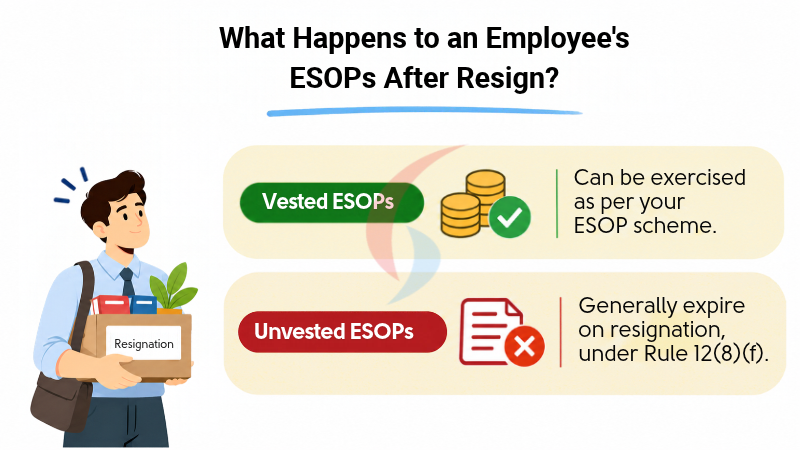
Resignation is one of the most common situations in which employees become worried about their ESOP benefits. Many employees believe that leaving the company means losing all their stock options, but this is not always true. Under Rule 12(8)(f) of the Companies (Share Capital and Debentures) Rules, 2014, unvested options expire when an employee resigns or their employment is terminated. However, vested options may still be exercised within the period and conditions provided under the approved ESOP scheme. Therefore, the most important thing employees should check before leaving is how many options have already vested and how much time remains to exercise them.
A Story: Amit's ESOPs After Resignation
Amit joined a technology startup in 2022 and received 4,000 ESOPs under a four-year vesting schedule. He worked hard, helped the company expand and completed two successful years. In 2024, another company offered him a better salary and a senior position. Amit was excited about the opportunity but worried about losing his ESOP benefits. After checking with his HR department, he discovered that 2,000 options had vested, assuming equal annual vesting, while the remaining 2,000 were still unvested.
According to the applicable rules, Amit's 2,000 unvested options would expire upon resignation. However, he could exercise the 2,000 vested options within the period permitted by his company's ESOP scheme. This made Amit realise why reviewing ESOP documents before resignation is just as important as checking salary, notice period and final settlement details.
Before resigning, employees should check their vested ESOP balance, exercise price and final exercise deadline. Missing the deadline may mean losing a valuable opportunity.
Employees should also understand the difference between holding stock options and owning company shares. For more clarity, read our article on ESOP vs Shares: The Key Differences in Company Ownership
Can Employees Exercise ESOPs After Resignation?
Yes, employees may exercise their vested ESOPs after resignation if the company's approved scheme permits it. However, the exercise period can differ from one company to another. Some companies allow a short post-resignation exercise window, while others provide a longer period. There is no universal 30-day or 90-day deadline applicable to every Indian ESOP scheme. The actual deadline depends on the approved policy and applicable legal requirements. Employees should request written confirmation of their vested options, exercise deadline, payment process and any share transfer restrictions before their final working day.
Another important consideration is the money required to exercise the options. Even if an employee has 5,000 vested options, exercising them may require a substantial payment. The employee may also face tax obligations when shares are allotted. This becomes particularly challenging in unlisted startups because employees might not be able to sell their shares immediately. Therefore, exercising ESOPs should involve careful financial planning rather than assuming that vested options automatically create an immediate cash benefit.
What Happens to ESOPs When an Employee Is Terminated?
Termination is different from voluntary resignation because an employee may leave the company without planning to do so. Sometimes organisations terminate employees because of business restructuring, financial difficulties or performance concerns. In other situations, employment may end because of serious misconduct. Under Rule 12(8)(f), unvested options generally expire upon termination, but the treatment of vested options depends on the approved ESOP scheme and applicable legal requirements. Certain schemes contain separate conditions for termination involving misconduct, making it important to examine the actual reason for termination and the company's documented policy.
Consider Neha, who worked with a growing company for four years and had 3,000 vested ESOPs. Unfortunately, her employer announced workforce reductions because of financial difficulties. Neha was concerned that she might lose the stock options she had earned over several years. Instead of making assumptions, she requested the company to confirm her vested option balance, exercise period and applicable conditions. Her situation shows why companies must communicate ESOP exit terms clearly, especially when employees are leaving involuntarily.
Companies must follow proper legal procedures when granting, exercising or cancelling employee stock options. To understand these requirements, refer to our ESOPs Compliance Checklist and Procedure under the Companies Act, 2013
ESOP Treatment in Different Employment Situations
|
Situation |
Unvested ESOPs |
Vested ESOPs |
|---|---|---|
|
Voluntary resignation |
Generally expire |
Exercisable according to scheme terms |
|
Termination without cause |
Generally expire |
Subject to approved scheme |
|
Termination for misconduct |
Generally expire |
Specific valid lapse conditions may apply |
|
Death during employment |
Vest in legal heirs or nominees |
Rights pass to legal heirs or nominees |
|
Permanent incapacity during employment |
Vest under applicable legal provisions |
Subject to exercise conditions |
Companies should ensure that termination-related ESOP conditions are properly documented in their employee stock option policies. Clear provisions help employees understand their rights and reduce disputes during the exit process. Businesses can also review the ESOPs Compliance Checklist under the Companies Act, 2013 to understand the important legal procedures.
What Happens to ESOPs After an Employee's Death?
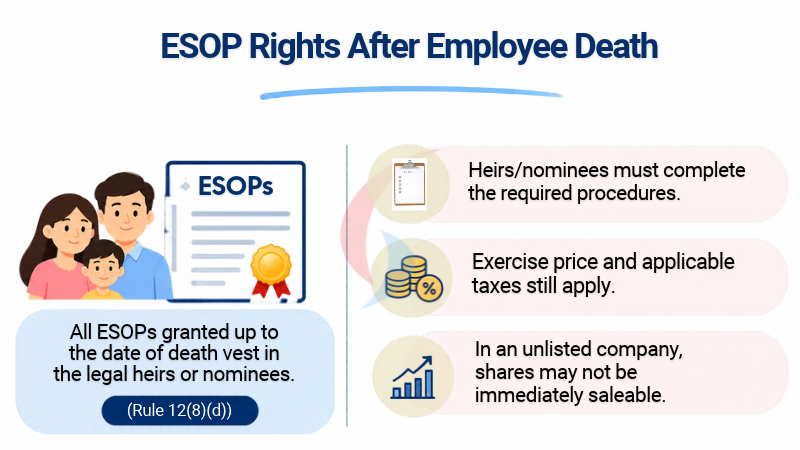
The death of an employee is a sensitive situation because their family may already be facing emotional and financial difficulties. In such circumstances, ESOP benefits can provide an important financial opportunity for the family. Indian company law recognises this situation and provides specific protection for employee stock options. Under Rule 12(8)(d) of the Companies (Share Capital and Debentures) Rules, 2014, where an employee dies while in employment, all options granted up to the date of death vest in the employee's legal heirs or nominees.
For example, Rahul worked at a private technology company and received 3,000 ESOPs. Unfortunately, he passed away while still employed, when only 1,500 options had vested under the normal schedule. Under the applicable provision, all 3,000 granted options would vest in his legal heirs or nominees. However, his family would still need to complete the necessary procedures to establish entitlement and exercise those options. Depending on the circumstances, the company may request documents such as a death certificate, nominee details or other legal records. The family must also understand the exercise price, applicable taxes and whether the resulting shares can be sold.
It is important to remember that ESOPs do not automatically become cash after an employee's death. When the company is unlisted, shares may not have an immediate buyer. Similarly, if the employee had already exercised the options and received shares before death, the ownership of those shares would be dealt with through applicable share transmission procedures rather than the vesting of outstanding options.
The rights of employees and their legal heirs also depend on the type of employee benefit arrangement offered by the company. Learn more about these arrangements in our article on Different Types of ESOPs – Employee Stock Ownership Plans
Why Is the ESOP Vesting Period Important?
The ESOP vesting period determines when employees become eligible to exercise their stock options. Many startups follow a four-year vesting schedule because it encourages employees to remain associated with the company and contribute to its long-term success. Under Rule 12(6)(a), there must generally be a minimum period of one year between the grant and vesting of options, subject to applicable exceptions. However, completing the minimum period does not automatically mean every option has vested. Companies may introduce cliff periods, annual vesting schedules or performance-linked conditions depending on their ESOP policies.
Suppose a startup grants an employee 4,000 options that vest equally over four years. If the employee resigns after completing three years and all vesting conditions have been satisfied, 3,000 options may have vested while the remaining 1,000 would generally expire. However, if the employee leaves before completing a one-year cliff, none of the options may have vested. This is why employees should understand the difference between the number of options granted in their offer letter and the options they have actually earned.
Startups should carefully design their ESOP vesting schedules to reward employees while protecting business interests. For more information, read our guide on ESOP for Startups in India
ESOP Taxation After Resignation or Termination
ESOP taxation is another important concern because employees sometimes assume that they will pay tax only when they sell their shares. In India, employee stock options are generally taxed at two stages. The first stage arises when options are exercised and shares are allotted or transferred, creating a taxable salary perquisite based on the prescribed fair market value and exercise price. The second stage arises when the employee sells those shares, potentially resulting in capital gains tax. Merely resigning or holding unexercised options does not ordinarily create a new ESOP perquisite tax event, although special tax-deferral rules may affect the timing of payment.
Employees should understand the tax implications before exercising their vested stock options, particularly when company shares are not immediately saleable. For a detailed explanation, read ESOP Taxation for Employees and Startups in India
Example of ESOP Tax Calculation
Suppose Priya resigns from a startup and decides to exercise 1,000 vested options at Rs 100 per share. At the relevant valuation date, the fair market value of each share is Rs 300. Priya pays Rs 1,00,000 to acquire the shares, while the difference between the fair market value and exercise price amounts to Rs 2,00,000. Assuming the fair market value is determined under the applicable tax rules, this difference becomes the taxable perquisite value. If Priya later sells the shares, a separate capital gains calculation may apply.
|
Particulars |
Amount |
|---|---|
|
Options exercised |
Rs 1,000 |
|
Exercise price per share |
Rs 100 |
|
Fair market value per share |
Rs 300 |
|
Total exercise cost |
Rs 1,00,000 |
|
Taxable perquisite value |
Rs 2,00,000 |
Certain eligible startups receive special ESOP tax-deferral treatment under the applicable income-tax provisions. In qualifying cases, the relevant tax payment or deduction is deferred until the earliest of specified events, including the expiry of 48 months from the end of the relevant assessment year, sale of the shares or cessation of employment. Therefore, resignation may bring forward an existing deferred tax obligation. Employees and employers should carefully examine eligibility and applicable tax timelines before taking decisions.
Key Laws and Regulations for ESOPs in India
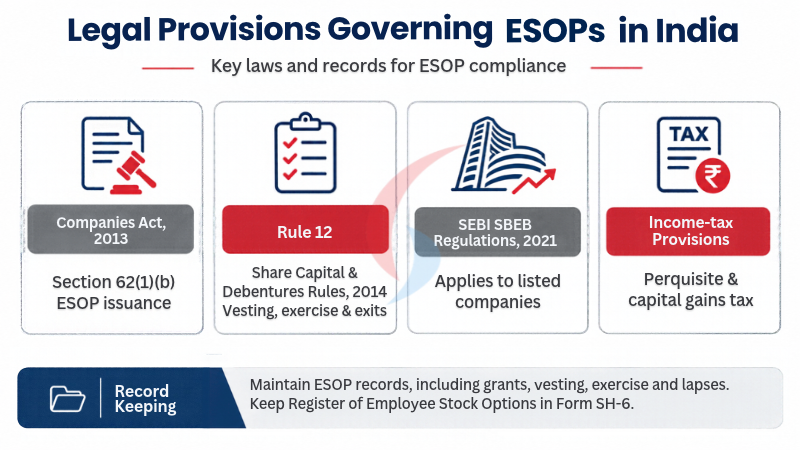
ESOPs are subject to different legal requirements depending on whether the company is listed or unlisted. For unlisted companies, Section 62(1)(b) of the Companies Act, 2013 and Rule 12 of the Companies (Share Capital and Debentures) Rules, 2014 are particularly important. These provisions deal with employee stock option schemes, shareholder approvals, vesting conditions, employee exits and related disclosures. Listed companies must additionally comply with the applicable SEBI (Share Based Employee Benefits and Sweat Equity) Regulations, 2021, as amended.
|
Legal Provision |
Importance |
|---|---|
|
Section 62(1)(b), Companies Act, 2013 |
Issuance of employee stock options |
|
Rule 12, Share Capital and Debentures Rules, 2014 |
Vesting, exercise and employee exit conditions |
|
SEBI SBEB and Sweat Equity Regulations, 2021 |
Requirements for listed companies |
|
Applicable Income-tax Provisions |
ESOP perquisite and capital gains taxation |
Companies must also maintain appropriate ESOP records, including details of options granted, vested, exercised and lapsed. Under Rule 12, applicable companies must maintain the Register of Employee Stock Options in Form SH-6. Proper records become especially important when employees leave because they help establish the correct option balance and avoid disagreement over employee entitlements.
Common ESOP Mistakes Employees and Companies Should Avoid
One common mistake employees make is assuming that all the ESOPs mentioned in their offer letter already belong to them. In reality, only options that have completed the applicable vesting conditions become eligible for exercise. Another mistake is resigning without checking the exercise deadline, which may result in the loss of valuable vested options. Employees should also avoid treating ESOPs as guaranteed cash benefits because shares in an unlisted company may be difficult to sell. Understanding the tax implications before exercising options is equally important.
Companies can also create problems by preparing unclear ESOP policies, failing to update option records or not explaining exit conditions to employees. Disputes may arise when employees discover important restrictions only after their resignation or termination. A well-drafted ESOP scheme should clearly explain vesting, exercise, lapse conditions, treatment on death and applicable approval procedures. Businesses should periodically review these documents to ensure they remain consistent with the law and the company's actual practices.
A properly structured employee stock option scheme can also help startups attract experienced professionals and encourage long-term employee retention. To understand this connection, explore our article on Startup Funding and ESOPs: Leveraging Employee Stock Options for Growth
Why Choose Compliance Calendar LLP for ESOP Compliance?
Managing ESOPs becomes challenging when employees resign, employment ends unexpectedly or legal heirs need assistance in understanding stock option rights. A small mistake in vesting calculations, exercise deadlines, employee records or share allotment procedures can create unnecessary legal and financial complications. Compliance Calendar LLP supports startups, private limited companies and growing businesses with ESOP scheme drafting, documentation, shareholder approvals, statutory compliance, share valuation coordination and employee exit-related requirements. Our team helps companies understand the applicable provisions of the Companies Act, 2013, maintain proper ESOP records and establish clear policies for resignation, termination and death. Whether a business is introducing ESOPs for the first time or reviewing an existing employee stock option scheme, Compliance Calendar LLP provides practical assistance to help manage the process while protecting the interests of the company and its employees.
If you need assistance with ESOP Scheme Compliance, including vesting, exercise and employee exit-related requirements, you can contact Compliance Calendar LLP on +91 9988424211 or info@ccoffice.in.
Frequently Asked Questions (FAQs)
Q1. What happens to ESOPs after resignation in India?
Ans. When an employee resigns, unvested ESOPs generally expire under Rule 12. Vested options may still be exercised within the period permitted under the approved ESOP scheme. Employees should confirm the exercise deadline before leaving.
Q2. Can a company cancel vested ESOPs after termination?
Ans. The treatment of vested ESOPs depends on the company's approved scheme and applicable legal provisions. Some schemes contain specific lapse conditions for termination involving misconduct. Such conditions must be legally valid and properly documented.
Q3. What happens to ESOPs when an employee dies?
Ans. If an employee dies during employment, all options granted up to that date vest in their legal heirs or nominees under Rule 12. The beneficiaries must establish entitlement and complete the applicable exercise process. The options do not automatically become cash.
Q4. Are ESOPs taxable after resignation?
Ans. Resignation alone does not always create an immediate ESOP tax liability. Tax generally arises when options are exercised and shares are allotted, with capital gains tax potentially applying upon sale. Special deferral provisions may apply to eligible startups.
Q5. Can employees sell ESOP shares after leaving a company?
Ans. Employees who already own shares may sell them subject to applicable legal and contractual restrictions. Shares of unlisted startups may be difficult to sell because buyers are not always available. The company's Articles of Association and shareholders' agreement may also restrict transfers.
Q6. What is the ESOP exercise period after resignation?
Ans. The exercise period depends on the company's approved ESOP scheme. Indian law does not prescribe one identical post-resignation deadline for every company. Employees should confirm the deadline and exercise procedure in writing.
Q7. What happens to unvested ESOPs after termination?
Ans. Unvested options generally expire when an employee's employment is terminated. The company should update its ESOP records accordingly. Vested options require separate examination under the approved scheme.
Q8. Can legal heirs exercise ESOPs after an employee's death?
Ans. Yes, legal heirs or nominees may exercise options that vest upon an employee's death during employment, subject to applicable requirements. The company may request documents to establish entitlement. The beneficiaries must also understand the relevant exercise and payment conditions.
Q9. Does ESOP vesting continue after resignation?
Ans. Ordinarily, unvested ESOPs expire when employment ends, and the normal vesting schedule does not continue. Special legal treatment applies to certain situations such as death or permanent incapacity. Employees should review the scheme before assuming further options will vest.
Q10. Why is ESOP compliance important for startups?
Ans. ESOP compliance helps startups maintain accurate records, communicate employee benefits clearly and follow applicable company law requirements. It also reduces disputes during resignation, termination and other employee exit situations. Proper documentation supports long-term employee confidence.
Article last updated on : 18 Nov 2026.













































































_learn_crop10_thumb.jpg)