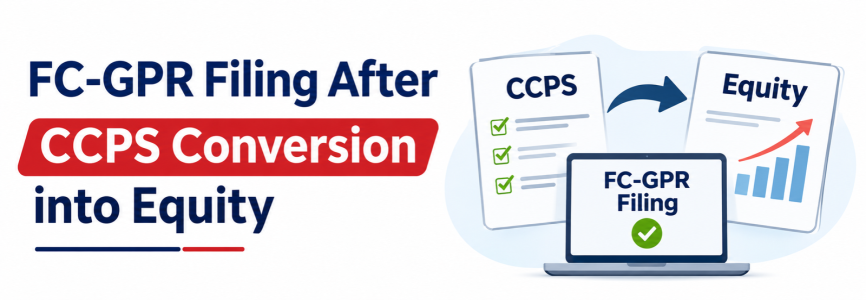



Imagine a Bengaluru-based technology startup that raised Rs 5 crore from a Singapore investor two years ago. Instead of issuing ordinary equity shares, the company issued Compulsorily Convertible Preference Shares (CCPS). The investment helped the business expand without immediately changing the ordinary equity shareholding structure.
Now the conversion date has arrived. The investor's CCPS must be converted into equity shares according to the agreed conversion terms. The company secretary prepares the board documents, while the finance team starts reviewing RBI reporting requirements.
One question creates confusion: Does CCPS conversion into equity require a fresh FC-GPR filing, even when the original CCPS allotment was already reported?
The answer requires careful examination. RBI treats fully and mandatorily convertible preference shares as equity instruments for foreign investment purposes. Their original issuance is generally reportable in Form FC-GPR. Whether a second filing is necessary on conversion requires examination of the transaction and the applicable RBI reporting instructions; it should not be assumed automatically.
What is CCPS Conversion into Equity Shares?
Compulsorily Convertible Preference Shares are preference shares that must convert into equity shares within the prescribed period or upon the occurrence of an agreed event. They are commonly used by Indian startups and companies receiving investments from foreign venture capital funds, overseas parent companies and other eligible non-resident investors.
For example, a Singapore investor may subscribe to 50,000 CCPS in an Indian private limited company. The original investment agreement may provide that each preference share converts into two equity shares after three years.
When the conversion takes place, the investor receives 1,00,000 equity shares according to the agreed ratio. The company must update its share capital records and complete the applicable corporate filings.
For FEMA purposes, fully paid, compulsorily and mandatorily convertible preference shares are recognised as equity instruments. Their original issuance and subsequent conversion must therefore be assessed under both the foreign investment rules and the Companies Act.
Is FC-GPR Filing Mandatory After CCPS Conversion?
This is the most important legal question for companies dealing with foreign-investor CCPS. Under Regulation 4(1) of the Foreign Exchange Management (Mode of Payment and Reporting of Non-Debt Instruments) Regulations, 2019, an Indian company issuing equity instruments to a person resident outside India, where the issue constitutes FDI, must report the issue in Form FC-GPR within 30 days.
Because CCPS themselves qualify as equity instruments, their original issuance to a foreign investor is ordinarily reported through FC-GPR. However, the RBI provisions reviewed do not expressly identify the routine conversion of already reported CCPS into ordinary equity as a separate mandatory FC-GPR event in every case.
The treatment must be distinguished from conversion of convertible notes and external commercial borrowings, for which specific reporting provisions exist.
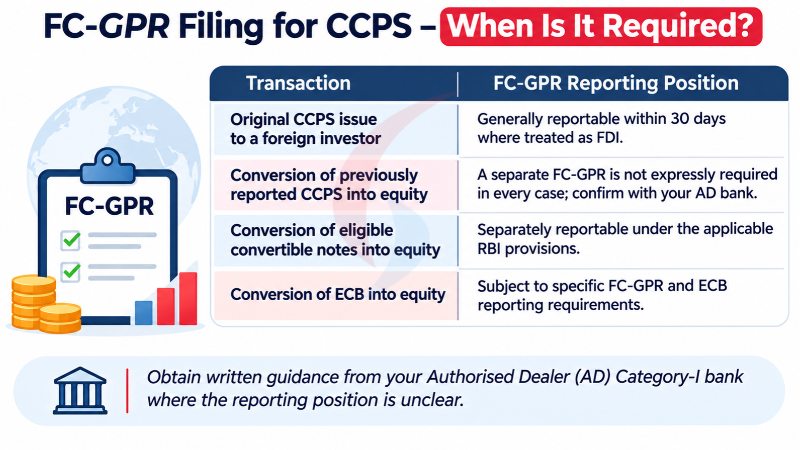
|
Transaction |
FC-GPR Reporting Position |
|
Original CCPS issue to a foreign investor |
Generally reportable within 30 days where treated as FDI. |
|
Conversion of previously reported CCPS into equity |
A separate FC-GPR is not expressly established for every routine conversion; confirm the applicable reporting treatment with the AD bank. |
|
Conversion of eligible convertible notes into equity |
Separately reportable under the applicable RBI provisions. |
|
Conversion of ECB into equity |
Subject to specific FC-GPR and ECB reporting requirements. |
|
Transfer of existing shares between relevant parties |
FC-TRS may apply instead, depending on the transaction. |
Therefore, companies should not submit a second FC-GPR merely because new equity shares appear after conversion without first checking whether the filing is required and supported by the current RBI system. The company should obtain written guidance from its Authorised Dealer (AD) Category-I bank where the reporting position is unclear.
Laws and Legal Provisions Governing CCPS Conversion
CCPS conversion involves two sets of obligations: corporate law requirements for the conversion and foreign exchange rules governing the investment.
|
Applicable Law |
Important Provisions |
Legal Requirements |
|
Sections 6 and 13 |
Foreign investment regulation and contraventions. |
|
|
Applicable definitions, pricing and investment conditions |
Governs foreign investment in equity instruments, including qualifying CCPS. |
|
|
FEMA (Mode of Payment and Reporting of Non-Debt Instruments) Regulations, 2019 |
Regulation 4 |
Prescribes FC-GPR and other foreign investment reporting requirements. |
|
Sections 39, 55, 62 and relevant provisions |
Governs allotment, preference shares and further issue of capital, as applicable. |
|
|
Rule 9 and applicable provisions |
Addresses preference share terms, including conversion conditions. |
|
|
Companies (Prospectus and Allotment of Securities) Rules, 2014 |
Rule 12 |
Prescribes applicable return-of-allotment requirements. |
The key distinction is that MCA reporting and RBI reporting are separate legal obligations. Completing Form PAS-3, where required, does not automatically establish that all FEMA compliance has been completed.
RBI Pricing Guidelines for CCPS Conversion
RBI's Master Direction on Foreign Investment in India requires the price or conversion formula for compulsorily convertible equity instruments to be determined upfront when those instruments are issued. For CCPS, the conversion price must not be lower than the fair value determined at the time of original issuance in accordance with the applicable Non-Debt Instruments Rules.
This means a company cannot freely revise the conversion ratio later simply because its valuation has changed. For example, suppose an investor subscribes to CCPS when the agreed valuation supports a minimum conversion price of Rs 100 per equity share. If the business subsequently performs poorly, the company cannot automatically adopt a conversion price of Rs 60 when that would violate the applicable floor determined at issuance.
The company must examine its original valuation report, investment agreement and contractual conversion formula.= A later valuation may be relevant in particular transactions, but it does not automatically replace the original pricing requirements applicable to qualifying CCPS. The original valuation and conversion formula play an important role in determining FEMA compliance when CCPS are converted into equity shares.
Read our article on Need of Valuation Report under FEMA Law to understand the applicable valuation and pricing requirements.
Practical Example: A Startup Converting CCPS into Equity
Consider NovaTech Innovations Private Limited, a fictional technology company based in Hyderabad. In 2023, it received Rs 2 crore from an overseas investor and issued 20,000 CCPS at Rs 1,000 each, including securities premium.
The company filed FC-GPR for the original CCPS issue and retained the RBI acknowledgement. Its investment agreement provided a fixed conversion ratio of one CCPS into five equity shares.
In November 2026, the shares become due for conversion. The company proposes to allot 1,00,000 equity shares against the existing 20,000 CCPS.
Before proceeding, its company secretary reviews the original conversion terms, FEMA pricing compliance, board approvals and authorised share capital. The finance team retrieves the earlier FC-GPR acknowledgement and asks its AD bank whether any separate FEMA filing or reconciliation is required.
The company also checks whether Form PAS-3 must be filed with the Registrar of Companies for the conversion allotment. This approach is safer than assuming that conversion requires no compliance because no fresh foreign remittance is received.
Documents Required for FC-GPR Review After CCPS Conversion
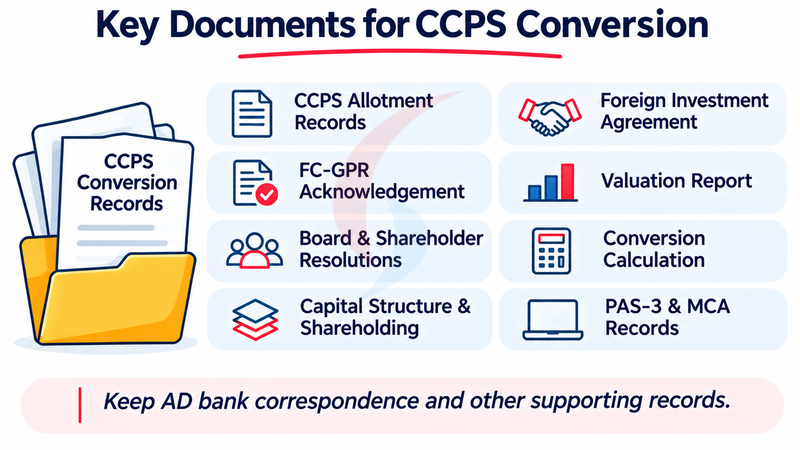
The company should maintain complete records of the original investment and the subsequent conversion.
|
Required Document |
Purpose |
|
Original CCPS Allotment Records |
Establish the number, issue price and date of the original instruments. |
|
Original FC-GPR Acknowledgement |
Confirms previously reported foreign investment. |
|
Foreign Investment Agreement |
Establishes agreed conversion terms and investor rights. |
|
Original Valuation Report |
Supports compliance with FEMA pricing requirements. |
|
Board and Shareholder Resolutions |
Establish applicable corporate approvals. |
|
Conversion Calculation |
Shows the conversion ratio and resulting equity allotment. |
|
Capital Structure and Shareholding Pattern |
Records ownership before and after conversion. |
|
PAS-3 and MCA Records |
Support applicable corporate allotment reporting. |
|
AD Bank Correspondence |
Records the bank's determination of the FEMA reporting treatment. |
If a fresh FC-GPR is required for the particular transaction, the bank may also request prescribed declarations, Company Secretary certification and relevant supporting documents. The original FIRC and investor KYC should be retained where available, but companies should not invent a fresh inward remittance merely because the preference shares convert into equity.
For related documentation requirements, read our article on FC-GPR and FLA Return: Filing Rules and Penalties.
Step-by-Step Process After CCPS Conversion
Companies should complete the corporate conversion procedure and determine the applicable RBI reporting position before making the final regulatory filings.
|
Step |
Compliance Procedure |
|
1. Review CCPS Terms |
Verify the original conversion date, ratio, pricing formula and shareholder agreement. |
|
2. Check FEMA Compliance |
Confirm that the original issue complied with applicable FDI pricing, entry-route and sectoral conditions. |
|
3. Review Earlier FC-GPR |
Retrieve the original filing and verify the number and value of CCPS reported. |
|
4. Obtain Corporate Approvals |
Complete applicable board and shareholder approvals for conversion and allotment. |
|
5. Allot Equity Shares |
Convert CCPS according to the approved terms and update statutory registers. |
|
6. Complete MCA Filings |
File PAS-3 or other applicable forms within the prescribed period. |
|
7. Confirm RBI Reporting |
Obtain AD bank guidance on whether a separate FC-GPR or other reporting action is required. |
|
8. Maintain Records |
Preserve conversion documents, bank correspondence and the updated shareholding pattern. |
FC-GPR Filing Deadline After CCPS Conversion
The general FC-GPR reporting deadline is 30 days from the date of issue of the reportable equity instruments. However, this deadline should not be presented as a universal requirement for every conversion of previously reported CCPS.
|
Compliance |
General Timeline |
|
FC-GPR for Original CCPS Issuance |
Within 30 days of issue, where reportable as FDI. |
|
Fresh FC-GPR After CCPS Conversion |
Only where the applicable reporting provisions require it; obtain AD bank confirmation. |
|
PAS-3 Return of Allotment |
Generally within 30 days of allotment under Rule 12, subject to applicable exceptions. |
|
FLA Return |
Generally by 15 July each year for companies meeting the reporting conditions. |
Businesses should calculate deadlines from the legally relevant transaction or allotment date, not merely from the date on which the compliance team receives the supporting documents. The RBI reporting rules and general FC-GPR timeline are available in its official foreign investment regulations.
Latest RBI and FEMA Updates in 2026
As of November 2026, several regulatory developments are relevant to foreign investment reporting and CCPS conversion.
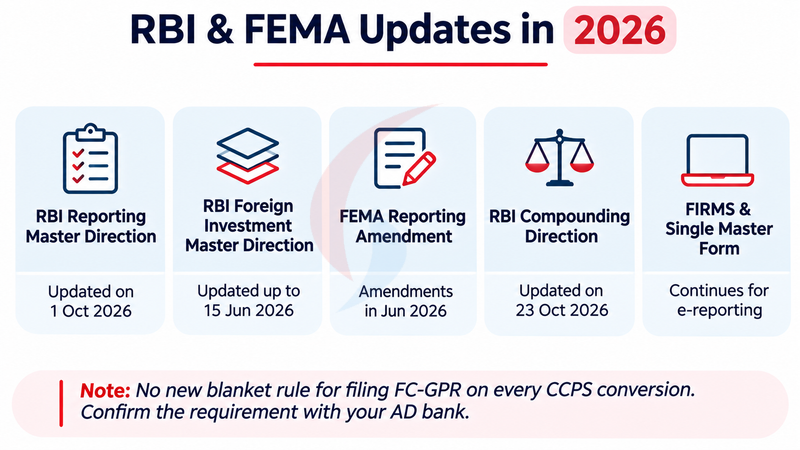
|
Regulatory Development |
Importance |
|
RBI Reporting Master Direction |
Updated as of 1 October 2026; remains a key source for applicable FEMA reporting. |
|
RBI Foreign Investment Master Direction |
Updated up to 15 June 2026; addresses eligible equity instruments and pricing conditions. |
|
FEMA Reporting Amendment, June 2026 |
RBI notified amendments to the Mode of Payment and Reporting of Non-Debt Instruments Regulations. |
|
RBI Compounding Direction |
Updated as of 23 October 2026; relevant to the treatment of FEMA contraventions. |
|
FIRMS and Single Master Form |
Continue to provide electronic reporting facilities for prescribed foreign investment transactions. |
The RBI's official Master Directions index confirms the October 2026 reporting update and the October 2026 compounding update.
Important 2026 clarification: The reviewed RBI sources do not establish a new blanket rule requiring every previously reported CCPS conversion to be filed again through FC-GPR. Companies should verify the current reporting instructions and transaction-specific position with their AD bank before making that claim.
Penalties and Late Submission Fees for FC-GPR
If a mandatory FC-GPR filing is delayed, the RBI may impose a Late Submission Fee (LSF) under the applicable FEMA reporting regulations.
LSF Formula:
LSF = Rs 7,500 + (0.025% × A × n)
Here, A represents the amount involved, and n represents the delay period calculated under RBI guidelines.
Example: For a delayed filing involving Rs 1 crore with a delay of one year, the illustrative LSF is Rs 10,000, subject to applicable RBI conditions.
However, a separate FC-GPR is not automatically required for every conversion of previously reported CCPS into equity. More serious contraventions may attract penalties under Section 13 of the Foreign Exchange Management Act, 1999.
Read our article on Compounding Procedures for Form FC-GPR Violations under FEMA for related compliance guidance.
Why Choose Compliance Calendar LLP ?
Companies receiving foreign investment often face difficulties with CCPS conversion calculations, RBI reporting, valuation documents and MCA compliance. At Compliance Calendar LLP, we assist businesses with foreign investment reporting and related regulatory documentation.
|
Our Services |
How We Help |
|
CCPS Conversion Review |
Assist with reviewing original investment terms and conversion records. |
|
FEMA Applicability Assessment |
Examine applicable RBI reporting requirements and previous filings. |
|
FC-GPR Documentation |
Support preparation of prescribed reports and supporting documents. |
|
FIRMS Portal Assistance |
Assist with electronic filing where legally applicable. |
|
MCA Compliance |
Provide guidance on relevant company law documentation and filings. |
|
FEMA Delay Resolution |
Assist with identifying delayed reporting and applicable regularisation procedures. |
Businesses should also examine their obligations under the FEMA Due Diligence Process and Compliance Checklist.
For professional assistance with CCPS conversion and foreign investment reporting, contact Compliance Calendar LLP at 9988424211 or info@ccoffice.in.
Frequently Asked Questions (FAQs)
Q1. Is FC-GPR filing required after CCPS conversion into equity?
Ans: FC-GPR is generally required when an Indian company originally issues qualifying CCPS to a foreign investor. A separate FC-GPR on routine conversion of previously reported CCPS is not expressly prescribed for every case in the reviewed RBI provisions. Companies should confirm the transaction-specific reporting position with their AD bank.
Q2. What is the FC-GPR filing deadline for CCPS?
Ans: Where an FC-GPR filing is required for the issuance of equity instruments to a non-resident investor, the general deadline is 30 days from the date of issue. This deadline applies to the original reportable CCPS issuance. It should not automatically be applied to every subsequent conversion without examining the reporting requirements.
Q3. Which laws govern CCPS conversion into equity in India?
Ans: CCPS conversion is governed by the Companies Act, 2013, applicable company rules, FEMA, 1999, and the Foreign Exchange Management (Non-Debt Instruments) Rules, 2019. RBI's foreign investment and reporting directions are also relevant. Companies must satisfy both corporate and foreign exchange requirements.
Q4. Is a valuation report required for CCPS conversion?
Ans: FEMA requires the conversion price or formula for qualifying CCPS to be determined upfront at the time of original issuance. The conversion must comply with the applicable pricing floor. Whether a fresh valuation report is necessary depends on the transaction, original documentation and applicable requirements.
Q5. Is Form PAS-3 required after CCPS conversion?
Ans: Where CCPS conversion results in an allotment of equity shares, the company must examine the return-of-allotment requirements under Section 39(4) of the Companies Act and Rule 12 of the relevant 2014 Rules. The general PAS-3 deadline is 30 days from allotment, subject to applicable provisions.
Q6. Can a company change the CCPS conversion ratio?
Ans: A company cannot freely change the conversion ratio in a manner that violates the original investment terms or applicable FEMA pricing requirements. Material changes may require shareholder approvals and examination of foreign investment rules. Any proposed amendment should be reviewed before implementation.
7. Is FC-TRS required when CCPS are converted into equity?
Ans: Ordinary conversion of CCPS into equity by the same holder is not automatically a transfer between different persons. Therefore, FC-TRS is not generally triggered merely by conversion. FC-TRS may become relevant if a separate reportable transfer of equity instruments takes place.
Q8. What happens if an FC-GPR filing is delayed?
Ans: If a legally required FC-GPR filing is delayed, RBI's Late Submission Fee mechanism may apply. The amount depends on the relevant transaction and delay period, subject to prescribed rules. Certain contraventions may require regularisation or compounding under FEMA.
Q9. What are the latest CCPS and FC-GPR updates in 2026?
Ans: RBI's Reporting Master Direction was updated as of 1 October 2026, while its Foreign Investment Master Direction was updated up to 15 June 2026. Companies should review these directions, the June 2026 reporting amendment and current AD bank instructions before undertaking conversion-related reporting.
Q10. Can Compliance Calendar LLP assist with FC-GPR and CCPS conversion?
Ans: Yes. Compliance Calendar LLP assists businesses with FEMA documentation, foreign investment reporting, FC-GPR applications where applicable, and related compliance reviews. Our team can help companies examine their original investment documents and prepare records for the relevant regulatory procedures.
Article last updated on : 18 Nov 2026.













































































_learn_crop10_thumb.jpg)