


Imagine a manufacturing company in India that has been earning good profits for years. Its sales are increasing, investors are satisfied, and the business is expanding into new markets. One day, a foreign investor asks the management a few questions: How much water does your factory consume? What steps have you taken to reduce carbon emissions? Are your employees working in safe conditions? How does your company prevent corruption?
The company has financial statements showing its profits, but it has no proper records to answer these questions. This is where ESG Reporting in India becomes important.
ESG stands for Environmental, Social and Governance. It helps businesses explain how their activities affect the environment, employees, customers and society, and how responsibly the business is managed. In India, ESG reporting has become an important regulatory requirement, particularly for large listed companies regulated by the Securities and Exchange Board of India (SEBI).
What is ESG Reporting in India?
ESG Reporting is the process through which a company discloses information about its environmental performance, social responsibilities and corporate governance practices. Unlike traditional financial reporting, which mainly deals with revenue, expenses and profits, ESG reporting examines how the company conducts its business and manages its wider responsibilities.
The environmental part includes energy consumption, greenhouse gas emissions, water use, waste management and pollution control. The social part covers employee welfare, workplace safety, diversity, human rights, customer protection and community relations. Governance focuses on board accountability, ethical business conduct, transparency, conflicts of interest and responsible decision-making.
For example, suppose a textile manufacturer uses substantial quantities of water for dyeing and processing fabrics. Its financial statements may show growing revenue, but investors may also want to know whether the company treats wastewater properly and follows environmental laws. ESG Reporting provides a structured way to present this information alongside the company's business performance.
Businesses can also explore ESG Compliance in India: Laws, Rules and Requirements to understand the wider legal obligations connected with sustainability, labour laws and corporate governance.
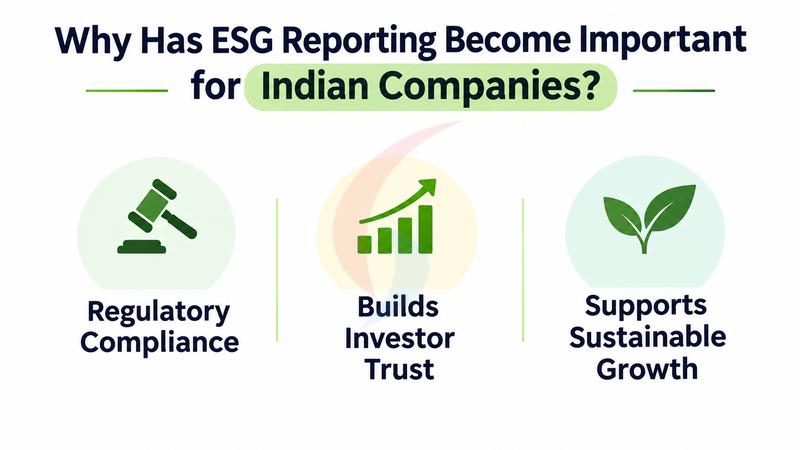
Why Has ESG Reporting Become Important for Indian Companies?
Earlier, many businesses treated sustainability reporting as a voluntary activity or an opportunity to improve their public image. However, investors, lenders, customers and regulators increasingly expect companies to support environmental and social claims with reliable information.
A company claiming to be environmentally responsible should be able to demonstrate its actual electricity consumption, emission levels, waste disposal practices and environmental initiatives. Similarly, a business promoting employee welfare should maintain suitable records of workplace safety, employee benefits and grievance handling.
ESG reporting helps investors compare companies, identify potential risks and understand whether business growth is sustainable over the long term. It may also help companies identify excessive resource consumption, improve internal processes and respond to sustainability requirements imposed by major customers.
For Indian businesses supplying products to international companies, ESG information can be particularly useful because overseas buyers may request details about carbon emissions, labour standards, product safety and supply chain practices.
ESG Reporting Applicability in India: Which Companies Must Comply?
One of the most common questions is whether ESG reporting is compulsory for every company registered in India. The answer is no. The principal mandatory BRSR requirement is linked to a company's listing status and market capitalisation ranking.
Under Regulation 34(2)(f) of the SEBI LODR Regulations, 2015, the top 1,000 listed entities by market capitalization are required to include a Business Responsibility and Sustainability Report in their annual reports. Mandatory BRSR reporting became applicable from FY 2022–23, following an initial voluntary reporting period.
Companies falling outside this category are not automatically required to prepare the same BRSR solely because they have high turnover, significant profits or a large workforce. However, other statutory obligations and sector-specific disclosure requirements may still apply.
ESG Reporting Applicability Table
|
Category of Company |
ESG Reporting Requirement |
|
Top 1,000 listed entities by market capitalisation |
Mandatory BRSR reporting |
|
Top 500 listed entities in FY 2025–26 |
Mandatory BRSR Core assessment or assurance |
|
Top 1,000 listed entities in FY 2026–27 |
Mandatory BRSR Core assessment or assurance |
|
Other listed companies |
BRSR generally voluntary unless otherwise applicable |
|
Unlisted private companies |
No general mandatory SEBI BRSR requirement |
|
MSMEs and startups |
Usually voluntary, but customer and contractual requirements may apply |
For example, consider two companies. GreenTech Industries Ltd. is among India's top 400 listed entities, while Sunrise Components Pvt. Ltd. is an unlisted manufacturer with annual sales of Rs 200 crore.
GreenTech Industries must comply with the applicable BRSR requirements and, for FY 2025–26, the BRSR Core assessment or assurance requirement. Sunrise Components is not automatically required to file BRSR merely because of its turnover. However, if Sunrise supplies products to a large listed company, it may receive ESG data requests from that customer.
This distinction is important because mandatory ESG reporting and voluntary ESG disclosure are not the same thing.
Laws and Legal Provisions Governing ESG Reporting in India
India does not have a single ESG Reporting Act applicable to all businesses. Instead, ESG-related obligations are governed by SEBI regulations, the Companies Act, environmental legislation, labour laws and other applicable legal provisions.
|
Applicable Law / Regulation |
Relevant Sections / Provisions |
Key ESG Reporting Requirements |
|---|---|---|
|
Regulation 34(2)(f) |
Mandatory BRSR disclosures for the top 1,000 listed entities by market capitalisation. BRSR forms part of their annual reports. |
|
|
Circular dated May 10, 2021 |
Introduced the Business Responsibility and Sustainability Report (BRSR) format for reporting environmental, social and governance performance. |
|
|
Circular dated July 12, 2023 |
Introduced BRSR Core covering nine ESG attributes and a phased schedule for independent verification, subsequently amended to permit assessment or assurance. |
|
|
Companies Act, 2013 |
Sections 134, 135, 166 and 177 |
Covers Board's Report disclosures, Corporate Social Responsibility, directors' duties and Audit Committee oversight, where applicable. |
|
Applicable provisions and rules |
Regulates environmental protection, pollution-related requirements and compliance with prescribed environmental standards. |
|
|
Applicable consent and pollution-control provisions |
Requires eligible businesses to obtain relevant pollution control consents and comply with water and air pollution requirements. |
|
|
Applicable labour codes, legislation and rules |
Covers employee safety, working conditions, wages, social security, workplace rights and grievance mechanisms. |
Important Note: SEBI's BRSR requirements apply to specified listed entities, while environmental, labour and company law obligations may apply independently to listed and unlisted businesses. Companies should check the applicability of each provision based on their operations, size and legal status.
For more information about corporate social responsibilities, read Section 135 of Companies Act, 2013 – Corporate Social Responsibility.
What Is BRSR Reporting Under SEBI?
The Business Responsibility and Sustainability Report, commonly called BRSR, is a structured disclosure format prescribed by SEBI. It is designed around the nine principles of the National Guidelines on Responsible Business Conduct (NGRBC).
BRSR helps listed companies present comparable information about sustainability practices, employee welfare, environmental performance, ethical business conduct and stakeholder relationships.
The report is divided into three main sections.
Section A – General Disclosures: This section provides basic information about the listed entity, its products, operations, employees, business activities, CSR applicability, transparency and other prescribed particulars.
Section B – Management and Process Disclosures: This section explains the company's policies, governance practices and internal processes relating to the nine NGRBC principles. It includes information about policy commitments, oversight, reviews and responsible business conduct.
Section C – Principle-wise Performance Disclosures: This section contains detailed disclosures against the nine NGRBC principles. It includes essential indicators and leadership indicators. Essential indicators capture the prescribed core information, while leadership indicators provide additional disclosures in the manner specified by the format.
A manufacturing company preparing its BRSR may therefore need information from its finance, HR, production, legal, procurement and compliance teams. ESG reporting cannot be completed accurately by the finance department alone.
What Is BRSR Core and How Is It Different From BRSR?
BRSR Core is a subset of the wider BRSR disclosures. It contains selected key performance indicators under nine ESG attributes that SEBI considers particularly important for comparability and independent verification.
The nine attributes cover greenhouse gas emissions, water footprint, energy footprint, waste management, employee wellbeing and safety, gender diversity, inclusive development, fairness in dealings with customers and suppliers, and openness of business.
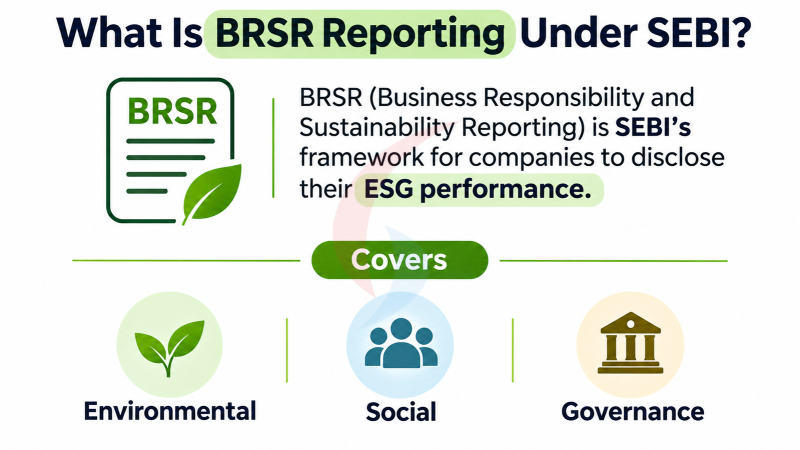
While BRSR presents a broader picture of corporate sustainability, BRSR Core focuses on measurable information that can be subjected to assessment or assurance.
For example, a company may report that it has taken steps to reduce electricity consumption. BRSR Core requires relevant quantitative indicators to be presented using the applicable measurement approach, allowing the information to be examined more systematically.
BRSR Core Applicability Timeline
|
Financial Year |
Applicable Listed Entities |
|
FY 2023–24 |
Top 150 |
|
FY 2024–25 |
Top 250 |
|
FY 2025–26 |
Top 500 |
|
FY 2026–27 |
Top 1,000 |
Under the amended rules, covered listed entities must obtain assessment or assurance of BRSR Core, rather than being required in every case to obtain only reasonable assurance.
ESG Reporting Requirements and Latest SEBI Updates in 2026
The latest ESG Reporting requirements in India reflect amendments introduced by SEBI on March 28, 2025, and the provisions consolidated in its Master Circular updated on January 30, 2026. These changes provide greater flexibility in BRSR Core verification, value chain disclosures and green credit reporting.
|
Key Update |
Latest SEBI Requirements |
Applicability / Timeline |
|---|---|---|
|
BRSR Core Assessment or Assurance |
Listed entities can choose between independent third-party assessment and assurance of BRSR Core indicators. |
Phased applicability, extending to the top 1,000 listed entities in FY 2026–27. |
|
Third-Party Verification Standards |
Assessments must follow the applicable Industry Standards Forum standards developed in consultation with SEBI. Providers must meet independence and expertise requirements. |
Applicable to entities required to obtain BRSR Core assessment or assurance. |
|
Eligibility of Verification Providers |
The provider must have relevant sustainability expertise and satisfy conflict-of-interest requirements. Being a Chartered Accountant is not mandatory. |
Applicable to BRSR Core verification engagements. |
|
Voluntary Value Chain ESG Reporting |
ESG disclosures relating to qualifying upstream and downstream value chain partners are voluntary. |
Top 250 listed entities from FY 2025–26. |
|
Value Chain Assessment or Assurance |
Independent assessment or assurance of value chain ESG disclosures is voluntary. |
From FY 2026–27. |
|
Value Chain Partner Threshold |
Relevant partners individually accounting for 2% or more of purchases or sales by value are considered under the revised criteria. |
Applicable when preparing voluntary value chain disclosures. |
|
Value Chain Disclosure Coverage |
Companies may limit coverage to 75% of purchases and sales, respectively, and disclose their actual reporting coverage. |
Applicable to voluntary value chain ESG reporting. |
|
Voluntary Green Credit Disclosure |
A leadership indicator under BRSR Principle 6 covers green credits generated or procured by the entity and its top ten value chain partners. |
Voluntary disclosure under the revised BRSR requirements. |
How to Prepare and Submit an ESG Report in India
Preparing an ESG report involves much more than collecting a few environmental figures and publishing a sustainability statement. Companies need an organised process to ensure the disclosed information is complete, accurate and supported by records.
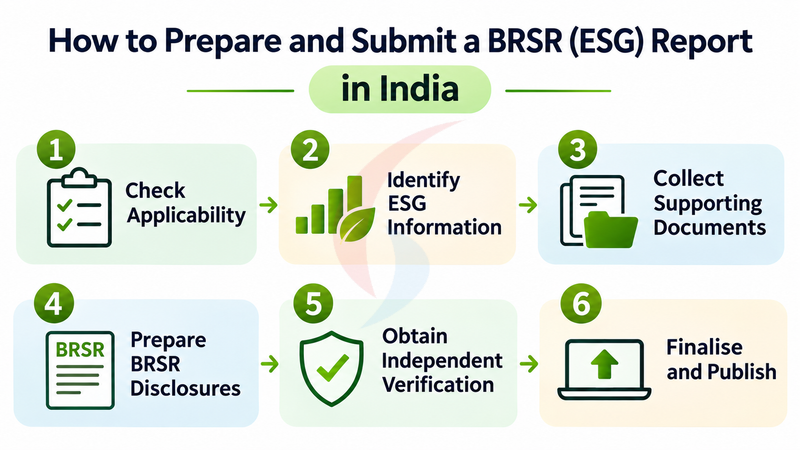
Step 1 – Check Applicability: The company should first determine whether mandatory BRSR reporting applies and whether its market capitalisation ranking brings it within the BRSR Core assessment or assurance schedule.
Step 2 – Identify ESG Information: Different departments should identify relevant information, including electricity consumption, fuel usage, emissions, water consumption, employee data, workplace safety and governance practices.
Step 3 – Collect Supporting Documents: The company should maintain relevant electricity bills, water records, environmental monitoring reports, HR records, safety information, policy documents and other evidence supporting its disclosures.
Step 4 – Prepare BRSR Disclosures: Information should be compiled according to the applicable SEBI BRSR format, including general, management and principle-wise disclosures. The company should explain material assumptions, estimation methods and reporting boundaries wherever required.
Step 5 – Obtain Independent Verification: Where BRSR Core assessment or assurance is mandatory, the company should appoint an eligible and independent provider with appropriate sustainability expertise.
Step 6 – Finalise and Publish: After internal review and the applicable approvals, the BRSR should form part of the company's annual report and be submitted in accordance with the SEBI LODR requirements.
Under Regulation 34, annual report submission is linked to dispatch to shareholders and stock exchange filing requirements. Companies must follow the applicable annual reporting timeline rather than assume that every entity has one separate, fixed national BRSR filing date.
A Practical Story: How ESG Reporting Helped an Indian Manufacturer
Consider Aarav Packaging Ltd., a fictional listed company operating three factories in India. While preparing ESG disclosures, management discovered that electricity consumption, employee safety records and waste management expenses were maintained separately.
During the review, the company found that one factory consumed more electricity than others, while some employee training records were incomplete. Management introduced better energy monitoring, organised safety records and assigned ESG responsibilities to specific employees.
Suppose these improvements reduced annual electricity expenses from Rs 1.20 crore to Rs 1.08 crore, saving Rs 12 lakh annually. This example shows how ESG compliance can identify operational gaps, reduce costs and improve business efficiency.
Is ESG Reporting Mandatory for Private Limited Companies and MSMEs?
A private limited company is not automatically required to prepare SEBI BRSR merely because it has substantial revenue, receives foreign investment or supplies products to a listed company.
However, private companies and MSMEs may still face ESG-related obligations under environmental laws, labour requirements, the Companies Act and contractual arrangements with customers or lenders.
For example, suppose a small auto-component manufacturer supplies products to a major listed automobile company. The listed customer may request information about electricity consumption, workplace safety and waste disposal as part of its sustainability-related procurement process.
The supplier may not be independently required to file BRSR, but its ability to provide reliable ESG information could influence customer relationships.
For emerging businesses, ESG Compliance: Legalities of Environment, Social and Governance Norms for Startups explains how responsible business practices can become relevant during growth and investment discussions.
Difference Between ESG Reporting and CSR Reporting
ESG Reporting and Corporate Social Responsibility (CSR) are closely related, but their objectives, applicability and legal requirements are different.
|
Basis |
ESG Reporting |
CSR Reporting |
|---|---|---|
|
Meaning |
Environmental, Social and Governance Reporting |
Corporate Social Responsibility Reporting |
|
Legal Provisions |
SEBI LODR Regulations, 2015, particularly Regulation 34(2)(f) |
Section 135 of the Companies Act, 2013 |
|
Applicability |
Mandatory BRSR for the top 1,000 listed entities by market capitalisation |
Companies meeting prescribed net worth, turnover or net profit criteria |
|
Main Objective |
Evaluate environmental performance, social responsibility and corporate governance |
Report prescribed CSR activities, expenditure and related compliance |
|
Key Focus Areas |
Carbon emissions, water consumption, employee safety, governance and sustainability |
Education, healthcare, environmental projects and other Schedule VII activities |
|
Spending Requirement |
No general mandatory ESG spending percentage under BRSR |
Generally 2% of average net profits, calculated as prescribed |
|
Example |
Reporting factory water consumption, emissions and workplace safety |
Spending Rs 50 lakh on eligible education-related CSR activities |
|
Regulatory Authority |
SEBI for mandatory listed-entity BRSR disclosures |
Ministry of Corporate Affairs (MCA) |
Example: A company spends Rs 50 lakh on education-related CSR activities but operates a factory with excessive water consumption and inadequate workplace safety measures. Although it may have fulfilled its CSR spending obligation, this does not automatically mean it has achieved satisfactory ESG performance.
For detailed CSR requirements, companies can refer to CSR Full Form, Meaning, Benefits and Applicability.
How Compliance Calendar LLP Can Help?
ESG Reporting involves several areas of corporate compliance, including SEBI regulations, sustainability disclosures, company law, environmental requirements and internal governance. Managing these responsibilities can become challenging when information is spread across multiple departments or business locations.
Compliance Calendar LLP assists businesses in understanding applicable ESG legal requirements, identifying relevant compliance obligations, reviewing corporate disclosures and coordinating regulatory reporting activities. Its professional support can help companies identify reporting gaps, organise necessary records and prepare for applicable BRSR and BRSR Core requirements.
Businesses seeking specialised assistance can explore ESG Advisory and Consultation in India, ESG Compliance Services and Annual Company Filing Services. With appropriate legal and compliance support, companies can approach sustainability reporting as a regular business responsibility rather than an exercise undertaken only at the end of the financial year.
Frequently Asked Questions (FAQ'S)
Q1. Is ESG Reporting mandatory in India in 2026?
Ans. Yes, ESG Reporting through the Business Responsibility and Sustainability Report (BRSR) is mandatory for the top 1,000 listed entities by market capitalization under SEBI LODR Regulation 34(2)(f). Other companies may voluntarily prepare ESG reports or have separate legal requirements.
Q2. What is the full form of ESG and BRSR?
Ans. ESG stands for Environmental, Social and Governance, while BRSR stands for Business Responsibility and Sustainability Report. BRSR is the reporting format prescribed by SEBI to disclose the sustainability performance of specified listed entities.
Q3. Which companies are required to submit BRSR Reports in India?
Ans. The top 1,000 listed entities by market capitalization must include BRSR disclosures in their annual reports. Other listed companies can voluntarily adopt BRSR reporting, subject to applicable SEBI requirements.
Q4. What is BRSR Core under SEBI regulations?
Ans. BRSR Core is a subset of BRSR containing key ESG performance indicators covering nine attributes, including emissions, water, energy, waste and employee wellbeing. It is subject to phased independent assessment or assurance requirements.
Q5. Is BRSR Core assurance mandatory in FY 2026–27?
Ans. For FY 2026–27, the top 1,000 listed entities must obtain third-party assessment or assurance of their BRSR Core disclosures. SEBI permits the choice between assessment and assurance, subject to applicable requirements.
Q6. Is ESG Reporting mandatory for private limited companies and MSMEs?
Ans. Private limited companies and MSMEs are not automatically required to prepare SEBI BRSR reports. However, they may need ESG-related records to meet environmental laws, labour regulations, investor expectations or customer requirements.
Q7. What is the difference between ESG Reporting and CSR Reporting?
Ans. ESG Reporting evaluates a company's environmental performance, social responsibilities and governance practices. CSR Reporting focuses on prescribed corporate social responsibility obligations under Section 135 of the Companies Act, 2013.
Q8. What are the latest SEBI ESG Reporting updates applicable in 2026?
Ans. SEBI's March 28, 2025 amendments allow assessment or assurance of BRSR Core and make value chain ESG disclosures voluntary from FY 2025–26 for the top 250 listed entities. Voluntary green credit disclosures were also introduced.
Q9. What happens if a company fails to comply with mandatory ESG Reporting requirements?
Ans. Failure to comply with mandatory BRSR requirements may lead to regulatory scrutiny, stock exchange action and penalties under applicable SEBI provisions. The consequences depend on the nature and seriousness of the violation.
Q10. How can a company prepare an ESG Report in India?
Ans. A company should first check BRSR applicability, collect environmental and social performance data, review governance policies and prepare disclosures in SEBI's prescribed format. Where applicable, it must also obtain BRSR Core assessment or assurance before finalising the annual reporting process.
Article last updated on : 18 Nov 2026.













































































_learn_crop10_thumb.jpg)