


What Is an Insurance Broker Client Agreement?
An Insurance Broker Client Agreement is a written arrangement between a registered insurance broker and its client that explains the terms on which insurance-related services will be provided. The agreement generally identifies the parties, describes the broker's services, allocates responsibilities and explains commercial arrangements. It may cover risk assessment, quotation comparison, policy placement assistance, renewals, claims support, confidentiality and termination.
Insurance brokers act as intermediaries between clients and insurance companies, making proper documentation and regulatory authorisation essential. Businesses planning to provide insurance broking services must obtain an Insurance Broker License from IRDAI before commencing regulated activities. Similarly, entrepreneurs planning to establish an insurance company must complete the applicable Insurance Company Registration process and obtain the required IRDAI approval. Although insurance brokers and insurance companies operate under different regulatory requirements, both must maintain appropriate agreements, documentation and compliance records to ensure transparency and protect policyholder interests.
For example, a manufacturing business may appoint an insurance broker to examine its existing policies and recommend improvements. The client agreement can specify whether the broker will only provide advice or will also arrange insurance cover after receiving the client's instructions. Although a detailed standalone client agreement is useful, it should not automatically be treated as a universally prescribed document for every insurance transaction. Its necessity and contents depend on the services, the client's requirements and applicable regulatory provisions.
Businesses planning to enter the insurance broking sector can explore our guide on Insurance Broker Registration in India to understand IRDAI eligibility, documentation and registration requirements.
What Is an Insurance Broker Mandate Letter?
An Insurance Broker Mandate Letter is a written authorisation issued by a client permitting a registered insurance broker to represent the client for specified insurance-related activities. Under Schedule I, Form H of the IRDAI (Insurance Brokers) Regulations, 2018, brokers are generally required to obtain written mandates when representing clients before insurers or reinsurers. The Code of Conduct also recognises exceptions for pre-underwritten policies and retail/individual policies.
A mandate can authorise the broker to approach insurers, obtain quotations, negotiate proposed terms and assist in arranging insurance, subject to its actual wording. Importantly, receiving a mandate does not automatically mean that insurance coverage has started. Insurance becomes effective according to the insurer's acceptance and applicable policy conditions.
Difference Between Client Agreement and Mandate Letter
Although the two documents are connected, they serve different purposes.
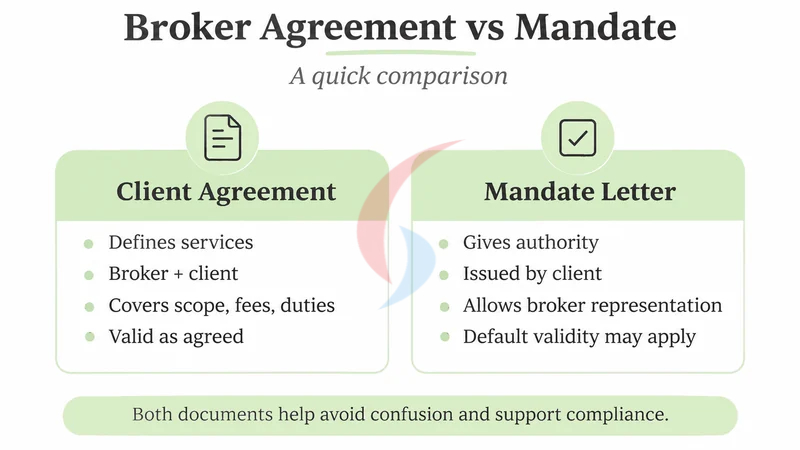
| Particulars | Client Agreement | Mandate Letter |
| Main purpose | Defines service relationship | Authorises representation |
| Parties | Broker and client | Usually issued by client to broker |
| Scope | Services, fees and responsibilities | Specific authorised activities |
| Validity | As agreed between parties | As stated; regulatory default may apply |
| Commercial terms | Generally included | May be limited |
| Regulatory relevance | Supports contractual clarity | Important under IRDAI Code of Conduct |
A comprehensive client agreement can incorporate a valid written mandate clause. However, the authorisation should be explicit and capable of being demonstrated through reliable records.
To understand how insurance brokers differ from other distribution intermediaries, read our article on Difference Between Insurance Broker and Corporate Agent.
Legal Provisions Governing Broker Agreements and Mandates
Insurance broker relationships are primarily regulated by the Insurance Act, 1938, the IRDAI Act, 1999 and the IRDAI (Insurance Brokers) Regulations, 2018, as amended.
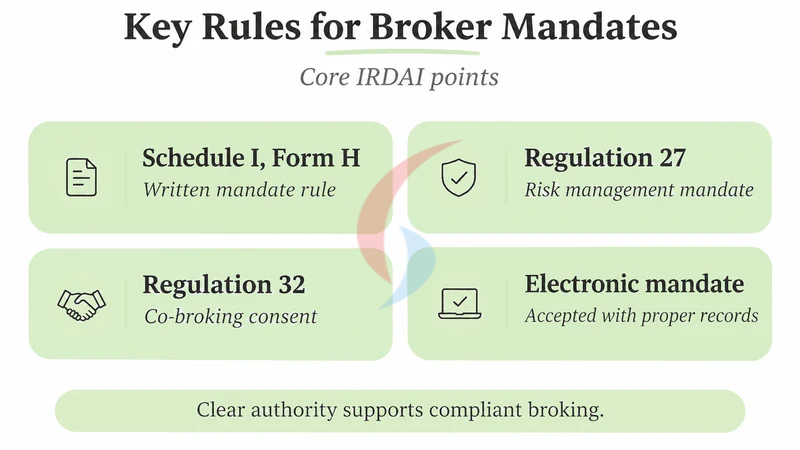
| Legal Provision | Relevance |
| Insurance Act, 1938 | Regulation of insurance intermediaries |
| IRDAI (Insurance Brokers) Regulations, 2018 | Broker registration and duties |
| Regulation 30 | Code of Conduct |
| Schedule I, Form H | Client relationships and written mandates |
| Regulation 27(4) | Written mandate for risk management services |
| Regulation 28 | Claims consultancy requirements |
| Regulation 32 | Written consent and agreements for co-broking |
| IRDAI clarification dated 24 December 2018 | Recognition of electronic written mandates |
Schedule I, Form H requires brokers to act with integrity, exercise care, explain their relationship with clients and protect confidential information. Brokers must also obtain specific client authority to develop insurance terms.
The IRDAI (Insurance Intermediaries) (Amendment) Regulations, 2026, notified on 30 July 2026, introduced changes concerning intermediary registration and supervision. Brokers should read their client documentation obligations alongside the currently applicable amended regulations.
For a better understanding of regulatory responsibilities, explore our guide on IRDAI Compliance Requirements for Insurance Intermediaries, covering ongoing compliance, documentation and reporting obligations.
Is a Written Mandate Mandatory for Every Insurance Broker?
A written mandate is generally required where the broker represents a client for the activities covered by Schedule I, Form H. However, the regulations expressly provide that a mandate is not required for pre-underwritten policies or retail/individual policies. For example, a broker arranging a customised industrial insurance programme should ordinarily obtain appropriate written authorisation before approaching insurers on behalf of the client.
In contrast, the specific mandate exception may apply to an eligible retail insurance transaction. Even where the exception applies, the broker must still follow applicable customer identification, product suitability, disclosure and documentation requirements. A client agreement should never be used to bypass regulatory requirements. The correct documentation depends on the transaction and the broker's role.
Essential Clauses in an Insurance Broker Client Agreement
1. Identification of Parties
The agreement should mention the legal names, registered addresses and contact details of the insurance broker and client. It must also include the broker's IRDAI registration number and relevant business details. Correct identification helps establish the legal relationship between both parties.
2. Scope of Services
The agreement should clearly explain the insurance services the broker will provide, including risk assessment, policy comparison and placement assistance. It may also cover renewal support and claims-related services. A defined scope helps prevent disagreements about the broker's responsibilities.
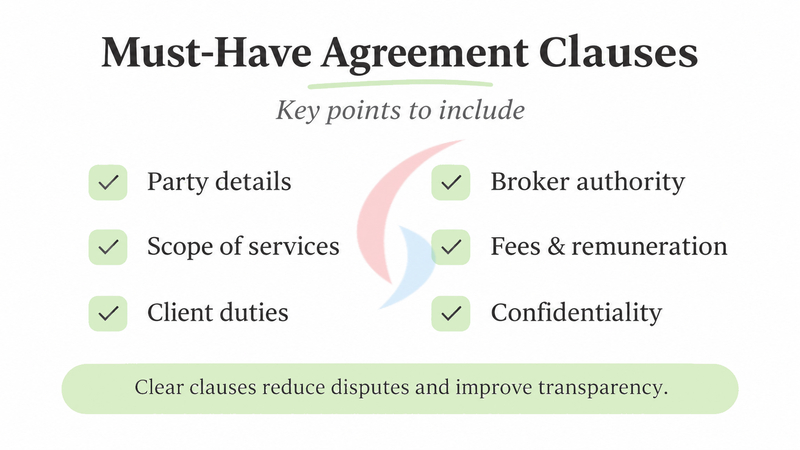
3. Responsibilities of the Client
The client must provide accurate information about business activities, insured assets and potential risks. They should disclose material facts and review insurance quotations before making decisions. Incorrect or incomplete information may affect policy coverage and claim settlement.
4. Broker's Authority
The agreement should specify the activities the insurance broker is authorised to perform on behalf of the client. It should clarify whether the broker can negotiate policy terms or only obtain insurance quotations. Final policy acceptance must follow the client's actual authorisation.
5. Remuneration and Fees
The agreement should explain the applicable remuneration arrangements and any separately permitted service fees. All payments must comply with IRDAI regulations and relevant disclosure requirements. Clear financial terms help maintain transparency between the broker and client.
6. Confidentiality
Insurance brokers often receive confidential financial, commercial and personal information from clients. The agreement should explain how this information will be protected, used and shared when necessary. Brokers must follow applicable confidentiality and data protection requirements.
7. Term and Termination
The agreement should specify its commencement date, duration and circumstances in which either party may terminate the relationship. It should also explain how pending insurance matters and documents will be handled. Clear termination provisions help avoid disputes when the relationship ends.
8. Complaints and Dispute Resolution
The agreement should explain how clients can raise complaints regarding insurance services or professional conduct. It should identify appropriate communication channels and the applicable dispute-resolution procedure. Clients must retain access to regulatory complaint remedies wherever applicable.
Important Details in an Insurance Broker Mandate Letter
A mandate should be sufficiently specific to demonstrate the client's actual authorisation. Common details include the client's legal name, broker's name and IRDAI registration number, date of authorisation, description of insurance requirements, permitted activities, effective period and signature of an authorised representative.
For example, a manufacturing company may authorise a broker to obtain quotations for fire, machinery breakdown and business interruption insurance for its identified factory. The mandate may permit quotation negotiations while reserving final acceptance of proposed insurance terms to the client. This distinction is important because an authority to obtain quotations does not necessarily authorise the broker to accept every quotation or commit the client to a particular policy.
Validity of an Insurance Broker Mandate Letter
Schedule I, Form H contains an important rule unless otherwise specified, a written mandate with no stated validity period is valid for one year. For example, if a company issues a mandate on 1 December 2026 without specifying its validity, the regulatory default of one year generally applies.
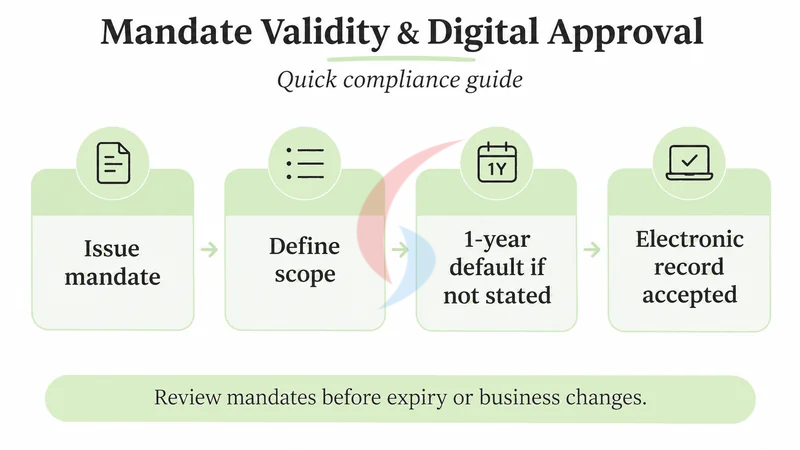
A client may instead specify an appropriate validity period depending on the insurance programme and services involved. Businesses should review mandates before expiry and obtain fresh or extended authorisation where required. They should also check whether a mandate has been revoked or replaced by a later instruction. The duration of the client's authority should not be confused with the validity of the broker's IRDAI registration.
Along with maintaining valid client mandates, registered brokers should understand their ongoing obligations through our guide on Insurance Broker Compliances in India.
Can an Insurance Broker Obtain an Electronic Mandate?
Yes. IRDAI clarified on 24 December 2018 that a mandate communicated electronically may qualify as a written mandate under the relevant provisions of the Insurance Brokers Regulations, 2018. This means an electronically communicated authorisation can be recognised, provided the applicable legal requirements are satisfied. For practical compliance, brokers should maintain records establishing the client's identity, authorised signatory, actual consent, date of communication and scope of authorisation. An electronic mandate should remain accessible for future reference. Digital communications should also be handled in accordance with applicable electronic-record and evidentiary requirements.
For more information on permitted brokerage payments and fee arrangements, read our detailed article on Insurance Broker Commission and Remuneration Rules.
Mandate Requirements for Risk Management and Claims Consultancy
A general insurance placement mandate is not necessarily sufficient for every specialised service offered by an insurance broker. Under Regulation 27(4), an insurance broker providing permitted risk management services must obtain a written mandate and maintain records covering the client, place of risk, services and fee arrangements.
Regulation 28 separately governs claims consultancy for specified commercial general insurance claims. It requires a written mandate and imposes additional eligibility, reporting and approval conditions. For example, a business appointing a broker for a specialised claims consultancy assignment should clearly identify the relevant claim and consultancy services. The parties must also assess whether the proposed assignment is permitted under Regulation 28. Brokers should distinguish ordinary claims assistance connected with an arranged policy from a separately chargeable claims consultancy engagement.
Can Insurance Brokers Charge Fees Under a Client Agreement?
Insurance brokers receive permitted remuneration for insurance distribution activities in accordance with applicable regulatory provisions and insurer arrangements. Certain additional services, such as commercial risk management, may attract separately agreed client fees where permitted under Regulation 27.
However, a client agreement cannot make an otherwise prohibited payment lawful. Brokers must avoid charging overlapping remuneration and fees in circumstances restricted by the regulations. For example, if a broker is separately engaged for a commercial risk assessment, the client agreement should explain the assessment services, calculation of fees and payment terms.
Client Mandates in Co-Broking and Reinsurance
Under Regulation 32, two or more registered insurance brokers may jointly handle a client's insurance requirements with the client's written consent. The brokers must enter into an appropriate Terms of Business Agreement addressing their respective responsibilities and remuneration arrangements. For reinsurance and composite brokers, Schedule I, Form I also provides for a Terms of Business Agreement with the insurer or reinsurer involved in reinsurance placement. These arrangements differ from an ordinary broker–client mandate. Parties should clearly identify who gives instructions, who approaches insurers or reinsurers, and who remains responsible for documentation and communication.
Businesses exploring different insurance broking activities can read Types of Insurance Brokers: Direct vs Reinsurance to understand their roles, registration categories and regulatory requirements.
Storytelling Example: A Dispute Avoided Through a Clear Mandate
Returning to Sunrise Packaging Private Limited, Amit decides to appoint a registered insurance broker for the factory's insurance programme.
Instead of relying on a telephone conversation, the company signs a client agreement describing the proposed services. It also issues a mandate authorising the broker to approach insurance companies and obtain quotations.
The mandate states that the broker may negotiate terms but cannot confirm policy placement without written approval from the company.
After receiving competing quotations, the broker recommends suitable coverage and explains material exclusions. Amit selects the preferred policy and sends written acceptance.
The broker then communicates with the insurer and confirms the issued coverage details to the client.
Several months later, the company expanded its warehouse facilities. Because the service agreement defines the responsibilities of both parties, Amit knows that the new risk must be disclosed and appropriate policy changes considered.
This fictional example shows how well-drafted agreements and mandates can improve communication, reduce uncertainty and support regulatory compliance.
Common Mistakes Insurance Brokers Should Avoid
One common mistake is using the same generic mandate for every client without identifying the actual insurance services required. Another is relying on outdated authorisations or failing to verify whether the signatory has authority to act for the company. Brokers should also avoid accepting instructions that exceed the mandate, failing to explain policy exclusions or assuming that issuing a mandate automatically activates insurance protection.
Where a client changes brokers, the outgoing and incoming brokers should maintain proper records of the transition and follow applicable obligations regarding the client's documentation. A clear audit trail can be particularly useful if disputes later arise about quotations, policy placement or responsibility for communicating material information.
Brokers should also understand the financial risks of professional mistakes by reading our guide on Professional Indemnity Insurance for Insurance Brokers.
Why Choose Compliance Calendar LLP?
Compliance Calendar LLP assists businesses in understanding the regulatory requirements applicable to insurance intermediaries and maintaining proper compliance documentation. Businesses planning to establish an insurance broking company can explore our Insurance Broker Registration in India guide for eligibility, documentation and approval requirements.
Our team can also assist businesses in understanding IRDAI compliance obligations, reviewing relevant registration documentation and identifying regulatory considerations connected with insurance broker client agreements and mandate letters.
For professional assistance with insurance broker registration and compliance, contact Compliance Calendar LLP at +91 9988424211 or info@ccoffice.in.
Frequently Asked Questions (FAQs)
Q1 What is an Insurance Broker Mandate Letter?
Ans. An Insurance Broker Mandate Letter is a written authorisation allowing a registered insurance broker to represent a client. It generally specifies the services and activities the broker can perform. The broker must act within the authorised scope and applicable IRDAI requirements.
Q2 Is a client agreement compulsory for every insurance policy?
Ans. A separate client agreement is not universally mandatory for every insurance transaction. However, written mandates are required for certain broker representation activities under IRDAI regulations. The documentation requirements depend on the type of insurance and services provided.
Q3 Is a written mandate mandatory under IRDAI regulations?
Ans. A written mandate is generally required when an insurance broker represents a client for specified insurance activities. Schedule I, Form H provides exceptions for pre-underwritten and retail or individual policies. Brokers should verify whether the exception applies before proceeding without a mandate.
Q4 What is the validity of a mandate letter?
Ans. Under Schedule I, Form H, a written mandate without a specified validity period generally remains valid for one year. Clients may specify a different period depending on their insurance requirements. Brokers should check the mandate's validity before undertaking authorised activities.
Q5 Can an insurance broker accept an electronic mandate?
Ans. Yes, IRDAI has clarified that electronically communicated written mandates may be accepted under the applicable regulations. Brokers should maintain reliable records of the client's authorisation and the scope of services. Electronic documentation must also satisfy applicable legal requirements.
Q6 Can one client appoint two insurance brokers?
Ans. Yes, clients may engage multiple registered insurance brokers through a permitted co-broking arrangement. Regulation 32 requires written client consent and an appropriate agreement between participating brokers. The agreement should clearly define their responsibilities and applicable remuneration arrangements.
Q7 Does a mandate letter authorise automatic policy issuance?
Ans. No, issuing a mandate letter does not automatically result in insurance coverage. The broker can only perform activities permitted by the client's written authorisation. Insurance coverage becomes effective according to the insurer's acceptance and applicable policy terms.
Q8 Can a broker charge a separate advisory fee?
Ans. Insurance brokers may charge fees for certain permitted services, subject to applicable IRDAI regulations. The fee arrangement should be properly documented and communicated to the client. Brokers must avoid prohibited charges or overlapping remuneration.
Q9 Is a separate mandate required for claims consultancy?
Ans. Regulation 28 requires a written mandate for the specified claims consultancy services governed by that provision. The mandate should identify the client, relevant claim and consultancy services. Brokers must also comply with the applicable eligibility, approval and regulatory conditions.
Q10 What happens if a broker acts without proper authorisation?
Ans. An insurance broker acting beyond the client's authority may face contractual disputes, financial liability or regulatory consequences. Such conduct may also damage client relationships and professional credibility. Maintaining accurate written mandates helps demonstrate the authorised scope of services.
Article last updated on : 18 Nov 2026.













































































_learn_crop10_thumb.jpg)