


Insurance Broker Commission and Remuneration Rules govern how registered insurance brokers receive payments for arranging insurance policies, assisting customers and providing permitted professional services. These requirements are regulated by the Insurance Regulatory and Development Authority of India (IRDAI), which supervises insurance companies and registered insurance intermediaries.
Businesses planning to enter the insurance sector must understand the regulatory requirements applicable to both insurers and intermediaries. While Insurance Company Registration is required for eligible entities intending to undertake insurance business, companies planning to offer insurance broking services must obtain an Insurance Broker License from IRDAI. Understanding these registration requirements, commission rules and ongoing compliance obligations helps businesses operate lawfully and maintain transparency in their financial arrangements.
For a detailed understanding of registration eligibility, documentation and approval requirements, readers can refer to our Insurance Broker Registration in India: Process & Rules article.
Legal Provisions Governing Insurance Broker Commission in India
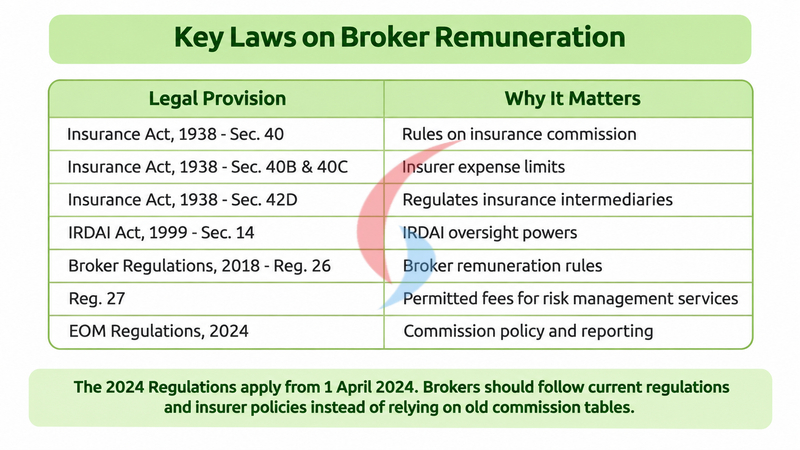
Insurance broker remuneration is not governed by a single provision. Several insurance laws and IRDAI regulations operate together to determine how insurance intermediaries receive commission, charge permitted fees and maintain regulatory compliance.
| Legal provision | Relevance to insurance broker remuneration |
|---|---|
| Insurance Act, 1938 – Section 40 | Statutory provisions relating to insurance commission |
| Insurance Act, 1938 – Sections 40B and 40C | Expenses of management of insurers |
| Insurance Act, 1938 – Section 42D | Registration and regulation of insurance intermediaries |
| IRDAI Act, 1999 – Section 14 | IRDAI's regulatory and supervisory powers |
| IRDAI (Insurance Brokers) Regulations, 2018 – Regulation 26 | Remuneration for direct insurance and reinsurance business |
| Regulation 27 | Fees for risk management and similar services |
| IRDAI (Expenses of Management, including Commission, of Insurers) Regulations, 2024 | Commission policy, expense limits, reporting and insurer responsibilities |
The 2024 Regulations came into effect on 1 April 2024. They brought commission and insurer operating expenses within a consolidated regulatory approach, replacing the earlier 2023 payment-of-commission arrangements. Brokers should therefore avoid relying on historical commission percentage tables without examining current regulations and insurer policies.
How Do Insurance Brokers Earn Commission in India?
Insurance brokers generally earn commission or brokerage from insurers for placing eligible insurance business. The payment is linked to the insurance distribution activities performed by the broker and must comply with the insurer's approved remuneration policy and applicable IRDAI requirements. For example, suppose Rajesh arranges a commercial insurance policy with an annual premium of Rs 4 lakh. Assume the insurer's applicable brokerage arrangement provides an illustrative commission of 10%. Rajesh's company would earn Rs 40,000 before applicable taxes, adjustments and other contractual conditions.
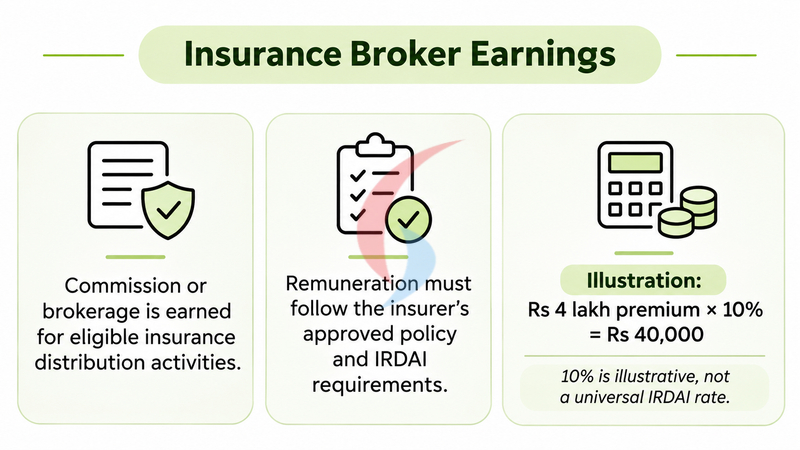
However, 10% is only an example, not a universally prescribed IRDAI rate. Actual remuneration depends on the insurance product, insurer policy, commercial arrangements and regulatory requirements. A broker cannot assume that every general insurance, health insurance or life insurance policy carries the same commission percentage. The main principle is that insurance brokers must earn remuneration transparently and avoid practices that create unfair incentives or compromise the suitability of insurance recommendations.
IRDAI Commission Limits for Insurance Brokers
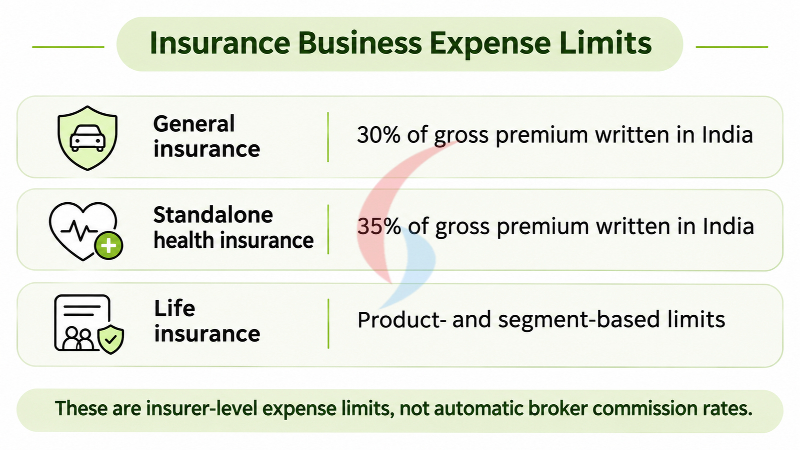
One of the most important developments in insurance intermediary remuneration is the introduction of the consolidated Expenses of Management (EOM) requirements. Rather than prescribing one uniform commission percentage for every insurance product, the 2024 Regulations require insurers to manage commissions within their applicable overall expense limits. Under Regulation 6, the general insurance and standalone health insurance expense limits are based on gross premium written in India during the financial year.
| Insurance business | Prescribed expense-of-management limit |
|---|---|
| General insurance | 30% of gross premium written in India |
| Standalone health insurance | 35% of gross premium written in India |
| Life insurance | Product- and segment-based limits under Regulations 7 and 8 |
These percentages are insurer-level EOM limits, not individual insurance broker commission rates. An insurance broker cannot automatically claim 30% or 35% brokerage merely because these figures appear in the regulations. Life insurance expenses follow a different calculation based on the relevant business segments. Consequently, commission arrangements should always be assessed against the insurer's approved policy and applicable regulatory provisions.
Board-Approved Commission Policy Under IRDAI Regulations
Regulation 4 of the 2024 EOM Regulations requires every insurer to maintain a written, board-approved commission payment policy. The policy helps establish how commission will be structured and administered while protecting policyholders and maintaining business efficiency. The policy must consider the nature and tenure of insurance products, the interests of policyholders, insurance penetration, intermediary performance and the insurer's business strategy. It must also be reviewed periodically to ensure that remuneration arrangements remain appropriate.
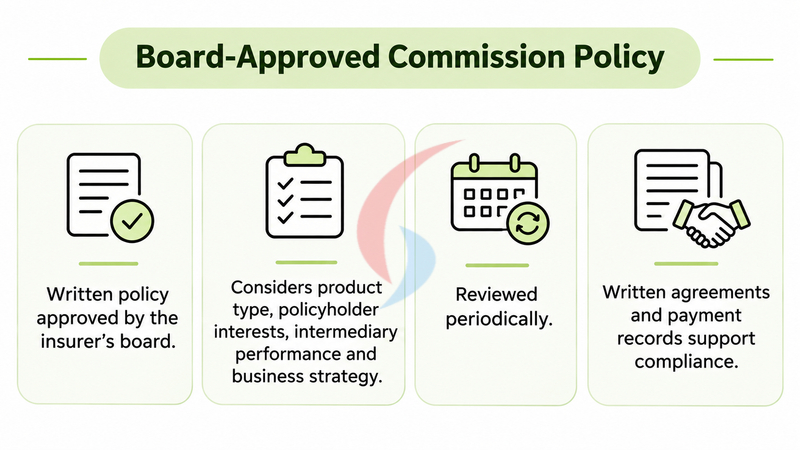
For instance, an insurer distributing business insurance products may have different commercial remuneration arrangements from an insurer offering individual health insurance. Those arrangements must still comply with applicable regulatory requirements. An insurance broker should understand the insurer's commission terms before accepting business. Maintaining written agreements, payment records and relevant correspondence is important for regulatory inspections and internal accounting.
Difference Between Commission, Remuneration and Professional Fees
The terms commission, remuneration and professional fees are sometimes used interchangeably, but they may refer to different payment arrangements.
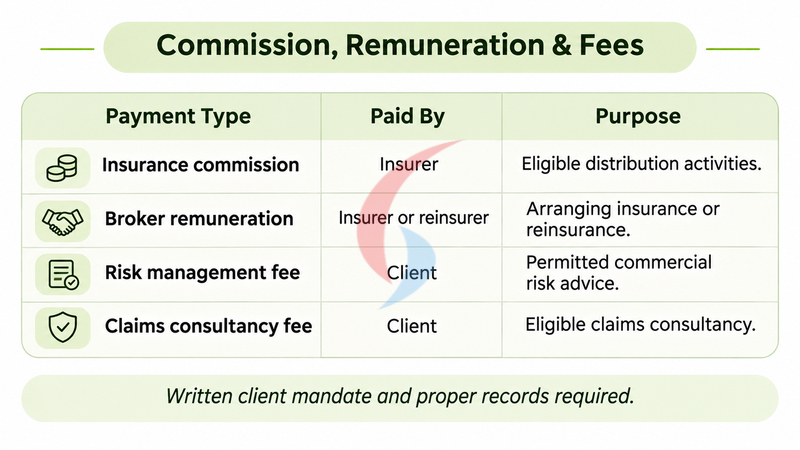
| Payment type | Meaning | Common payer |
|---|---|---|
| Insurance commission | Compensation for eligible insurance distribution activities | Insurer |
| Broker remuneration | Payment for arranging insurance or reinsurance business | Insurer or reinsurer, as applicable |
| Risk management fee | Payment for permitted commercial risk assessment and advisory services | Client |
| Claims consultancy fee | Payment for eligible claims consultancy services | Client |
Regulation 27 of the Insurance Brokers Regulations, 2018 allows brokers to charge fees for permitted risk management services concerning commercial risks, subject to specified conditions. These include obtaining the client's written confirmation and mandate and maintaining proper records of the services and fees. The regulations also restrict receiving remuneration and separate risk management fees for the same services in the manner prohibited by Regulation 27. Therefore, a broker should not treat client advisory fees as unrestricted additional income.
Can Insurance Brokers Charge Clients Additional Fees?
Insurance brokers may charge clients for specified professional services where permitted under the applicable regulations. However, they cannot simply add arbitrary advisory or processing charges to every insurance policy.
Suppose Rajesh is approached by a large manufacturing company that requires a detailed assessment of fire hazards, machinery breakdown exposure and business interruption risks. The company may engage Rajesh's firm to provide a separate commercial risk management service under an appropriate written agreement.
The agreement should identify the scope of work, fees, services and relevant regulatory conditions. Rajesh must also ensure that the same risk management service is not improperly compensated through both brokerage and client fees.
This distinction helps businesses understand whether a payment relates to insurance placement or a separately permitted professional service.
To understand the difference between direct insurance broking and reinsurance services, read our Types of Insurance Brokers: Direct vs Reinsurance guide.
Commission Rules for Direct, Reinsurance and Composite Brokers
The insurance brokerage industry includes direct brokers, reinsurance brokers and composite brokers. Although they operate under the same broad regulatory supervision, their activities and commercial remuneration arrangements can differ. A direct broker primarily assists customers in obtaining insurance policies from insurers. A reinsurance broker helps insurance companies obtain reinsurance protection for risks they have accepted. Composite brokers are authorised to perform both categories of activities within their registration scope.
Regulation 26 of the 2018 Insurance Brokers Regulations separately addresses remuneration for direct insurance and reinsurance business. Its original text references the earlier commission regulations for direct business, so it must now be read alongside the subsequently applicable commission provisions. For reinsurance business, the regulation refers to prevailing market practices and provides for monthly settlement of accounts without cross-settlement of outstanding balances. These differences make proper classification of brokerage revenue important, especially for composite brokers handling multiple types of insurance business.
Disclosure Requirements and Conflict of Interest
Insurance brokers are expected to provide appropriate advice, explain insurance products accurately and act in accordance with their regulatory code of conduct. Commission arrangements must not result in misleading recommendations or improper treatment of customers.
Consider Rajesh's earlier example. The manufacturing customer needs a policy covering expensive machinery, fire damage and business interruption. If Rajesh recommends a product solely because it offers higher remuneration, without properly considering suitable coverage, a conflict of interest may arise.
The broker should compare the policy terms, identify significant exclusions and explain coverage limitations to the customer. Required remuneration disclosures, where applicable, and relevant communications should also be properly documented. These obligations help ensure that insurance decisions remain centred on the customer's requirements rather than an intermediary's earning potential.
For a broader explanation of regulatory duties, records and reporting obligations, refer to IRDAI Insurance Broker Compliance.
GST and Taxation of Insurance Broker Commission
Insurance brokerage income must also be examined under applicable Goods and Services Tax provisions. Brokerage and commission services ordinarily attract GST, subject to the applicable tax treatment, exemptions and reverse charge provisions.Insurance brokers should determine whether they are responsible for charging and remitting GST or whether the relevant recipient is liable under reverse charge. The answer depends on the legal classification of the intermediary, the nature of the service and the applicable GST notifications.
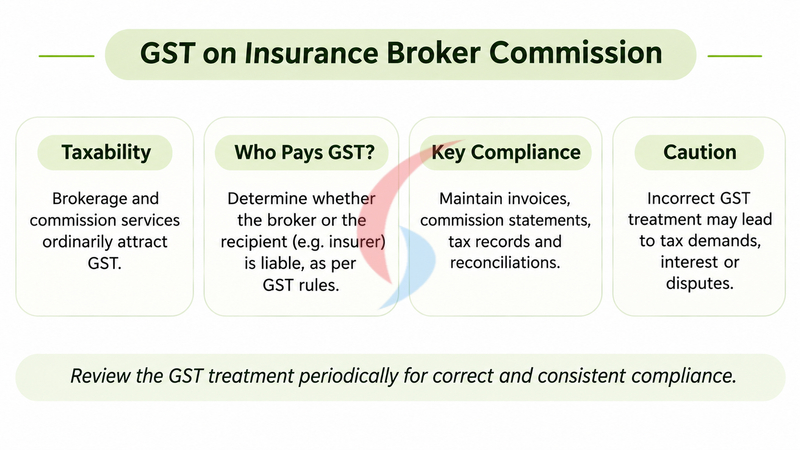
A registered broker must maintain accurate invoices, commission statements, tax records and reconciliation details. For example, where an insurer reports brokerage paid to Rajesh's company, the amount should be reconciled with the broker's accounting records and the relevant GST treatment. Incorrect GST classification may lead to tax demands, interest or compliance disputes. Therefore, brokers should review their tax treatment periodically rather than assume that every insurance commission transaction follows the same invoicing procedure.
Commission Accounting, Records and Regulatory Reporting
Proper accounting is essential for insurance brokers because regulatory authorities may examine remuneration received, business placed, client documentation and financial records during inspections. Brokers should maintain insurer-wise commission statements, policy references, commission agreements, debit and credit notes, settlement details and evidence of applicable tax compliance. These records should match the firm's financial statements and relevant regulatory returns.
Under Regulation 14 of the 2024 EOM Regulations, insurers must submit board-approved commission payment returns to IRDAI within 45 days after the end of the financial year. This is an insurer reporting obligation, distinct from the separate records and returns required from brokers. For example, if Rajesh's accounting software records Rs 12 lakh in insurance brokerage revenue while insurer statements show Rs 11.5 lakh, the difference should be investigated. It could arise from timing differences, adjustments, cancelled policies or accounting errors. Regular reconciliation helps reduce disputes, strengthen internal controls and support audit readiness.
Common Insurance Broker Commission Compliance Mistakes
One common mistake is recommending insurance products because they offer higher commission without properly considering policy suitability. Another is using outdated commission tables or treating an insurer's EOM limit as the maximum commission that an individual broker may automatically receive. Problems may also arise where a broker accepts payments from unauthorised sources, fails to document separate professional fees, maintains incomplete commission records or provides misleading information about policy coverage.
The most effective way to prevent these issues is to introduce clear internal procedures for product comparisons, commission accounting, customer communications and supervisory review. Staff handling insurance placement should understand both commercial arrangements and regulatory obligations. A brokerage business should also maintain appropriate controls to identify conflicts of interest before they affect policyholders.
Latest IRDAI Developments in 2026
The regulatory environment for insurance intermediaries continued to develop in 2026. Following the Sabka Bima, Sabki Raksha (Amendment of Insurance Laws) Act, 2025, IRDAI notified the Insurance Intermediaries (Amendment) Regulations, 2026 on 30 July 2026. These amendments introduced changes affecting insurance brokers and other insurance intermediaries, including aspects of registration, accountability, disclosure, personnel identification and operational compliance.
The amendments also introduced additional disclosure requirements for specified intermediaries, including certain entities meeting prescribed foreign-shareholding or commission-related thresholds. Insurance brokers should examine whether such requirements apply to their business. However, the 2026 intermediary amendments should not be interpreted as introducing a new universal brokerage commission percentage. The relevant 2024 EOM Regulations and current IRDAI directions remain essential when determining commission arrangements
For more information on intermediary obligations and regulatory developments, read IRDAI Compliance Requirements for Insurance Intermediaries.
Case Study: How Transparent Commission Practices Helped Rajesh Retain a Client
Returning to Rajesh's manufacturing client, Amit receives three insurance quotations. The cheapest policy contains an important exclusion for certain machinery-related losses. Another provides broader protection, while the third offers Rajesh a comparatively higher commission but less suitable coverage.
Instead of recommending the policy that generates the highest income, Rajesh prepares a comparison explaining premium amounts, covered risks, deductibles and major exclusions. He also explains the role of his brokerage company and provides relevant information about the remuneration arrangement.
Amit chooses the policy that offers more appropriate protection for his business. Although Rajesh may earn less commission on that particular policy, his professional approach helps build confidence and establishes the basis for a longer-term customer relationship.
The example demonstrates that regulatory compliance and commercial success do not necessarily conflict. Transparent recommendations, adequate documentation and suitable insurance coverage can support sustainable brokerage operations.
Why Choose Compliance Calendar LLP for Insurance Broker Compliance?
Insurance brokers must manage several responsibilities beyond obtaining registration. These include commission records, financial reporting, professional indemnity insurance, qualified personnel, regulatory disclosures and ongoing compliance with IRDAI requirements.
Compliance Calendar LLP assists insurance businesses in understanding applicable registration procedures, documentation requirements and regulatory obligations. Our professional team can help identify relevant compliance requirements, review supporting documents and guide businesses through procedural matters.
Whether an entity plans to establish a direct insurance broking company or review the compliance requirements of an existing insurance intermediary, understanding the relevant legal provisions is essential.
For further information on registration eligibility and documentation, readers may refer to our Conditions for Grant of Insurance Broker License in India article.
Frequently Asked Questions (FAQs)
Q1. What are Insurance Broker Commission and Remuneration Rules?
Ans. These rules regulate how insurance brokers receive commission and permitted professional fees. They operate under IRDAI regulations and applicable provisions of the Insurance Act, 1938. Brokers must follow relevant remuneration, disclosure and compliance requirements.
Q2. Who pays commission to insurance brokers in India?
Ans. Insurance brokers generally receive brokerage or commission from insurance companies. The payment depends on the insurance product and applicable remuneration arrangements. Client fees may be charged separately only for permitted professional services.
Q3. What is the maximum insurance broker commission in India?
Ans. There is no single universal commission percentage applicable to every insurance product. Commission arrangements must comply with applicable IRDAI rules and insurer policies. The insurer's overall expenses must remain within the prescribed regulatory limits.
Q4. Is the 30% EOM limit the maximum broker commission?
Ans. No, the 30% limit applies to the general insurer's expenses of management. It includes relevant expenses and is not an individual broker commission entitlement. Actual brokerage depends on the insurer's policy and applicable regulations.
Q5. Can insurance brokers charge customers advisory fees?
Ans. Yes, insurance brokers may charge for specified professional services where permitted. Commercial risk management fees require appropriate written client documentation. Brokers must also follow restrictions on receiving multiple payments for the same services.
Q6. Is GST applicable to insurance brokerage income?
Ans. Insurance brokerage services are generally subject to applicable GST provisions. The exact tax liability depends on the nature of the transaction and relevant notifications. Brokers should verify whether normal charge or reverse charge applies.
Q7. Can an insurance broker receive commission from multiple insurers?
Ans. A registered broker may work with multiple insurers within its authorised activities. Commission arrangements must follow applicable regulations and insurer policies.The broker should maintain accurate records of remuneration received.
Q8. Can higher commission influence insurance policy recommendations?
Ans. Brokers must provide suitable advice and comply with their professional code of conduct. Recommending an unsuitable policy merely for higher remuneration may create compliance concerns. Customer requirements and appropriate insurance coverage should guide recommendations.
Q9. Are reinsurance broker remuneration rules different?
Ans. Yes, reinsurance business has separate remuneration provisions under Regulation 26. The regulations refer to prevailing market practices for reinsurance remuneration. Monthly settlement requirements and other applicable conditions must also be followed.
Q10. What documents should brokers maintain for commission compliance?
Ans. Brokers should maintain commission agreements, insurer statements and accounting records. Relevant policy references, fee mandates, invoices and correspondence should be preserved. These records support financial audits, reconciliation and regulatory inspections.
Article last updated on : 18 Nov 2026.













































































_learn_crop10_thumb.jpg)