


A company may have foreign investors, a growing customer base and plans for expansion, yet its balance sheet may show negative net worth. This situation is particularly common among startups and businesses that have invested heavily in product development, infrastructure or market expansion before becoming profitable.
Now consider an Indian company that received Rs 3 crore from a foreign investor but has accumulated losses of Rs 4 crore. When its finance team begins preparing the annual Foreign Liabilities and Assets (FLA) Return, an important question arises: Does a company with negative net worth still need to file its FLA Return with RBI?
The answer is yes, where the company meets the applicable FLA reporting conditions. A negative net worth does not automatically exempt a business from filing.
The Reserve Bank of India requires eligible Indian entities with outstanding Foreign Direct Investment (FDI) or Overseas Direct Investment (ODI) to report their foreign financial liabilities and assets annually. The obligation depends on the existence of reportable foreign investment positions, not simply whether the company is profitable.
However, negative net worth can create practical difficulties when completing financial information, calculating equity values and reconciling foreign investment figures.
This article explains FLA Return filing for companies with negative net worth, including applicability, RBI valuation rules, the FLAIR portal process, reporting deadlines, supporting documents, penalties and the latest RBI guidance available in 2026.
What is an FLA Return under FEMA?
The Annual Return on Foreign Liabilities and Assets, commonly called the FLA Return, is a regulatory statement submitted to the Reserve Bank of India by eligible Indian entities with reportable foreign investment positions. It captures information about foreign investments received by Indian entities, investments made outside India and related external financial positions.
Unlike Form FC-GPR, which reports specified fresh issuances of equity instruments, the FLA Return provides an annual picture of outstanding foreign financial liabilities and assets. The information helps RBI compile India's Balance of Payments, International Investment Position and other external-sector statistics.
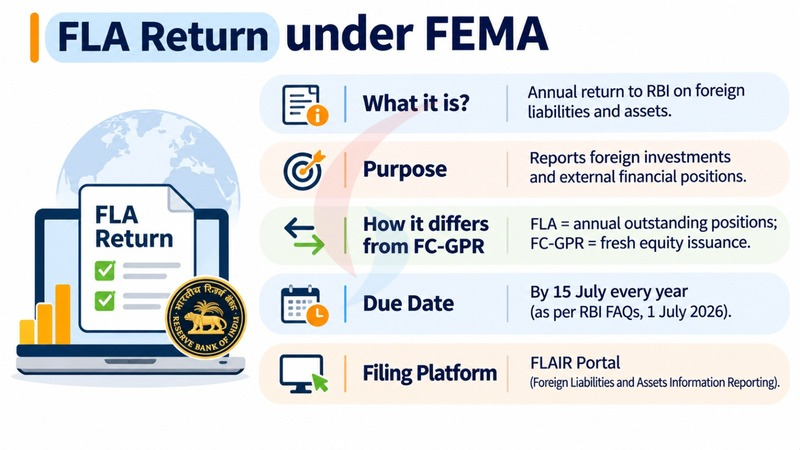
Under RBI's updated FAQs dated 1 July 2026, eligible entities must generally submit the return by 15 July each year through the Foreign Liabilities and Assets Information Reporting (FLAIR) portal. The return reports the relevant positions as at the end of March for the previous and latest financial years.
Businesses looking for a broader explanation can read our article on FLA Return Filing and Due Dates with Checklist.
Is FLA Return Mandatory for Companies with Negative Net Worth?
Yes. Negative net worth does not by itself remove the FLA filing requirement. An Indian company that has outstanding reportable foreign direct investment or overseas direct investment during the relevant reference periods must assess its annual reporting obligation regardless of accumulated losses.
A company may have a negative equity position because its losses exceed its paid-up capital and reserves. However, this accounting situation does not mean that the foreign investor has ceased to hold shares in the business.
For example, a foreign investor may continue to own 40% of an Indian company even though that company's accumulated losses exceed its shareholders' funds. The ownership relationship still exists, and the company must report its relevant foreign investment position.
RBI's 2026 FAQs confirm that entities with reportable outstanding FDI or ODI positions must file even where no new foreign investment was received during the financial year.
|
Company's Financial Position |
FLA Reporting Position |
|
Negative net worth with outstanding reportable FDI |
Filing generally required. |
|
Negative net worth with outstanding ODI |
Filing generally required. |
|
Loss-making company with foreign shareholders |
Filing required where the holdings constitute reportable foreign investment. |
|
No fresh FDI during the year, but existing reportable FDI |
Filing generally required. |
|
Only share application money received, without outstanding FDI or ODI |
Generally not required on that basis alone. |
|
No reportable FDI or ODI in either relevant March reference period |
Generally not required. |
|
Only qualifying NRI investment on a non-repatriation basis |
Generally not required solely because of that investment. |
Therefore, companies should examine their foreign investment records before deciding whether an FLA Return is necessary. Profitability and reporting applicability are separate questions.
What Does Negative Net Worth Mean for FLA Reporting?
Negative net worth occurs when a company's relevant equity funds become negative, commonly because accumulated losses exceed the company's capital and reserves. In the FLA Return, RBI uses a prescribed calculation of net worth based on paid-up equity and participating preference share capital, reserves and surplus, and accumulated losses.
For unlisted entities, RBI applies the Own Funds at Book Value (OFBV) method for the relevant foreign equity investment valuation. The FLAIR system automatically calculates certain net-worth and foreign equity valuation fields using information entered by the reporting entity.
Consider the following illustrative calculation:
|
Financial Particulars |
Amount |
|
Paid-up equity capital |
Rs 20 lakh |
|
Securities premium and other relevant reserves |
Rs 80 lakh |
|
Accumulated losses |
Rs 150 lakh |
|
Illustrative net worth |
Rs 50 lakh |
In this example, the company's negative net worth is Rs 50 lakh. This does not mean that the business has no assets, nor does it mean that its foreign investors have surrendered their shares.
The company must report the underlying financial information accurately and follow the FLAIR system's prescribed calculation and validation instructions.
A negative accounting value should not be replaced with zero, a positive figure or the original investment amount merely to make the return appear financially stronger. Any portal-specific restriction on negative calculated values should be resolved using RBI's official instructions rather than changing the underlying financial records. ;RBI's July 2026 FAQs explain both the net-worth calculation and the OFBV approach for unlisted entities.
Laws and Legal Provisions Governing FLA Return Filing
FLA reporting is part of India's foreign exchange regulatory system. The following provisions are particularly relevant to companies receiving FDI or making overseas investments.
|
Applicable Act / Regulation |
Important Provisions |
Legal Requirements |
|
Sections 6, 13 and 37 |
Governs capital-account transactions, contraventions and specified enforcement powers. |
|
|
FEMA (Mode of Payment and Reporting of Non-Debt Instruments) Regulations, 2019 |
Regulation 4(5) |
Prescribes the annual FLA reporting obligation for applicable Indian entities. |
|
Annual FLA Reporting |
Establishes reporting of foreign liabilities and assets under FEMA. |
|
|
RBI A.P. (DIR Series) Circular No. 16, dated 30 September 2022 |
Late Submission Fee |
Specifies the applicable LSF mechanism for delayed FEMA reporting. |
|
Sections 128, 129 and 134 |
Governs books of account, financial statements and related corporate reporting responsibilities. |
The Companies Act requires companies to maintain proper financial information, while FEMA governs the reporting of qualifying foreign investment positions. These are separate requirements. Filing financial statements with the Registrar of Companies does not replace the RBI FLA Return.
Practical Example: A Startup with Negative Net Worth and Foreign Investment
Consider GreenOrbit Technologies Private Limited, a fictional startup based in Bengaluru. The company develops software for logistics businesses and received funding from a Singapore investor in 2023. The investor acquired 40% of its equity shares through a permitted FDI arrangement.
During its first three years, GreenOrbit spent heavily on employees, software development, marketing and customer acquisition. Although sales increased, the company continued to report accounting losses. By 31 March 2026, its accumulated losses had exceeded the capital and reserves shown in its financial statements.
The company's finance manager believed that the FLA Return was unnecessary because the business had negative net worth and had not received any new foreign investment during FY 2025–26. However, the foreign investor still owned 40% of the company's equity, meaning the company continued to have an outstanding foreign investment position. The annual reporting requirement therefore remained relevant.
The finance team prepared provisional financial statements, reconciled the foreign shareholder details and submitted the FLA Return through RBI's FLAIR portal. This example highlights an important distinction: A company's financial losses can affect its reported investment valuation, but they do not automatically remove its FEMA reporting obligations.
Documents and Financial Records Required for FLA Filing
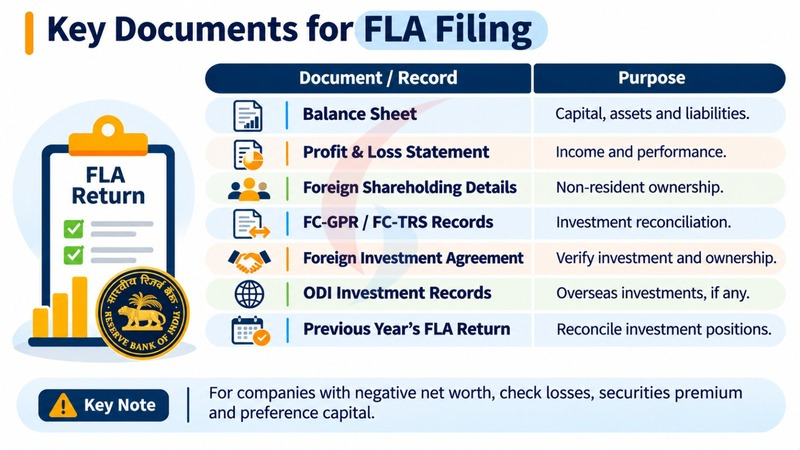
The FLA Return primarily requires financial and investment information. RBI does not ordinarily require companies to upload their complete balance sheet and profit and loss account with the annual return, although those records are essential for preparing accurate figures.
|
Document or Record |
Purpose |
|
Audited or Provisional Balance Sheet |
Provides paid-up capital, reserves, losses, assets and liabilities. |
|
Profit and Loss Statement |
Supports reporting of income and financial performance. |
|
Foreign Shareholding Details |
Establishes the non-resident investors' ownership percentages. |
|
FC-GPR and FC-TRS Records |
Supports reconciliation of relevant investment transactions. |
|
Foreign Investment Agreements |
Helps verify investment details and ownership relationships. |
|
ODI Investment Records |
Supports reporting of overseas direct investments, if any. |
|
Previous Year's FLA Return |
Helps reconcile opening and closing investment positions. |
|
Authority and Verification Letters |
Required for relevant FLAIR portal registration procedures. |
For companies with negative net worth, the finance team should pay particular attention to carried-forward losses, securities premium, the classification of preference capital and differences between audited and provisional figures.
To understand related foreign investment reporting requirements, read our article on FC-GPR and FLA Return: Filing Rules and Penalties.
Step-by-Step FLA Return Filing Process on RBI FLAIR Portal
The filing process is largely the same for profitable companies and companies with negative net worth. However, businesses reporting accumulated losses should perform an additional reconciliation of their financial information.
|
Step |
FLA Filing Procedure |
|
Step 1 – Check Applicability |
Verify outstanding FDI or ODI for the relevant reporting periods. |
|
Step 2 – Prepare Financial Data |
Collect balance sheet figures, reserves, accumulated losses and foreign investment information. |
|
Step 3 – Register on FLAIR |
Complete entity registration and submit prescribed authority documents if not already registered. |
|
Step 4 – Access the Online Return |
Log in to the RBI FLAIR portal and select the relevant reporting year. |
|
Step 5 – Complete Financial Particulars |
Enter the company's paid-up capital, reserves, losses and other prescribed financial data. |
|
Step 6 – Report Foreign Positions |
Provide FDI, ODI and related foreign liabilities or assets in the applicable sections. |
|
Step 7 – Review Calculations |
Check negative net worth, automated valuation fields and reconciliation differences. |
|
Step 8 – Submit and Retain Records |
Submit the return and preserve the acknowledgement. |
|
Step 9 – Revise if Necessary |
Obtain RBI approval through FLAIR before submitting corrected information. |
Companies must ensure that their financial statements, foreign investment details, and shareholding records are accurate before submitting the FLA Return. Proper documentation and timely filing can help avoid reporting errors, RBI queries, and penalties.
For additional guidance, read our article on How to File Foreign Liabilities and Assets on the FLAIR Portal of RBI to understand the step-by-step filing process, required information, and submission procedure.
Difference Between FLA Return, FC-GPR and FLAIR Reporting
Companies often confuse the annual FLA Return with other RBI forms. These reporting requirements serve different purposes.
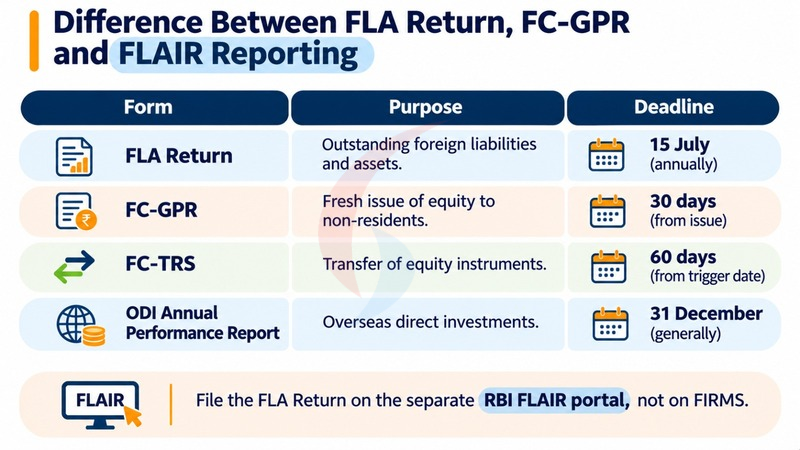
|
Reporting Form |
Purpose |
General Deadline |
|
FLA Return |
Reports outstanding foreign financial liabilities and assets. |
15 July annually |
|
Reports qualifying fresh issues of equity instruments to non-residents. |
30 days from issue |
|
|
Reports specified transfers of equity instruments. |
60 days from the prescribed trigger date |
|
|
ODI Annual Performance Report |
Reports prescribed information concerning overseas direct investments. |
Generally 31 December, where applicable |
Companies filing the FLA Return must use the separate RBI FLAIR portal, rather than treating it as an ordinary Single Master Form filing on FIRMS.
For more information, read our article on RBI FEMA/FDI Reporting: EMF, SMF, FC-TRS and FLA Return.
Latest RBI Updates on FLA Return Filing in 2026
RBI updated its official FLA Return FAQs on 1 July 2026, providing important clarifications for companies preparing their annual foreign investment reports.
|
RBI Guidance |
Relevance |
|
FLA FAQ Update – 1 July 2026 |
Clarifies applicability, filing procedures and reporting requirements. |
|
15 July Annual Deadline |
Continues to apply to eligible entities. |
|
Provisional Financial Data |
Can be used when audited figures are unavailable by the deadline. |
|
Revised FLA Returns |
Require RBI permission through the prescribed FLAIR process. |
|
OFBV Valuation Method |
Applicable to relevant unlisted equity investment reporting. |
|
Foreign Investment Reporting Regulations – Updated June 2026 |
Continue to prescribe applicable foreign investment reporting obligations. |
The June 2026 consolidated regulations identify annual FLA reporting under Regulation 4(2) of the FEMA (Mode of Payment and Reporting of Non-Debt Instruments) Regulations, 2019. This is the correct provision to cite for annual FLA reporting under those regulations.
Why Choose Compliance Calendar LLP for FLA Return Filing?
Companies with negative net worth often require additional attention while preparing foreign investment records, calculating book values and reconciling accumulated losses. At Compliance Calendar LLP, we assist businesses with FEMA reporting, foreign investment documentation and related regulatory compliance.
|
Our Services |
How We Help |
|
FLA Applicability Review |
Determine whether annual RBI reporting applies. |
|
Negative Net Worth Reporting |
Assist with financial data preparation and reconciliation. |
|
FLAIR Portal Filing |
Support preparation and submission of annual FLA Returns. |
|
FDI and ODI Reconciliation |
Review foreign investment records and previous filings. |
|
Revised FLA Returns |
Assist with preparing correction requests and updated returns. |
|
Delayed Filing Assistance |
Provide guidance on LSF and applicable regularisation procedures. |
Businesses can explore our FLA Return Compliance Services for professional assistance.
If your company has negative net worth and requires assistance with RBI FLA Return filing, contact Compliance Calendar LLP at 9988424211 or info@ccoffice.in.
Frequently Asked Questions (FAQs)
Q1. Is FLA Return mandatory for a company with negative net worth?
Ans: Yes, where the company has reportable outstanding FDI or ODI positions. Negative net worth does not automatically create an exemption. The reporting obligation depends on the relevant foreign investment holdings.
Q2. Can a loss-making company file an FLA Return?
Ans: Yes. RBI permits loss-making companies to file their annual FLA Returns using the applicable financial information. The business should disclose the relevant capital, reserves and accumulated losses accurately.
Q3. How is negative net worth calculated for FLA reporting?
Ans: For relevant unlisted entities, RBI's OFBV approach uses paid-up equity and participating preference capital, reserves and surplus, and accumulated losses. The FLAIR system automatically calculates certain fields based on the reported data.
Q4. What is the FLA Return due date for FY 2025–26?
Ans: The ordinary deadline was 15 July 2026. The reporting information relates to the relevant positions as at 31 March 2025 and 31 March 2026.
Q5. Can FLA Return be filed without audited financial statements?
Ans: Yes. RBI permits filing using provisional or unaudited financial statements when audited figures are unavailable by 15 July. Once audited figures are ready, the entity should obtain RBI permission and revise the return.
Q6. Is FLA filing required if no new foreign investment was received?
Ans: Yes, where reportable foreign investment remains outstanding during the relevant reference periods. The absence of a fresh investment transaction does not automatically remove the annual filing requirement.
Q7. What is the penalty for late FLA Return filing?
Ans: RBI's applicable Late Submission Fee for delayed FLA Returns is Rs 7,500 per return, wherever the LSF facility applies. Non-filing may also constitute a FEMA contravention requiring further action.
Q8. Can a company revise its FLA Return after submission?
Ans: Yes. RBI allows eligible entities to request permission through the FLAIR portal to revise previously submitted information. Corrected returns should be submitted after the required approval.
Q9. Is FLA Return filed on the RBI FIRMS portal?
Ans: No. The ordinary FLA Return is filed through RBI's separate FLAIR portal at https://flair.rbi.org.in/. FIRMS is used for prescribed transaction-based reporting forms.
Q10. Can Compliance Calendar LLP assist with FLA Returns for companies with losses?
Ans: Yes. Compliance Calendar LLP assists with determining FLA applicability, preparing financial information, reviewing foreign investment records, FLAIR submissions and related FEMA compliance.
Article last updated on : 18 Nov 2026.













































































_learn_crop10_thumb.jpg)