


An Indian living in Dubai decides to sell shares in a private limited company based in Mumbai. The buyer is an Indian resident, the share price has been agreed upon, and both parties are ready to complete the transaction. However, during the documentation process, the company's Chartered Accountant asks an important question: Has Form FC-TRS been filed with the Reserve Bank of India?
The seller is surprised. After all, the shares already belong to him, and the company is not receiving any fresh investment. Why should RBI reporting be required?
This confusion is common in transactions involving Non-Resident Indians (NRIs). Many shareholders understand the procedures for transferring shares under the Companies Act, 2013, but are unfamiliar with the additional reporting obligations under the Foreign Exchange Management Act, 1999 (FEMA).
FC-TRS Reporting for NRI Share Transfers is required for specified transfers of equity instruments involving residents and non-residents. The requirement depends on the parties' residential status, whether the investment is held on a repatriation or non-repatriation basis, and the nature of the transfer.
What is Form FC-TRS under FEMA?
FC-TRS stands for Foreign Currency–Transfer of Shares. It is the prescribed reporting form used for certain transfers of equity instruments of Indian companies involving resident and non-resident persons. The reporting requirement is prescribed under Regulation 4(3) of the Foreign Exchange Management (Mode of Payment and Reporting of Non-Debt Instruments) Regulations, 2019.
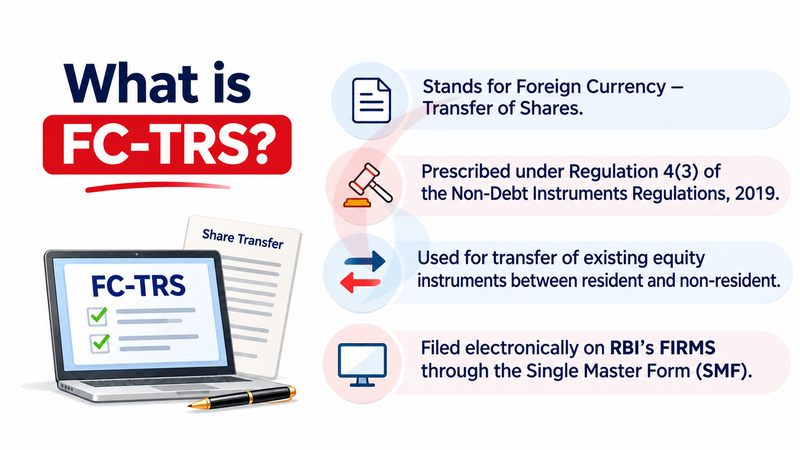
For example, if an Indian resident purchases shares from an NRI who holds the investment on a repatriation basis, Form FC-TRS will generally be required, subject to the applicable conditions. Unlike Form FC-GPR, which reports qualifying fresh issues of equity instruments to non-resident investors, FC-TRS relates to transfers of existing instruments. The reporting is completed electronically through the RBI's Foreign Investment Reporting and Management System (FIRMS), using the Single Master Form (SMF) facility.
Businesses can read our article on FC-GPR vs FC-TRS 2026: When to File Each Form? to understand the difference between new share allotments and transfers of existing shares.
When is FC-TRS Reporting Required for NRI Share Transfers?
An NRI's involvement does not automatically make a transaction reportable. The investment's repatriation status and the identity of the other party are particularly important.
Under the RBI reporting regulations, Form FC-TRS applies to specified transfers between persons holding investments on different bases, including certain transfers between a person resident outside India and an Indian resident.
|
Share Transfer Transaction |
FC-TRS Reporting Position |
|
NRI holding shares on a repatriation basis sells to an Indian resident |
Generally required. |
|
Indian resident transfers shares to an NRI acquiring on a repatriation basis |
Generally required. |
|
NRI holding shares on a non-repatriation basis sells to an Indian resident |
Not required for a qualifying sale under the express reporting exemption. |
|
Indian resident sells to an NRI acquiring on a non-repatriation basis |
Generally not required where the transaction qualifies under the relevant exemption. |
|
NRI holding on a repatriation basis transfers to an NRI holding on a non-repatriation basis |
Reportable under the specified provisions. |
|
NRI transfers shares to another non-resident on the same repatriation basis |
Not automatically reportable under the ordinary FC-TRS categories; other conditions may apply. |
|
NRI gifts shares to another person |
Separate gift, approval and reporting provisions must be examined. |
The key distinction is that investments made by NRIs on a non-repatriation basis can receive different treatment from investments made on a repatriation basis. Before filing FC-TRS, the parties must establish how the shares were originally acquired and how the transferee intends to hold them.
Our guide on RBI FEMA/FDI Reporting: EMF, SMF, FC-TRS and FLA Return explains the reporting requirements and relevant compliance procedures.
What is the Difference Between Repatriation and Non-Repatriation Basis?
For NRI shareholders, repatriation status determines whether investment proceeds can be transferred outside India. It also affects FEMA compliance, pricing requirements, and FC-TRS reporting.
|
Particulars |
Repatriation Basis |
Non-Repatriation Basis |
|---|---|---|
|
Meaning |
Permits eligible investment proceeds to be transferred abroad. |
Investment proceeds are subject to restrictions on repatriation. |
|
Investment Status |
Generally treated as foreign investment under FEMA. |
Qualifying NRI/OCI investments are treated as domestic investment under the NDI Rules. |
|
Bank Account |
Generally involves permitted foreign remittances or eligible NRE/FCNR(B) accounts. |
Generally involves an NRO account or other permitted payment routes. |
|
FEMA Pricing Rules |
Applicable pricing guidelines must be followed. |
Generally exempt from standard FDI pricing guidelines for qualifying investments. |
|
FC-TRS Reporting |
Required for specified reportable share transfers. |
Certain qualifying transfers are exempt from FC-TRS reporting. |
|
Sale Proceeds |
May be repatriated abroad, subject to applicable conditions and taxes. |
Generally credited to an NRO account, subject to applicable remittance rules. |
Example: An NRI investing in an Indian company on a repatriation basis may transfer eligible sale proceeds abroad. Another NRI investing on a non-repatriation basis may face different restrictions and reporting requirements. Therefore, FC-TRS applicability depends on the investment's repatriation status and the nature of the share transfer, not merely on the shareholder's NRI status.
Laws and Legal Provisions Governing FC-TRS Filing
NRI share transfers are governed by several Indian laws. The following provisions are particularly relevant.
|
Applicable Act or Regulations |
Important Provisions |
Legal Requirements |
|
Sections 6 and 13 |
Governs foreign exchange capital transactions and contraventions. |
|
|
Rules 9, 21 and relevant schedules |
Regulates transfers, pricing and investment conditions. |
|
|
FEMA (Mode of Payment and Reporting of Non-Debt Instruments) Regulations, 2019 |
Regulation 4(3) |
Prescribes FC-TRS reporting, responsible parties and deadlines. |
|
Sections 56 and 58 |
Governs share transfer procedures and registration of transfers. |
|
|
Applicable share transfer provisions |
Addresses share transfer documentation where relevant. |
|
|
Sections 45, 48 and 195, as applicable |
Governs capital gains and relevant withholding obligations. |
RBI's Master Direction on Foreign Investment in India provides additional instructions concerning NRI investments, pricing, payment methods and transfers. These legal requirements operate together. Compliance with the Companies Act alone does not automatically satisfy FEMA reporting or applicable tax obligations.
Practical Story: An NRI Selling Shares in a Delhi Company
Consider Aarav, an NRI working in Singapore. In 2021, he invested Rs 20 lakh in an Indian software company, BrightCode Private Limited, through a permitted repatriable investment arrangement. Five years later, Aarav decides to sell his shares to Rohit, an Indian resident. The agreed consideration is Rs 35 lakh.
The parties sign a share purchase agreement and prepare the transfer documentation. However, the company's compliance team identifies three important questions.
- First, is the proposed price consistent with the FEMA valuation requirements?
- Second, can Aarav receive the sale proceeds through the proposed banking arrangement?
- Third, who is responsible for submitting FC-TRS?
The team obtains an appropriate valuation certificate, verifies the original investment documents and examines the tax treatment of the sale. Because the transfer is between an NRI holding the shares on a repatriation basis and an Indian resident, FC-TRS reporting is generally applicable.
Rohit, as the resident transferee, is responsible for ensuring the prescribed reporting is completed. The company assists with the shareholding and transfer records, while the parties coordinate with their Authorised Dealer (AD) Category-I bank.
RBI Pricing Guidelines for NRI Share Transfers
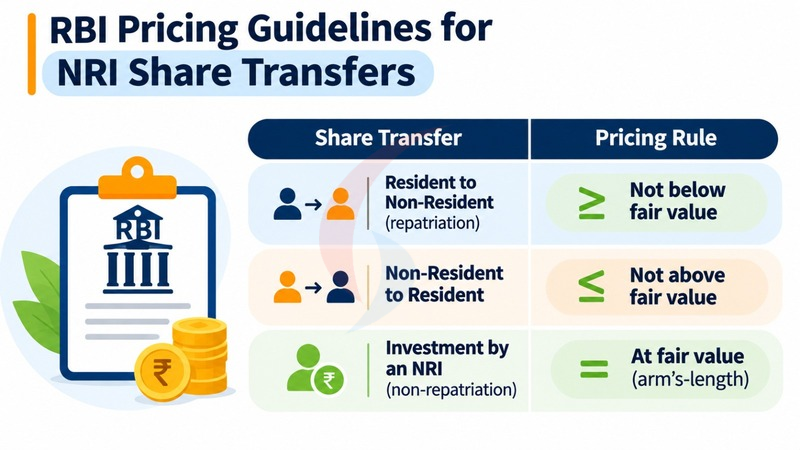
Pricing is one of the most important aspects of cross-border share transfers. Under Rule 21 of the FEMA (Non-Debt Instruments) Rules, 2019, specified transfers must satisfy the applicable valuation requirements. For unlisted Indian companies, the valuation generally follows an internationally accepted pricing methodology on an arm's-length basis, supported by a certificate from an eligible professional. The treatment differs depending on the direction of the transaction
|
Share Transfer |
Applicable Pricing Principle |
|
Resident to Non-Resident on a repatriation basis |
Transfer price generally cannot be below the prescribed fair value. |
|
Non-Resident to Resident |
Transfer price generally cannot exceed the prescribed fair value. |
|
Investment by an NRI on a non-repatriation basis |
Standard foreign investment pricing guidelines generally do not apply, subject to relevant conditions. |
|
Listed Company Share Transfer |
Relevant SEBI pricing requirements apply, where prescribed. |
For example, assume an Indian company's shares have an applicable fair value of Rs 500 per share. If an NRI holding the shares on a repatriation basis sells them to an Indian resident, the applicable ceiling generally prevents the sale price from exceeding Rs 500 per share.
However, if an Indian resident sells the same shares to a foreign investor on a repatriation basis, the applicable minimum price generally cannot be below Rs 500.
RBI's June 2026 updated Foreign Investment Master Direction also states that a valuation certificate used for applying the pricing guidelines must generally be no more than 90 days old on the relevant investment date, subject to the specified SEBI-related exception.
Companies can review our article on FEMA Due Diligence: Process, Checklist and Compliance to understand how valuation records, investment documents and regulatory reporting should be examined together.
FC-TRS Filing Deadline for NRI Share Transfers
Under Regulation 4(3) of the FEMA reporting regulations, Form FC-TRS must generally be filed within 60 days from the date of transfer of equity instruments or the date of receipt or remittance of funds, whichever is earlier.
The reporting obligation generally rests with the resident transferor or transferee. In specified transfers involving repatriable and non-repatriable non-resident holdings, the non-resident holding the instruments on a non-repatriation basis has the reporting responsibility.
|
Particulars |
FC-TRS Reporting Requirement |
|
Form Name |
Foreign Currency–Transfer of Shares |
|
Applicable Regulation |
Regulation 4(3), FEMA Reporting Regulations, 2019 |
|
Filing Deadline |
60 days from transfer or receipt/remittance of funds, whichever is earlier |
|
Filing Portal |
RBI FIRMS – Single Master Form |
|
Reporting Responsibility |
Resident transferor/transferee or specified non-repatriable holder |
|
Verification |
Authorised Dealer Category-I bank |
|
Ordinary RBI Filing Fee |
No standard government filing fee prescribed for timely FC-TRS submission |
Example: If a reportable share transfer takes place on 10 November 2026, but consideration was received on 5 November 2026, the filing deadline is calculated from the earlier date, 5 November 2026. Companies should not wait until all internal documentation has been finalised before checking the reporting deadline.
Documents Required for FC-TRS Reporting
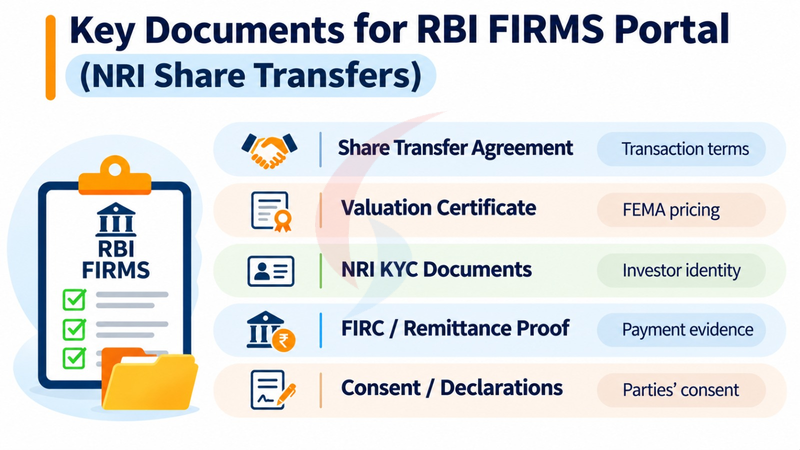
The RBI FIRMS portal and AD bank require information establishing the parties' identities, the transfer terms, the payment and the applicable pricing conditions. The exact documents depend on whether shares are being purchased or sold, the investor's residential status and the bank's verification requirements.
|
Document |
Purpose |
|
Share Purchase or Transfer Agreement |
Establishes the transaction terms and consideration. |
|
Valuation Certificate |
Supports the applicable FEMA pricing requirements. |
|
NRI KYC and Identification Documents |
Verifies the non-resident investor's identity and status. |
|
FIRC or Bank Remittance Evidence |
Establishes receipt or payment of consideration. |
|
Consent Letters or Declarations |
Records the parties' agreement and relevant confirmations. |
|
Shareholding Pattern |
Shows ownership before and after the transfer. |
|
Share Certificate or Demat Statement |
Establishes the instruments and ownership records. |
|
Form SH-4, Where Applicable |
Supports physical share transfer under company law. |
|
Tax Documents, Where Applicable |
Supports withholding and remittance compliance. |
|
Government or Regulatory Approval |
Required where the transaction is subject to an approval condition. |
The AD bank may also request the original acquisition documents and supporting records for an NRI's repatriation status.
For a detailed discussion of documentary requirements, read our article on CA Certificate and Tax ClearanceDocuments for Form FC-TRS Filing on RBI FIRMS Portal.
Step-by-Step FC-TRS Filing Process on RBI FIRMS Portal
Once the transaction's reporting applicability has been confirmed, the parties can prepare the FC-TRS filing. Companies dealing with foreign shareholders should maintain complete investment records and ensure timely submission of applicable RBI returns.
|
Step |
Filing Procedure |
|
Step 1 – Verify Applicability |
Check the parties' FEMA residential status, investment basis and reporting obligation. |
|
Step 2 – Review Valuation |
Obtain a valuation certificate where required and verify the transfer price. |
|
Step 3 – Complete Transfer Documents |
Finalise the agreement, payment evidence, declarations and corporate records. |
|
Step 4 – Access RBI FIRMS |
Log in as an authorised Business User through the FIRMS portal. |
|
Step 5 – Select Form FC-TRS |
Enter the relevant transaction and transfer details through the Single Master Form facility. |
|
Step 6 – Upload Documents |
Attach valuation, payment, KYC and other supporting documents. |
|
Step 7 – Submit to AD Bank |
Submit the report for verification by the designated Authorised Dealer bank. |
|
Step 8 – Resolve Queries |
Respond to observations or requests for additional documents. |
|
Step 9 – Preserve Records |
Retain the filing acknowledgement, bank communication and updated shareholding records. |
The filer must ensure that information entered in the FIRMS portal matches the share transfer agreement, valuation certificate and bank records. A mismatch in the number of shares, investor particulars or transfer consideration may result in a request for clarification or resubmission.
For information about the available banking support channels, see our guide on Contact Details of AD Banks for Clarification on SMF FIRMS.
Latest RBI and FEMA Updates Affecting FC-TRS in 2026
Businesses handling NRI share transfers in 2026 should review the latest RBI directions rather than relying only on older reporting instructions.
|
Regulatory Development |
Relevance to NRI Share Transfers |
|
RBI Foreign Investment Master Direction – Updated 15 June 2026 |
Explains transfer conditions, pricing requirements, permitted payment methods and NRI investment treatment. |
|
FEMA Reporting Amendment – 13 June 2026 |
Amended the Mode of Payment and Reporting of Non-Debt Instruments Regulations, 2019. |
|
RBI Reporting Master Direction – Updated 1 October 2026 |
Consolidates applicable FEMA reporting requirements and procedures. |
|
RBI Compounding Master Direction – Updated 23 October 2026 |
Relevant when examining FEMA contraventions requiring compounding. |
|
Income-tax Act, 2025 – Effective 1 April 2026 |
Introduced updated tax provisions relevant to transactions and payments involving non-residents. |
The 60-day FC-TRS reporting timeline remains reflected in RBI's current published return requirements. There is no basis to treat the June 2026 amendments as removing the FC-TRS filing obligation for all NRI share transfers.
Important 2026 tax clarification: For payments or credits occurring on or after 1 April 2026, the applicable withholding provisions are under the Income-tax Act, 2025, including Section 393. Section 195 of the Income-tax Act, 1961 remains relevant for transactions governed by the earlier law.
Why Choose Compliance Calendar LLP ?
At Compliance Calendar LLP, we assist Indian companies, resident shareholders and NRI investors with foreign investment documentation and regulatory filings.
|
Our Services |
How We Help |
|
FC-TRS Applicability Review |
Examine the transaction, residential status and repatriation conditions. |
|
Share Transfer Documentation |
Assist with agreements, declarations and corporate records. |
|
FEMA Valuation Compliance |
Support documentation for applicable pricing requirements. |
|
RBI FIRMS Portal Filing |
Assist with preparing and submitting reportable FC-TRS transactions. |
|
AD Bank Coordination |
Help address documentation queries and filing observations. |
|
Delayed Reporting Assistance |
Support review of applicable LSF and regularisation requirements. |
Businesses looking for professional assistance can explore our FC-TRS Share Transfer Services or FEMA Due Diligence Services.
For assistance with NRI share transfers, FC-TRS filing or FEMA reporting, contact Compliance Calendar LLP at 9988424211 or info@ccoffice.in.
Frequently Asked Questions (FAQs)
Q1. What is FC-TRS reporting for NRI share transfers?
Ans: FC-TRS is the RBI reporting form used for specified transfers of equity instruments involving resident and non-resident persons. It records details of the transfer, consideration and parties involved. Its applicability depends on the transaction and investment's repatriation status.
Q2. Is FC-TRS mandatory when an NRI sells shares to an Indian resident?
Ans: FC-TRS is generally required when an NRI sells shares held on a repatriation basis to an Indian resident. However, qualifying sales of non-repatriable investments to residents are expressly exempt from FC-TRS reporting. The original investment status must be verified before filing.
Q3. What is the FC-TRS filing deadline in 2026?
Ans: The general filing deadline is 60 days from the date of transfer or the date of receipt or remittance of consideration, whichever occurs earlier. The reporting party should identify the applicable trigger date and arrange documents in advance.
Q4. Who is responsible for filing Form FC-TRS?
Ans: The resident transferor or transferee generally carries the reporting responsibility. In specified transactions between non-residents holding investments on different repatriation bases, responsibility rests with the non-repatriable holder. The Indian company may assist with the required documentation.
Q5. Is a valuation report mandatory for FC-TRS?
Ans: A valuation certificate is generally relevant where FEMA pricing guidelines apply. For unlisted shares, an internationally accepted valuation methodology may be required. Transactions exempt from pricing guidelines must be assessed separately.
Q6. Can an NRI transfer shares through an NRO account?
Ans: Permitted payments involving non-repatriable investments may be made through an NRO account in accordance with RBI regulations. However, the permitted banking route depends on the nature of the investment and transaction. An AD bank should verify the arrangement.
Q7. Is RBI approval required before every NRI share transfer?
Ans: No. Many transfers are permitted without separate prior RBI approval if they satisfy the applicable foreign investment conditions. Certain gifts, restricted investments or other exceptional transactions may require approval. Each transaction should be examined individually.
Q8. What happens if FC-TRS is filed late?
Ans: A delayed mandatory FC-TRS filing may attract RBI's Late Submission Fee under the applicable directions. Other FEMA violations may require separate regularisation or compounding. The reporting party should consult its AD bank to identify the correct procedure.
Q9. Is FC-GPR the same as FC-TRS?
Ans: No. FC-GPR is used for reporting qualifying fresh issues of equity instruments by Indian companies to non-resident investors. FC-TRS is used for specified transfers of existing equity instruments. Both are submitted through the RBI FIRMS reporting system.
Q10. Can Compliance Calendar LLP help with FC-TRS filing?
Ans: Yes. Compliance Calendar LLP assists businesses with FC-TRS applicability assessments, share transfer documentation, FEMA pricing requirements, RBI FIRMS submissions and related compliance matters.
Article last updated on : 18 Nov 2026.













































































_learn_crop10_thumb.jpg)