


Such a situation can create serious financial problems for an insurance broker. Even an experienced professional can face claims arising from negligence, documentation errors or incorrect advice. This is where Professional Indemnity Insurance for Insurance Brokers becomes important. It helps protect insurance broking businesses against specified legal liabilities arising from professional mistakes, subject to the policy's terms and exclusions.
Starting an insurance broking business in India involves more than advising clients and arranging insurance policies. Entrepreneurs planning to enter this sector must obtain an Insurance Broker License from IRDAI and meet the applicable financial, operational and regulatory requirements. Those choosing a company structure may also need to complete Private Limited Company Registration before applying for the required regulatory approval. Once registered, insurance brokers must maintain Professional Indemnity Insurance, follow IRDAI compliance requirements and ensure that their professional activities do not expose clients to unnecessary financial risks.
What Is Professional Indemnity Insurance for Insurance Brokers?
Professional Indemnity Insurance, also known as PI Insurance, is a liability insurance policy that protects professionals and businesses against covered claims arising from errors, omissions, negligence or breaches of professional duty while providing their services. For an insurance broker, this coverage is particularly important because clients depend on the broker's knowledge when selecting insurance products. A mistake in explaining policy exclusions, arranging coverage or communicating essential information may result in financial losses and compensation claims.
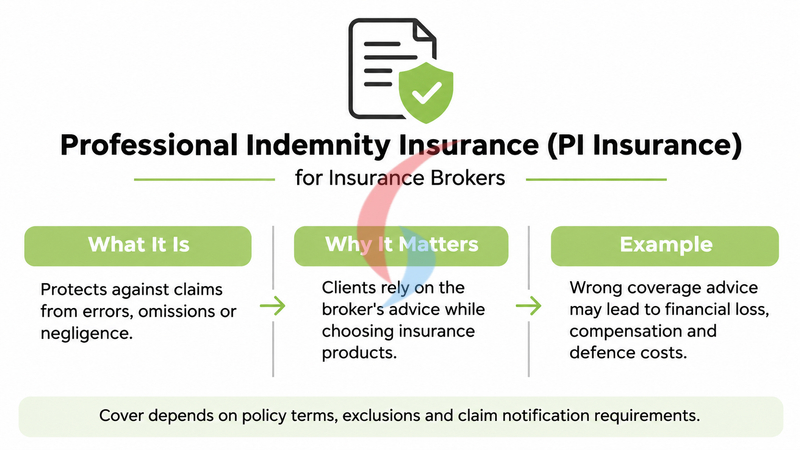
For example, suppose a broker accidentally provides incorrect information about the coverage available under a commercial insurance policy. If the customer suffers a financial loss and establishes the broker's legal liability, a Professional Indemnity Insurance policy may cover the eligible compensation and defence expenses. However, PI Insurance does not guarantee payment for every complaint or business loss. Coverage depends on the insured activities, policy wording, applicable exclusions and claim notification requirements.
Businesses comparing insurance distribution models can also read Difference Between Insurance Broker and Corporate Agent to understand their distinct roles and regulatory obligations.
Professional Indemnity Insurance Mandatory for Insurance Brokers in India?
Regulation 24 of the IRDAI (Insurance Brokers) Regulations, 2018 requires insurance brokers to obtain and maintain Professional Indemnity Insurance throughout the period their registration remains in force. The coverage must comply with the requirements specified under Schedule II, Form S. The regulation also allows IRDAI, in appropriate cases, to permit a newly registered insurance broker to submit the policy within twelve months of receiving its Certificate of Registration. This relaxation is not an automatic exemption and requires the Authority's permission.
The IRDAI guidelines issued in 2021 introduced a standard Professional Indemnity Insurance policy for insurance brokers and certain other insurance intermediaries to improve consistency with regulatory requirements. Businesses planning to establish an insurance broking company must therefore consider this insurance requirement alongside capital, net worth, infrastructure and registration obligations.
Businesses planning to enter the insurance broking sector can read our detailed guide on Insurance Broker Registration in India to understand IRDAI eligibility, capital requirements and the registration process.
Legal Provisions Governing Professional Indemnity Insurance
The principal legal requirements arise from the Insurance Act, 1938, the IRDAI Act, 1999 and the applicable insurance broker regulations.
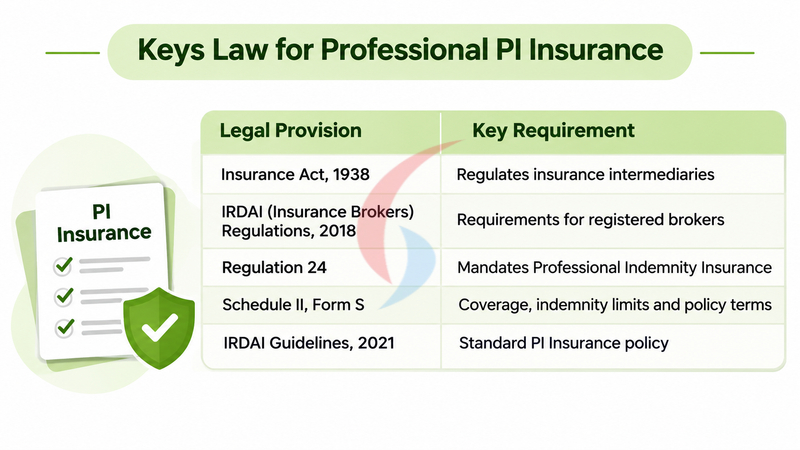
| Legal Provision | Requirement |
|---|---|
| Insurance Act, 1938 | Governs insurance intermediaries and regulatory obligations |
| IRDAI (Insurance Brokers) Regulations, 2018 | Principal requirements for registered brokers |
| Regulation 24 | Mandatory Professional Indemnity Insurance |
| Schedule II, Form S | Coverage, indemnity limits and policy conditions |
| IRDAI Guidelines, 2021 | Standard Professional Indemnity Insurance policy |
| IRDAI Intermediaries Amendment Regulations, 2026 | Updated intermediary registration and compliance requirements |
The IRDAI (Insurance Intermediaries) (Amendment) Regulations, 2026, notified on 30 July 2026, introduced changes affecting insurance intermediary registration, annual fees and regulatory supervision. Insurance brokers should read their Professional Indemnity Insurance obligations together with the currently applicable amended provisions. Insurance businesses should review their professional liability coverage whenever their registration status, business category or regulatory requirements change.
Readers exploring other insurance distribution businesses can refer to Corporate Agent Under IRDAI to understand its registration requirements and regulatory responsibilities.
What Does Professional Indemnity Insurance Cover?
Professional Indemnity Insurance for insurance brokers covers specified liabilities arising from the services provided by the broker and its authorised personnel. Under Schedule II, Form S, the required coverage includes errors, omissions and negligence involving the broker, employees and directors. It also addresses certain liabilities involving loss of money or property, loss of documents and dishonest or fraudulent acts committed by employees or former employees. The standard policy additionally provides for eligible legal defence costs and other benefits subject to its conditions.
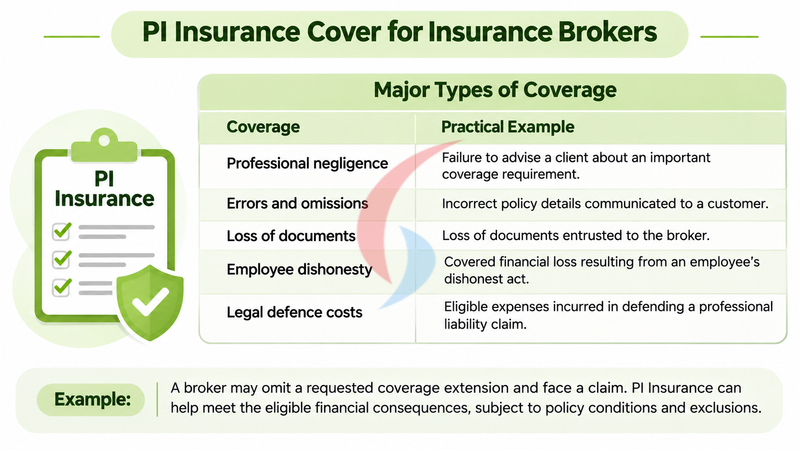
Major Types of Coverage
| Coverage | Practical Example |
|---|---|
| Professional negligence | Failure to advise a client about an important coverage requirement |
| Errors and omissions | Incorrect policy details communicated to a customer |
| Loss of documents | Loss of documents entrusted to the broker |
| Employee dishonesty | Covered financial loss resulting from an employee's dishonest act |
| Legal defence costs | Eligible expenses incurred in defending a professional liability claim |
For example, a broker responsible for placing a commercial insurance policy may accidentally omit a coverage extension requested by the client. If the omission results in a covered liability claim against the broker, Professional Indemnity Insurance may help meet the eligible financial consequences. The broker should carefully examine the policy conditions because contractual liabilities, deliberate wrongdoing by the insured and certain other losses may be excluded.
Minimum Professional Indemnity Insurance Coverage Required by IRDAI
IRDAI prescribes different indemnity limits for direct insurance brokers, reinsurance brokers and composite brokers. Under Schedule II, Form S of the 2018 Regulations, the required limit is linked to the broker's annual remuneration, subject to minimum coverage requirements and additional higher-limit provisions.
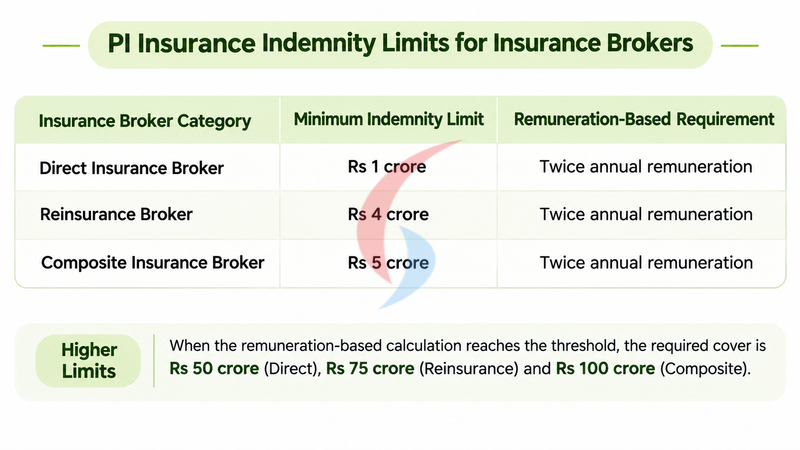
| Insurance Broker Category | Minimum Indemnity Limit | Remuneration-Based Requirement |
|---|---|---|
| Direct Insurance Broker | Rs 1 crore | Twice annual remuneration |
| Reinsurance Broker | Rs 4 crore | Twice annual remuneration |
| Composite Insurance Broker | Rs 5 crore | Twice annual remuneration |
The minimum amount is not necessarily sufficient for every broker. For example, if a direct insurance broker receives annual remuneration of Rs 80 lakh, twice its remuneration is Rs 1.60 crore. Accordingly, the broker would generally need coverage of at least Rs 1.60 crore under this calculation. Schedule II also specifies higher-limit requirements involving Rs 50 crore for direct brokers, Rs 75 crore for reinsurance brokers and Rs 100 crore for composite brokers when the remuneration-based calculation reaches the respective threshold. The final limit must be determined from the applicable regulatory wording and the company's remuneration records.
To understand how the roles and regulatory requirements differ across broker categories, explore our article on Types of Insurance Brokers: Direct vs Reinsurance.
Important Policy Conditions Under IRDAI Rules
Obtaining a policy with a sufficient sum insured is only one part of regulatory compliance. The policy must also satisfy the prescribed conditions. Professional Indemnity Insurance is generally maintained on an annual basis. The policy should provide the required claims-made protection and must not make payment dependent on the broker first discharging the liability personally. The regulations specify an Any One Accident to Any One Year (AOA:AOY) indemnity ratio of 1:1. They also restrict the uninsured excess for each claim to a maximum of 5% of the capital employed by the insurance broker. Another important requirement concerns the retroactive date, which is linked to the date the broker originally received its registration. Brokers should maintain uninterrupted coverage to protect their position in relation to earlier professional activities. A Professional Indemnity Insurance policy should be checked for its indemnity limit, retroactive date, deductible, claims conditions and regulatory conformity before it is purchased or renewed.
For a better understanding of ongoing regulatory duties, read our guide on IRDAI Compliance Requirements for Insurance Intermediaries, covering reporting obligations, internal controls and regulatory compliance.
How Much Does Professional Indemnity Insurance Cost?
There is no single fixed premium applicable to every insurance broker in India. The premium depends on factors such as the broker's category, annual remuneration, nature of insurance business, requested indemnity limit, claims history and insurer's underwriting assessment. For example, a newly registered direct broker handling relatively straightforward retail insurance policies may have a different risk profile from a composite broker arranging large commercial insurance and reinsurance transactions. Insurance companies may also consider the broker's internal controls, previous claims, professional experience and requested coverage extensions. Before selecting a policy, brokers should compare quotations while ensuring that the coverage meets IRDAI requirements. Choosing the cheapest policy without examining its exclusions or indemnity conditions can create problems during a claim.
Documents Required for Professional Indemnity Insurance
Insurance companies generally request documents to assess the broker's business and calculate the appropriate coverage. Common documents include:
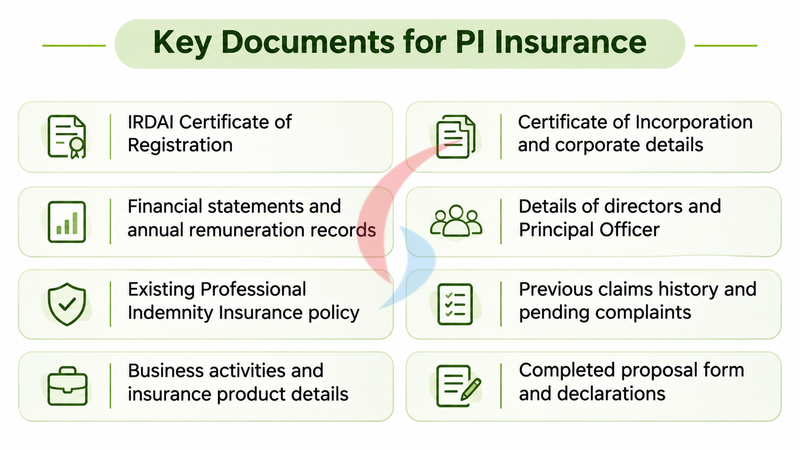
- IRDAI Certificate of Registration
- Certificate of Incorporation and corporate details
- Financial statements and annual remuneration records
- Details of directors and Principal Officer
- Existing Professional Indemnity Insurance policy
- Previous claims history and pending complaints
- Business activities and insurance product details
- Completed proposal form and declarations
Professional Indemnity Insurance Claim Process
If a customer alleges professional negligence, the broker should immediately review its policy and notify the Professional Indemnity insurer according to the notification requirements. The broker should preserve emails, policy proposals, customer instructions, advice records and all other relevant documents. These records help establish what services were provided and whether the broker met its professional responsibilities. The insurer may investigate the circumstances, examine the allegations and assess whether the claim falls within the policy. Where coverage applies, the insurer may provide eligible defence costs and compensation, subject to the policy limit, deductible, exclusions and applicable conditions. Brokers should not admit liability, agree to a settlement or incur significant defence expenses without considering the insurer's consent requirements.
Case Study: An Insurance Broker Faces a Negligence Claim
Consider a fictional company, SecureShield Insurance Brokers Private Limited, operating in Mumbai. The company provides commercial insurance advisory services to manufacturing and logistics businesses.
One of its clients requests insurance protection for goods stored in a warehouse. During the policy arrangement process, an employee overlooks an important coverage requirement. Later, the warehouse suffers damage, and part of the customer's insurance claim remains unpaid.
The client alleges that SecureShield failed to arrange the requested protection and demands Rs 35 lakh as compensation.
SecureShield informs its Professional Indemnity insurer and provides the client communications, policy documents and placement records. Following investigation, the insurer evaluates whether the broker's alleged error falls within the policy.
If the claim is covered and the broker's liability is established, the policy may respond to eligible compensation and legal defence costs.
This example shows how PI Insurance can provide financial protection while also demonstrating the importance of accurate documentation and professional advice.
Professional Indemnity Insurance Renewal and Compliance
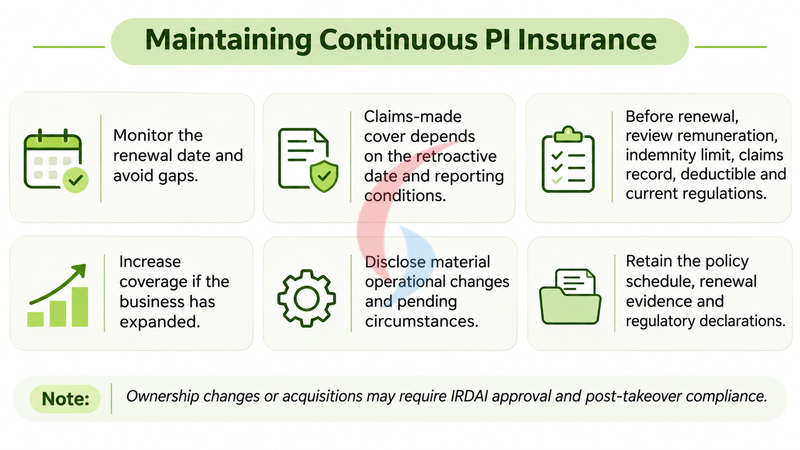
Insurance brokers must monitor the renewal date of their Professional Indemnity Insurance and avoid unnecessary gaps in coverage. Under the 2021 IRDAI standard policy guidelines, continuity is important because the cover operates on a claims-made basis, subject to the specified retroactive date and reporting conditions. Before renewal, the broker should review its remuneration, indemnity limit, claims record, deductible and current regulatory requirements. A broker whose business has expanded significantly may need to increase its coverage. It should also disclose material changes in its operations and pending circumstances that could give rise to claims. The compliance team should retain the current policy schedule, renewal evidence and relevant regulatory declarations.
Insurance brokers planning ownership changes or acquisitions can explore IRDAI Approval for Insurance Broker Takeover to understand the applicable approval procedures and post-takeover compliance requirements.
Consequences of Not Maintaining Professional Indemnity Insurance
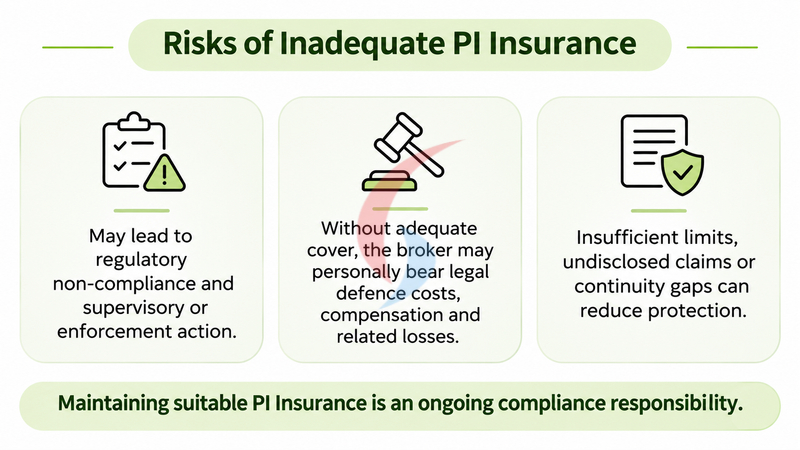 Failure to maintain the required Professional Indemnity Insurance may result in regulatory non-compliance and expose the broker to substantial financial liability. Depending on the circumstances and applicable provisions, IRDAI may take supervisory or enforcement action against a broker that fails to meet its regulatory obligations. Without adequate cover, the broker may also have to bear legal defence expenses, compensation payments and related financial losses personally. Even where a policy exists, insufficient limits, undisclosed claims or gaps in continuity may affect the protection available. Therefore, maintaining suitable PI Insurance should be treated as an ongoing compliance responsibility rather than a one-time requirement.
Individuals interested in starting a career in insurance distribution can explore our guide on How to Become an Insurance Agent in India to understand eligibility, training, examinations and appointment requirements.
Why Choose Compliance Calendar LLP?
Compliance Calendar LLP assists businesses with insurance regulatory matters, registration documentation and post-registration compliance requirements. Businesses planning to establish an insurance broking company can seek guidance on Insurance Broker Registration, applicable IRDAI requirements and maintaining regulatory records. Our team can also assist brokers in understanding the regulatory provisions relevant to Professional Indemnity Insurance, reviewing documentation requirements and identifying compliance obligations associated with registration and renewal.
Frequently Asked Questions (FAQs)
Q1. Is Professional Indemnity Insurance mandatory for insurance brokers?
Ans. Yes, Professional Indemnity Insurance is mandatory for registered insurance brokers in India under Regulation 24 of the IRDAI (Insurance Brokers) Regulations, 2018. It protects brokers against financial liabilities arising from professional negligence, errors, or omissions. Brokers must maintain the required insurance coverage in accordance with applicable IRDAI provisions.
Q2. What is the minimum coverage for a direct broker?
Ans. A direct insurance broker must maintain Professional Indemnity Insurance with a prescribed minimum coverage of Rs 1 crore. The required coverage also depends on twice the broker's annual remuneration and other applicable regulatory conditions. Brokers must ensure that their policy meets the minimum indemnity limits prescribed by IRDAI.
Q3. Do reinsurance brokers need Professional Indemnity Insurance?
Ans. Yes, reinsurance brokers are required to maintain Professional Indemnity Insurance under IRDAI regulations. The prescribed minimum indemnity limit for a reinsurance broker is Rs 4 crore, subject to other applicable coverage requirements. This insurance protects brokers against financial liabilities resulting from professional mistakes in reinsurance transactions.
Q4. Does PI Insurance cover professional negligence?
Ans. Yes, Professional Indemnity Insurance generally covers financial losses arising from professional negligence, errors, or omissions committed by insurance brokers. This may include incorrect advice, documentation mistakes, or failure to perform professional duties properly. However, compensation depends on the policy terms, coverage limits, and applicable exclusions.
Q5. Does the policy cover fraud committed by employees?
Ans. Professional Indemnity Insurance may cover certain dishonest or fraudulent acts committed by employees or former employees. Such coverage is included within the regulatory requirements applicable to insurance brokers, subject to specified conditions. However, intentional misconduct by the insured broker and other excluded activities may not be covered.
Q6. Is the policy premium fixed by IRDAI?
Ans. No, IRDAI does not prescribe a fixed premium for Professional Indemnity Insurance policies purchased by insurance brokers. Insurance companies calculate premiums based on factors such as business size, annual revenue, claim history, and coverage requirements. Brokers can compare different insurance providers to obtain suitable coverage at competitive premiums.
Q7. What is the usual policy period?
Ans. Professional Indemnity Insurance policies for insurance brokers are generally issued for a period of one year. Brokers must ensure continuous insurance protection by renewing their policies before the expiry date. Maintaining uninterrupted coverage is important for meeting IRDAI compliance requirements and avoiding financial exposure.
Q8. Can a newly registered broker obtain additional time?
Ans. Yes, IRDAI may allow a newly registered insurance broker additional time to obtain the required Professional Indemnity Insurance policy. In appropriate cases, the regulator may permit up to twelve months to produce the policy. However, this relaxation is not automatic and depends on IRDAI's approval and applicable regulatory conditions.
Q9. What happens when a Professional Indemnity policy expires?
Ans. If a Professional Indemnity Insurance policy expires without renewal, the insurance broker may become non-compliant with IRDAI requirements. The broker may also face financial risks because claims arising during a coverage gap might not be insured. Therefore, timely policy renewal is necessary to maintain regulatory compliance and continuous protection.
Q10. Does Professional Indemnity Insurance cover every customer complaint?
Ans. No, Professional Indemnity Insurance does not automatically cover every complaint made against an insurance broker. Coverage generally applies to eligible claims involving professional negligence, errors, omissions, or other insured professional liabilities. Complaints involving excluded activities, uncovered losses, or liabilities outside the policy terms may not qualify for compensation.
Article last updated on : 18 Nov 2026.













































































_learn_crop10_thumb.jpg)