Imagine joining a growing startup where the founder offers you something beyond your monthly salary. Instead of giving you an immediate bonus, the company promises that you can purchase its shares at a fixed price in the future. If the business becomes successful, those shares could become valuable. This is the idea behind an Employee Stock Option Plan (ESOP), which has become an important employee compensation tool for Indian startups and established companies.
But there is one question that both employees and companies must understand: How is the value of these stock options calculated? A company may offer 1,000 options at Rs 100 each, but their actual value may be higher or lower depending on the company's financial position, future performance and applicable valuation rules. This is where ESOP Valuation in India becomes important.
ESOP valuation helps businesses determine the fair value of employee stock options and their underlying shares. It is relevant for financial reporting, taxation, employee compensation and corporate compliance. Companies must follow applicable provisions of the Companies Act, 2013, the Income-tax Act, 2025, relevant valuation rules and accounting standards. Understanding these requirements can help businesses avoid incorrect calculations, tax disputes and compliance difficulties.
What is ESOP Valuation in India?
ESOP Valuation is the process of determining the fair value of stock options granted to employees or the shares that employees can acquire by exercising those options. Under an ESOP scheme, employees receive the right to purchase company shares at a predetermined price, usually after completing specified employment or performance conditions. The company must consider the value of these rights for accounting and other relevant purposes.
Suppose an employee receives 2,000 options with an exercise price of Rs 100 per share. After three years, the fair market value of the company's shares increases to Rs 400 each. If the employee exercises all options, the total fair market value of the acquired shares would be Rs 8,00,000, while the employee pays Rs 2,00,000. The difference of Rs 6,00,000 represents the economic benefit before applicable taxes and costs.
However, this difference should not be confused with the grant-date fair value of the options. The actual accounting value of an option may depend on several factors, including volatility, expected exercise period and market conditions. Similarly, the fair market value used for ESOP taxation follows specific income-tax rules.
If you are new to employee stock options, our article on ESOPs: Full Form, Meaning, Benefits and Taxation explains the basic concept of ESOPs, their benefits and how they work for employees and businesses.
Why is ESOP Valuation Important for Startups and Companies?
Startups often face difficulties when competing with large companies for experienced employees. A growing business may not have enough funds to offer high salaries, but it can provide employees with an opportunity to participate in future business growth. ESOPs make this possible by connecting employee rewards with the company's long-term performance.
Proper ESOP valuation also helps founders understand how employee stock options affect ownership and financial statements. Investors generally examine employee stock option pools before investing because issuing new shares may reduce the ownership percentage of existing shareholders. An unrealistic valuation may create confusion about employee benefits or the company's actual value.
From a compliance perspective, valuation becomes important when companies recognise ESOP expenses, calculate taxable employee benefits and prepare supporting records for auditors and tax authorities. Businesses must use an appropriate valuation for each purpose instead of assuming that a single share price will satisfy every legal requirement.
|
Purpose |
Importance of ESOP Valuation |
|---|---|
|
Employee compensation |
Helps measure the value of stock-based rewards |
|
Tax compliance |
Determines the taxable benefit arising from ESOP exercise |
|
Financial reporting |
Supports recognition of share-based payment expenses |
|
Startup fundraising |
Helps assess employee shareholding and dilution |
|
Corporate compliance |
Supports disclosures and proper records |
|
Employee understanding |
Explains the potential value of stock options |
For businesses that require professional valuation of unlisted shares, Compliance Calendar LLP provides Merchant Banking Valuation Services that can assist with the applicable valuation requirements.
Startups planning to introduce employee stock options can also read our detailed guide on ESOP for Startups in India to understand how ESOP schemes help attract employees and support long-term business growth.
Understanding the Different Stages of an ESOP
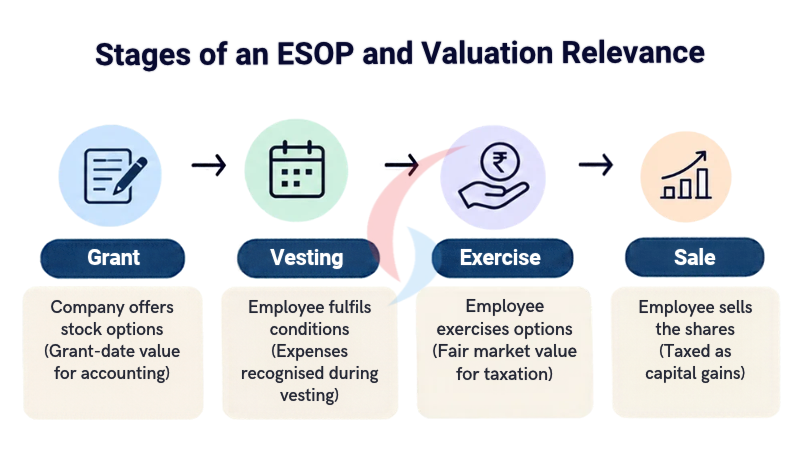
Before understanding ESOP valuation methods, it is important to know how an ESOP works. The process normally begins when a company grants options to employees and ends when the employees sell the shares acquired through those options. Each stage has a different purpose and may involve different accounting or tax consequences.
|
ESOP Stage |
Meaning |
Valuation Relevance |
|---|---|---|
|
Grant |
Company offers stock options to employees |
Grant-date fair value may be required for accounting |
|
Vesting |
Employee fulfils the required conditions |
Expenses may be recognised during the vesting period |
|
Exercise |
Employee exercises options to acquire shares |
Fair market value is relevant for perquisite taxation |
|
Sale |
Employee sells the acquired shares |
Sale value and tax cost determine capital gains |
For example, an employee may receive options in 2026 that become exercisable in 2029. The value calculated for accounting purposes in 2026 may be different from the fair market value determined in 2029. If the employee eventually sells the shares in 2031, the capital gains calculation will involve another value.
This is why companies should identify the purpose of valuation before appointing a professional or preparing a valuation report.
Employees who want to understand how stock options work in practice can explore our article on ESOPs for Employees: What It Is, How It Works and Advantages, which explains employee ownership benefits, rights and important considerations.
Major ESOP Valuation Methods Used in India
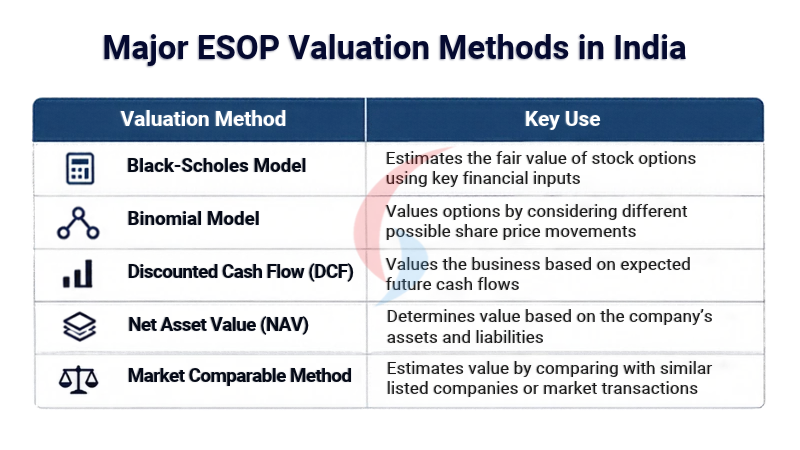
Different ESOP Valuation Methods are available depending on the company's financial position, the nature of the options and the applicable valuation requirements. Some methods calculate the value of the underlying business or shares, while others calculate the value of the employee stock option itself.
1. Black-Scholes Valuation Method
The Black-Scholes Model is commonly used to estimate the fair value of employee stock options. It considers the current share price, exercise price, expected life of the option, expected volatility, risk-free interest rate and expected dividend payments. These factors help estimate the economic value of an option before it is exercised.
For example, suppose a startup grants options with an exercise price of Rs 150 when its estimated share value is Rs 200. The option may still have significant value because the employee could benefit from future increases in the share price. The Black-Scholes calculation considers this possibility rather than simply treating Rs 50 as the complete value of the option.
However, employee options often contain restrictions that differ from ordinary traded options. The valuation professional must therefore select suitable assumptions, particularly regarding expected option life and employee exercise behaviour.
2. Binomial Option Pricing Model
The Binomial Model estimates option value by considering different possible movements in the company's share price over time. Instead of calculating only one future outcome, this method creates several possible scenarios and works backwards to determine an estimated present value.
This method can be helpful when an ESOP scheme allows employees to exercise options at different times or contains conditions affecting exercise decisions. For example, employees may exercise options early after vesting rather than hold them until expiry.
The Binomial Model can provide greater flexibility for complex schemes, but it requires reliable assumptions and professional judgement. The results can change significantly if expected volatility or employee exercise behaviour changes.
3. Discounted Cash Flow (DCF) Method
The Discounted Cash Flow Method is widely used for valuing businesses, including unlisted startups. It estimates the company's value based on expected future cash flows, which are discounted to their present value using an appropriate discount rate.
Consider a technology company expecting its business operations to generate increasing cash flows over the next five years. A valuation professional examines the company's forecasts, operating costs, business risks and expected growth. These financial estimates help determine an appropriate value for the business and, after necessary adjustments, its equity shares.
DCF is useful for growth-oriented businesses with reasonable financial projections. However, it values the underlying business or equity, not the employee option directly. The resulting share value may be used as an input in a separate option-pricing model.
4. Net Asset Value (NAV) Method
The Net Asset Value Method determines the value of a business by considering its assets and liabilities. It is often useful for companies that own substantial tangible assets, such as manufacturing businesses, real estate companies or investment-holding entities.
Suppose a business has assets valued at Rs 10 crore and liabilities of Rs 4 crore. Its simplified net asset value would be Rs 6 crore. A professional would then consider the capital structure, share rights and other appropriate adjustments before determining the value attributable to particular shares.
NAV may not fully capture the future potential of a technology startup with limited physical assets. Therefore, it is important to select a method that reflects the nature of the business.
5. Market Comparable Method
The Market Comparable Method estimates company value by comparing financial information with similar listed companies or relevant market transactions. The valuation professional may examine revenue multiples, earnings multiples, profit margins, growth prospects and industry risks.
For example, an unlisted software company may be compared with listed businesses operating in the same industry. However, adjustments are generally necessary because smaller private companies may have different risk levels, financial performance and liquidity.
This method can be useful when reliable comparable information is available. It may also be used alongside other approaches to check whether the estimated value is reasonable.
Comparison of ESOP Valuation Methods
|
Valuation Method |
Primary Application |
Suitable Situation |
|---|---|---|
|
Black-Scholes |
Option valuation |
Relatively straightforward stock options |
|
Binomial Model |
Option valuation |
Complex exercise conditions |
|
DCF |
Business or share valuation |
Growing companies with financial forecasts |
|
NAV |
Business or share valuation |
Asset-heavy businesses |
|
Market Comparable |
Business or share valuation |
Companies with reliable comparable market data |
No single method is automatically suitable for every company. The valuation professional must consider the purpose of valuation and the characteristics of the business and stock options.
To understand how companies determine share value using different financial approaches, read our article on Different Methods of Valuation of Shares, which explains commonly used valuation techniques and their applications.
ESOP Valuation Compliance Under the Companies Act, 2013
Companies issuing employee stock options must comply with the applicable provisions of the Companies Act, 2013. Section 62(1)(b), read with Rule 12 of the Companies (Share Capital and Debentures) Rules, 2014, governs important requirements for employee stock option schemes of unlisted companies.
Companies generally require approval through a special resolution of shareholders before implementing an ESOP scheme, subject to applicable exemptions. The explanatory statement should provide details such as the total number of options, eligible employees, vesting requirements, exercise price or pricing formula, exercise period and valuation method.
The company must also comply with the applicable minimum vesting period, ordinarily one year between grant and vesting, subject to prescribed exceptions. Proper disclosures and record maintenance are essential, including maintaining the Register of Employee Stock Options in Form SH-6. Listed companies must also consider applicable SEBI share-based employee benefit regulations.
Companies introducing an employee stock option scheme should also understand the applicable approvals and documentation requirements. Our article on ESOPs Compliance Checklist and Procedure under the Companies Act, 2013 explains the important legal steps.
ESOP Valuation Under Income-tax Rules, 2026
ESOP taxation is one of the most important reasons for determining fair market value correctly. From 1 April 2026, the Income-tax Act, 2025 and Income-tax Rules, 2026 apply to income earned during Tax Year 2026–27 onwards. Earlier tax years continue to be governed by the relevant provisions of the Income-tax Act, 1961. Under Section 17(1)(d) of the Income-tax Act, 2025, read with Rule 15(6) of the Income-tax Rules, 2026, the fair market value of shares received through employee stock options must be calculated according to prescribed requirements. The method depends on whether the shares are listed or unlisted.
For listed companies, the fair market value generally depends on the average opening and closing price on the recognised stock exchange on the exercise date, subject to the special rules for multiple exchanges or days without trading. For unlisted companies, the fair market value must be determined by a SEBI-registered Category I Merchant Banker. The valuation date may be the exercise date or another permitted date not more than 180 days before the exercise date.
How is ESOP Taxable Value Calculated?
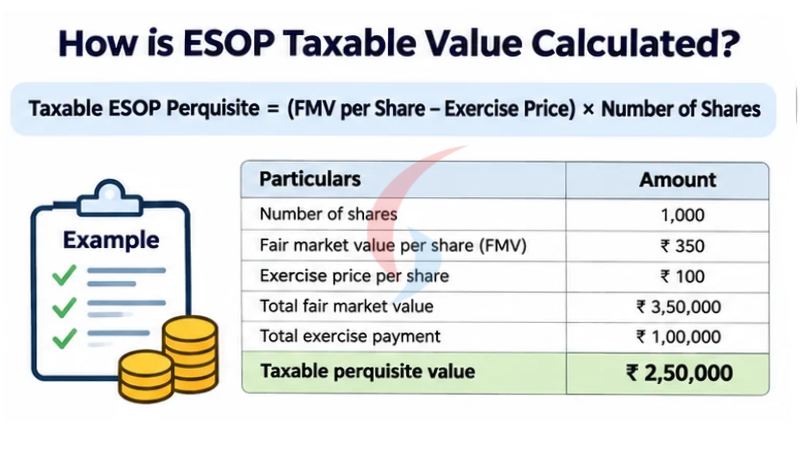
The basic calculation is:
Taxable ESOP Perquisite = (Fair Market Value per Share − Exercise Price per Share) × Number of Shares
Consider an employee who exercises 1,000 options at Rs 100 per share when the applicable fair market value is Rs 350 per share.
|
Particulars |
Amount |
|---|---|
|
Number of shares |
Rs 1,000 |
|
Fair market value per share |
Rs 350 |
|
Exercise price per share |
Rs 100 |
|
Total fair market value |
Rs 3,50,000 |
|
Total exercise payment |
Rs 1,00,000 |
|
Taxable perquisite value |
Rs 2,50,000 |
In this example, Rs 2,50,000 is the taxable perquisite value, not the actual income-tax payable. The tax amount depends on the employee's applicable tax rate and circumstances.
For eligible startups satisfying the statutory conditions, special provisions may defer payment or deduction of tax on ESOP perquisites until the prescribed event. Such benefits are not automatically available to every startup.
Employees receiving stock options should also understand the tax implications of exercising and selling their shares. Our detailed guide on ESOP Taxation for Employees and Startups in India explains perquisite taxation, capital gains and tax considerations for eligible startups.
Who Can Issue an ESOP Valuation Report?
A common question among founders is whether an ESOP valuation report must always be prepared by a registered valuer or merchant banker. The correct answer depends on the purpose of the valuation and the specific legal requirement.
For income-tax valuation of unlisted shares acquired through ESOPs, a SEBI-registered Category I Merchant Banker is required. For financial reporting, the company must apply the relevant accounting standards and may obtain assistance from a suitably qualified valuation professional. Certain separate transactions under company law may require a registered valuer where specifically prescribed.
Companies should not assume that a report prepared for fundraising, accounting or another legal transaction will automatically satisfy ESOP taxation requirements. Each valuation should clearly mention its purpose, valuation date, method and relevant assumptions.
For a better understanding of professional share valuation requirements, refer to our article on Valuation of Shares by Merchant Bankers and Registered Valuers, which discusses valuation professionals, methods and regulatory requirements.
ESOP Accounting and Ind AS 102 Compliance
ESOP valuation is also important for financial statements. Companies following Indian Accounting Standards must consider Ind AS 102, Share-based Payment. For typical equity-settled employee stock options, the fair value is generally measured at the grant date, and the related employee compensation expense is recognised over the applicable vesting period.
For example, if a company grants options having a total grant-date fair value of Rs 12 lakh and the employees must complete three years of service, the company generally recognises the expense over the vesting period, subject to the relevant accounting requirements and vesting estimates.
Other companies may need to follow the applicable accounting standards and ICAI guidance for employee share-based payments. The accounting method should not be confused with the fair market value calculation required for employee income-tax purposes.
Practical Example: How ESOP Valuation Helps a Growing Startup
Consider the fictional example of Aarav, the founder of a Bengaluru-based software startup. His company has 25 employees and is planning to expand its operations. The business has recently attracted investor interest, but Aarav is concerned about retaining experienced developers because larger companies are offering significantly higher salaries. After discussing the situation with his advisers, Aarav decides to introduce an ESOP scheme. He plans to grant options to selected employees based on their roles, performance and continued service. Initially, he assumes that the share price agreed during the company's fundraising discussions can be used for every ESOP purpose.
However, during the compliance review, the company discovers that fundraising valuation, grant-date option valuation and exercise-date tax valuation serve different purposes. Its accounting team requires an appropriate option valuation for financial reporting, while future exercises involving unlisted shares will require fair market value determination under the prescribed merchant banker rules. Aarav revises the plan, arranges the required valuation work and ensures that employees receive clear information about vesting, exercise prices and tax implications. The company can now communicate the ESOP benefits more responsibly without promising that employees will definitely earn a particular amount.
This example shows that ESOP valuation is not merely about calculating a share price. It also helps founders make better compensation decisions and reduces misunderstandings between the company and its employees.
Employee stock options also play an important role in a startup's fundraising and retention strategy. Read our article on Startup Funding and ESOPs: Leveraging Employee Stock Options for Growth to understand the relationship between ESOP planning, business growth and employee ownership.
Documents Required for ESOP Valuation
The documents required for an ESOP valuation depend on the company's financial position, its shareholding structure and the purpose of valuation. A startup with limited operating history may need to provide business projections, while an established company may rely more heavily on historical financial statements and market information.
|
Document |
Purpose |
|---|---|
|
Certificate of Incorporation |
Confirms company details |
|
MOA and AOA |
Establishes constitutional provisions |
|
Audited Financial Statements |
Helps assess financial performance |
|
Latest Capitalisation Table |
Shows ownership and share classes |
|
ESOP Scheme and Grant Letters |
Provides option terms |
|
Board and Shareholder Resolutions |
Supports scheme approval |
|
Financial Projections |
Helps estimate future performance |
|
Previous Valuation Reports |
Provides historical valuation information |
|
Fundraising and Share Allotment Details |
Helps assess relevant transactions |
Companies should ensure that the documents are consistent and accurate. Differences between financial statements, investment agreements and shareholding records can delay the valuation process or require additional explanations.
Common Mistakes Companies Make During ESOP Valuation
One common mistake is assuming that a startup's latest fundraising valuation automatically represents the fair market value of every share or employee stock option. Investor shares may carry rights and preferences that differ from ordinary equity shares. These differences can affect how the company's value should be allocated among shareholders and option holders.
Another mistake is using an old valuation report without checking its date or purpose. A company may experience significant changes in revenue, profitability, funding or financial risk. These developments can affect the share value and may make an earlier valuation unsuitable for a new transaction.
Businesses also sometimes confuse the accounting value of options with the taxable perquisite value. Both calculations may involve fair value, but their measurement dates and legal requirements can be different. Incorrect treatment can affect financial reporting, payroll deductions and tax compliance.
Finally, founders should avoid explaining ESOPs to employees as guaranteed future earnings. Stock options may become valuable if the business performs well, but employees may face liquidity restrictions, tax liabilities and the possibility of shares losing value.
When Should a Company Obtain a Fresh ESOP Valuation?
A company should review its valuation requirements when introducing an ESOP scheme, granting new options, recognising share-based payment expenses or processing employee exercises. The relevant valuation date and professional requirements must be determined according to the purpose of each transaction.
Major developments such as new fundraising rounds, mergers, acquisitions, changes in share rights or significant business changes may also justify reviewing existing valuations. However, there is no universal rule requiring every Indian company to obtain a fresh ESOP valuation every year for every purpose.
For income-tax purposes, unlisted share valuation must comply with the permitted valuation-date requirements under Rule 15 of the Income-tax Rules, 2026. Companies should therefore plan employee exercises carefully and arrange the required merchant banker valuation rather than relying on an unrelated historical report.
Conclusion
ESOP Valuation in India plays an important role in connecting employee rewards with the company's growth while maintaining proper financial and legal compliance. Whether a business is introducing its first ESOP scheme or managing options granted several years ago, it must understand the differences between share valuation, option valuation and fair market value for taxation.
The correct valuation method depends on the company's financial position, option conditions and applicable legal requirements. By maintaining accurate records, using appropriate valuation professionals and following the Companies Act, income-tax provisions and relevant accounting standards, companies can manage employee stock options more effectively and avoid unnecessary compliance complications.
Why Choose Compliance Calendar LLP for ESOP Valuation?
Compliance Calendar LLP assists startups, private limited companies and growing businesses with corporate compliance, share valuation and related regulatory requirements. Our team can help companies understand ESOP documentation, applicable valuation methods, statutory approvals and employee stock option compliance. For businesses requiring a Merchant Banker Valuation Report, we can assist in coordinating the appropriate valuation process with eligible professionals and reviewing the relevant documentation. Whether your company is introducing an ESOP scheme, preparing for fundraising or managing employee share allotments, Compliance Calendar LLP can support you in understanding the applicable legal and tax requirements.
If you are planning to introduce an ESOP scheme or need assistance with ESOP Valuation, Merchant Banker Valuation or ESOP Compliance in India, you can contact Compliance Calendar LLP at +91 9988424211 or info@ccoffice.in.
Frequently Asked Questions on ESOP Valuation in India
Q1. What is ESOP Valuation in India?
Ans. ESOP Valuation is the process of calculating the fair value of employee stock options or the underlying shares for accounting, taxation and compliance purposes.
Q2. Is ESOP valuation mandatory in India?
Ans. Companies must comply with applicable accounting and tax valuation requirements. The specific method and professional requirement depend on the purpose of the valuation.
Q3. Which method is best for ESOP valuation?
Ans. Black-Scholes and Binomial models are commonly used for option valuation. DCF, NAV and market comparable methods may help determine the underlying share value.
Q4. Who can provide an ESOP valuation report?
Ans. For tax valuation of unlisted shares acquired through ESOPs, a SEBI-registered Category I Merchant Banker is required. Other purposes may involve different professional requirements.
Q5. What is the difference between FMV and exercise price?
Ans. Fair Market Value is the value of the shares determined under the applicable rules. Exercise price is the amount employees must pay to acquire shares through their options.
Q6. Is ESOP taxable when granted?
Ans. Ordinarily, an ESOP grant does not create the standard taxable salary perquisite. Taxation generally arises when shares are allotted or transferred following exercise, subject to applicable provisions.
Q7. Can startups use the DCF method for ESOP valuation?
Ans. Startups may use DCF to estimate the value of their business or underlying shares when suitable. However, it is not a direct substitute for option pricing or prescribed tax valuation requirements.
Q8. What is the validity of an ESOP valuation report?
Ans. There is no single validity period for every ESOP valuation. For the prescribed tax valuation of unlisted shares, the permitted valuation date cannot be more than 180 days before the exercise date.
Q9. What happens if ESOP valuation is incorrect?
Ans. An incorrect valuation may lead to inaccurate financial statements, employee tax calculations, compliance difficulties or disputes with tax authorities, depending on the circumstances.
Q10. Can employees sell ESOP shares immediately?
Ans. Employees can sell shares only when permitted by the company's share transfer conditions, applicable laws and available liquidity arrangements. Private company shares are not necessarily easy to sell.
Article last updated on : 18 Nov 2026.













































































_learn_crop10_thumb.jpg)