


Who Is a Broker Qualified Person in India?
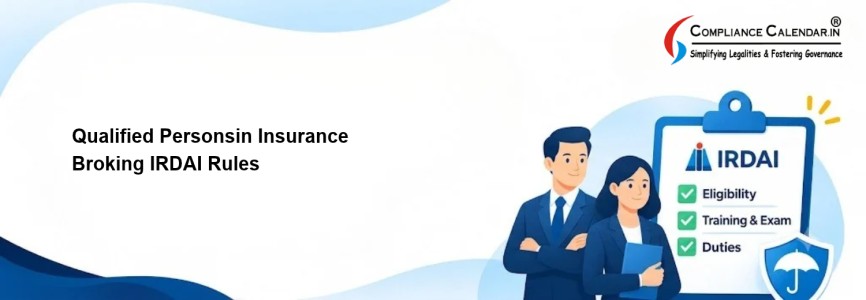
A Broker Qualified Person (BQP) is an individual working as an employee or director of a registered insurance broker who is engaged in soliciting and procuring insurance business and has completed the prescribed training and examination requirements.The definition is provided under Regulation 2(1)(d) of the IRDAI (Insurance Brokers) Regulations, 2018. A BQP is expected to possess the necessary knowledge to understand insurance products, identify client requirements and assist in arranging suitable insurance coverage.
For example, an employee helping businesses compare industrial insurance policies and obtain quotations may need to qualify as a BQP before carrying out regulated solicitation and procurement activities. However, not every person employed by an insurance broker automatically becomes a BQP. Employees performing purely administrative or supporting functions may have different responsibilities, depending on their actual work.
Why Are Qualified Persons Important in Insurance Broking?
Insurance brokers act as professional intermediaries between customers and insurance companies. Their recommendations may influence important decisions involving business assets, financial protection and potential liabilities. A qualified professional should understand the risks faced by clients and the limitations of available insurance products. This becomes particularly important when dealing with commercial insurance, where exclusions, deductibles and policy conditions can significantly affect claim outcomes.
For instance, a manufacturing company may require fire insurance, machinery breakdown cover and business interruption protection. A trained BQP should understand these requirements before recommending suitable options. Qualified Persons therefore support responsible insurance distribution, customer protection and compliance with IRDAI regulations.
Legal Provisions Governing Broker Qualified Persons
The main regulatory requirements arise from the Insurance Act, 1938, the IRDAI Act, 1999 and the IRDAI (Insurance Brokers) Regulations, 2018, as amended.
| Legal Provision | Requirement |
| Regulation 2(1)(d) | Definition of Broker Qualified Person |
| Regulation 8(2)(c) | Minimum qualified personnel and branch requirements |
| Schedule I, Form E | Educational qualifications, training and examination |
| Schedule I, Form H | Professional conduct and client responsibilities |
| Regulation 13 | Registration conditions and policy-wise records |
| Regulation 14 and Form E | Historical renewal training provisions |
| IRDAI Amendment Regulations, 2026 | Updated insurance intermediary registration requirements |
The Insurance Brokers Regulations establish professional standards intended to ensure that individuals involved in insurance solicitation have the necessary knowledge and competence. The IRDAI (Insurance Intermediaries) (Amendment) Regulations, 2026, effective from 30 July 2026, also changed important registration-related provisions for insurance intermediaries. Accordingly, BQP requirements should be read together with the latest applicable amendments and IRDAI instructions.
Eligibility Criteria for Broker Qualified Persons
Schedule I, Form E prescribes the educational qualifications and professional certification requirements for Principal Officers and Broker Qualified Persons.
| Eligibility Requirement | Details |
| Educational qualification | Recognised bachelor's degree or other prescribed qualification |
| Professional qualification | Specified insurance, risk management or professional institute qualifications may qualify |
| Training | Generally 50 hours, with a 25-hour route for eligible professionals |
| Examination | Pass the prescribed insurance brokers' examination |
| Certification | Obtain a valid certificate from the recognised examining body |
| Employment | Be associated with the sponsoring registered insurance broker |
| Professional competence | Handle insurance activities within the person's knowledge and experience |
Applicants may qualify through a recognised degree in arts, science, social sciences, commerce, engineering or law. Schedule I, Form E also recognises several professional qualifications, including specified insurance, actuarial, accountancy and company secretarial qualifications. A person does not necessarily need to hold a specialised insurance degree to become a BQP. However, possessing an eligible qualification alone does not replace the prescribed training and examination requirements.
Minimum Number of Qualified Persons Required for Insurance Brokers
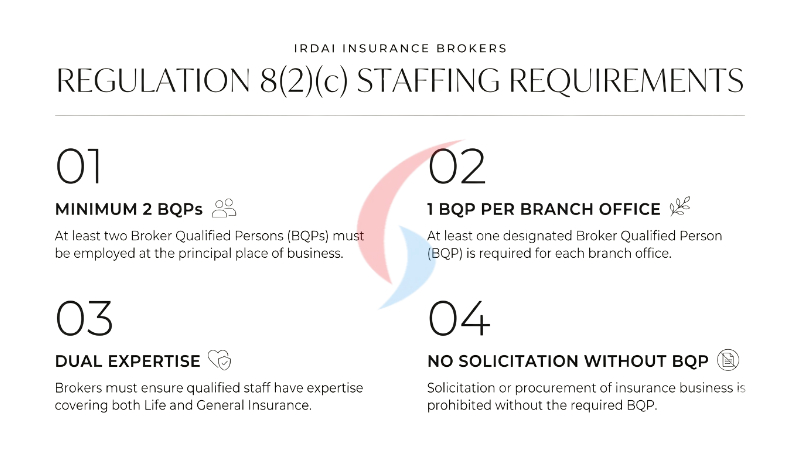
Regulation 8(2)(c) of the 2018 Regulations provides important staffing requirements for insurance broking businesses. An insurance broker applicant is generally required to have at least two Broker Qualified Persons possessing the prescribed qualifications and relevant experience. Where the broker has branch offices, the regulation also requires one qualified person for each branch office. Where a broker intends to conduct both life and general insurance business, at least one qualified person should have relevant experience in life insurance and another in general insurance.
| Business Arrangement | Qualified Person Requirement |
| Insurance broker applicant | Minimum two BQPs |
| Branch office | One BQP per branch |
| Life and general insurance business | Relevant experience in both categories |
| Branch without the required BQP | Solicitation and procurement must not continue from that branch until compliance is restored |
For example, suppose an insurance broker operates its head office in Delhi and opens an additional branch in Jaipur. The company should examine the qualified-person staffing requirement before commencing regulated insurance distribution from the new branch. These are minimum requirements under the cited regulatory provisions. IRDAI may consider the overall adequacy of the applicant's staff, infrastructure and business arrangements.
Training Requirements for Broker Qualified Persons
Professional training is an important part of becoming a Broker Qualified Person. Schedule I, Form E prescribes theoretical and practical training through an institution recognised by IRDAI. The general training requirement is 50 hours. However, specified professionally qualified candidates may be eligible for a reduced 25-hour training programme, subject to the applicable conditions. Training introduces candidates to insurance principles, policy documentation, risk assessment, professional ethics and insurance distribution practices.
For example, a commerce graduate joining an insurance broking company may be required to complete the general training programme. A person holding a specified recognised professional qualification may qualify for the reduced training route. Candidates should confirm their eligibility with the recognised training institution before enrolling.
Insurance Broker Qualified Person Examination
After completing the required training, candidates must pass the prescribed insurance brokers' examination conducted by the National Insurance Academy, Pune, or another examining body recognised by IRDAI. The examination tests knowledge of insurance concepts, regulatory requirements, broker responsibilities and insurance-related professional practices. The National Insurance Academy's published instructions state that candidates should take the examination within one year from completion of training. Registration is linked to the sponsoring insurance broking company. Candidates should verify the current examination schedule, applicable fees, syllabus and identification requirements directly from the recognised examining body. Passing the examination is important, but the individual must also satisfy the applicable certification and association requirements before performing regulated BQP activities.
Process to Become a Broker Qualified Person
Step 1: Verify Educational Eligibility
The candidate should check whether the educational or professional qualification satisfies Schedule I, Form E. Relevant certificates must be available for verification. The sponsoring insurance broker should also review the candidate's proposed responsibilities.
Step 2: Join or Obtain Sponsorship from an Insurance Broker
The candidate should follow the sponsoring broker's recruitment and nomination procedure. The employer's details are relevant to the examination and certification process. The candidate must provide accurate personal and qualification information.
Step 3: Complete Prescribed Training
The candidate must complete the applicable 50-hour or eligible 25-hour training programme. Training should be undertaken through an institution recognised by IRDAI. Completion records should be retained for examination registration.
Step 4: Register for the Examination
The applicant should register for the prescribed brokers' examination through the authorised examination process. Required details, training records and applicable fees must be submitted. The candidate should verify the examination category before appearing.
Step 5: Pass the Examination
The candidate must qualify in the examination conducted by the recognised examining body. Preparation should cover insurance concepts, product knowledge and regulatory responsibilities. The result should be retained for certification and employer compliance records.
Step 6: Obtain Certification and Maintain Compliance
After qualification, the individual must obtain the applicable BQP certificate. The sponsoring broker should update its personnel and regulatory records. The BQP must continue following professional conduct, training and certification requirements.
Validity and Renewal of BQP Certification
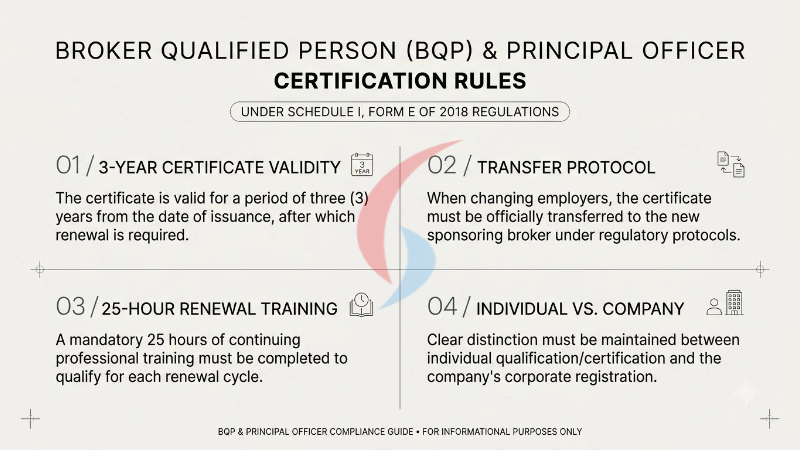
Under Schedule I, Form E of the 2018 Regulations, a certificate issued to a Principal Officer or Broker Qualified Person is valid for three years from its date of issue. The certificate identifies the sponsoring insurance broker. Where a qualified individual moves to another insurance broking company, the prescribed process involves the new sponsoring broker and an appropriate certificate update. The earlier provisions also require at least 25 hours of renewal training within the prescribed period. Companies should distinguish the validity of an individual's professional certification from the validity of the insurance broker's regulatory registration. In view of the 2026 amendments affecting insurance intermediary registration, brokers should confirm current continuing-training and certification instructions with IRDAI or the recognised examination body before relying on an older renewal checklist.
Duties and Responsibilities of Broker Qualified Persons
Broker Qualified Persons are expected to follow the professional standards applicable to the insurance broker and to the activities they perform.
-
Understanding Client Requirements
A BQP should identify the customer's insurance needs before recommending any policy. This includes understanding the client's business activities, insured assets and important risks. Suitable insurance recommendations depend on accurate information.
-
Explaining Insurance Products
Qualified Persons should explain relevant coverage benefits, exclusions, deductibles and premium obligations. They should not present an insurance product as offering protection beyond its actual terms. Clear explanations help customers make informed decisions.
-
Maintaining Professional Integrity
A BQP should provide truthful information and avoid misleading sales practices. Customers should not be pressured into purchasing unsuitable policies. All professional activities must comply with applicable IRDAI conduct requirements.
-
Assisting with Policy Documentation
Qualified Persons should help ensure that proposal information and client instructions are accurately recorded. Important declarations and relevant insurance documents must be handled carefully. Incorrect documentation can create difficulties during claim assessment.
-
Supporting Claims and Renewals
A BQP may assist customers with policy servicing and claims-related communication within the broker's permitted activities. Important claim procedures and renewal requirements should be explained accurately. The individual must not promise claim approval or coverage that the insurer has not confirmed.
-
Maintaining Regulatory Records
Insurance brokers must maintain records linking solicited policies to the relevant BQP or other authorised person, wherever applicable. Qualified Persons should ensure that their activities are accurately documented. These records support internal supervision and regulatory inspection.
Difference Between Principal Officer and Broker Qualified Person
A Principal Officer and a Broker Qualified Person are both important to an insurance broking business, but their roles are not identical.
| Principal Officer | Broker Qualified Person |
| Responsible for principal management and regulatory functions | Engaged in permitted insurance solicitation and procurement |
| Oversees organisational compliance | Performs client-facing insurance activities |
| Must satisfy prescribed qualification and certification requirements | Must satisfy applicable BQP training and examination requirements |
| Coordinates regulatory responsibilities | Maintains accurate client and transaction records |
Documents Required for Broker Qualified Person Certification
A candidate should generally prepare the documents required by the sponsoring broker, training institution and recognised examining body.
- Educational qualification certificates
- PAN and acceptable identity proof
- Training completion certificate
- Examination result or pass certificate
- Employment and sponsorship details
- Existing BQP certification, where applicable
- Previous employer's NOC or other transfer documents, where required
- Applicable declarations and supporting records
The company should ensure that employee records and certification information remain accurate and accessible.
Case Study: How a Qualified Person Prevented a Coverage Dispute
Consider SecureLife Insurance Brokers Private Limited, which later appointed a properly trained Broker Qualified Person named Neha.
A logistics company approached Neha seeking insurance for goods transported between several cities. The customer initially requested a basic transit insurance policy to minimise premiums.
Instead of recommending the first available product, Neha asked about the value of goods, transportation routes, storage arrangements and previous loss experience. She discovered that some shipments involved temporary storage at third-party warehouses.
Neha explained that the proposed policy might not cover every storage-related exposure and recommended reviewing the policy terms and available extensions.
After comparing suitable options, the client selected coverage based on its actual operational requirements. The insurer's final terms were communicated and documented before policy placement.
Several months later, the company faced a claim arising from damage during transportation. Because the relevant coverage conditions and client instructions had been properly discussed and recorded, the parties had a clearer basis for assessing the claim.
This fictional example shows how professional training, careful questioning and accurate documentation can reduce insurance distribution disputes.
Common Compliance Mistakes Involving Broker Qualified Persons
Insurance broking companies sometimes assume that an employee with strong sales experience can solicit insurance business without completing the prescribed qualification process. This can create regulatory concerns where the employee performs activities reserved for authorised personnel. Another mistake is failing to monitor certificate expiry or continuing-training requirements. Companies may also overlook staffing obligations when opening branch offices or transferring qualified employees.
Poor recordkeeping is another common risk. If the company cannot identify which qualified person handled a particular policy, it may struggle to demonstrate proper supervision. Internal reviews should therefore cover staff authorisation, BQP certificates, training records, policy-wise attribution and applicable branch requirements.
Consequences of Non-Compliance with BQP Requirements
Failure to meet qualified-person requirements may expose an insurance broker to regulatory scrutiny and action under applicable provisions. IRDAI may examine whether the broker maintains adequate trained manpower, satisfies its registration conditions and follows the Code of Conduct. The regulator may also consider whether clients received appropriate advice from competent and authorised personnel. Where a branch lacks the required BQP, the 2018 Regulations restrict its ability to conduct insurance broking business until the staffing condition is fulfilled. Non-compliance can also create commercial risks, including customer disputes, reputational damage and additional compliance costs.
Why Choose Compliance Calendar LLP?
Compliance Calendar LLP assists businesses in understanding insurance regulatory requirements and preparing documentation for registration and ongoing compliance. Companies entering the sector can explore our Insurance Broker License service to understand IRDAI eligibility, staffing, financial and registration requirements. Our team can also assist organisations in reviewing documentation relating to Principal Officers, Broker Qualified Persons, employee records and regulatory compliance obligations.
For professional assistance with insurance broker registration and compliance requirements, contact Compliance Calendar LLP at +91 9988424211 or info@ccoffice.in.
Frequently Asked Questions (FAQs)
Q1 Who is a Broker Qualified Person in India?
Ans. A Broker Qualified Person is an employee or director of a registered insurance broker involved in soliciting and procuring insurance business. The person must complete the prescribed training and examination. The applicable requirements are provided under the IRDAI Insurance Brokers Regulations.
Q2 What qualification is required to become a BQP?
Ans. A recognised bachelor's degree or another prescribed professional qualification may satisfy the educational eligibility requirement. The candidate must also complete applicable training and pass the examination. Schedule I, Form E specifies the recognised qualifications.
Q3 How many Broker Qualified Persons are required?
Ans. Under Regulation 8(2)(c), an insurance broker applicant generally requires at least two BQPs. A branch office also requires a qualified person under the prescribed conditions. Brokers should maintain adequate staffing for their authorised business activities.
Q4 How many hours of BQP training are required?
Ans. The general initial training requirement is 50 hours. Eligible candidates holding specified professional qualifications may qualify for 25 hours. Training must be completed through an institution recognised by IRDAI.
Q5 Who conducts the BQP examination?
Ans. The prescribed examination is conducted by the National Insurance Academy, Pune, or another body recognised by IRDAI. Candidates must follow the applicable training and registration requirements. Current examination details should be confirmed with the recognised body.
Q6 What is the validity of a BQP certificate?
Ans. Schedule I, Form E of the 2018 Regulations provides for three-year certificate validity. Continuing-training and certificate requirements must be monitored. Brokers should also check subsequent IRDAI instructions applicable to the certification.
Q7 Can a BQP work for another insurance broker?
Ans. A qualified person may change sponsoring brokers by following the prescribed procedure. The 2018 Regulations address the employer's NOC and amendment of the certificate. The new employer should verify the updated authorisation before assigning regulated duties.
Q8 Is a Principal Officer the same as a BQP?
Ans. No. A Principal Officer performs principal management and regulatory responsibilities. A BQP is specifically qualified for permitted solicitation and procurement activities. Both roles have prescribed eligibility and certification requirements.
Q9 Can an unqualified sales executive sell insurance policies?
Ans. A sales executive should not undertake regulated BQP solicitation or procurement activities without the necessary authorisation and qualifications. The person's actual duties determine the applicable requirements. Insurance brokers must supervise staff and prevent unauthorised activities.
Q10 hat happens if a broker does not maintain sufficient BQPs?
Ans. A shortage may result in non-compliance with applicable registration and staffing conditions. An affected branch may be restricted from conducting insurance business. Serious or repeated violations may also attract regulatory action.
Article last updated on : 18 Nov 2026.













































































_learn_crop10_thumb.jpg)