


Imagine a manufacturing company in Gurugram called GreenTech Components Pvt. Ltd. The company manufactures electrical components and supplies them to several large businesses across India. Its sales are growing, its products meet quality standards, and its management is planning to attract foreign investment.
One day, a major customer sends the company a detailed questionnaire asking about electricity consumption, waste disposal, employee safety, labour practices and corporate governance. The customer also asks whether the company maintains environmental approvals and can provide records supporting its sustainability claims.
The directors are surprised. They have never prepared an ESG report because their company is not listed on the stock exchange. However, their customer explains that environmental and social information is now important for supplier evaluation and sustainability reporting.
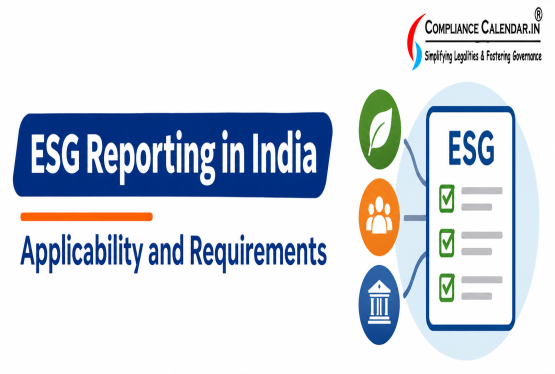
This is where ESG Compliance in India becomes relevant. ESG stands for Environmental, Social and Governance. It examines how responsibly a business manages its environmental impact, treats employees and communities, and follows ethical management practices.
In India, ESG obligations arise through different laws, regulations and reporting requirements. Although every company is not required to prepare a formal ESG report, businesses may still have mandatory environmental, labour, corporate governance and other statutory responsibilities.
What Is ESG Compliance in India?
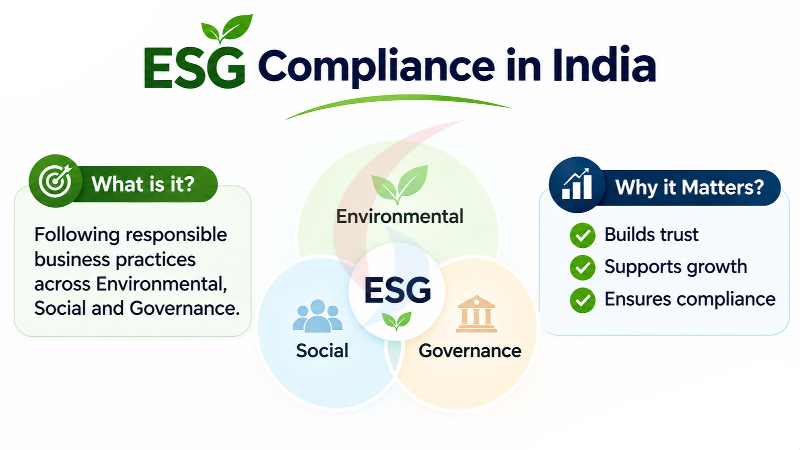
ESG compliance refers to identifying, following and reporting the legal and business requirements relating to environmental responsibility, social welfare and corporate governance.
The Environmental component focuses on pollution prevention, energy consumption, carbon emissions, natural resources and waste management. The Social component deals with employee welfare, workplace safety, equal opportunity, human rights and community development. Governance covers accountability, board oversight, transparency, ethical practices, internal controls and regulatory compliance.
For example, a pharmaceutical manufacturing company may need pollution control approvals, hazardous waste authorisation, workplace safety measures and statutory corporate disclosures. All these responsibilities contribute to the company's ESG performance.
An important distinction is that ESG is not a single licence or registration under Indian law. Companies must comply with the specific laws that apply to their activities and follow ESG reporting requirements where legally prescribed.
Major ESG Laws and Regulations in India
India does not have one comprehensive ESG Act. Instead, several laws and regulations collectively establish the obligations that businesses must follow.
|
Law or Regulation |
Main ESG Requirement |
|---|---|
|
Sustainability reporting and BRSR requirements for specified listed entities |
|
|
Companies Act, 2013 |
CSR, board responsibilities and corporate disclosures |
|
Environment (Protection) Act, 1986 |
Environmental standards, pollution control and waste management |
|
Water Act, 1974 and Air Act, 1981 |
Applicable pollution control consents and operating conditions |
|
Waste Management Rules |
Registration, waste handling, recycling and EPR obligations |
|
Wages, workplace safety, social security and industrial relations |
|
|
Regulation of ESG Rating Providers |
|
|
Personal data governance, subject to phased commencement |
The exact compliance requirements depend on the company's industry, listing status, workforce, financial position and business activities.
SEBI BRSR Reporting Requirements in India
One of the most important ESG reporting requirements comes from the Securities and Exchange Board of India (SEBI).
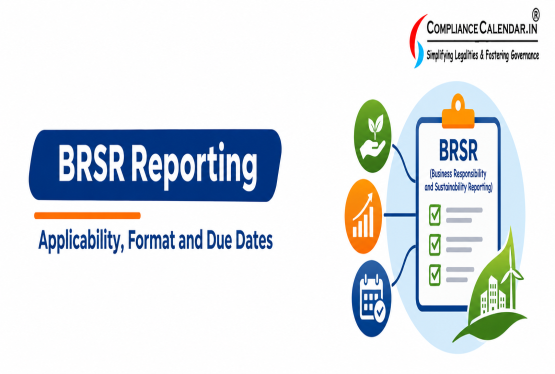
Under Regulation 34(2)(f) of the SEBI (Listing Obligations and Disclosure Requirements) Regulations, 2015, the top 1,000 listed entities by market capitalisation must include a Business Responsibility and Sustainability Report (BRSR) in their annual reports.
BRSR reporting became mandatory for these entities from the financial year 2022-23. The reporting format is based on the nine principles of the National Guidelines on Responsible Business Conduct (NGRBC).
The report provides information about business operations, employee welfare, environmental performance, ethical conduct, consumer responsibility and other sustainability-related matters.
BRSR contains three main sections: general disclosures about the business, management and process disclosures, and principle-wise performance disclosures. Performance indicators are further divided into essential and leadership indicators.
For example, a listed textile company may need to report water consumption, energy usage, waste generation, employee-related information and relevant governance practices.
Businesses can read more about sustainability obligations in our learn article on ESG Compliance and Legalities for Startups.
BRSR Core Requirements and Applicability in 2026
BRSR Core is a subset of BRSR containing selected key performance indicators designed to improve the reliability and comparability of ESG information.
SEBI introduced BRSR Core through its circular dated 12 July 2023. Subsequently, the circular dated 28 March 2025 permitted eligible listed entities to choose between prescribed third-party assessment and assurance, instead of requiring reasonable assurance alone.
The applicability of mandatory BRSR Core assessment or assurance is being expanded in stages.
|
Financial Year |
Listed Entities Covered |
|---|---|
|
FY 2023-24 |
Top 150 |
|
FY 2024-25 |
Top 250 |
|
FY 2025-26 |
Top 500 |
|
FY 2026-27 |
Top 1,000 |
These requirements are determined by market capitalisation, in accordance with applicable SEBI provisions.
Important 2026 Update: ESG value-chain disclosures are voluntary for the top 250 listed entities from FY 2025-26. Assessment or assurance of those value-chain disclosures is voluntary from FY 2026-27. Under the revised provisions, relevant upstream and downstream business partners are generally identified using the individual 2% purchases or sales threshold, with the permitted 75% coverage limit.
Consider a listed automobile company purchasing components from several suppliers. The company may request information about energy use, emissions and workplace conditions from relevant suppliers for its voluntary value-chain disclosures. Those suppliers do not automatically become subject to mandatory BRSR filing merely because of this business relationship.
Environmental Compliance Requirements Under Indian Laws
Environmental compliance is an important part of ESG responsibility, particularly for manufacturing, chemical, pharmaceutical, construction and other regulated industries. Businesses must follow applicable environmental laws to control pollution, manage waste and protect natural resources.
|
Environmental Law / Requirement |
Key Provisions and Compliance Requirements |
|---|---|
|
Environment (Protection) Act, 1986 |
Section 3 empowers the Central Government to take environmental protection measures, while Section 5 permits directions to be issued to regulated entities. |
|
Water (Prevention and Control of Pollution) Act, 1974 |
Section 25 requires applicable industrial activities to obtain consent from the State Pollution Control Board or Pollution Control Committee, subject to applicable exemptions. |
|
Air (Prevention and Control of Pollution) Act, 1981 |
Section 21 prescribes consent requirements for applicable industrial plants operating in air pollution control areas. |
|
Consent to Establish (CTE) |
Applicable businesses must obtain the required consent before establishing industrial operations, subject to exemptions and current procedures. |
|
Consent to Operate (CTO) |
Applicable industrial units must obtain the required consent before commencing operations and comply with prescribed pollution control conditions. |
|
Waste Management and Pollution Control |
Businesses must comply with applicable wastewater discharge, air emission, waste handling and disposal requirements. |
|
Environmental Impact Assessment (EIA) Notification, 2006 |
Certain projects require prior environmental clearance under the EIA Notification, 2006, as amended. |
Example: A food-processing factory using recyclable packaging must still comply with applicable wastewater treatment, emission control, waste disposal and environmental consent requirements. Sustainable packaging alone does not establish full environmental compliance.
Extended Producer Responsibility and Waste Management
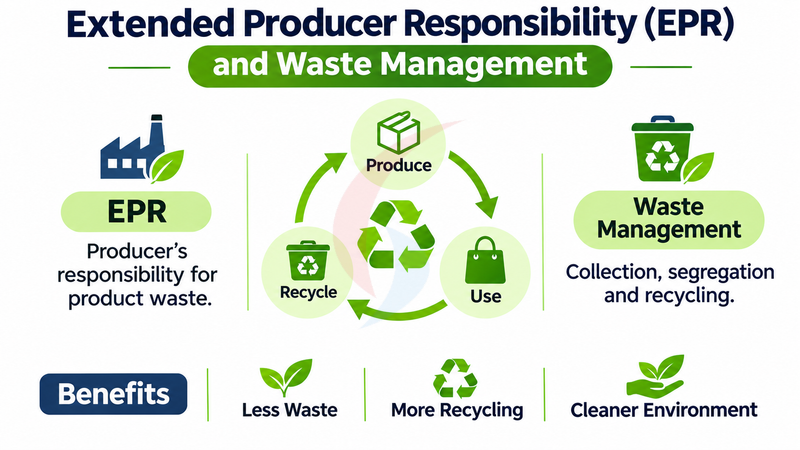
Extended Producer Responsibility (EPR) is another important part of environmental compliance. It requires specified producers and other regulated entities to fulfil responsibilities relating to waste collection, recycling, refurbishment or environmentally sound disposal.
Depending on the product and business activity, the applicable requirements may arise under the Plastic Waste Management Rules, 2016, E-Waste (Management) Rules, 2022, Battery Waste Management Rules, 2022, or other waste-specific regulations.
Imagine an electronics brand importing rechargeable batteries for sale in India. Even when the batteries meet the applicable product standards, the brand must separately examine whether it has producer registration and recycling obligations under the Battery Waste Management Rules.
Businesses can understand these responsibilities through our detailed article on EPR Registration 2026: Process and Documents.
Social Responsibilities Under Indian ESG Requirements
The Social component of ESG focuses on employee welfare, workplace safety, fair wages, social security, equal opportunities and the protection of workers' rights. Companies must follow applicable labour laws and maintain proper records to demonstrate compliance.
|
Law / Requirement |
Key Provisions and Compliance Requirements |
|---|---|
|
Covers minimum wages, timely payment of wages, bonus provisions and equal remuneration without gender-based discrimination. |
|
|
Regulates industrial relations, trade unions, dispute resolution, standing orders and applicable retrenchment procedures. |
|
|
Provides for applicable social security benefits, including provident fund, employee insurance, gratuity and maternity benefits. |
|
|
Occupational Safety, Health and Working Conditions Code, 2020 |
Prescribes workplace safety, health, welfare facilities and working conditions for covered establishments. |
|
Requires employers to prevent workplace sexual harassment, establish appropriate complaint mechanisms and constitute an Internal Committee where prescribed. |
|
|
Businesses must maintain applicable wage records, statutory benefits, workplace safety arrangements and employee grievance procedures. |
Important 2026 Update: India's four Labour Codes came into effect on 21 November 2025, subject to applicable rules and transitional provisions. Companies should review the relevant Central and State rules when assessing their compliance obligations.
Corporate Social Responsibility Under Section 135
Corporate Social Responsibility (CSR) is an important legal requirement under Section 135 of the Companies Act, 2013. It applies to companies meeting at least one of the prescribed financial thresholds during the immediately preceding financial year.
|
Financial Criteria |
CSR Applicability Threshold |
|---|---|
|
Net Worth |
Rs 500 crore or more |
|
Turnover |
Rs 1,000 crore or more |
|
Net Profit |
Rs 5 crore or more |
Covered companies are generally required to spend at least 2% of the average net profits of the three immediately preceding financial years on qualifying CSR activities, subject to the statutory provisions.
CSR activities may include education, healthcare, environmental sustainability, gender equality and rural development, provided they qualify under Schedule VII of the Companies Act.
Section 135 also provides rules for CSR committees, unspent CSR amounts and transfers to prescribed funds or Unspent CSR Accounts, as applicable. The Companies (CSR Policy) Rules, 2014 prescribe further procedural requirements, including reporting and qualifying implementing agencies.
For a detailed explanation, read our article on Section 135 of the Companies Act, 2013: Corporate Social Responsibility.
ESG Ratings and ESG Rating Providers
ESG ratings help investors and other stakeholders evaluate a company's sustainability-related performance and risks.
In India, ESG Rating Providers are regulated by SEBI under the SEBI (Credit Rating Agencies) Regulations, 1999, as amended, and applicable circulars. The regulatory requirements address registration, rating methodology, disclosures, conflicts of interest and ongoing obligations.
An ESG rating is different from BRSR reporting. BRSR is a prescribed corporate disclosure, while an ESG rating represents an evaluation by a rating provider using its stated methodology.
A company may receive different ratings from different agencies because their assessment methods and indicator weightings can vary.
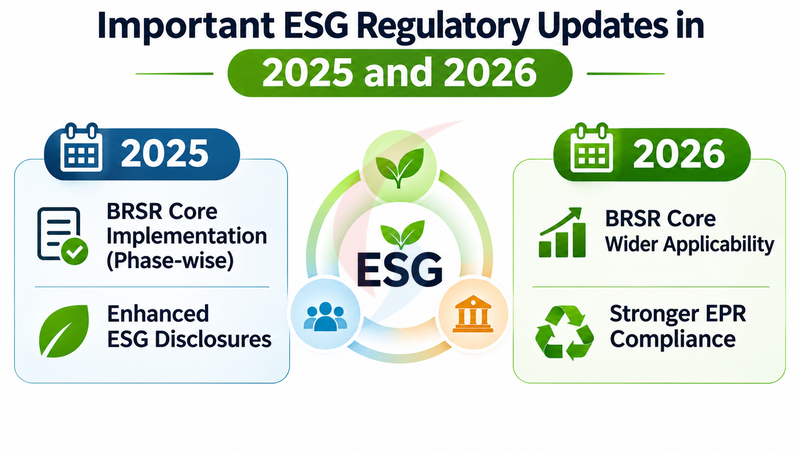
Important ESG Regulatory Updates in 2025 and 2026
Several recent regulatory developments have changed how Indian companies approach ESG compliance, particularly in sustainability reporting, environmental approvals, labour laws and data protection.
|
Date / Year |
Regulatory Update |
Key Changes and Compliance Requirements |
|---|---|---|
|
March 2025 |
SEBI BRSR Amendments |
SEBI introduced the assessment-or-assurance option for BRSR Core, revised value-chain disclosure requirements and added voluntary green-credit disclosures. |
|
November 2025 |
Implementation of Four Labour Codes |
The four Labour Codes became effective on 21 November 2025, subject to applicable rules and transitional provisions. Employers must review wage, social security, workplace safety and industrial relations requirements. |
|
January 2026 |
Environmental Consent Amendments |
The Central Government amended air and water pollution consent guidelines, including provisions recognising Registered Environment Auditors and changes to consent processing procedures. |
|
January 2026 |
SEBI Master Circular Update |
SEBI updated its master circular on 30 January 2026, consolidating applicable listed-entity compliance directions, including sustainability-related reporting provisions. |
|
2026 |
Digital Data Governance Requirements |
The Digital Personal Data Protection Act, 2023 and DPDP Rules, 2025 have phased commencement dates. Companies must prepare for applicable privacy, data security, notice and personal data handling requirements. |
Important: These regulatory developments highlight the need for companies to review their ESG compliance regularly, update internal policies and maintain appropriate records rather than relying on outdated sustainability practices.
How Can a Company Implement ESG Compliance?
The first step is to identify the company's actual legal obligations. A listed company, manufacturing unit and small service provider may have different compliance requirements.
Management should review existing environmental approvals, workforce policies, statutory filings, waste management registrations and governance records. The company can then identify compliance gaps and assign responsibilities to the relevant departments.
For example, a manufacturing company may appoint an environmental officer to monitor energy and waste data, an HR professional to maintain employee-related records, and a company secretary or compliance team to supervise governance disclosures.
Where BRSR applies, information should be collected systematically and supported by appropriate evidence. Applicable BRSR Core assessment or assurance should be arranged through a competent, independent provider.
The objective is to make ESG compliance part of everyday business operations rather than a report prepared only at the end of the financial year.
Case Study: How a Manufacturing Company Improved Its ESG Compliance
Consider GreenTech Components Pvt. Ltd., the company introduced at the beginning of this article.
After receiving the customer's sustainability questionnaire, GreenTech conducts an internal compliance review. Its management discovers that energy consumption is not being recorded consistently, waste disposal certificates are scattered across departments, and employee safety training records need improvement.
The company first checks its existing environmental consents and waste management obligations. It then introduces monthly electricity tracking, maintains waste disposal documentation, updates safety training records and establishes a process for management review.
Within several months, GreenTech has more organised compliance records and can provide reliable information to its customer. The company also identifies opportunities to reduce resource wastage and improve operational efficiency.
This is an illustrative example, but it explains an important point: ESG compliance becomes useful when businesses connect legal obligations with practical operational improvements.
Why Choose Compliance Calendar LLP for ESG Compliance?
Businesses approaching Compliance Calendar LLP often face a practical problem: environmental approvals, corporate filings, labour obligations and sustainability reporting are handled by different people, making it difficult to understand the complete compliance position.
Our ESG Advisory and Consultation Services help businesses understand relevant ESG requirements, review existing practices, identify compliance gaps and prepare suitable reporting and documentation processes.
For example, a company seeking guidance on BRSR reporting may also need to examine its corporate disclosures and environmental documentation. Rather than treating each issue separately, our team can assist with coordinating the relevant compliance requirements according to the company's activities.
Whether your business is preparing for sustainability reporting, responding to investor questions or improving internal compliance processes, Compliance Calendar LLP can provide practical regulatory guidance based on your specific needs.
For professional assistance with ESG Compliance in India, BRSR Reporting, ESG Advisory and regulatory requirements, connect with Compliance Calendar LLP. Contact Us: 9988424211 or info@ccoffice.in .
Frequently Asked Questions on ESG Compliance in India
Q1. What is ESG compliance in India?
Ans: ESG compliance involves following applicable environmental, social and corporate governance laws and meeting sustainability reporting requirements where prescribed.
Q2. Is ESG compliance mandatory for all companies in India?
Ans: No. Mandatory ESG reporting does not apply to every company. However, applicable environmental, labour, governance and other statutory obligations must still be followed.
Q3. Which companies must file BRSR in India?
Ans: The top 1,000 listed entities by market capitalisation are required to prepare BRSR under the applicable SEBI LODR provisions.
Q4. What is BRSR Core?
Ans: BRSR Core is a set of selected ESG performance indicators requiring assessment or assurance for specified listed entities under SEBI's phased requirements.
Q5. Is BRSR mandatory for private limited companies?
Ans: Generally, no. An unlisted private limited company is not automatically required to prepare BRSR, although it may face contractual sustainability information requests.
Q6. What are the main ESG laws in India?
Ans: Important laws include the Companies Act, SEBI LODR Regulations, Environment (Protection) Act, Water Act, Air Act, applicable waste management rules and labour legislation.
Q7. Is CSR the same as ESG?
Ans: No. CSR concerns specific social responsibility obligations under company law, whereas ESG covers broader environmental, social and governance matters.
Q8. Are ESG value-chain disclosures mandatory in 2026?
Ans: Under the revised SEBI requirements, value-chain ESG disclosures are voluntary for the top 250 listed entities from FY 2025-26.
Q9. Do companies need an ESG certificate in India?
Ans: There is no universal government-issued ESG certificate that every Indian company must obtain. Industry-specific registrations, statutory approvals and applicable reporting requirements must be considered separately.
Q10. How can a company start ESG compliance?
Ans: A company should identify applicable laws, review its existing records, assess compliance gaps, establish internal responsibilities and prepare disclosures wherever legally required.
Article last updated on : 17 Nov 2026.





































































_learn_crop10_thumb.jpg)