


Becoming an insurance agent in India is a career option for individuals who want to work in the insurance sector without making a large initial investment. Whether someone is a student, working professional, homemaker or aspiring entrepreneur, insurance agency offers an opportunity to earn commissions by helping people choose suitable insurance policies. However, selling insurance is a regulated activity, and a person cannot simply start selling policies without meeting the prescribed requirements.
The Insurance Regulatory and Development Authority of India (IRDAI) regulates insurance distribution in India. To become an insurance agent, an applicant generally needs to satisfy eligibility conditions, complete the insurer's required training, pass the prescribed insurance examination and obtain an appointment from an insurance company. Understanding these steps is important because passing an examination alone does not authorise someone to sell insurance.
What is an Insurance Agent in India?
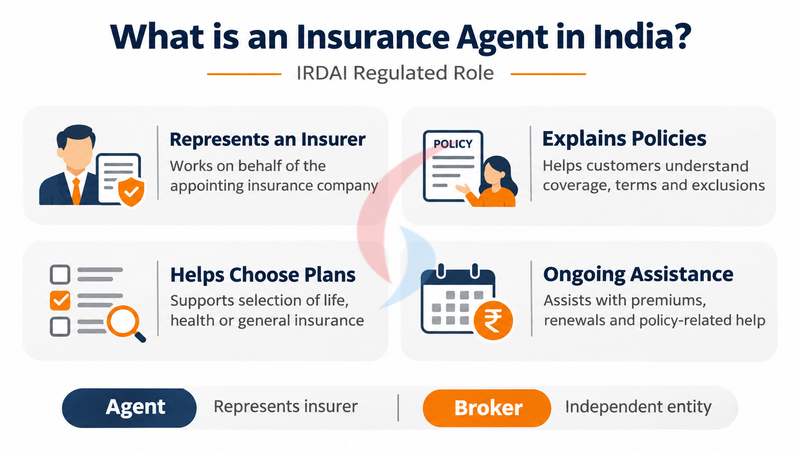
An insurance agent is an individual appointed by an insurance company to explain insurance products, assist customers in selecting suitable policies and procure insurance business on behalf of the insurer. An agent may deal with life insurance, health insurance or general insurance, depending on the appointment received and the products authorised for distribution.
Individuals planning to establish an independent insurance broking business can explore our guide on Insurance Broker Registration in India to understand its separate eligibility and IRDAI approval requirements.
For example, a life insurance agent may help a customer purchase a term insurance policy, while a health insurance agent may explain hospitalisation coverage, waiting periods and policy exclusions. The agent also assists customers with premium payments, renewals and policy-related services. An insurance agent is different from an insurance broker because an agent represents the appointing insurer rather than operating as an independently registered insurance broking entity.
A Real-Life Style Example: How Priya Started Her Insurance Career
Priya, a 26-year-old graduate from Jaipur, wanted to earn an income while continuing her family responsibilities. She was interested in financial services but did not have the capital required to establish a business. One day, a family friend working in insurance suggested that she consider becoming an insurance agent.
Initially, Priya thought she could start selling insurance policies immediately after joining an insurance company. However, she learned that insurance agents must satisfy eligibility requirements and pass the prescribed examination before receiving an appointment.
She approached an insurance company, submitted her documents and completed the required training. After studying insurance fundamentals, customer protection and policy conditions, she passed the IC-38 examination and received her appointment letter and agency code.
During her first few months, Priya focused on understanding customers rather than simply selling policies. She helped a young couple understand term insurance and explained health insurance exclusions to a small business owner. Gradually, she began building a customer base through referrals and reliable service.
Priya's story is illustrative, but it explains an important point: success as an insurance agent depends not only on passing an examination but also on product knowledge, honesty and customer relationships.
Eligibility to Become an Insurance Agent in India
Before applying for an insurance agency, candidates should verify whether they meet the eligibility conditions prescribed under the Insurance Act, 1938, the IRDAI (Appointment of Insurance Agents) Regulations, 2016 and the insurer's applicable recruitment policy.
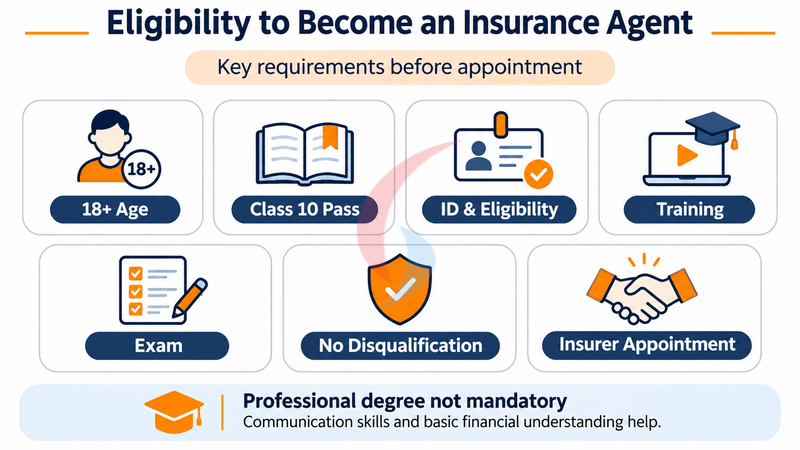
| Eligibility Requirement | Details |
| Minimum Age | Generally 18 years |
| Educational Qualification | Commonly Class 10 pass or equivalent |
| Citizenship and identity | Applicant must satisfy applicable identity and eligibility requirements |
| Training | Complete training prescribed by the insurer |
| Examination | Pass the prescribed insurance agency examination |
| Legal eligibility | Must not attract disqualifications under Section 42(3) |
| Appointment | Must receive an official appointment from an insurer |
A candidate generally does not need a professional degree in finance, commerce or law. However, good communication skills, basic financial understanding and the ability to explain insurance products accurately can improve career prospects.
Step-by-Step Process to Become an Insurance Agent in India
Step 1: Choose the Type of Insurance Agency
The first step is deciding which insurance products the applicant wants to distribute. Life insurance agents mainly deal with term plans, savings-oriented insurance and other life insurance products. General insurance agents may distribute motor, property, travel and other non-life policies, while health insurance agents focus on medical insurance coverage. The applicant should select an insurer based on its products, training support, customer service, commission arrangements and market reputation. Choosing a suitable insurance company is important because the agent will represent that insurer when approaching customers.
Those exploring other insurance distribution business models can also understand the Difference Between Insurance Broker and Corporate Agent before selecting a suitable business structure.
Step 2: Apply to an Insurance Company
After selecting an insurer, the candidate can approach its official branch, recruitment department or authorised agency recruitment channel. The insurance company generally provides an application process and explains the documents, training schedule and examination requirements.Under Regulation 4 of the IRDAI (Appointment of Insurance Agents) Regulations, 2016, an applicant seeking appointment ordinarily submits Form I-A to the insurer's designated official. Existing agents seeking an additional permitted appointment may need to follow the composite agency application procedure. The applicant must provide accurate information about identity, educational qualifications, previous agency appointments and other relevant details.
Step 3: Complete Insurance Agent Training
Insurance agent training introduces candidates to insurance principles, policy structures, customer obligations and the responsibilities of an agent. Insurers arrange training according to the applicable requirements and their approved policies. Training generally covers the meaning of insurance, policy benefits, premiums, claims, exclusions, customer disclosures and ethical sales practices. Some insurer recruitment programmes specify approximately 25 hours of training, although candidates should confirm the actual training requirements with their insurer.
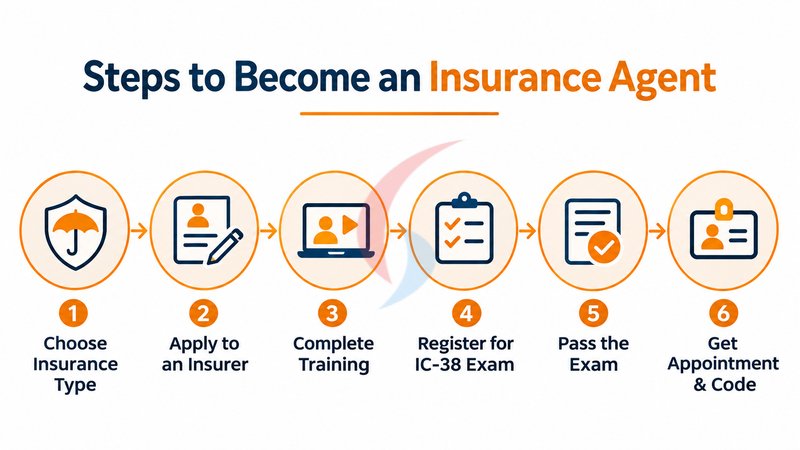
Step 4: Register for the IC-38 Examination
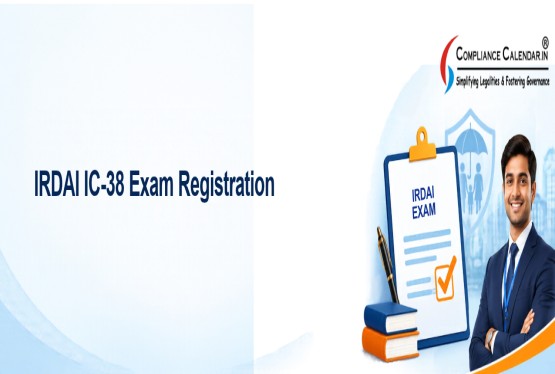
After completing the required preparation and training, applicants must qualify in the prescribed insurance agency examination. The IC-38 examination is commonly associated with insurance agent recruitment and covers the knowledge required to distribute insurance products responsibly. The examination process is normally coordinated through the recruiting insurance company and an authorised examination arrangement. Candidates should confirm their examination category, registration details, applicable fee, examination centre or mode and identification requirements before appearing.
Candidates who want to understand the examination process, eligibility, fees and preparation requirements can read our detailed guide on IRDAI IC-38 Exam Registration.
Step 5: Pass the Insurance Agency Examination
The examination tests whether candidates understand insurance concepts and customer responsibilities sufficiently to work as agents. Common topics include principles of insurance, policy documentation, product suitability, claims, customer protection and professional conduct. Candidates should prepare using the prescribed syllabus and official study material rather than relying only on memorised questions. Once the applicant passes, the examination result or certificate becomes part of the appointment verification process.
Step 6: Obtain the Appointment Letter and Agency Code
Passing the examination is not the final step. The insurance company must verify the application, examine legal eligibility and approve the candidate's appointment. Under Regulation 4 of the 2016 Regulations, the insurer's designated official may issue the appointment letter within 15 days after receiving all required documents and satisfying the regulatory conditions. The insurer also allots an agency code to the appointed individual. After the appointment, the agent can begin soliciting insurance business within the authorised scope and must follow the insurer's instructions and applicable regulatory requirements.
Documents Required for Insurance Agent Appointment
The documents required may differ between insurers, but applicants should generally prepare the following:
- PAN card and acceptable identity proof
- Aadhaar or another accepted address proof, where applicable
- Educational qualification certificate
- Recent passport-size photograph
- Bank account details
- Completed insurance agency application
- Insurance examination pass certificate
- Previous agency details or cessation certificate, where applicable
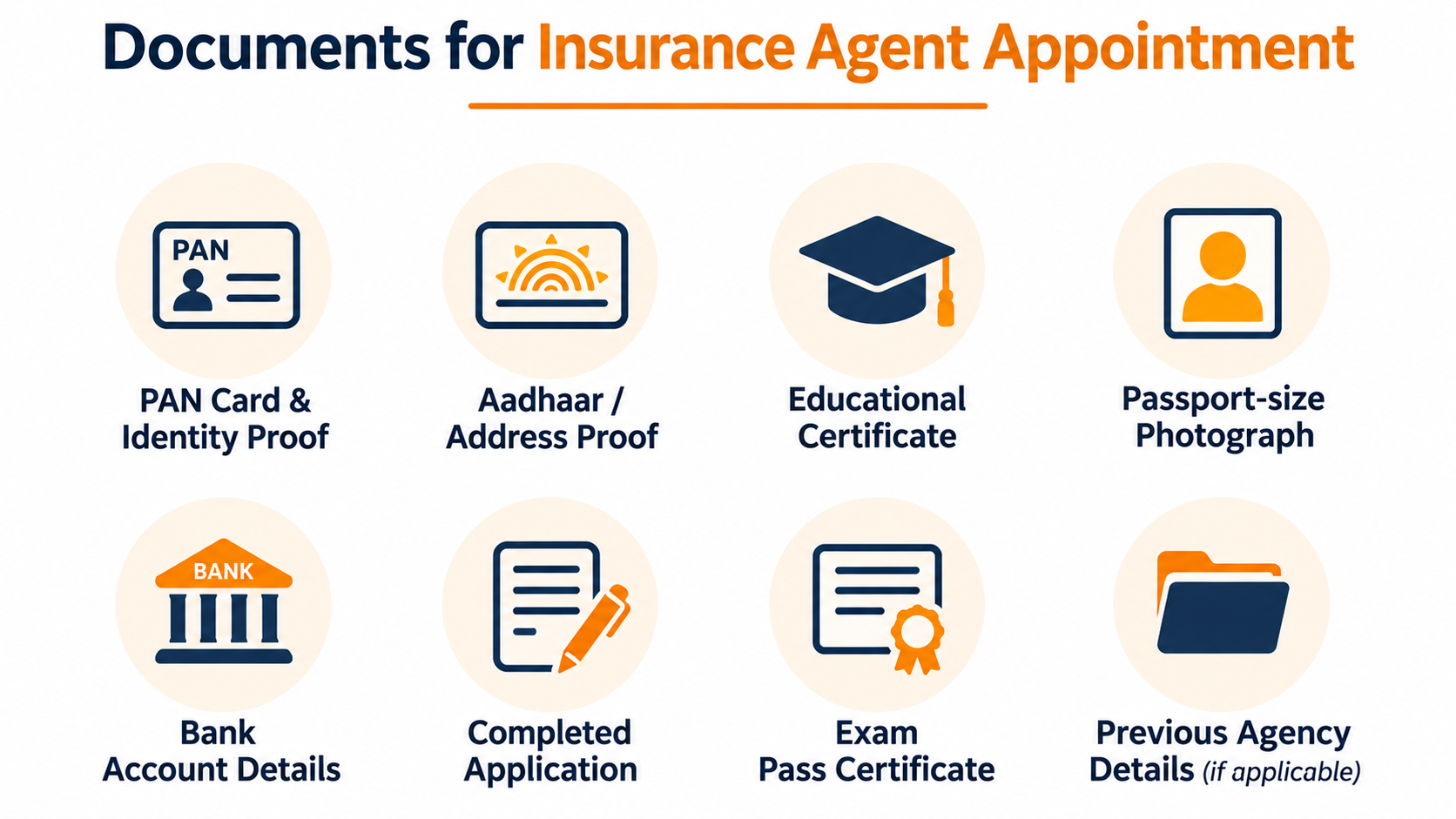
The insurer may request additional documents for verification. Candidates should ensure that their names, dates of birth and identification details match across records to avoid delays during recruitment.
IC-38 Exam Fees and Cost of Becoming an Insurance Agent
The cost of becoming an insurance agent depends on the recruiting insurer, examination arrangements and training requirements. Some insurers provide training support, while others may require candidates to pay applicable examination or administrative charges. For example, New India Assurance publishes an insurance agency examination fee of Rs 425 plus GST on its intermediary information page. However, this should not be treated as a uniform fee applicable to every insurer or examination booking in 2026. Candidates should obtain a current fee confirmation directly from their recruiting insurer or authorised examination provider. They should also avoid paying recruitment charges to unauthorised individuals promising guaranteed agency appointments.
Can an Insurance Agent Work with Multiple Insurance Companies?
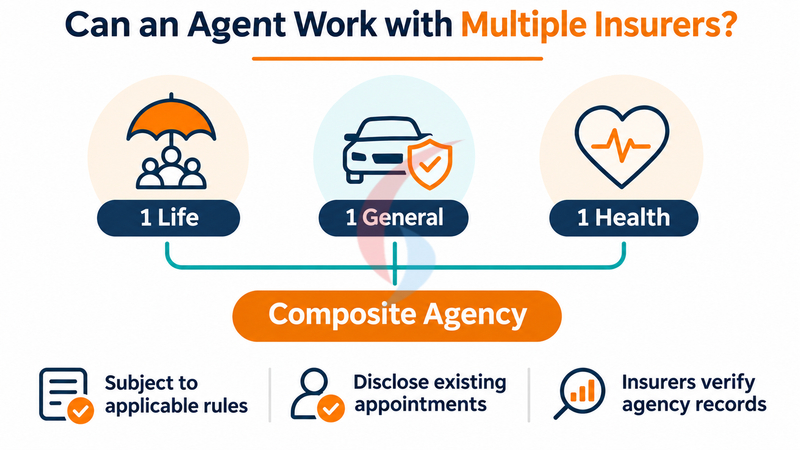
Section 42(2) of the Insurance Act, 1938 places restrictions on the number of insurers an individual agent can represent. An individual may generally hold an appointment with one life insurer, one general insurer and one health insurer, subject to the applicable rules. Separate provisions also address mono-line insurers. For example, an individual appointed by one life insurance company cannot ordinarily become an agent of another life insurer simultaneously. However, the person may seek an eligible appointment from a general or health insurer by completing the required procedure. This arrangement is often referred to as a composite insurance agency. Applicants must disclose existing appointments, and insurers must verify the relevant agency records before granting additional appointments.
Individuals who want to expand beyond working as an insurance agent can explore other insurance business opportunities in India. Entrepreneurs planning to establish their own insurance company must obtain Insurance Company Registration from IRDAI. Businesses interested in distributing insurance policies can consider Insurance Broker License, Corporate Agency License or Insurance Marketing Firm Registration, depending on their business model. Each category has separate eligibility, capital, registration and compliance requirements under applicable IRDAI regulations.
Businesses planning to distribute insurance products through a corporate entity can read our guide on Requirements and Eligibility for Corporate Agent Registration to understand the applicable IRDAI registration requirements.
How Much Can an Insurance Agent Earn in India?
Insurance agents generally earn commissions based on eligible insurance business, subject to the insurer's commission policy and applicable regulations. Income may depend on the type of insurance product, premiums, renewals, sales performance and customer retention. Under the IRDAI (Expenses of Management, including Commission, of Insurers) Regulations, 2024, insurers must maintain a board-approved policy governing commission payments. There is no single commission percentage applicable to every insurance product or insurance company.
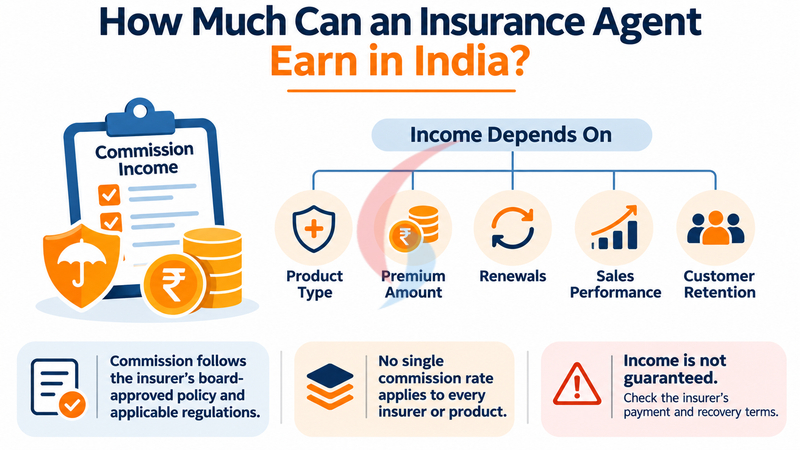
For example, an agent who builds a strong customer base and provides consistent renewal support may develop a more sustainable income stream than someone relying entirely on occasional new policy sales. However, commissions are not guaranteed, and candidates should understand the insurer's payment and recovery conditions before accepting an appointment.
Legal Responsibilities of an Insurance Agent
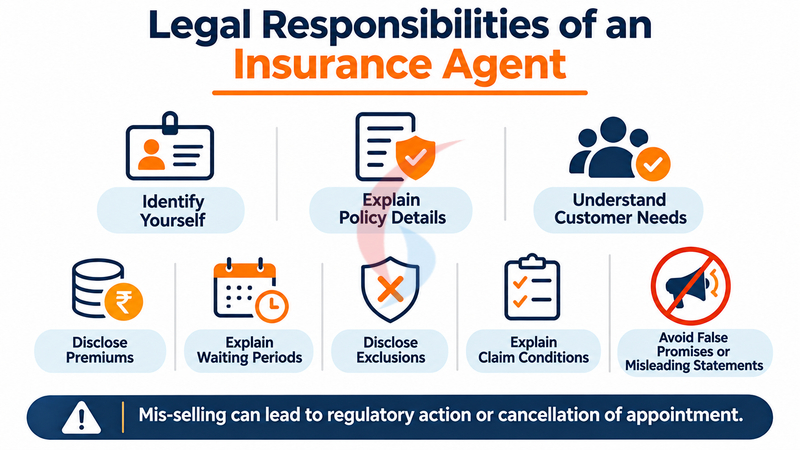
An insurance agent must act honestly and provide customers with accurate information. The code of conduct under the IRDAI insurance agent regulations requires agents to identify themselves, explain relevant policy information and consider customers' insurance needs. Agents must not misrepresent guaranteed returns, conceal exclusions, encourage false disclosures or use misleading statements to sell policies. They should explain premium obligations, waiting periods, claim conditions and other important limitations wherever relevant. For instance, if a customer is buying health insurance, an agent should explain the applicable waiting periods and pre-existing disease conditions rather than suggesting that every medical expense will automatically be covered. Non-compliance can result in regulatory action, cancellation of appointment and other consequences under applicable law.
To understand the wider regulatory obligations applicable to insurance distribution businesses, readers can refer to our article on IRDAI Compliance Requirements for Insurance Intermediaries.
Why Choose Compliance Calendar LLP?
Compliance Calendar LLP provides professional assistance with insurance-related regulatory requirements, documentation and compliance matters. Individuals and businesses exploring opportunities in insurance distribution can seek guidance on applicable IRDAI provisions, eligibility conditions and related legal requirements. Our team also assists businesses with regulatory matters involving Insurance Broker Registration, Corporate Agent Registration and other insurance intermediary compliance requirements, depending on the nature of the proposed business.
For expert guidance on insurance agent registration and IRDAI compliance requirements, contact Compliance Calendar LLP at +91 9988424211 or email info@ccoffice.in.
Frequently Asked Questions ( FAQs)
Q1 . How long does it take to become an insurance agent in India?
Ans. The time required depends on the insurance company's training schedule, IC-38 examination availability and document verification process. After passing the examination and completing the required formalities, eligible candidates can receive an appointment from the insurer.
Q2 Can I become an insurance agent without passing the IC-38 exam?
Ans. Generally, candidates must pass the prescribed insurance agency examination before receiving an appointment. However, certain applicants may qualify for exemptions under applicable rules. Candidates should confirm their eligibility and examination requirements with the insurance company.
Q3 Can I become an insurance agent without a degree?
Ans. Yes. A university degree is generally not compulsory for an individual insurance agency appointment. Applicants must satisfy the prescribed educational and other eligibility requirements.
Q4 Can an insurance agent work from home?
Ans. Insurance agents may perform certain customer communication and administrative activities remotely, subject to their insurer's operational requirements. However, the agent must follow identification, disclosure and customer protection requirements.
Q5 Does passing IC-38 automatically make me an insurance agent?
Ans. No. Passing the examination establishes an important qualification, but the applicant must still receive an appointment from an insurance company before acting as its agent.
Q6 Can a salaried employee become an insurance agent?
Ans. A salaried employee may be eligible, depending on employment restrictions, applicable law and the insurer's requirements. They should check their employment contract before taking an additional agency appointment.
Q7 Is insurance agent income fixed?
Ans. Insurance agent income is generally commission-based and may fluctuate according to business performance and the insurer's payment policy. A fixed salary should not be assumed unless separately agreed under an applicable employment arrangement.
Q8 Who appoints insurance agents in India?
Ans. Insurance companies appoint eligible individuals as agents through their designated officials. IRDAI regulates the appointment requirements, but applicants ordinarily receive their appointment from the insurer.
Q9 Can a 12th-pass student become an insurance agent in India?
Ans. Yes. A 12th-pass applicant can generally apply if they satisfy the minimum age, examination, training and other eligibility conditions prescribed by the insurer and applicable regulations.
Q10 Is the IC-38 examination compulsory for insurance agents?
Ans. An applicant must pass the prescribed insurance agency examination unless an applicable exemption exists. IC-38 is a commonly used examination route for insurance agency recruitment.
Article last updated on : 17 Nov 2026.


































































_learn_crop10_thumb.jpg)