


Imagine a listed manufacturing company in Pune that has been operating successfully for more than twenty years. Its financial results are strong, its shareholders are satisfied, and the management is planning to expand production. During the preparation of its annual report, however, the Company Secretary asks for details that the finance department has never collected before. How much electricity was consumed at each factory? How many employees received safety training? What quantity of water was recycled? How many customer complaints were received during the financial year?
The management realises that financial statements alone cannot answer these questions. The production team has electricity records, the HR department maintains employee information, and the legal department handles regulatory matters. However, no single department has complete information about the company's environmental, social and governance performance.
This is where BRSR Reporting in India becomes important. The Business Responsibility and Sustainability Report, commonly known as BRSR, requires specified listed entities to disclose how their business activities affect the environment, employees, customers, communities and other stakeholders.
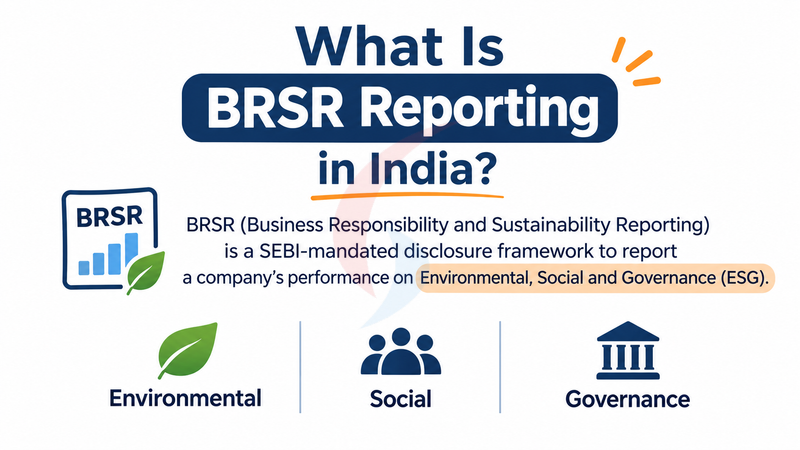
What Is BRSR Reporting in India?
BRSR stands for Business Responsibility and Sustainability Report. It is a reporting format introduced by SEBI to disclose the Environmental, Social and Governance (ESG) performance of listed entities. It covers energy consumption, waste management, employee wellbeing, workplace safety and corporate governance.
For example, a textile company earning Rs 800 crore annually may report strong profits, but investors also want to understand its environmental impact. BRSR helps disclose such information through the nine principles of the National Guidelines on Responsible Business Conduct (NGRBC), promoting ethical and responsible business practices.
Companies can also read ESG Compliance in India: Laws, Rules and Requirements to understand the broader legal responsibilities relating to sustainability and governance.
Why Did SEBI Introduce BRSR Reporting?
Before BRSR, certain listed companies were required to prepare a Business Responsibility Report (BRR). However, growing investor interest in sustainability and responsible business practices created a need for more detailed and comparable disclosures.
SEBI introduced BRSR through Circular No. SEBI/HO/CFD/CMD-2/P/CIR/2021/562 dated May 10, 2021. The reporting framework was initially voluntary for FY 2021–22 and became mandatory for the top 1,000 listed entities from FY 2022–23.
The purpose was not simply to increase the number of pages in an annual report. SEBI intended to improve the quality and comparability of non-financial information available to investors and other stakeholders.
For instance, two companies operating in the same industry may earn similar profits but have significantly different environmental impacts and workplace safety records. BRSR allows stakeholders to examine these differences through prescribed disclosures, rather than depending entirely on promotional sustainability statements.
BRSR Reporting Applicability in India
One of the most important questions for compliance professionals is whether every listed or unlisted company must prepare BRSR. The answer depends primarily on the nature of the listing, the entity's market capitalisation ranking and the applicable SEBI provisions.
Under Regulation 34(2)(f) of the SEBI LODR Regulations, the top 1,000 listed entities by market capitalisation are required to prepare and include BRSR in their annual reports.
For companies outside the mandatory category, voluntary BRSR reporting is generally permitted. However, an unlisted company does not become subject to SEBI BRSR merely because its turnover is high or it has substantial foreign investment.
BRSR Applicability Table
|
Category of Entity |
BRSR Reporting Requirement |
|
Top 1,000 listed entities by market capitalisation |
Mandatory, subject to applicable SEBI provisions |
|
Other equity-listed companies |
Generally voluntary unless otherwise required |
|
Unlisted public companies |
No general mandatory SEBI BRSR requirement |
|
Private limited companies |
Generally not mandatory |
|
MSMEs and startups |
Voluntary, unless another applicable requirement or contractual obligation applies |
|
Suppliers of listed companies |
May receive ESG data requests; supplying a listed company does not itself create a general BRSR filing obligation |
BRSR applicability depends on a company's market capitalisation ranking and SEBI's transition provisions under Regulation 3(2) of the LODR Regulations. Under the 2024 amendments, companies entering the top 1,000 must check the applicable compliance timeline before determining their first mandatory BRSR reporting year.
Legal Provisions Governing BRSR Reporting in India
BRSR Reporting is governed primarily by the SEBI LODR Regulations and the circulars prescribing the reporting format and associated sustainability indicators.
|
Law or Regulation |
Relevant Provision |
Requirement |
|
Regulation 34(2)(f) |
Mandatory BRSR reporting for covered listed entities |
|
|
Regulation 34(1) |
Submission of the annual report to stock exchanges |
|
|
Regulation 3(2) |
Applicability and transition of market capitalisation-based obligations |
|
|
Prescribed BRSR format |
General, management and principle-wise sustainability disclosures |
|
|
BRSR Core framework |
Selected ESG indicators and phased independent verification |
|
|
Assessment, assurance and value chain amendments |
Provides assessment or assurance options and voluntary value chain disclosures |
|
|
Sections 134, 135 and 166 |
Board reporting, CSR obligations and directors' duties, where applicable |
It is important to distinguish the legal requirement to prepare BRSR from the wider environmental, labour and corporate governance laws. BRSR is a reporting requirement, whereas laws relating to pollution control, employee welfare and corporate conduct may impose separate substantive obligations.
Companies managing multiple stock exchange requirements can also refer to SEBI Periodic Compliance for Listed Companies.
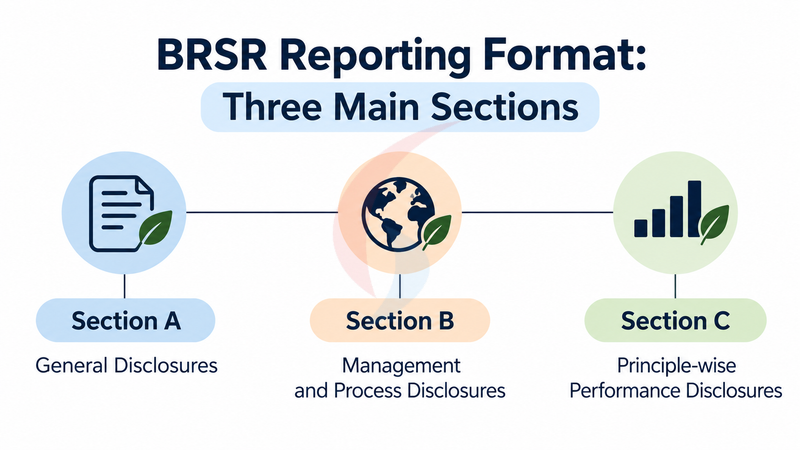
BRSR Reporting Format: Three Main Sections
The SEBI BRSR format is divided into three main sections covering company information, management policies and sustainability performance.
|
Section |
Reporting Requirements |
Examples |
|---|---|---|
|
Section A – General Disclosures |
Covers company details, business activities, products, operational locations, employees, subsidiaries and CSR applicability. |
A manufacturing company reports its factory locations, workforce details and business operations. |
|
Section B – Management and Process Disclosures |
Explains ESG policies, governance practices, management responsibilities and compliance monitoring under the nine NGRBC principles. |
A company discloses its employee safety, anti-corruption and environmental management policies. |
|
Section C – Principle-wise Performance Disclosures |
Covers the nine NGRBC principles, including environmental protection, human rights, employee wellbeing and customer responsibility. Includes essential and leadership indicators. |
A company reports energy consumption, waste management, workplace safety and customer complaints. |
Main Components of BRSR Format
|
Section |
Reporting Area |
Examples of Information |
|
Section A |
General Disclosures |
Company profile, operations, employees and business activities |
|
Section B |
Management and Process Disclosures |
ESG policies, governance mechanisms and accountability |
|
Section C |
Principle-wise Performance Disclosures |
Energy, emissions, water, safety, human rights, consumer complaints and ethical conduct |
The applicable BRSR format and SEBI updates should be consulted before finalising the report, as the disclosure requirements have evolved since their original introduction.
Nine Principles Covered Under BRSR Reporting
BRSR disclosures are aligned with the nine NGRBC principles. Each principle addresses a different aspect of responsible business conduct.
|
Principle |
Main Reporting Focus |
|
Principle 1 |
Ethical, transparent and accountable business conduct |
|
Principle 2 |
Safe and sustainable goods and services |
|
Principle 3 |
Employee and worker wellbeing |
|
Principle 4 |
Stakeholder interests and engagement |
|
Principle 5 |
Human rights |
|
Principle 6 |
Environmental protection and restoration |
|
Principle 7 |
Responsible public and regulatory policy engagement |
|
Principle 8 |
Inclusive growth and equitable development |
|
Principle 9 |
Responsible consumer engagement and value delivery |
For example, a pharmaceutical company may need to disclose information relating to product safety under Principle 2, employee safety under Principle 3, waste management under Principle 6 and customer complaints under Principle 9.
These principles encourage companies to examine responsible business conduct across their entire operations rather than concentrating on one environmental initiative.
What Is BRSR Core Under SEBI Regulations?
BRSR Core is a subset of the wider BRSR reporting format that contains selected Key Performance Indicators (KPIs) covering nine ESG attributes.
SEBI introduced BRSR Core through its July 12, 2023 circular to improve the reliability and comparability of important sustainability information. The indicators cover areas such as greenhouse gas emissions, water footprint, energy footprint, waste management, employee wellbeing, gender diversity, inclusive development, fairness in business relationships and openness of business.
For example, a company may report that it has reduced electricity consumption through the installation of energy-efficient machinery. BRSR Core requires specified quantitative information to be presented using applicable methodologies, making it easier to assess performance over time.
BRSR Core Applicability Timeline
|
Financial Year |
Listed Entities Covered |
|
FY 2023–24 |
Top 150 |
|
FY 2024–25 |
Top 250 |
|
FY 2025–26 |
Top 500 |
|
FY 2026–27 |
Top 1,000 |
The table shows the phased implementation of independent verification of BRSR Core. Under the amended regulatory provisions, covered entities may choose the prescribed assessment or assurance route.
BRSR Reporting Due Dates in India for 2026
BRSR is an annual reporting requirement. It is included in the annual report of the listed entity and is governed by the applicable annual report submission requirements under Regulation 34 of the SEBI LODR Regulations.
There is no universal, separately prescribed BRSR filing date such as July 31 or September 30 for every listed entity. The applicable submission deadline depends on the annual reporting process and the requirements governing dispatch and submission of annual reports.
Under Regulation 34(1), the listed entity must submit the annual report to the stock exchange not later than the day of commencement of dispatch to shareholders. If changes to the annual report are approved at the AGM, the revised report and explanation of changes must be submitted within the prescribed 48-hour period.
BRSR Filing Timeline for FY 2025–26
|
Compliance Activity |
Timeline |
|
Financial year covered |
April 1, 2025 to March 31, 2026 |
|
Collection of sustainability information |
During the financial year and annual reporting preparation |
|
BRSR Core assessment or assurance |
Before finalisation of the relevant annual disclosures, where applicable |
|
Annual report containing BRSR |
Not later than commencement of dispatch to shareholders under Regulation 34(1) |
|
Revised annual report, if amended at AGM |
Within 48 hours after the AGM |
|
Additional stock exchange BRSR submissions |
As required by the relevant exchange filing requirements |
For a company following the normal April–March financial year, the AGM timeline under Section 96 of the Companies Act, 2013 is also relevant. Ordinarily, the AGM must be held within six months of the financial year-end, subject to applicable exceptions and extensions.
However, September 30 should not be treated as a universal independent BRSR filing deadline. Companies must determine the actual annual report submission date based on their AGM schedule, shareholder dispatch and applicable SEBI requirements.
How to Prepare and File a BRSR Report in India
Preparing BRSR requires proper coordination between the Company's secretarial, finance, HR, operations, legal and environmental compliance teams. Companies should start collecting information during the financial year rather than treating BRSR as a document to be prepared only before the AGM.
Step 1 – Determine BRSR Applicability: The company should examine its market capitalisation ranking, applicable SEBI provisions and reporting year. It should separately confirm whether BRSR Core assessment or assurance is required.
Step 2 – Identify Reporting Responsibilities: The management should assign responsibility for different information categories. For example, HR may handle workforce information, operations may provide energy and water data, and the legal team may provide details about relevant governance practices.
Step 3 – Collect Supporting Documents: Companies should obtain electricity bills, water consumption records, waste disposal information, employee safety records, training documents, customer complaint data and other relevant evidence.
Step 4 – Prepare the BRSR Format: The company should complete Sections A, B and C in accordance with the prescribed disclosure requirements. Where estimates or calculations are used, the company should document the methodology, assumptions and reporting boundaries.
Step 5 – Conduct Internal Verification: Before finalisation, the information should be checked for completeness, consistency and accuracy. Figures included in BRSR should be reconciled with relevant operational records and other published disclosures.
Step 6 – Obtain BRSR Core Assessment or Assurance: Where required, the company must obtain independent verification through an appropriately qualified and independent provider, following the applicable SEBI requirements.
Step 7 – Submit and Publish: The finalised BRSR should be included in the annual report and submitted to the relevant stock exchanges. The company should also follow applicable exchange instructions for structured BRSR or XBRL submissions.
A practical point is that ordinary corporate financial auditors do not automatically satisfy every independent verification requirement. A BRSR Core verification provider must meet the relevant competence and independence criteria.
A Practical Example of BRSR Reporting in India
Consider a fictional company, Sunrise Auto Components Ltd., which manufactures automotive parts and has factories in Haryana and Maharashtra. The company is among India's top 500 listed entities and must prepare BRSR disclosures for FY 2025–26, including the applicable BRSR Core verification.
During preparation, the compliance team discovers that the Haryana factory uses substantially more electricity per unit of production than the Maharashtra factory. The HR department also reveals that employee safety training records are maintained separately at different locations, making consolidated reporting difficult.
The management decides to introduce centralised data collection and monthly sustainability reviews. The Haryana factory replaces inefficient equipment, while the HR department establishes a uniform employee training register. These measures improve the quality of the company's disclosures and help management identify unnecessary expenditure.
Suppose the company's annual electricity expenditure decreases from Rs 2 crore to Rs 1.85 crore. The illustrative saving is Rs 15 lakh annually. However, the actual environmental improvement would need to be measured using relevant energy consumption and emissions information rather than expenditure alone.
This example shows how BRSR preparation can identify business risks and operational inefficiencies that may otherwise remain unnoticed.
Latest SEBI BRSR Reporting Updates Applicable in 2026
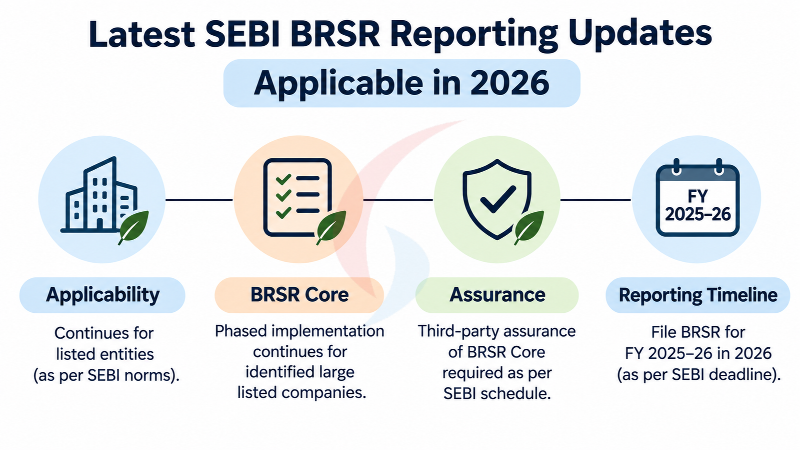
The regulatory position in 2026 reflects SEBI's July 2023 BRSR Core circular, the March 28, 2025 amendments and subsequent regulatory guidance, including the January 30, 2026 LODR Master Circular.
Assessment or Assurance of BRSR Core
SEBI's March 28, 2025 circular permits listed entities to choose between third-party assessment and assurance of BRSR Core disclosures. Previously, the framework focused on reasonable assurance.
The verification provider must possess suitable expertise and comply with independence and conflict-of-interest requirements. SEBI has clarified that a provider is not required to be a Chartered Accountant merely to undertake the prescribed assessment or assurance.
Voluntary ESG Disclosures for Value Chain Partners
Under the amended provisions, ESG value chain disclosures for the top 250 listed entities are voluntary from FY 2025–26. The associated assessment or assurance is also voluntary from FY 2026–27.
The revised framework identifies relevant upstream and downstream value chain partners using a threshold of 2% or more of purchases and sales by value, respectively. Subject to the prescribed conditions, reporting coverage may be limited to 75% of purchases and sales, with actual coverage disclosed.
Green Credit Disclosures
SEBI has introduced a voluntary leadership indicator under Principle 6 concerning green credits generated or procured by the listed entity and its top ten value chain partners.
Companies should distinguish green credits from carbon credits and ensure that sustainability-related statements are supported by suitable records.
Regulatory Updates in 2026
SEBI issued an updated LODR Master Circular on January 30, 2026. The consolidated SEBI LODR Regulations were subsequently updated through October 15, 2026. Companies preparing reports in November 2026 should therefore consult the updated regulatory text along with the BRSR-specific circulars rather than relying only on the original 2021 format.
These developments demonstrate that BRSR Reporting is evolving towards reliable and comparable disclosures while providing additional flexibility for specified reporting and verification requirements.
Is BRSR Reporting Mandatory for Private Companies and MSMEs?
BRSR Reporting is not automatically mandatory for private limited companies, unlisted public companies, MSMEs or startups. However, these businesses may need to maintain ESG-related information to meet investor, customer or contractual requirements.
|
Company Category |
BRSR Applicability |
ESG Reporting Requirements |
|---|---|---|
|
Not generally mandatory |
May voluntarily prepare ESG reports to meet investor or business requirements. |
|
|
Unlisted Public Companies |
Not generally mandatory |
May maintain sustainability records for investors, lenders and corporate governance purposes. |
|
Not generally mandatory |
May need to provide environmental, employee safety and waste management information to customers. |
|
|
Not generally mandatory |
May adopt ESG practices to support fundraising, investor confidence and responsible business growth. |
|
|
Suppliers of Listed Companies |
No automatic independent BRSR filing requirement |
May receive requests for electricity consumption, water usage, workplace safety and waste disposal data. |
Important Note: Although these businesses are generally not required to file BRSR under SEBI Regulation 34(2)(f), they must comply with other applicable environmental, labour and corporate laws.
For more information, read ESG Compliance: Legalities of Environment, Social and Governance Norms for Startups.
Why Choose Compliance Calendar LLP for BRSR Reporting?
BRSR Reporting requires an understanding of SEBI regulations, corporate governance, ESG disclosures and the practical documentation maintained by different business departments. Companies may find it challenging to identify applicable requirements, collect relevant information and coordinate the annual reporting process.
Compliance Calendar LLP provides professional assistance with corporate compliance, SEBI-related reporting and ESG advisory matters. Businesses can seek support in understanding BRSR applicability, reviewing reporting obligations, identifying documentation gaps and coordinating relevant compliance processes.
For professional assistance with BRSR Reporting in India, contact Compliance Calendar LLP on 9988424211 or email info@ccoffice.in.
Frequently Asked Questions (FAQ’S)
Q1. What is the full form of BRSR?
Ans. BRSR stands for Business Responsibility and Sustainability Report. It is a structured reporting format prescribed by SEBI for disclosing environmental, social and governance information of specified listed entities.
Q2. Is BRSR Reporting mandatory in India in 2026?
Ans. Yes. BRSR Reporting is mandatory for the top 1,000 listed entities by market capitalization under Regulation 34(2)(f) of the SEBI LODR Regulations, subject to applicable provisions.
Q3. What is the BRSR Reporting due date for FY 2025–26?
Ans. BRSR forms part of the annual report. Under Regulation 34(1), the annual report must be submitted to the stock exchange not later than the commencement of dispatch to shareholders. There is no universal separate BRSR filing date.
Q4. What are the three sections of the BRSR format?
Ans. BRSR includes Section A for general disclosures, Section B for management and process disclosures, and Section C for principle-wise performance disclosures aligned with the nine NGRBC principles.
Q5. Is BRSR mandatory for private limited companies?
Ans. No. An unlisted private limited company is generally not required to prepare BRSR under SEBI Regulation 34(2)(f). However, environmental, labour, corporate governance and contractual ESG requirements may still apply.
Q6. What is the difference between BRSR and BRSR Core?
Ans. BRSR provides broad sustainability disclosures, while BRSR Core contains selected ESG indicators that are subject to independent assessment or assurance for specified listed entities.
Q7. Is BRSR Core verification mandatory in FY 2026–27?
Ans. Yes. The phased verification requirement extends to the top 1,000 listed entities in FY 2026–27. Covered companies may choose between the permitted assessment and assurance options.
Q8. Are BRSR value chain disclosures mandatory in 2026?
Ans. No. Under SEBI's March 28, 2025 amendments, value chain ESG disclosures are voluntary for the top 250 listed entities from FY 2025–26. Related assessment or assurance is also voluntary from FY 2026–27.
Q9. Can a Company Secretary prepare a BRSR Report?
Ans. A Company Secretary can coordinate BRSR preparation and related compliance activities. However, technical sustainability information generally requires contributions from departments such as HR, operations, finance and environmental compliance.
Q10. What happens if a listed company fails to submit BRSR?
Ans. Failure to comply with mandatory BRSR requirements may lead to regulatory scrutiny, stock exchange enforcement action and penalties under applicable SEBI provisions. The specific consequences depend on the nature of the non-compliance.
Article last updated on : 18 Nov 2026.













































































_learn_crop10_thumb.jpg)