


Imagine a manufacturing company in Gujarat that has been growing steadily for the past ten years. Its revenue has crossed Rs 200 crore, new investors are showing interest, and management plans to open another factory. Everything appears promising until an environmental inspection reveals that its wastewater treatment system is not functioning properly. Around the same time, several employees raise concerns about workplace safety, and a major customer requests information about the company's sustainability practices.
Suddenly, the company faces regulatory exposure, possible business disruption and questions from investors. These problems could have been identified earlier through proper ESG Risk Management.
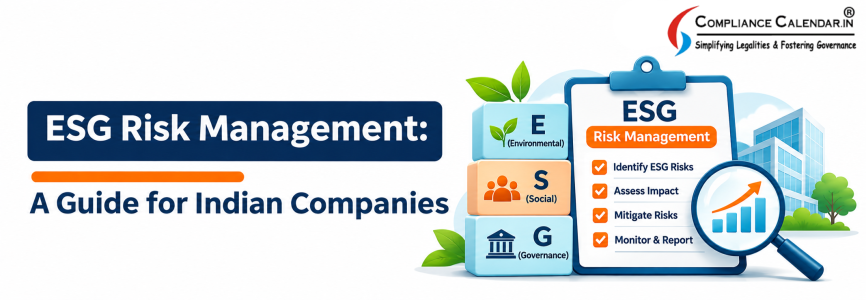
ESG Risk Management in India involves identifying and controlling Environmental, Social and Governance risks that may affect a company's legal compliance, financial performance and business reputation. Indian businesses must consider requirements under the Companies Act, 2013, SEBI regulations, environmental legislation, labour laws and other applicable rules.
What Is ESG Risk Management?
ESG Risk Management is the process of identifying, assessing, monitoring and reducing risks relating to environmental protection, employee welfare and corporate governance. It helps companies understand how their operations could create legal liabilities, financial losses or difficulties in maintaining business relationships.
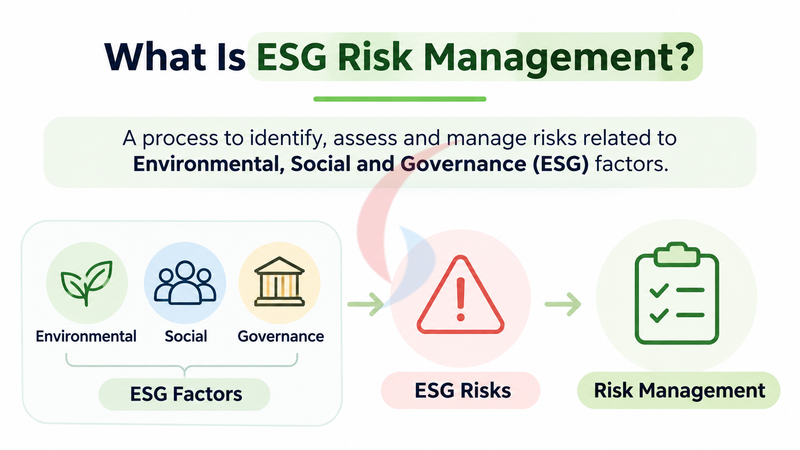
Environmental risks may include excessive pollution, improper waste disposal, high energy consumption and water shortages. Social risks involve unsafe working conditions, employment disputes, discrimination and inadequate employee welfare. Governance risks include fraud, conflicts of interest, weak internal controls and non-compliance with statutory requirements.
For example, a chemical manufacturer may face environmental risks from hazardous waste, social risks from unsafe working conditions and governance risks from unapproved related-party transactions. ESG risk management examines these issues together rather than treating them as unrelated problems.
For a broader understanding of the legal obligations, companies can read ESG Regulations for Companies in India.
Why Is ESG Risk Management Important for Indian Companies?
Business risks are not always visible in financial statements. A company may earn substantial profits while facing environmental proceedings, employee disputes or weaknesses in corporate governance.
ESG risk management helps companies identify these concerns before they develop into larger problems. It also assists management in improving resource efficiency, strengthening internal controls and maintaining reliable compliance records.
Consider a textile manufacturer that consumes large quantities of water. If groundwater availability declines or pollution control conditions become more demanding, production may be affected. A company that monitors water consumption and evaluates alternative processes can plan more effectively.
Similarly, investors and large corporate customers may examine ESG practices before entering into commercial relationships. Companies with organised compliance systems are generally better prepared to respond to these information requests.
Is ESG Risk Management Mandatory in India?
India does not have one comprehensive ESG Risk Management Act requiring every company to adopt the same procedure. Legal requirements depend on listing status, market capitalisation, industry, workforce and business activities.
For specified listed entities, SEBI prescribes corporate governance, risk management and sustainability disclosure requirements. Private companies and MSMEs must comply with the environmental, labour and company law provisions applicable to them, even where BRSR reporting is not mandatory.
ESG Risk Management Applicability
|
Company Category |
Key Requirements |
|
Top 1,000 listed entities |
Mandatory BRSR reporting, subject to applicable SEBI provisions. |
|
Listed entities covered by Regulation 21 |
Risk Management Committee and prescribed risk oversight requirements. |
|
Applicable environmental, labour and governance compliance. |
|
|
Manufacturing Companies |
Pollution control, waste management and workplace safety requirements. |
|
Applicable statutory obligations and possible investor or customer ESG requirements. |
For example, an unlisted packaging manufacturer may not be required to prepare BRSR, but it must still comply with applicable pollution control and waste management laws.
Legal Provisions Governing ESG Risk Management in India
Several Indian laws address different ESG-related risks. Companies should identify the provisions applicable to their business rather than assume that a single policy covers every legal obligation.
|
Law / Regulation |
Relevant Provisions |
Risk Management Requirements |
|
Regulations 17, 21 and 34(2)(f) |
Board oversight, Risk Management Committee and BRSR reporting, where applicable. |
|
|
Sections 134, 135, 166 and 177 |
Risk disclosures, CSR, directors' duties and governance oversight. |
|
|
Sections 3, 5 and applicable rules |
Environmental standards, directions and pollution-related compliance. |
|
|
Applicable consent provisions |
Pollution control permissions and operating conditions. |
|
|
Applicable waste and EPR requirements |
Registration, waste handling, recycling and reporting. |
|
|
Applicable notified provisions |
Wages, employment relations, social security and workplace safety. |
|
|
Sections 4, 9 and 19 |
Workplace harassment prevention, complaint handling and employer duties. |
|
|
Provisions according to phased commencement |
Personal data governance and security obligations. |
These regulations operate independently. A company cannot avoid environmental or employment liabilities merely because it has prepared an ESG risk management report.
Environmental Risks and Compliance Requirements
Environmental risks are particularly important for manufacturing, chemical, textile, construction, mining, packaging and waste management businesses.
Under the Environment (Protection) Act, 1986 and applicable pollution control legislation, companies may be required to meet environmental standards, obtain Consent to Establish (CTE), secure Consent to Operate (CTO) and comply with relevant approval conditions.
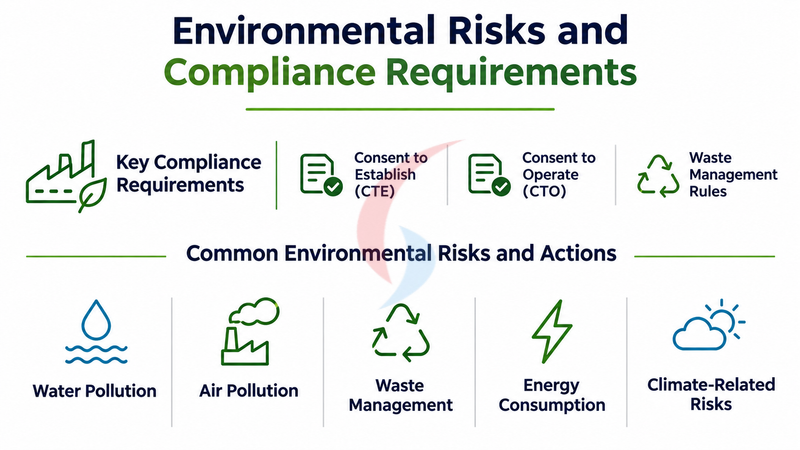
Businesses handling regulated waste may also face obligations under the Plastic Waste Management Rules, 2016, E-Waste (Management) Rules, 2022, Battery Waste Management Rules, 2022 and other applicable legislation, as amended.
Common Environmental Risks
|
Environmental Risk |
Possible Business Impact |
Preventive Measures |
|
Water Pollution |
Regulatory action and operational restrictions |
Maintain wastewater treatment and monitoring systems. |
|
Air Pollution |
Violations of prescribed emission standards |
Monitor emissions and pollution control equipment. |
|
Waste Management |
Improper disposal and EPR non-compliance |
Maintain authorisations and disposal records. |
|
Energy Consumption |
Higher operating costs and emissions |
Monitor energy usage and improve efficiency. |
|
Climate-Related Risks |
Flooding, heat stress and supply disruption |
Prepare business continuity and adaptation measures. |
For example, a textile dyeing unit operating without a valid pollution control consent may face regulatory action even if its annual financial results are strong.
Companies should regularly review consent conditions, statutory returns and applicable environmental permissions.
Social Risks Under Indian Labour Laws
The social component of ESG risk management examines whether companies provide lawful and safe working conditions and meet applicable employee-related obligations.
India's four Labour Codes came into effect from November 21, 2025, subject to notified provisions, transition arrangements and applicable Central and State rules. These laws address wages, industrial relations, social security and occupational safety.
Companies should examine their actual employment arrangements, including contract workers where relevant, and maintain applicable wage registers, social security records, employee safety documents and grievance mechanisms.
The POSH Act, 2013 also imposes obligations concerning prevention and redressal of workplace sexual harassment, including the establishment of an Internal Committee where legally required.
For example, a manufacturer employing 250 workers may have written safety procedures but incomplete training records. This creates difficulties in demonstrating that workplace safety responsibilities have been properly implemented.
A regular review of employment practices, incidents and employee complaints helps management identify social risks before they result in legal disputes or business disruption.
Governance Risks Under the Companies Act, 2013
Governance risk management helps companies maintain transparency, accountability and effective internal controls under the Companies Act, 2013.
|
Legal Provision |
Key Requirements |
|---|---|
|
Section 134(3)(n) |
Disclose the development and implementation of a risk management policy in the Board's Report, including risks threatening the company's existence, where applicable. |
|
Section 166 |
Directors must act in good faith and consider the interests of the company, employees, shareholders, community and environment. |
|
Section 177 |
Prescribes Audit Committee requirements and oversight responsibilities for applicable companies. |
|
Section 188 |
Regulates specified related-party transactions and applicable approval requirements. |
Common Corporate Governance Risks
|
Governance Risk |
Compliance Concern |
|
Weak Board Oversight |
Inadequate monitoring of major business risks. |
|
Related-Party Transactions |
Missing approvals, disclosures or conflicts of interest. |
|
Financial Misreporting |
Inaccurate statutory records and disclosures. |
|
Fraud and Corruption |
Weak ethical controls and misconduct reporting procedures. |
|
Poor Risk Documentation |
Incomplete risk registers and management reviews. |
For example, a company may approve transactions with a related business without following applicable approval requirements. Even if the transaction appears commercially beneficial, non-compliance can create governance and legal risks.
SEBI Risk Management Committee Requirements
Regulation 21 of the SEBI LODR Regulations, 2015 prescribes Risk Management Committee (RMC) requirements for covered listed entities. The committee oversees risk identification, mitigation and monitoring in accordance with Schedule II, Part D.
|
Key Requirement |
SEBI Compliance Provisions |
Practical Example |
|---|---|---|
|
Legal Provision |
Regulation 21 and Schedule II, Part D of SEBI LODR Regulations. |
Applicable listed entities must comply with RMC requirements. |
|
Risk Management Policy |
Formulate and periodically review a detailed risk management policy. |
Identify environmental, financial and operational risks. |
|
ESG Risk Assessment |
Address sustainability, ESG, sectoral and other internal and external risks. |
Assess pollution incidents and employee safety concerns. |
|
Cybersecurity Risks |
Identify information security and cybersecurity risks. |
Establish measures against cyberattacks and data breaches. |
|
Risk Mitigation |
Develop appropriate mitigation measures and internal control systems. |
Introduce pollution monitoring and workplace safety procedures. |
|
Business Continuity |
Establish a business continuity plan to address operational disruptions. |
Prepare for raw material shortages or factory shutdowns. |
|
Committee Oversight |
Monitor policy implementation and review risk management arrangements periodically. |
Conduct committee reviews and track corrective actions. |
Important Note: Companies must verify the current applicability thresholds, committee composition and meeting requirements under the amended SEBI LODR Regulations.
ESG Risk Management and BRSR Reporting
BRSR reporting is closely connected with ESG risk management because it requires specified listed entities to disclose information about sustainability performance and responsible business practices.
Under Regulation 34(2)(f) of the SEBI LODR Regulations, the top 1,000 listed entities by market capitalisation are required to prepare BRSR, subject to applicable provisions.
BRSR Core contains selected ESG indicators relating to emissions, energy, water, waste, employee wellbeing, gender diversity and business transparency.
For FY 2026–27, the phased assessment or assurance requirement extends to the top 1,000 listed entities. These disclosures can help companies identify areas where sustainability data or internal monitoring requires improvement.
For more details, read BRSR Reporting: Applicability, Format and Due Dates and ESG Reporting in India: Applicability and Requirements.
Step-by-Step ESG Risk Management Process in India
An effective ESG risk management process should examine actual business operations, applicable legal requirements and potential financial consequences.
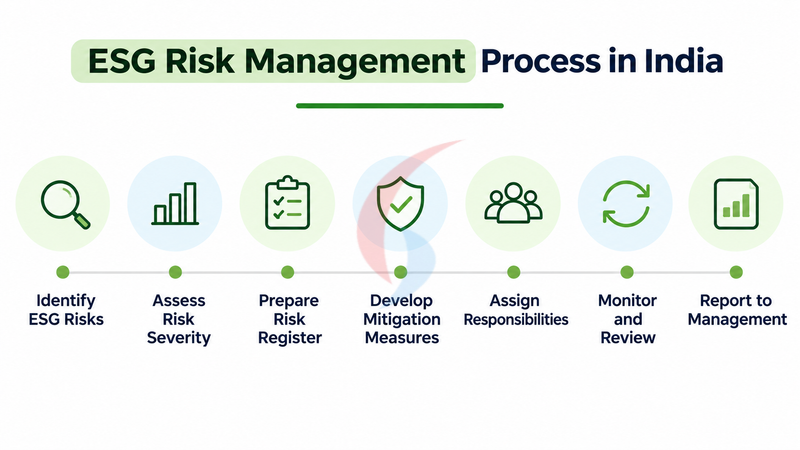
Step 1 – Identify ESG Risks: Review environmental activities, employee practices, governance arrangements and relevant regulatory obligations.
Step 2 – Assess Risk Severity: Evaluate the likelihood and potential consequences of each risk, including legal penalties, operational disruption and financial exposure.
Step 3 – Prepare a Risk Register: Document identified risks, responsible departments, existing controls and required corrective measures.
Step 4 – Develop Mitigation Measures: Establish practical actions such as improved pollution monitoring, employee training, internal approvals and compliance checks.
Step 5 – Assign Responsibilities: Designate managers or committees responsible for implementing the relevant measures.
Step 6 – Monitor and Review: Regularly review incidents, compliance records and performance indicators. Update the risk assessment when business operations or laws change.
Step 7 – Report to Management: Communicate significant findings to senior management and the Board or relevant committee, as applicable.
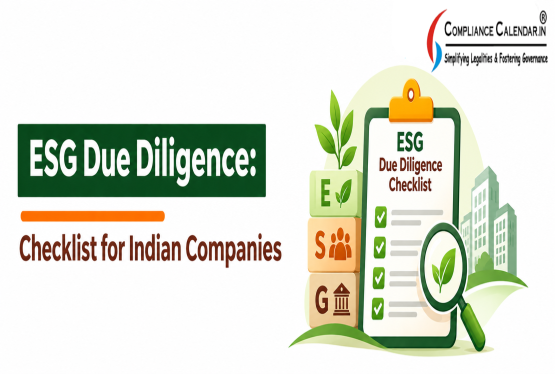
For businesses seeking a structured review, ESG Due Diligence: Checklist for Indian Companies explains the documents and compliance areas that should be examined.
ESG Risk Management Checklist for Indian Companies
|
Risk Category |
Key Documents to Review |
|
Environmental |
Pollution control consents, waste records and environmental reports. |
|
Employee Welfare |
Wage records, social security documents and employment policies. |
|
Workplace Safety |
Training registers, incident reports and safety procedures. |
|
Corporate Governance |
Board minutes, statutory registers and related-party transaction records. |
|
ESG Reporting |
BRSR disclosures, BRSR Core data and verification reports, where applicable. |
|
Business Continuity |
Risk registers, emergency procedures and business continuity plans. |
Companies should ensure that the documents are valid and supported by actual business practices. Written policies alone do not establish effective risk management.
Case Study: How ESG Risk Management Helped a Manufacturing Company
Consider the fictional example of GreenTech Components Pvt. Ltd., an automotive component manufacturer operating in Haryana. The company reported annual revenue of Rs 160 crore and was planning to expand production.
During an internal ESG risk review, management discovered that electricity consumption was increasing, employee safety records were incomplete and waste disposal documentation was maintained separately.
The company introduced monthly energy monitoring, standardised safety records and a centralised compliance review process.
|
Risk Area |
Problem Identified |
Improvement |
|
Energy Consumption |
Annual usage of 18 lakh units. |
Reduced consumption to 16 lakh units. |
|
Employee Safety |
Incomplete training records. |
Introduced regular safety reviews. |
|
Waste Management |
Scattered disposal documentation. |
Centralised waste compliance records. |
|
Governance |
Unclear compliance responsibilities. |
Assigned departmental risk owners. |
At an illustrative electricity tariff of Rs 8 per unit, reducing consumption by 2 lakh units could result in potential annual savings of Rs 16 lakh, excluding implementation expenses.
The company was not automatically required to prepare BRSR because it was unlisted. However, its ESG risk review helped management improve operational controls and respond more confidently to customer compliance requests.
This fictional example shows how identifying ESG risks early can support both legal compliance and cost management.
Latest ESG Risk Management Regulatory Updates in 2026
Several regulatory developments are important for companies reviewing their ESG risk management policies in November 2026.
|
Regulatory Development |
Latest Position |
|
BRSR Core Verification |
SEBI permits assessment or assurance under the March 28, 2025 amendments. |
|
FY 2026–27 Applicability |
Phased BRSR Core verification extends to the top 1,000 listed entities. |
|
Value Chain ESG Disclosures |
Voluntary for the top 250 listed entities from FY 2025–26. |
|
Green Credit Reporting |
Voluntary leadership indicator introduced under BRSR Principle 6. |
|
Environment Audit Rules, 2025 |
Introduced certification and registration arrangements for environmental auditors. |
|
Labour Codes |
Applicable provisions commenced from November 21, 2025, subject to relevant transition requirements. |
|
DPDP Act and Rules |
Data protection obligations are subject to phased commencement. |
The March 28, 2025 SEBI amendments also made value chain ESG disclosures voluntary for the top 250 listed entities from FY 2025–26, while related assessment or assurance is voluntary from FY 2026–27.
Companies should distinguish existing requirements from provisions scheduled to become applicable later, particularly in data protection and sector-specific regulations.
Common ESG Risk Management Mistakes
One common mistake is treating ESG risk management as an annual reporting exercise rather than a continuous management responsibility. Environmental violations, workplace incidents and governance failures can occur throughout the year.
Another mistake is relying on sustainability policies without checking whether they are followed. A company may publish ambitious carbon reduction goals while lacking accurate energy consumption data.
Businesses may also overlook contractor-related responsibilities, pending regulatory notices, supplier risks and the need for regular Board-level monitoring.
Companies should therefore focus on measurable controls, clear responsibilities and documented corrective action rather than general sustainability commitments.
How Compliance Calendar LLP Can Help with ESG Risk Management
ESG Risk Management requires an understanding of environmental regulations, employment laws, corporate governance and SEBI reporting requirements.
Compliance Calendar LLP provides professional support relating to corporate compliance, sustainability advisory and regulatory matters. Businesses can seek assistance in identifying applicable obligations, reviewing compliance records and coordinating corrective actions.
For professional assistance, contact Compliance Calendar LLP at 9988424211 or email info@ccoffice.in
Frequently Asked Questions (FAQ’S)
Q1. What is ESG Risk Management in India?
Ans. ESG Risk Management is the process of identifying, evaluating and controlling environmental, social and governance risks. It helps companies manage regulatory obligations, operational weaknesses and potential financial or reputational exposure.
Q2. Is ESG Risk Management mandatory for all Indian companies?
Ans. No single ESG risk management law applies uniformly to all companies. However, businesses must comply with relevant environmental, labour and corporate laws, while specified listed entities have additional SEBI obligations.
Q3. What are the three main types of ESG risks?
Ans. The three categories are environmental, social and governance risks. They cover issues such as pollution, workplace safety, employee welfare, fraud, transparency and corporate accountability.
Q4. What is the role of SEBI in ESG Risk Management?
Ans. SEBI regulates sustainability disclosures and prescribed risk oversight requirements for covered listed entities through the LODR Regulations, including Regulations 21 and 34(2)(f).
Q5. Is ESG Risk Management required for private limited companies?
Ans. Private companies are not automatically subject to SEBI's BRSR requirements. However, they must comply with applicable environmental, employment and company law obligations and may voluntarily adopt ESG risk management systems.
Q6. What is the difference between ESG Risk Management and ESG Audit?
Ans. ESG Risk Management is a continuous process of identifying and controlling risks. An ESG audit evaluates specified policies, performance or compliance against defined criteria at a particular time or over a reporting period.
Q7. What documents are needed for ESG Risk Management?
Ans. Important documents include environmental permissions, waste disposal records, employee registers, safety reports, Board minutes, statutory filings, risk registers and applicable sustainability disclosures.
Q8. What are the latest SEBI ESG updates applicable in 2026?
Ans. Important updates include BRSR Core assessment or assurance, expanded phased verification coverage for FY 2026–27, voluntary value chain disclosures and voluntary green credit reporting.
Q9. How can companies reduce environmental and social risks?
Ans. Companies can reduce risks through regular compliance reviews, pollution monitoring, employee safety training, proper documentation, grievance mechanisms and timely corrective actions.
Q10. Why is ESG Risk Management important for investors?
Ans. ESG Risk Management helps investors understand potential regulatory liabilities, operational risks and governance weaknesses. Reliable risk information may support more informed investment and business decisions.
Article last updated on : 21 Nov 2026.













































































_learn_crop10_thumb.jpg)