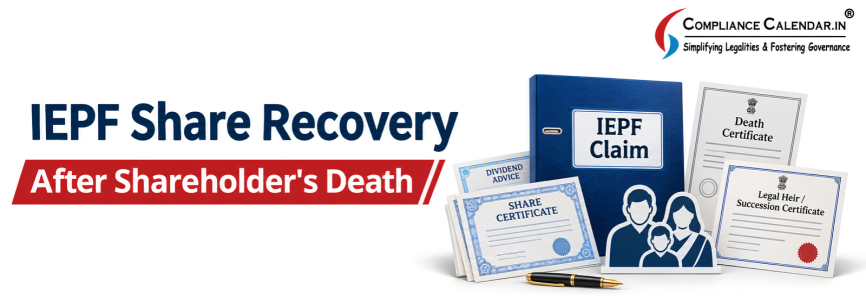



After a family member passes away, the first things most families look for are bank accounts, insurance policies and property documents. Shares purchased many years ago often receive little attention, especially when the investment was made through physical share certificates or the family has lost contact with the company.
Consider a family in Delhi whose father invested in shares of a listed company nearly twenty years ago. After his death, the family discovers old share certificates and dividend records. When his daughter contacts the company's Registrar and Transfer Agent (RTA), she learns that the shares have already been transferred to the Investor Education and Protection Fund (IEPF).
The shares are no longer reflected in the deceased shareholder's active holding records. Does this mean the investment is permanently lost?
No. Eligible legal heirs, nominees, successors and legal representatives can recover shares transferred to IEPF by following the prescribed transmission and claim procedures.
What is IEPF Share Recovery After a Shareholder's Death?
The Investor Education and Protection Fund is established under Section 125 of the Companies Act, 2013. It receives specified unclaimed amounts, including dividends, and holds shares transferred under Section 124(6).
Where dividends remain unpaid or unclaimed for seven consecutive years, the applicable amount is transferred to IEPF. Shares in respect of which dividends have not been paid or claimed for seven consecutive years are also subject to transfer under Section 124(6), subject to the statutory conditions.
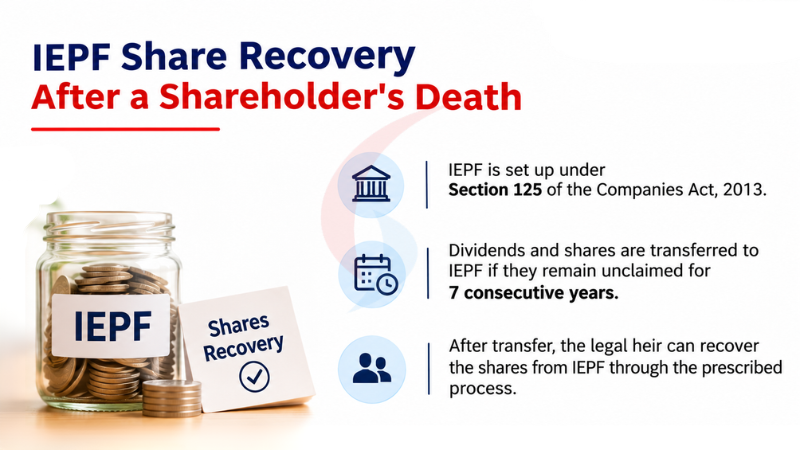
Importantly, the seven-year period relates to unclaimed dividends, not simply the number of years since the shareholder's death. For example, if a shareholder dies in 2018 but dividends continue to be claimed by an entitled person, the shares do not automatically become transferable to IEPF merely because seven years have passed since death. When eligible shares have already been transferred, the rightful claimant may seek their recovery through the prescribed process.
For a detailed explanation, read our article on Recovery of Shares from the Investor Education and Protection Fund
Who Can Claim IEPF Shares After the Shareholder's Death?
A claim may be made by a person legally entitled to the deceased shareholder's securities. The exact documents depend on the original holding structure and the claimant's legal status.
|
Eligible Claimant |
Basis for Claim |
|
Surviving Joint Holder |
Rights arising from the joint shareholding arrangement |
|
Registered Nominee |
Valid nomination recorded with the company or depository |
|
Legal Heir |
Entitlement established under applicable succession law |
|
Successor under a Will |
Valid testamentary entitlement, supported by appropriate documents |
|
Administrator or Executor |
Authority established through relevant legal documentation |
|
Authorised Representative |
May assist with filing on behalf of the entitled claimant, subject to prescribed authorisation |
A registered nominee may have a more straightforward documentary process than an heir without nomination. However, nomination should not automatically be treated as overriding the rights of lawful heirs under succession law. The company's verification process must consider the relevant holding and succession documents.
Laws and Legal Provisions Governing IEPF Share Recovery
IEPF share recovery is governed by the Companies Act, 2013, the IEPF Authority Rules, 2016, and relevant securities transmission requirements.
|
Applicable Act or Rules |
Important Provisions |
Legal Requirements |
|
Section 124(5) and (6) |
Governs transfer of unclaimed dividends and eligible shares to IEPF. |
|
|
Section 125(3) |
Provides for claims and refunds from IEPF. |
|
|
Section 56 |
Addresses transfer and transmission of securities. |
|
|
IEPF Authority (Accounting, Audit, Transfer and Refund) Rules, 2016 |
Rules 6 and 7 |
Governs share transfer to IEPF, claims, documents and verification. |
|
Schedule II and III amendments |
Simplifies specified legal-heir claims and lost-security documentation. |
|
|
Revised Form IEPF-5 |
Updates the prescribed claim application effective 6 October 2025. |
|
|
Transmission of Securities |
Updates the transmission procedure for securities covered by the circular. |
Inheritance rights may also depend on the Indian Succession Act, 1925, or other applicable personal succession laws. Those laws determine entitlement in relevant circumstances, while the IEPF Rules prescribe the process for releasing the securities.
Difference Between Share Transmission and IEPF Share Recovery
Although these procedures are connected, they perform different functions.
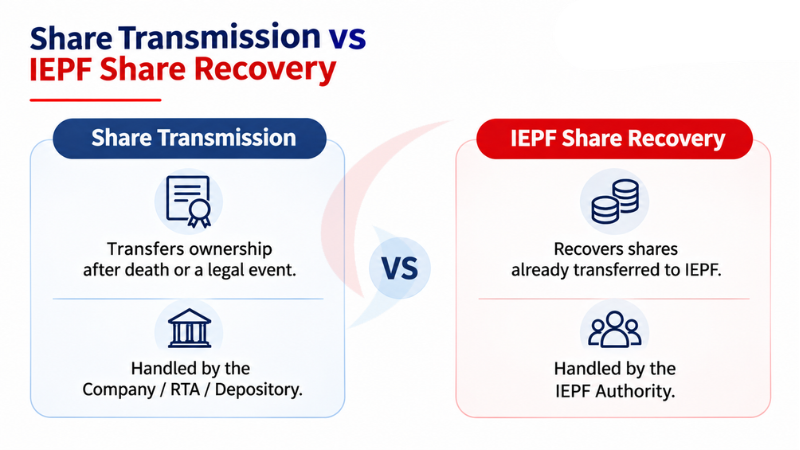
|
Particulars |
Share Transmission |
IEPF Share Recovery |
|
Meaning |
Recognition of ownership following death or another legal event |
Recovery of shares already transferred to IEPF |
|
Main Authority |
Company, RTA or depository, as applicable |
IEPF Authority, with company verification |
|
Principal Documents |
Death certificate, nomination or succession documents |
Form IEPF-5 and prescribed claim documents |
|
Purpose |
Establish the claimant's legal entitlement |
Obtain the release of eligible shares and amounts |
|
Final Outcome |
Recognition or transmission of eligible securities |
Credit of recovered shares to the entitled demat account |
Under Rule 7, legal heirs and nominees must complete the applicable transmission-related verification. Where the transfer or transmission request arises after the securities have moved to IEPF, the company verifies entitlement and provides the required confirmation through its verification report. This distinction matters because the shares are no longer held in the same way as ordinary securities awaiting transmission in the company's register.
For further information, read our article on Transmission Process in Recovery of Shares from IEPF
Practical Story: A Daughter Recovering Her Father's Shares
Consider ABC Investments, a fictional example involving a family in Jaipur. Mr Sharma purchased 500 shares of a listed company in 2005. After his death in 2017, his family could not locate the original investment documents. The dividend cheques continued arriving at his previous address and remained unclaimed.
Several years later, his daughter Priya discovers an old dividend statement mentioning the company name and folio number. She contacts the company's RTA and learns that the shares were transferred to IEPF after the prescribed period of unclaimed dividends.
Priya initially assumes that submitting her father's death certificate will be sufficient. However, the company explains that she must also establish her legal entitlement because no valid nomination is available. She gathers the relevant family documents, obtains the necessary succession-related evidence and completes the company's entitlement verification process.
After the documents are accepted, Priya files Form IEPF-5 through the MCA portal and submits the prescribed supporting papers to the company's Nodal Officer. The company verifies her claim and sends its e-verification report to the IEPF Authority. Following approval and completion of the prescribed procedures, the eligible shares can be credited to the authorised demat account. The example shows that old shares are not necessarily lost after a shareholder's death, but successful recovery requires proper ownership and succession documents.
Documents Required for IEPF Share Recovery by Legal Heirs
The documents required for a deceased shareholder's IEPF claim depend on whether a nominee exists, whether the shares were held jointly, and whether the claimant has valid succession documents.
|
Required Document |
Purpose |
|
Death Certificate |
Establishes the original shareholder's death. |
|
Claimant's PAN and Identity Proof |
Verifies the applicant's identity. |
|
Original Share Certificate or Folio Details |
Helps establish the original shareholding. |
|
Succession Certificate, Probate or Letters of Administration |
Supports entitlement where applicable. |
|
Legal Heirship Certificate |
May establish entitlement subject to the applicable rules. |
|
No-Objection Certificate (NOC) |
May be required from other legal heirs. |
|
Affidavit and Indemnity Bond |
Provides prescribed declarations and indemnity. |
|
Demat Client Master List (CML) |
Identifies the account for receiving recovered shares. |
|
Cancelled Cheque or Bank Proof |
Verifies the account for refunding eligible amounts. |
|
Form IEPF-5 and Acknowledgement |
Records the formal claim submitted to IEPF. |
The precise documentation must follow Schedule II of the IEPF Rules, including subsequent amendments. Lost physical certificates may require additional documents under Schedule III. In particular, the 2024 amendments recognised a legal heir certificate issued by a revenue authority not below the rank of Tahsildar, subject to the prescribed supporting documents and circumstances.
Step-by-Step IEPF Share Recovery Process After Death
Recovering a deceased shareholder's shares generally involves identifying the holding, establishing entitlement, filing Form IEPF-5 and obtaining verification from the relevant company.
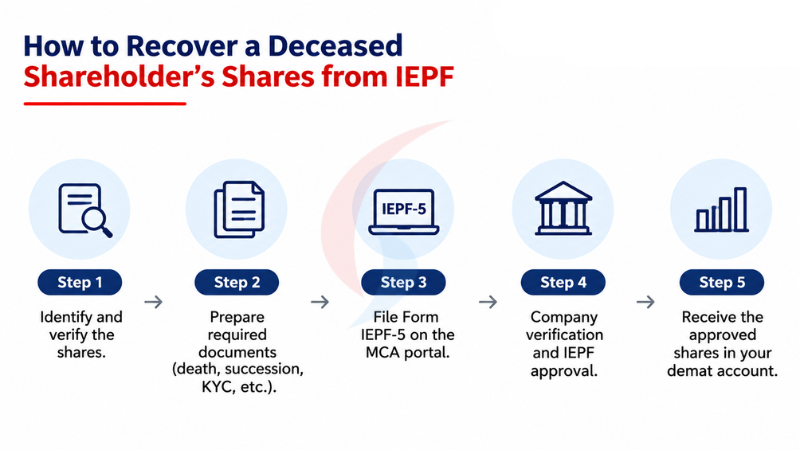
|
Step |
Recovery Procedure |
Key Requirements |
|
Step 1 |
Identify the Shares |
Find the company, folio number, DP details and shareholding records. |
|
Step 2 |
Confirm IEPF Transfer |
Contact the company or RTA to verify whether the shares were transferred. |
|
Step 3 |
Establish Entitlement |
Complete the applicable nomination or legal-heir verification process. |
|
Step 4 |
Prepare Documents |
Collect the death certificate, succession documents, KYC and bank details. |
|
Step 5 |
Arrange Demat Account |
Ensure the entitled claimant has an appropriate active demat account. |
|
Step 6 |
File Form IEPF-5 |
Submit the online claim through the MCA portal. |
|
Step 7 |
Send Supporting Documents |
Submit the prescribed documents to the company's Nodal Officer. |
|
Step 8 |
Company Verification |
The company examines the claim and submits its e-verification report. |
|
Step 9 |
IEPF Approval |
The Authority examines the verified claim and supporting information. |
|
Step 10 |
Receive Shares |
Approved shares are credited through the applicable demat process. |
The current claim facility is accessed through the Ministry of Corporate Affairs Portal under IEPF Services. The company's verification is important because the IEPF Authority generally relies on the company's confirmation of the claimant's entitlement and the original securities.
What Happens When There is No Nominee?
An absence of nomination does not automatically prevent recovery. The legal heirs must establish entitlement through appropriate succession documentation. Depending on the facts, this may involve a succession certificate, probate of a Will, letters of administration or an acceptable legal heirship certificate.
For example, suppose a deceased shareholder leaves behind a spouse and two children but has not nominated anyone. If one child wishes to receive all the shares, the company may require appropriate succession evidence and NOCs or other prescribed documents from the remaining heirs.
Where family members disagree over entitlement, the company or IEPF Authority may require the dispute to be resolved through the appropriate legal process. A claimant should therefore examine the applicable inheritance documents before filing Form IEPF-5.
Read our article on Can Legal Heirs Claim Shares from IEPF on Behalf of a Deceased Shareholder? for further guidance.
Latest IEPF Share Recovery Rules and Updates in 2026
Recent regulatory changes have made the documentation and transmission process particularly important for heirs claiming securities.
|
Regulatory Update |
Important Change |
|
9 September 2024 – IEPF Second Amendment Rules |
Simplified specified legal-heir documentation and revised provisions for lost securities. |
|
1 October 2025 – IEPF Amendment Rules |
Substituted Form IEPF-5, effective 6 October 2025. |
|
19 September 2025 – SEBI Circular |
Facilitated smoother transmission of securities from nominees to legal heirs. |
|
23 July 2026 – SEBI Circular |
Simplified and standardised the transmission process for covered securities. |
|
MCA V3 Filing System |
Provides electronic IEPF-5 filing and company e-verification facilities. |
Important 2026 SEBI Update
On 23 July 2026, SEBI issued Circular No. HO/38/13/11(14)2026-MIRSD-POD/I/17111/2026 concerning simplification and standardisation of securities transmission. This development is relevant to heirs dealing with listed companies, RTAs and depositories.
However, SEBI's transmission procedures and the IEPF Authority's refund requirements should not be treated as identical. A claimant recovering securities already transferred to IEPF must also satisfy Rule 7 and the relevant IEPF claim documentation requirements.
Important 2025 IEPF Amendment
Through G.S.R. 733(E), dated 1 October 2025, the Ministry of Corporate Affairs substituted the prescribed Form IEPF-5, effective 6 October 2025. The revised form includes details concerning claimant identity, entitlement, transmission, deceased shareholders and supporting documents. Therefore, claimants filing in November 2026 should use the current MCA webform rather than an outdated downloadable form or old checklist.
Why Choose Compliance Calendar LLP ?
At Compliance Calendar LLP, we assist shareholders, nominees and legal heirs with share recovery and related documentation.
|
Our Services |
How We Help |
|
IEPF Share Identification |
Assist in tracing eligible shares and relevant company records. |
|
Legal Heir Documentation |
Guide claimants on applicable succession and entitlement documents. |
|
Share Transmission Assistance |
Support documentation for company and RTA verification. |
|
IEPF-5 Filing |
Assist with preparing and submitting claims. |
|
Company and RTA Coordination |
Help respond to document requests and verification queries. |
|
Claim Follow-Up |
Assist with monitoring claim status and resolving discrepancies. |
Explore our Recovery of Shares from IEPF Services for professional assistance.
For guidance, contact Compliance Calendar LLP at 9988424211 or info@ccoffice.in
Frequently Asked Questions (FAQs)
Q1. Can legal heirs recover shares from IEPF after the shareholder's death?
Ans: Yes. Eligible legal heirs, nominees, successors and legal representatives can claim shares transferred to IEPF. They must establish their entitlement and complete the prescribed verification and IEPF-5 filing procedures.
Q2. Is a succession certificate mandatory for every IEPF claim?
Ans: No. The required documents depend on the claimant's status and the applicable provisions. Nomination, probate, legal heirship certificates and other supporting documents may be accepted in specified circumstances.
Q3. Can IEPF shares be recovered without a nominee?
Ans: Yes. Where there is no valid nominee, legal heirs can establish their entitlement using appropriate succession documents. Additional affidavits, indemnities or NOCs may be required.
Q4. Which form is required for recovering deceased shareholders' shares?
Ans: Form IEPF-5 is used to claim eligible shares and amounts transferred to IEPF. It is filed electronically through the MCA portal, followed by the prescribed company verification procedure.
Q5. What happens if the original share certificates are missing?
Ans: The claimant should contact the company or RTA and follow the lost-security documentation procedure. The 2024 amendments simplified certain requirements, but supporting evidence remains necessary.
Q6. How long does IEPF share recovery take?
Ans: The duration depends on company verification, the IEPF Authority's examination and the completeness of documents. Official procedures prescribe processing timelines, but inheritance disputes or incomplete records may cause delays.
Q7. Can a nominee sell shares recovered from IEPF?
Ans: Recovered shares may be dealt with according to applicable securities and succession laws. However, nomination does not necessarily extinguish the beneficial rights of lawful heirs. The nominee's legal position should be examined before disposal.
Q8. Is a demat account required for IEPF share recovery?
Ans: Yes, an appropriate demat account is generally required to receive recovered shares. The claimant should ensure that the account details match the entitlement and identity documents.
Q9. What is the latest IEPF share recovery update in 2026?
Ans: SEBI issued a circular on 23 July 2026 simplifying and standardising transmission of securities. Claimants must also follow the IEPF Rules and the revised IEPF-5 form introduced in October 2025.
Q10. Can Compliance Calendar LLP help recover IEPF shares after death?
Ans: Yes. Compliance Calendar LLP assists legal heirs and nominees with share identification, transmission documentation, IEPF-5 filing, company verification and related recovery procedures.
Article last updated on : 20 Nov 2026.































































_learn_crop10_thumb.jpg)