


What Is Insurance Broker Professional Training and Certification?
Insurance Broker Professional Training and Certification is the prescribed professional qualification process through which eligible individuals acquire the knowledge and certification required to perform specified functions in an insurance broking business. The training covers insurance principles, policy documentation, risk management, legal obligations, customer relationships and professional conduct. After completing the applicable training, candidates must pass the prescribed examination conducted by a recognised examining body.
Under the IRDAI (Insurance Brokers) Regulations, 2018, training and examination requirements apply principally to the Principal Officer and Broker Qualified Persons. However, individual professional certification does not replace the company's IRDAI registration. Both requirements must be satisfied where applicable.
For a detailed explanation of examination preparation and training procedures, explore IRDAI Broker or IMF Exam & Training: The Complete Guide
Legal Provisions Governing Insurance Broker Training
Insurance broker training and certification requirements are primarily prescribed under the Insurance Act, 1938 and the IRDAI (Insurance Brokers) Regulations, 2018, as subsequently amended.
| Legal provision | Requirement |
| Insurance Act, 1938 – Section 42D | Regulation of insurance intermediaries |
| Regulation 2(1)(d), Insurance Brokers Regulations | Definition of Broker Qualified Person |
| Regulation 8(2) | Eligibility and professional requirements for broker registration |
| Schedule I – Form E | Qualifications, training and examinations |
| Schedule I – Form E, Part II | Professional certification requirements |
| Regulation 14, original 2018 provisions | Continuing training and certification-related requirements |
| Schedule I – Form H | Professional conduct and staff competence |
| IRDAI Insurance Intermediaries Amendment Regulations, 2026 | Updated intermediary governance and operational requirements |
Schedule I – Form E is particularly important because it prescribes qualifications and the initial training routes for Principal Officers and Broker Qualified Persons.
Learn about the regulatory conditions for obtaining a broker licence in Conditions for Grant of Insurance Broker License in India
Who Needs Professional Training in an Insurance Broking Company?
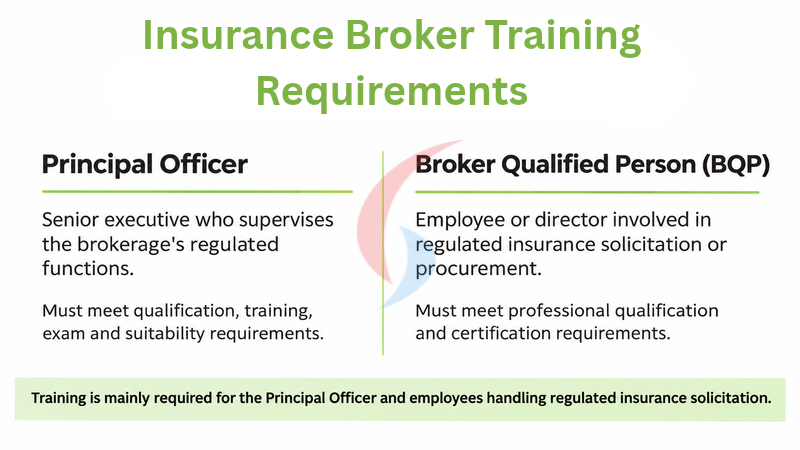
Not every employee working in an insurance brokerage company automatically needs the same professional certification. The requirements depend on the employee's designation and actual responsibilities. A person performing ordinary administrative functions is different from an employee authorised to solicit or procure insurance business. The two important categories are:
| Particulars | Principal Officer | Broker Qualified Person (BQP) |
|---|---|---|
| Role | A senior designated executive responsible for carrying out the brokerage's regulated functions. | An employee or director involved in regulated insurance solicitation or procurement activities. |
| Responsibilities | Supervises insurance broking operations and ensures regulatory compliance. | Performs authorised insurance solicitation and procurement activities. |
| Qualifications | Must meet prescribed educational, training, examination and suitability requirements. | Must meet applicable professional qualification, training and certification requirements. |
| Job Designation | Holds a designated senior executive position. | Eligibility depends on actual duties rather than job title. |
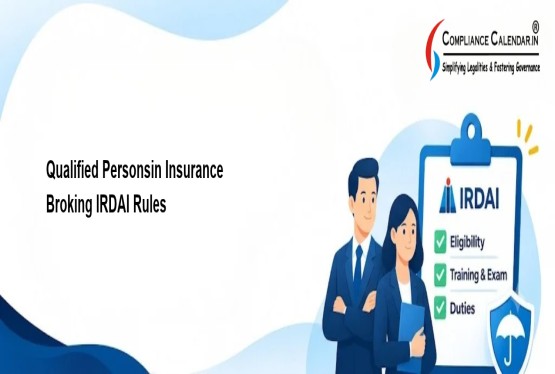
To understand the eligibility and responsibilities of certified personnel, read Qualified Persons in Insurance Broking
Educational Qualifications for Insurance Broker Certification
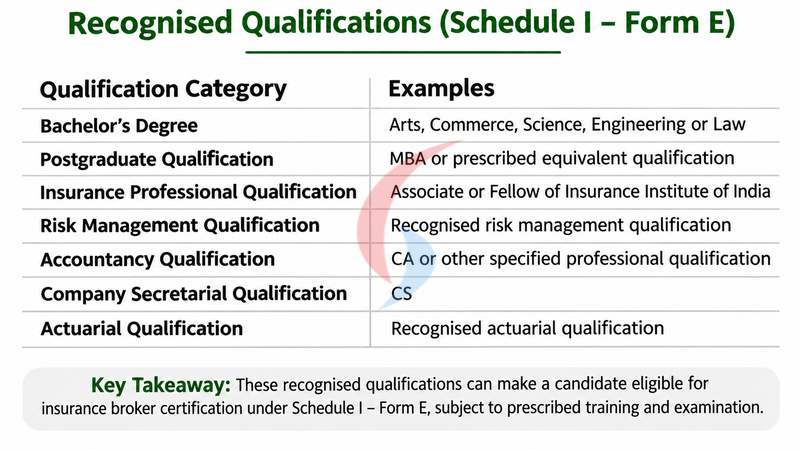
Schedule I – Form E recognises several educational and professional qualifications. Candidates do not necessarily need an insurance-specific degree if they possess another recognised qualification under the regulations.
| Qualification category | Examples |
| Bachelor's degree | Arts, Commerce, Science, Engineering or Law |
| Postgraduate qualification | MBA or prescribed equivalent qualification |
| Insurance professional qualification | Associate or Fellow of Insurance Institute of India |
| Risk management qualification | Recognised risk management qualification |
| Accountancy qualification | CA or other specified professional qualification |
| Company secretarial qualification | CS |
| Actuarial qualification | Recognised actuarial qualification |
For example, Rahul's commerce degree may satisfy the educational eligibility requirement. However, he must still complete the prescribed training and examination before being treated as a certified BQP. Certain recognised professional qualifications also provide eligibility for the reduced training route.
For senior management eligibility and qualifications, explore IRDAI Principal Officer Requirements for Insurance Brokers
Insurance Broker Training Hours
The initial training requirements under Schedule I – Form E distinguish between general candidates and those holding certain recognised professional qualifications. The general training requirement is 50 hours of theoretical and practical training through an institution recognised by IRDAI. Eligible candidates possessing certain specified professional qualifications may complete a reduced 25-hour training programme.
| Candidate category | Initial training hours |
| General eligible candidates | 50 hours |
| Candidates meeting the prescribed professional qualification conditions | 25 hours |
For example, Rahul, who holds a B.Com degree without one of the specified professional exemptions, would ordinarily follow the 50-hour route. A qualified Chartered Accountant meeting the applicable conditions may be eligible for the 25-hour route. Candidates should confirm their training category with the recognised training provider before enrolling. A degree or professional designation should not be assumed to qualify automatically for the shorter programme.
What Is Covered in Insurance Broker Professional Training?
Professional training prepares individuals to understand the practical and legal responsibilities involved in insurance distribution. The precise curriculum depends on the applicable programme and insurance broking category. Training generally addresses insurance principles, life and general insurance products, risk assessment, documentation, claims, professional ethics and regulatory requirements.
For example, a broker handling manufacturing clients should understand why a machinery breakdown policy may not automatically provide business interruption coverage. Similarly, an employee arranging employee health insurance should understand waiting periods, policy exclusions and the importance of accurate disclosures. Training also helps individuals understand customer confidentiality, suitability of recommendations and how to avoid misleading policy comparisons. The objective is not merely to pass an examination. It is to develop the professional competence necessary to assist customers responsibly.
Learn how professional conduct and customer protection obligations work in Conflict of Interest Rules for Insurance Broker
Insurance Broker Examination Conducted by National Insurance Academy
After completing the required training, candidates must pass the prescribed insurance brokers' examination. The National Insurance Academy (NIA), Pune administers the insurance brokers' examination and publishes the applicable registration procedure, examination pattern, fees and schedule. According to NIA's current published examination information:
| Examination detail | Requirement |
| Exam authority | National Insurance Academy, Pune |
| Mode | Online examination |
| Question format | Objective, multiple-choice |
| Passing marks | 50% |
| Direct / Reinsurance Broker papers | 80 questions |
| Composite Broker paper | 120 questions |
| Duration | Generally 90 or 120 minutes, depending on category |
| Examination fee | Rs 3,500 plus GST and applicable transaction charges |
The examination includes compulsory insurance knowledge and relevant modules for life, general or reinsurance broking. NIA states that candidates must complete the required 50-hour or 25-hour training before enrolling and register with their sponsoring company details. Its published schedule currently lists 5 December 2026 as the next examination date, with registration closing on 24 November 2026 at 4:00 PM. Candidates should verify any changes directly on NIA's website.
Case Study: Hiring an Uncertified Insurance Broker Employee
Akansha had recently established an insurance broking company in Faridabad. Her business was growing, and several clients had approached her for commercial insurance, employee health coverage and property insurance. To handle the increasing workload, she hired Rahul, an experienced sales professional who had previously worked in the financial services industry.
Rahul understood customer relationships and was confident about explaining financial products. Akansha believed that his experience would be sufficient to start approaching insurance customers. However, during an internal compliance review, her advisor asked a simple question: Had Rahul completed the prescribed insurance broker training and passed the required examination?
Rahul had not. Although he possessed a recognised degree and relevant work experience, he had never completed the professional training required for a Broker Qualified Person (BQP). Akansha realised that having a knowledgeable employee was not the same as having a properly qualified person authorised to perform regulated insurance broking activities.
Her advisor explained that insurance brokers must maintain qualified personnel who understand insurance products, risk assessment, customer protection and IRDAI regulations. Before undertaking regulated solicitation and procurement activities, the relevant personnel must satisfy the applicable professional requirements.
Process for Insurance Broker Training and Certification
Step 1: Verify Educational Eligibility
The candidate should first check whether their educational or professional qualification meets Schedule I – Form E. The insurance broking company should also verify the role for which the candidate requires certification. This prevents employees from joining an unsuitable training programme.
Step 2: Select the Appropriate Training Programme
Determine whether the candidate must complete 50 hours or qualifies for the reduced 25-hour programme. Training must be undertaken through an institution recognised for the prescribed purpose. Candidates can refer to the NIA Brokers' Online Training Portal for relevant training arrangements.
Step 3: Complete Professional Training
The candidate must complete the prescribed theoretical and practical training and obtain the training completion certificate. The programme should correspond to the intended insurance broking category. The sponsoring brokerage should retain evidence of completion.
Step 4: Register for the Examination
After completing training, candidates can follow the registration procedure available on the NIA examination website. They must submit the required personal, sponsorship and training information. The prescribed fee must be paid through the authorised payment system.
Step 5: Pass the Examination
The candidate must obtain the required passing marks in the applicable examination. Preparation should cover the compulsory module and relevant insurance subjects. After passing, the candidate should download and preserve the examination certificate.
Step 6: Complete Company Documentation
The brokerage should verify the training, examination and qualification records before assigning regulated responsibilities. The employee's certification and sponsoring-broker information should be maintained accurately. The company must also satisfy any applicable regulatory personnel requirements.
Insurance Broker Certification Validity and Continuing Training
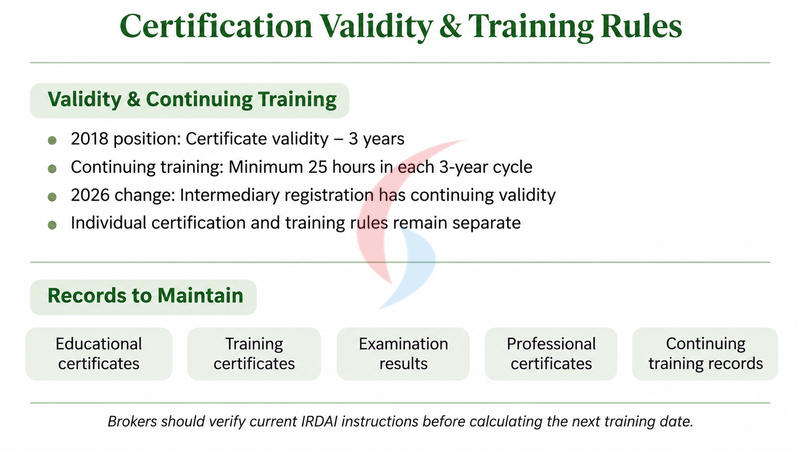
The original 2018 regulations provided a three-year validity period for individual Principal Officer and BQP certificates, with continuing training requirements. Regulation 14 also prescribed at least 25 hours of additional training within the applicable three-year training cycle. The original wording linked this requirement to the renewal of the broker's registration. The regulatory position changed in 2026 when IRDAI introduced continuing validity for intermediary registrations, subject to prescribed conditions. Therefore, a company's continuing registration should not be confused with the certification or continuing-training requirements applicable to individuals. Brokers should verify current IRDAI instructions concerning continuing training, individual certification validity and applicable transitional arrangements before calculating a particular employee's next training date.
Importance of Training Records and Certification Compliance
Maintaining training documentation is an important part of regulatory compliance. A brokerage should be able to demonstrate that individuals performing regulated activities possess the necessary qualifications. Relevant records include educational certificates, training completion certificates, examination results, professional certificates, employment details and continuing-training records.
The July 2026 intermediary amendments also strengthened requirements for identifying the authorised personnel associated with insurance solicitation. Insurance brokers must maintain relevant policy-wise records and arrangements for identifying the persons involved. For example, if Rahul solicits a commercial insurance policy, Akansha's company should be able to identify him as the responsible authorised person and produce his relevant qualification records when required.
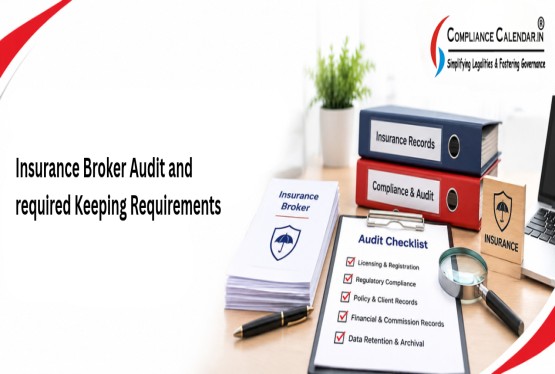
To understand document retention and regulatory inspections, explore Insurance Broker Audit and Record-Keeping Requirements
Latest IRDAI Updates Affecting Insurance Broker Training in 2026
On 30 July 2026, IRDAI notified the Insurance Intermediaries (Amendment) Regulations, 2026, introducing changes affecting insurance brokers and other regulated intermediaries. The amendments introduced continuing registration arrangements and stronger requirements for identifying personnel responsible for insurance solicitation. In digital insurance transactions conducted without a salesperson's involvement, specified documents must disclose the Principal Officer's contact details.
The reforms also address professional training and personnel arrangements across intermediary categories. However, training requirements for corporate agent or insurance marketing firms should not automatically be applied to insurance brokers without checking the relevant broker-specific provisions. Existing broker registration certificates issued for three-year periods are also subject to transitional arrangements, including the 31 January 2027 deadline for obtaining replacement certificates under the revised system, with a further prescribed window subject to additional fees. Insurance brokers should review their internal training and personnel compliance procedures in light of these developments.
Common Mistakes in Insurance Broker Training and Certification
One common mistake is assuming that sales experience or an academic degree automatically makes someone eligible to solicit insurance business. Another is enrolling candidates in the reduced training programme without confirming their eligibility. Brokerage companies may also overlook examination deadlines, retain incomplete certificates or fail to maintain accurate sponsoring-company records. Businesses should avoid assuming that a certificate of registration issued to the brokerage authorises every employee to undertake regulated insurance activities. Proper qualification checks, staff training calendars and regular documentation reviews can help reduce these risks.
For broader post-registration obligations, read Insurance Broker Compliances in India
Why Choose Compliance Calendar LLP?
Insurance Broker Professional Training and Certification involves eligibility assessment, prescribed professional courses, examinations, staff documentation and ongoing regulatory compliance.
Compliance Calendar LLP assists businesses in understanding insurance broker registration requirements and the documentation necessary for IRDAI-regulated operations. Our team helps organisations identify relevant licensing, personnel and compliance obligations.
For assistance with insurance broker registration and related regulatory compliance, contact Compliance Calendar LLP at +91 9988424211 or info@ccoffice.in
Frequently Asked Questions (FAQs)
Q1. Is professional training mandatory for insurance brokers in India?
Ans. Yes, Principal Officers and Broker Qualified Persons must meet the prescribed professional requirements. Training and examination conditions are provided under Schedule I – Form E of the 2018 Regulations. The applicable rules should be read with subsequent IRDAI amendments.
Q2. How many hours of training are required for insurance broker certification?
Ans. The general initial requirement is 50 hours of theoretical and practical training. Certain candidates holding specified recognised professional qualifications may qualify for 25 hours. Eligibility for the reduced training route must be verified.
Q3. Who conducts the insurance broker certification examination?
Ans. The National Insurance Academy, Pune, conducts the prescribed brokers' examination. Candidates must complete the applicable training before registering. The examination schedule, fees and registration procedures are published on NIA's official website.
Q4. What are the passing marks for the insurance broker examination?
Ans. The passing requirement published by the National Insurance Academy is 50%. The examination consists of objective questions covering compulsory and category-specific insurance subjects. The number of questions depends on the selected broker category.
Q5. Can a Chartered Accountant apply for insurance broker certification?
Ans. Yes, a qualified Chartered Accountant may satisfy the applicable professional qualification requirements. Certain recognised professionals may qualify for the reduced 25-hour initial training route. They must also satisfy the prescribed examination and certification conditions.
Q6. Can a commerce graduate become a Broker Qualified Person?
Ans. Yes, a recognised commerce degree can satisfy the educational eligibility requirement. However, the candidate must complete the applicable training and prescribed examination. A degree alone does not authorise regulated insurance solicitation.
Q7. Is continuing professional training necessary after initial certification?
Ans. The original 2018 Regulations prescribed a continuing-training requirement of at least 25 hours within the applicable cycle. Brokers should verify the current requirements following the 2026 amendments. Continuing professional development helps maintain regulatory and product knowledge.
Q8. Can an employee sell insurance before completing BQP certification?
Ans. An employee should not undertake activities requiring BQP authorisation without satisfying the applicable requirements. Purely administrative responsibilities may not require the same qualification. The company must assess the employee's actual duties.
Q9. Is insurance broker certification different from an insurance broker license?
Ans. Yes, an insurance broker license authorises an eligible business entity to conduct regulated brokerage activities. Individual professional certification establishes that specified personnel meet qualification requirements. Both operate under different regulatory provisions.
Q10. What documents are required for insurance broker examination registration?
Ans. Candidates generally need their training completion certificate, identification details, photograph and sponsoring-broker information. NIA specifies the documents and file formats required for examination registration. Candidates should follow the latest instructions published by the Academy.
Article last updated on : 21 Nov 2026.




















































_learn_crop10_thumb.jpg)