


A proprietorship is one of the easiest ways to start a business in India. One person owns the business, takes all decisions and manages its daily work. There are fewer formalities compared with running a company. This is why many small shop owners, traders, manufacturers and service providers start their businesses as proprietorship firms.
But as the business grows, the owner may need a different business structure. Perhaps the business wants to bring in an investor, work with large companies, apply for bigger loans or expand into new markets. At this stage, a Private Limited Company may be a better choice because it has its own legal identity and offers limited liability to its shareholders.
This change is commonly called conversion of a proprietorship firm into a Private Limited Company. However, it is important to understand that a proprietorship cannot be directly converted through one MCA form. The usual process is to register a new Private Limited Company and then transfer the existing business to it through proper documents and agreements. This may include the business name, stock, machinery, employees, customer contracts, assets and liabilities.
What Does Conversion of a Proprietorship into a Private Limited Company Mean?
A proprietorship and a Private Limited Company are two different types of business structures. In a proprietorship, the owner and the business are treated as the same person in law. The business may have a trade name, GST registration or Udyam Registration, but these do not create a separate legal identity for it.
A Private Limited Company is registered with the Ministry of Corporate Affairs (MCA). After registration, the company becomes a separate legal entity. It can own property, open a bank account, enter into agreements and carry out business in its own name. Its shareholders own the company, while its directors manage its work.
When a proprietor decides to move the business into a company, a new company is first registered. The existing business is then transferred to it through a Business Transfer Agreement or another suitable arrangement. The proprietor can become a shareholder and director of the new company. The transfer should clearly cover the assets, liabilities, stock, employees, contracts and other parts of the business.
A Real Example of a Proprietorship Becoming Part of a Company
A similar change has taken place in an actual Indian business. Quality RO Products was a proprietorship owned by Mr. Vivek Dholiya. Later, a new company named Quality RO Industries Private Limited was registered to take over this business.
As per the company's records filed with SEBI, both sides signed a Business Transfer Agreement on 2 November 2021. Under this agreement, the company took over the existing business, including its assets and liabilities. This means the business moved from the proprietor to the newly registered company through a proper agreement.
Why Do Business Owners Choose a Private Limited Company?
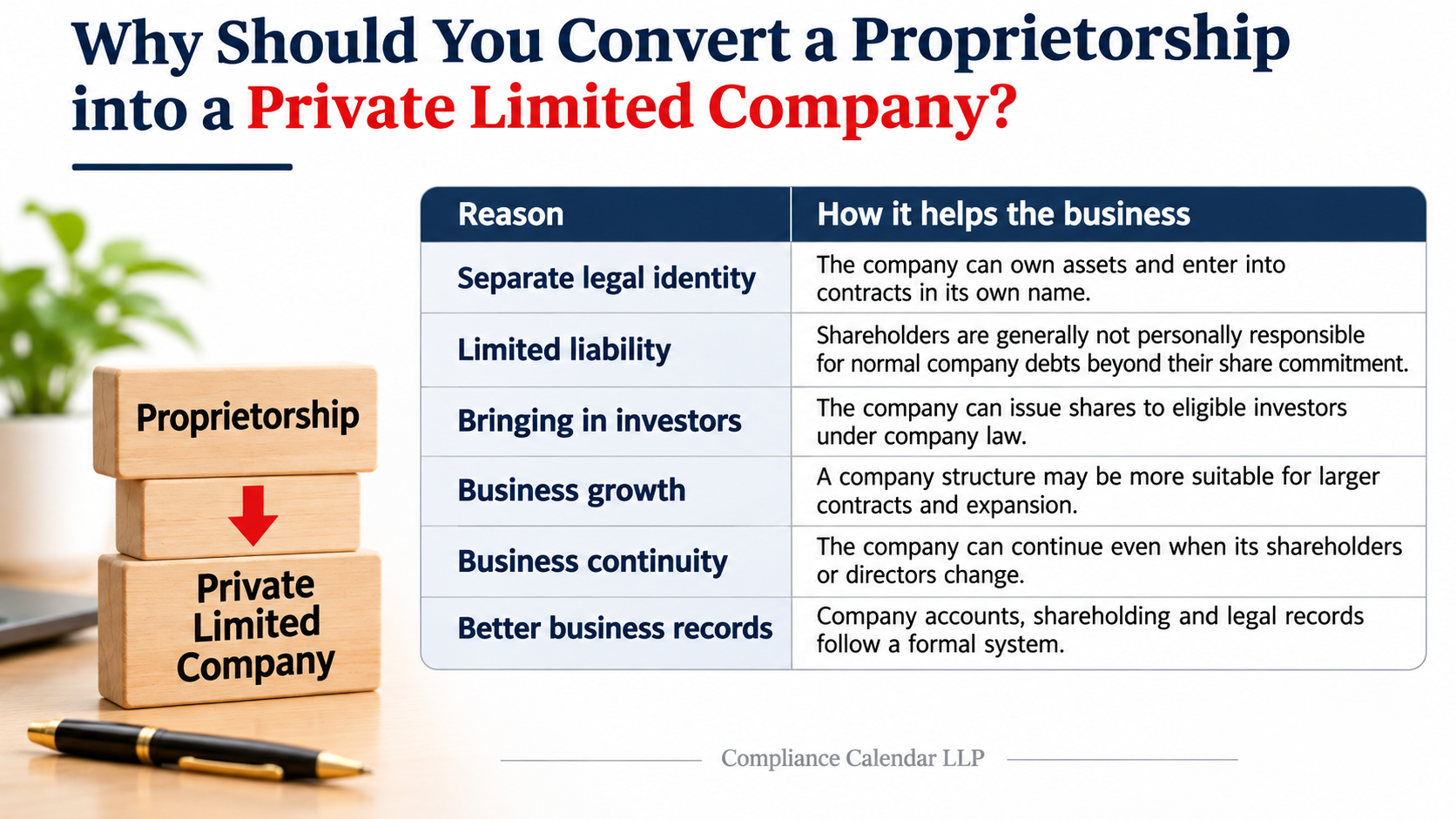
A proprietorship is suitable for many small businesses, but it may become less useful when the business grows. The owner may need more funds, better protection from business risks or a structure that allows other people to invest. A Private Limited Company can help with these needs, although it also brings more legal and filing work.
Here are some common reasons why business owners choose this change:
|
Reason |
How it helps the business |
|
Separate legal identity |
The company can own assets and enter into contracts in its own name |
|
Limited liability |
Shareholders are generally not personally responsible for normal company debts beyond their share commitment |
|
Bringing in investors |
The company can issue shares to eligible investors under company law |
|
Business growth |
A company structure may be more suitable for larger contracts and expansion |
|
Business continuity |
The company can continue even when its shareholders or directors change |
|
Better business records |
Company accounts, shareholding and legal records follow a formal system |
The biggest difference is that the company is separate from its owners. In a proprietorship, the owner is personally responsible for business debts. In a company, shareholders generally have limited liability. However, this protection is not absolute. Personal guarantees, fraud and certain legal defaults may still create personal responsibility.
A Private Limited Company also has more compliance requirements. It needs proper accounts, an annual audit, company filings and other records. So, the owner should compare the benefits with the extra cost and work before deciding.
What Are the Requirements for Conversion?
Before starting the process, the proprietor should understand the basic requirements for setting up a Private Limited Company and transferring the existing business.
|
Requirement |
What is needed |
|
Shareholders |
At least two shareholders |
|
Directors |
At least two directors |
|
Resident director |
At least one director must meet the Indian residency requirement |
|
Company name |
The proposed name must follow MCA rules and be available |
|
Registered office |
A valid registered office address in India |
|
Business transfer |
A proper agreement covering the business being transferred |
|
Shareholding |
The proprietor should plan the shareholding carefully |
|
Tax conditions |
The transfer should be checked for possible tax benefits and liabilities |
Note:The proprietor can become one of the shareholders and directors of the new company. Another person can join as the second shareholder and director. The same person can be both a shareholder and a director. There is no general minimum paid-up share capital requirement for an ordinary Private Limited Company. The company should decide its share capital based on its business needs.
Documents Required for Conversion of Proprietorship into Private Limited Company
The documents are needed for two main purposes: registering the new company and transferring the existing business. The exact list depends on the type of business, its assets, its registrations and the way the transfer is planned.
Documents for Company Registration
The proposed shareholders and directors generally need to provide:
- PAN card.
- Aadhaar card, passport or another accepted identity proof.
- Address proof, such as a bank statement or utility bill.
- Recent passport-size photographs.
- Mobile number and email address.
- Digital Signature Certificate (DSC), wherever required.
For the registered office, the following documents may be needed:
- Recent electricity bill or another utility bill.
- Ownership proof or rent agreement.
- No Objection Certificate (NOC) from the property owner, where applicable.
- Other address documents required by the MCA.
The company also needs a Memorandum of Association (MoA) and Articles of Association (AoA). The MoA explains the company's main business activities, while the AoA contains rules for managing the company.
For more information Kindly Visit : Alteration of MoA & AoA
Documents for Business Transfer
The proprietor should also arrange the following records:
- Existing business PAN and GST registration details.
- Udyam Registration or other business registration certificates, if applicable.
- List of machinery, equipment, stock and other assets.
- Details of loans, unpaid bills and other liabilities.
- Latest business accounts and financial records.
- Details of customers, suppliers and business contracts.
- Employee details and employment records.
- Trademark, brand name and other intellectual property details.
- Bank statements and other business records.
- Valuation report, where required.
A Business Transfer Agreement is particularly important because it records what the company is taking over, the value of the business or its assets, the liabilities being transferred and the agreed terms. The agreement should be prepared according to the actual business arrangement, not copied from a general format.
How to Convert a Proprietorship into a Private Limited Company
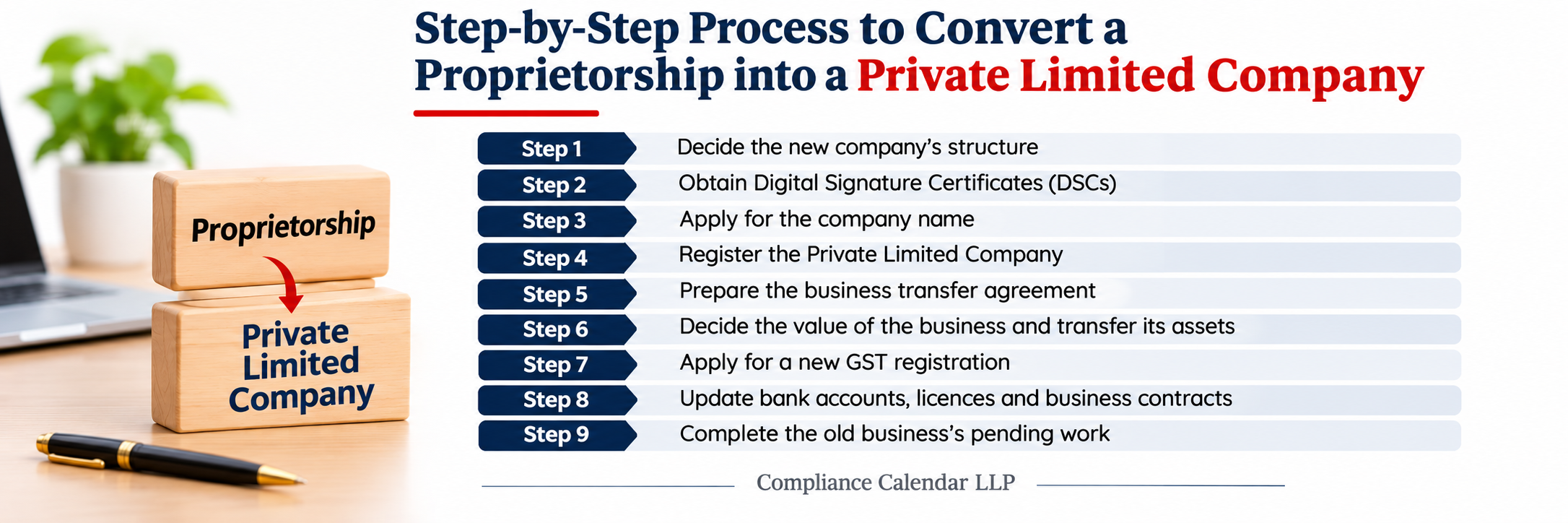
The process has two main parts: registering the new company and transferring the existing business to it. Both should be planned together so that there is no confusion about ownership, payments, tax or daily business operations.
Step 1: Decide the New Company's Structure
First, decide who will own and manage the new company. The proprietor should identify the proposed shareholders, directors, shareholding percentage, company name and registered office address.
The owner should also prepare a list of the existing business assets, liabilities, stock, employees, contracts and registrations. This will help decide what needs to be transferred and what approvals may be required. It is better to discuss the proposed shareholding and tax position with a Chartered Accountant or Company Secretary before starting the process.
Step 2: Obtain Digital Signature Certificates
The proposed directors and shareholders who need to sign the incorporation forms electronically must have valid Digital Signature Certificates (DSCs).
A DSC works like an electronic signature. It is used to sign forms and documents on the MCA portal. The details on the DSC application should match the identity documents and information used in the company registration forms. Any difference in names or other details may lead to filing problems.
Step 3: Apply for the Company Name
The proposed company name must be checked before applying for registration. It should not be identical or too similar to the name of an existing company or conflict with applicable naming rules.
The name can be applied for through Part A of the SPICe+ form on the MCA portal. The owner should also check whether the proposed name is already used as a trademark. For example, if the proprietorship operates under the name "Bright Future Traders", the owner may want to use a similar name for the new company. The final name will depend on MCA approval.
Remember that approval of a company name does not automatically give trademark rights. If the business wants to protect its brand name, it should separately consider Trademark Registration.
Step 4: Register the Private Limited Company
After the name is approved, the applicant can complete the incorporation application through SPICe+ Part B and the linked forms. The application includes details about the company, directors, shareholders, registered office, share capital and business activities. The MoA and AoA are also filed as part of the process.
Once the MCA approves the application, the Registrar of Companies (ROC) issues the Certificate of Incorporation. The company receives its own Corporate Identification Number (CIN), PAN and TAN through the incorporation process. The company is now legally registered, but the old proprietorship business has not automatically moved into it.
For more details, read our detailed well explained articles on How to Register a Private Limited Company in India and How to Register a Private Limited Company Through MCA.
Step 5: Prepare the Business Transfer Agreement
After the company is registered, the proprietor and the company should prepare a Business Transfer Agreement. This agreement records which parts of the existing business will move to the company and the terms of the transfer.
It may cover machinery, stock, furniture, customer contracts, supplier agreements, employees, business debts, trademarks and other rights. It should also explain the value of the transfer and how the company will pay for it. If the proprietor wants to claim the tax benefit available for succession of a proprietorship by a company, the agreement and share allotment must meet the required conditions.
The agreement should be properly drafted and checked before signing. You can explore our Drafting and Vetting Services for help with business agreements and other legal documents.
Step 6: Decide the Value of the Business and Transfer Its Assets
The proprietor should prepare a clear list of the assets and liabilities that will move to the company. This may include stock, machinery, computers, vehicles, loans, unpaid supplier bills and other business items.
The value of the business or its assets should be worked out using suitable records and professional advice. A valuation may be needed depending on the transaction and the legal or tax purpose. You can read about our Valuation Services if a business or asset valuation is required.
The transfer should also be recorded in the company's books. Some assets may need separate ownership documents, registrations or approvals. For example, transferring immovable property may require a registered document and payment of stamp duty under the applicable state law. A Business Transfer Agreement alone does not automatically update every ownership record.
Step 7: Apply for a New GST Registration
The new company has a separate PAN from the proprietor. Therefore, the old GST registration cannot simply continue in the company's name. The company must obtain its own GST registration if registration is required or if it chooses to register voluntarily.
If the proprietorship has unused Input Tax Credit (ITC), it may be possible to transfer the eligible credit to the company through Form GST ITC-02. This is subject to the GST rules and the required transfer of business liabilities. The company must accept the credit transfer on the GST portal.
Step 8: Update Bank Accounts, Licences and Business Contracts
The company should open and use its own bank account. Customers and suppliers should be informed about the change so that future invoices, payments and agreements carry the correct company details.
The proprietor should also review existing business licences and registrations. Some may need a fresh application, while others may allow an amendment or transfer after approval from the concerned authority. This may include the Shops and Establishment registration, trade licence, FSSAI licence, IEC, factory licence and other industry-specific approvals.
Existing loan documents, rental agreements, customer contracts and supplier agreements should also be checked. Some may require written consent before they can be transferred to the company.
Step 9: Complete the Old Business's Pending Work
After the transfer, the proprietor should check all pending tax returns, GST returns, payments and other filings up to the transfer date. Registrations that are no longer required in the proprietor's name should be closed or updated through the correct process.
The new company must maintain its own books, issue invoices in its own name and complete its tax and company law filings. Do not close the old registrations before checking that the company has received the required registrations and that the business transfer is properly recorded.
Is Conversion of a Proprietorship into a Private Limited Company Tax-Free?
The transfer may qualify for relief from capital gains tax, but it is not automatic. The conditions must be followed carefully.
For transfers taking place on or after 1 April 2026, Section 70(1)(zf) of the Income-tax Act, 2025 covers the succession of a sole proprietorship concern by a company. The main conditions are:
The transfer must meet these four conditions:
- All assets and liabilities of the proprietorship must be transferred to the company.
- The proprietor must hold at least 50% voting power in the company after the transfer.
- The proprietor must maintain this 50% shareholding for five years.
- The proprietor must receive company shares only, without any other payment or benefit.
For example, if the proprietor transfers the entire business to the new company and receives shares in return, the transfer may qualify for this relief if all the legal conditions are met. However, if the proprietor receives cash or other benefits, or the required shareholding is not maintained, the tax treatment may change.
For transfers made before 1 April 2026, the corresponding provision was Section 47(xiv) of the Income-tax Act, 1961. The applicable provision depends on the date of the business succession. A Chartered Accountant should review the transfer agreement, asset and liability records, shareholding and tax position before the transaction is completed.
What Happens to GST Registration After the Transfer?
The old GST registration belongs to the proprietorship and is linked to the proprietor's PAN. The new company has a different PAN, so it needs its own GST registration where applicable.
If the business has unused input tax credit, it may be transferred through Form GST ITC-02 when the required conditions are met. The transferor and the company must complete the required steps on the GST portal, including acceptance by the company.
The proprietor should also check the old GST returns, pending tax payments and stock records before applying to cancel the old registration. The date of transfer should be planned carefully so that invoices and GST returns are issued under the correct GSTIN.
What Needs to Be Done After Conversion?
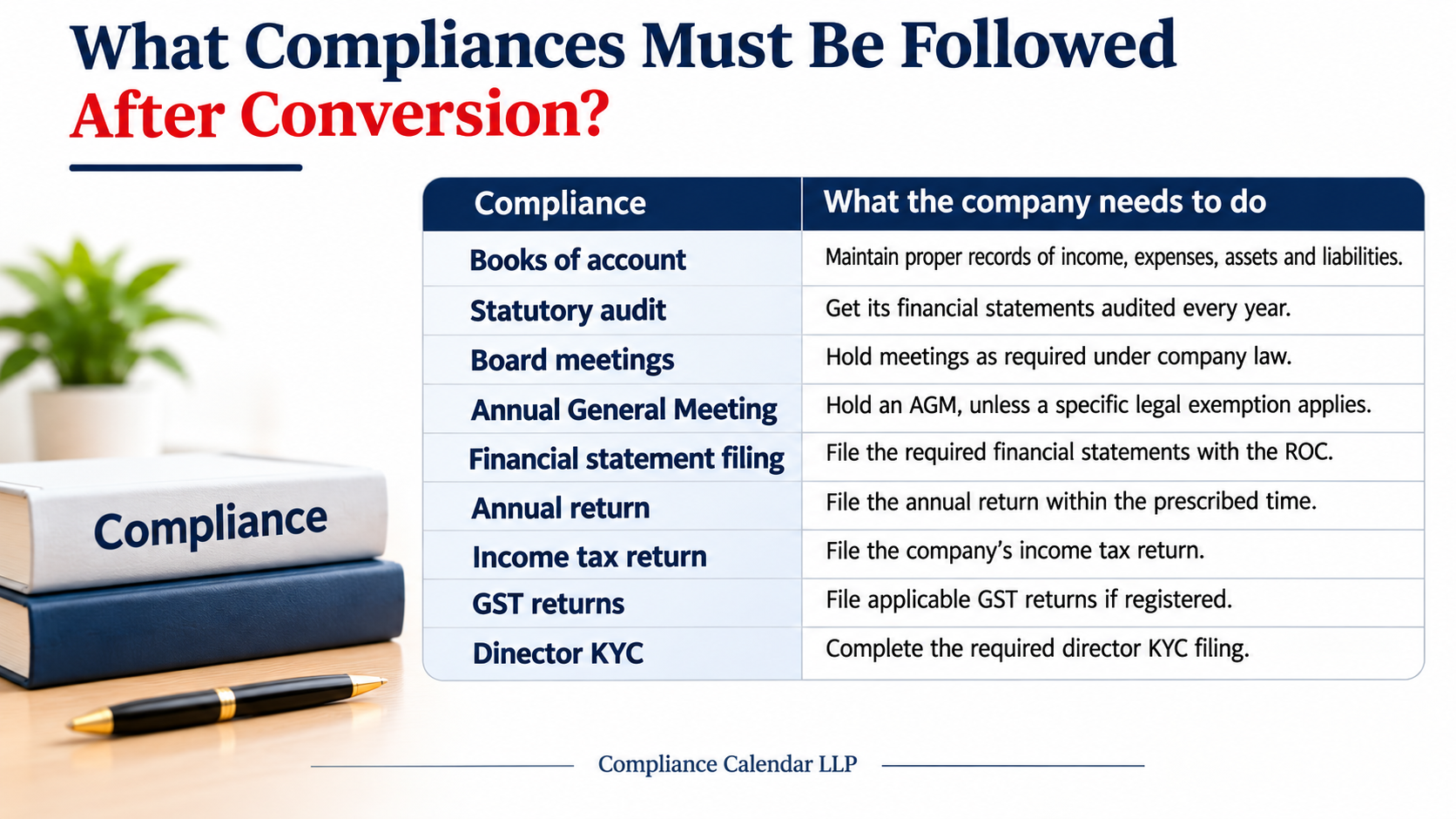
Once the new company takes over the business, it must follow the rules that apply to Private Limited Companies. It cannot continue operating only with the basic records used by the proprietorship.
|
Compliance |
What the company needs to do |
|
Books of account |
Maintain proper records of income, expenses, assets and liabilities |
|
Statutory audit |
Get its financial statements audited every year |
|
Board meetings |
Hold meetings as required under company law |
|
Annual General Meeting |
Hold an AGM, unless a specific legal exemption applies |
|
Financial statement filing |
File the required financial statements with the ROC |
|
Annual return |
File the annual return within the prescribed time |
|
Income tax return |
File the company's income tax return |
|
GST returns |
File applicable GST returns if registered |
|
Director KYC |
Complete the required director KYC filing |
The company may also need to follow labour laws, professional tax rules, factory rules and other industry-specific requirements.
For a detailed explanation, read our guides on Post-Incorporation Compliance of Private Limited Companies and Annual Compliances for a Private Limited Company. You can also explore our Annual Filings of Company service for support with ROC filings.
Common Mistakes to Avoid During Conversion
|
Common mistake |
What should be done instead? |
|
Assuming the business transfers automatically after company registration |
Prepare a proper Business Transfer Agreement to record the transfer of the existing business. |
|
Ignoring old loans and unpaid bills |
List all business debts and liabilities and clearly decide how they will be handled by the new company. |
|
Using the old GST registration |
Apply for a separate GST registration for the new company because it has a different PAN. |
|
Forgetting existing licences and agreements |
Check whether business licences, rental agreements and customer contracts need fresh approval or changes. |
|
Closing the old business too early |
Complete pending tax returns, GST filings and other formalities before closing old registrations. |
|
Assuming the transfer is automatically tax-free |
Check all tax conditions, including asset transfer and the proprietor's shareholding in the new company. |
|
Not keeping transfer documents |
Keep the signed agreement, asset details, liability records and valuation documents safely. |
How Compliance Calendar LLP Can Help
Moving a proprietorship into a Private Limited Company involves company registration, business transfer documents, tax planning, GST registration and changes to existing licences. These steps should be planned properly so that the business can continue without unnecessary problems.
Compliance Calendar LLP can assist with Proprietorship to Private Limited conversion, company incorporation, document preparation, business transfer agreements and related compliance work. Our team can also guide you on the steps involved in GST registration and post-incorporation filings. The final tax treatment and transfer structure should be checked by the appropriate tax and legal professionals based on your business records.
For assistance, contact Compliance Calendar LLP at +91 9988424211 or info@ccoffice.in.
Frequently Asked Questions (FAQs)
1. Can a proprietorship firm be converted into a Private Limited Company?
Yes. However, it is not a direct conversion through one MCA form. A new Private Limited Company is registered, and the existing business is transferred to it through a proper agreement and related documents.
2. Can the proprietor become a director and shareholder of the new company?
Yes. The proprietor can become a shareholder and director of the new company, subject to the legal requirements. A Private Limited Company generally needs at least two shareholders and two directors.
3. Is a Business Transfer Agreement required?
A written Business Transfer Agreement is strongly recommended. It records the assets, liabilities, stock, contracts and other business items being transferred. It also explains the value and terms of the transfer.
4. Can a proprietorship use Form URC-1 for conversion?
No. Form URC-1 is meant for certain existing entities, such as eligible partnership firms and LLPs, that meet the requirements under Section 366 of the Companies Act, 2013. A sole proprietorship normally needs a newly incorporated company and a separate business transfer.
5. Is the transfer of a proprietorship business tax-free?
It may qualify for capital gains tax relief if the conditions under Section 70(1)(zf) of the Income-tax Act, 2025 are met for transfers on or after 1 April 2026. These include transferring all business assets and liabilities, maintaining at least 50% voting power for five years and receiving only shares as consideration.
6. Will the new company get the old GST registration?
No. The company has a separate PAN and needs its own GST registration where applicable. Eligible unused input tax credit may be transferred through Form GST ITC-02 after meeting the GST requirements.
7. Can the new company use the same business name as the proprietorship?
It may be possible, but the proposed company name must be approved by the MCA. The name should also be checked against existing trademarks and company names. MCA approval does not automatically give trademark rights.
8. What happens to employees after the business transfer?
Employees may move to the company under the agreed transfer terms. Their salary, service period, benefits, pending payments and other employment conditions should be properly recorded and handled under applicable labour laws.
9. How much does it cost to convert a proprietorship into a Private Limited Company?
The cost depends on company registration fees, stamp duty, professional fees, valuation and business transfer expenses. GST, property transfer and licence-related costs may also apply. The total cost depends on the size and nature of the business.
10. How long does the conversion process take?
There is no single fixed timeline for every business. The time depends on company name approval, incorporation, preparation of transfer documents, asset records, GST formalities and changes to licences and contracts.
Article last updated on : 21 Nov 2026.













































































_learn_crop10_thumb.jpg)