


What Is Foreign Investment in an Insurance Broking Company?
Such investment may occur when a foreign company subscribes to newly issued shares, purchases shares from existing Indian shareholders or acquires a controlling interest in an established insurance broker. Foreign investment may help a broking company access international expertise, technology, capital and specialised insurance distribution practices. However, insurance broking remains a regulated activity, and the Indian company must continue complying with IRDAI requirements even after foreign investment. For example, if a foreign investor acquires 60% of Rajesh's company, the company remains responsible for its minimum capital, net worth, security deposit, qualified personnel and other regulatory obligations.
To understand insurance broker licensing and eligibility, read our Insurance Broker Registration in India
What Is the FDI Limit for Insurance Broking Companies in India?
Under India's current foreign investment policy, insurance intermediaries, including insurance and reinsurance brokers, are permitted to receive up to 100% foreign direct investment through the automatic route. The Government of India confirmed the relevant sectoral position through DPIIT Press Note No. 1 (2026 Series), dated 9 February 2026. The corresponding changes were incorporated into the Foreign Exchange Management (Non-Debt Instruments) Rules, 2019, through the 2026 amendments. The following table explains the permitted investment limits.
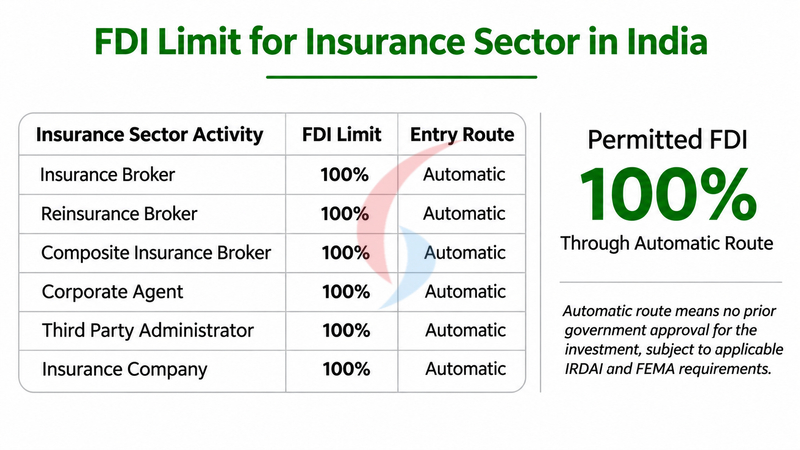
| Insurance sector activity | Foreign investment limit | Entry route |
| Insurance Broker | 100% | Automatic |
| Reinsurance Broker | 100% | Automatic |
| Composite Insurance Broker | 100% | Automatic |
| Corporate Agent | 100% | Automatic |
| Third Party Administrator | 100% | Automatic |
| Insurance Company | 100% | Automatic |
The automatic route generally means that separate government approval is not required solely because the investment is foreign, subject to applicable conditions. It does not override IRDAI verification, regulated share-transfer approvals, investor eligibility requirements or FEMA reporting.
Legal Provisions Governing Foreign Investment in Insurance Brokers
Foreign investment in insurance brokerage businesses is governed by insurance regulations, foreign exchange laws and corporate law provisions.
| Legal provision | Relevance |
| Insurance Act, 1938 – Section 42D | Registration and supervision of insurance intermediaries |
| IRDAI Act, 1999 – Section 14 | Regulatory powers of IRDAI |
| IRDAI Insurance Brokers Regulations, 2018 | Capital, ownership, registration and operational conditions |
| Regulation 19 | Capital requirements and foreign shareholding conditions |
| Regulation 25 and Schedule II – Form T | Share transfers and qualifying prior approvals |
| FEMA, 1999 | Foreign exchange transactions |
| FEMA Non-Debt Instruments Rules, 2019 | Foreign investment conditions and pricing requirements |
| FEMA Mode of Payment and Reporting Regulations, 2019 | Reporting foreign investment transactions |
| DPIIT Press Note No. 1, 2026 | Revised insurance sector FDI policy |
| Companies Act, 2013 | Share allotments, transfers and statutory filings |
These legal provisions operate together. An Indian insurance broker cannot rely exclusively on the automatic FDI route while ignoring IRDAI's ownership and control requirements.
Conditions for More Than 50% Foreign Shareholding
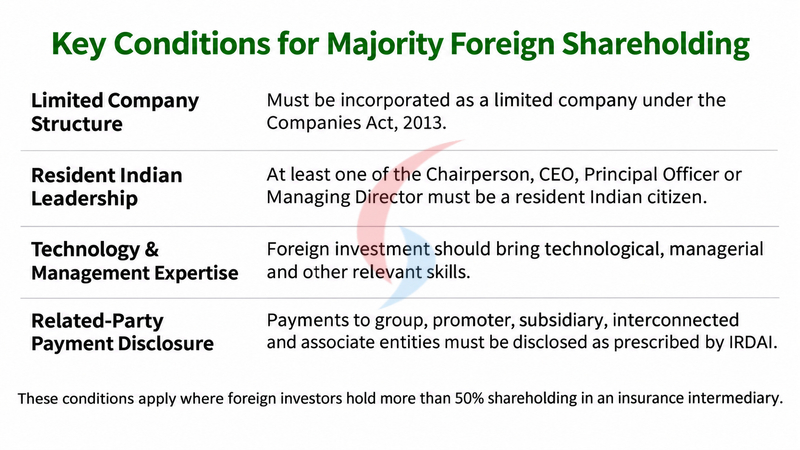
Where foreign investors acquire majority shareholding in an insurance intermediary, additional conditions become relevant. The applicable FDI policy and FEMA provisions require a majority foreign-owned insurance intermediary to satisfy specified organisational and disclosure requirements.
-
Incorporation as a Limited Company
A majority foreign-owned insurance intermediary must be incorporated as a limited company under the Companies Act, 2013. The legal structure should therefore be examined before accepting the investment.
-
Resident Indian Leadership
At least one among the Chairperson of the Board, Chief Executive Officer, Principal Officer or Managing Director must be a resident Indian citizen. The company should ensure that the relevant appointment satisfies the prescribed condition.
-
Technology and Management Expertise
The foreign-invested intermediary is required to bring in the latest technological, managerial and other skills. This condition reflects the policy objective of supporting the development of India's insurance distribution sector.
-
Disclosure of Related-Party Payments
The intermediary must disclose payments made to group, promoter, subsidiary, interconnected and associate entities in the formats prescribed by IRDAI. This helps the regulator examine financial relationships and potential conflicts of interest.
Minimum Capital and Net Worth Requirements After Foreign Investment
Foreign investment does not remove the financial requirements imposed under the Insurance Brokers Regulations. Whether a broker is Indian-owned or foreign-owned, it must maintain the prescribed capital, net worth and security deposit.
| Broker category | Minimum capital | Minimum net worth | Security deposit |
| Direct Broker | Rs 75 lakh | Rs 50 lakh | Rs 10 lakh |
| Reinsurance Broker | Rs 4 crore | Rs 2 crore | Rs 40 lakh |
| Composite Broker | Rs 5 crore | Rs 2.5 crore | Rs 50 lakh |
For example, if Rajesh receives Rs 2 crore from a foreign investor, the company must correctly account for the investment and continue satisfying the applicable capital requirements. The investment does not automatically replace the separate regulatory security deposit. Regulation 19 also contains conditions concerning the source of funds and restrictions on pledging shares representing regulatory capital.
To understand financial requirements for brokers, read our Insurance Broker Net Worth and Security Deposit Rules
IRDAI Approval for Foreign Shareholding Changes
An existing IRDAI-registered broker must examine Regulation 25 and Schedule II – Form T before transferring shares to foreign investors. Under the applicable provisions, prior approval can be required where the proposed transferee's total shareholding exceeds 20% or where the proposed transfer crosses the specified 10% nominal-value threshold. The application may involve Form TA, Form TB, ownership details, financial information and declarations concerning the proposed investor.
Importantly, automatic-route FDI and prior IRDAI share-transfer approval are separate legal questions. A transaction can qualify under the automatic FDI route while still requiring prior consent under insurance broker regulations.
Step-by-Step Process for Foreign Investment in an Insurance Broking Company
Step 1: Verify the Company's Regulatory Eligibility
Confirm the insurance broker's registration category and existing ownership structure. Review the applicable foreign investment limit and the proposed investor's eligibility. Identify any restrictions relating to the company's legal structure or business activities.
Step 2: Examine the Proposed Investment Structure
Determine whether the investor will subscribe to new shares or purchase existing shares. Calculate the proposed foreign shareholding percentage and resulting control. Check whether the transaction triggers IRDAI's prior approval requirements.
Step 3: Obtain Necessary Regulatory and Corporate Approvals
Prepare the relevant board resolutions and transaction documents. Submit Form TA and Form TB where prior IRDAI approval is required. Complete the transaction only after satisfying the applicable approval conditions.
Step 4: Receive Foreign Investment Through Permitted Channels
Receive the investment through an authorised banking channel. Maintain investor identification and remittance documentation. Verify that the payment structure follows FEMA and applicable pricing rules.
Step 5: Complete Share Allotment or Transfer
Issue or transfer shares according to the approved transaction structure. Follow the Companies Act, 2013, and applicable share issuance or transfer rules. Update the register of members and other statutory ownership records.
Step 6: Complete RBI and FEMA Reporting
File Form FC-GPR for reportable fresh share issuances to foreign investors. File Form FC-TRS for applicable transfers between residents and non-residents. Preserve the filing acknowledgements, valuation reports and banking documents.
Step 7: Maintain Post-Investment IRDAI Compliance
Review net worth, capital, security deposits and qualified personnel requirements. Comply with majority foreign ownership conditions and related-party disclosures. Keep regulatory records updated and submit applicable reports on time.
For investment documentation and compliance checks, refer to our FEMA Due Diligence: Process, Checklist & Compliance
FEMA Reporting Requirements for Foreign Investment
Foreign investment transactions must be reported under the applicable FEMA regulations. The required form depends on whether the investment is made through a new share issue or a transfer of existing securities.
| FEMA form | Purpose | General reporting deadline |
| FC-GPR | Fresh issue of reportable equity instruments to a non-resident | Within 30 days of issue |
| FC-TRS | Applicable resident–non-resident share transfers | Within 60 days of transfer or remittance, whichever is earlier |
| FLA Return | Annual reporting of foreign liabilities and assets | Generally 15 July |
| Form DI | Reportable downstream investment | Within the prescribed reporting period |
The applicability of each form depends on the transaction. Reporting is generally completed through RBI's FIRMS reporting arrangements and the relevant authorised dealer bank.
For the difference between fresh allotments and share transfers, read our FC-GPR vs FC-TRS 2026: When to File Each Form?.
Important Documents Required for Foreign Investment
The documentation depends on the investor, investment structure and regulatory approvals involved.
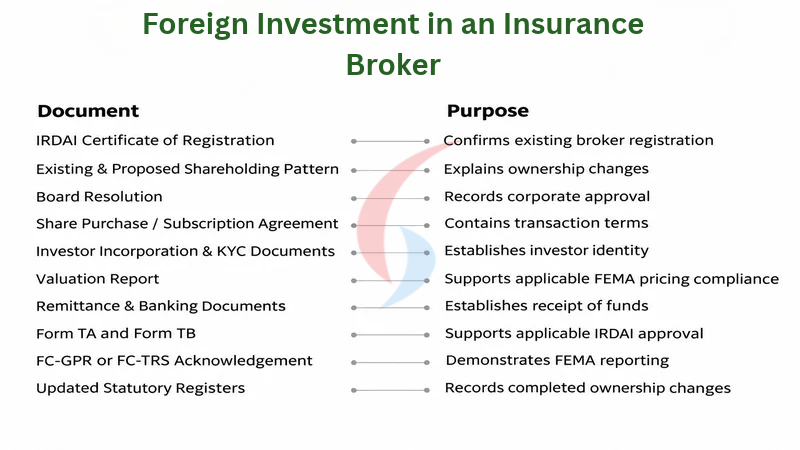
| Document | Purpose |
| IRDAI Certificate of Registration | Confirms existing broker registration |
| Existing and proposed shareholding pattern | Explains ownership changes |
| Board Resolution | Records corporate approval |
| Share Purchase or Subscription Agreement | Contains transaction terms |
| Investor incorporation and KYC documents | Establishes investor identity |
| Valuation Report | Supports applicable FEMA pricing compliance |
| Remittance and banking documents | Establishes receipt of funds |
| Form TA and Form TB | Supports applicable IRDAI approval |
| FC-GPR or FC-TRS acknowledgement | Demonstrates FEMA reporting |
| Updated statutory registers | Records completed ownership changes |
Latest Foreign Investment Updates
The Sabka Bima Sabki Raksha (Amendment of Insurance Laws) Act, 2025 introduced significant changes to India's insurance regulatory environment. DPIIT Press Note No. 1, dated 9 February 2026, confirmed the revised 100% foreign investment position for insurance companies and intermediaries. The Foreign Exchange Management (Non-Debt Instruments) (Second Amendment) Rules, 2026 subsequently incorporated the revised sectoral provisions into FEMA.
On 30 July 2026, IRDAI also notified the Insurance Intermediaries (Amendment) Regulations, 2026. These introduced changes affecting intermediary registration, disclosures and other regulatory obligations. Foreign-owned brokers should therefore examine the current consolidated rules rather than rely on older references to a 49% or 74% investment limit.
To understand annual foreign investment reporting, refer to our How to File Foreign Liabilities and Assets (FLA) on the FLAIR Portal of RBI?
Case Study: How Rajesh Completed a Foreign Investment Transaction
Returning to Rajesh's company, the Singapore-based investor offers to acquire 60% of the business. The parties agree that the investment will support technology development and expansion into additional cities.
Before completing the acquisition, Rajesh's compliance advisor reviews the company's existing shareholding, applicable IRDAI approvals and FEMA conditions. The advisor explains that the proposed investment can fall within the automatic FDI route, but the acquisition must still satisfy the separate insurance regulatory approval process.
The parties prepare the transaction agreement, financial records, investor declarations and prescribed regulatory forms. They also review the majority foreign ownership requirements, including resident Indian leadership and disclosure obligations.
After obtaining the applicable approvals, they complete the transfer, update statutory records and submit the relevant FEMA reporting documents.
The investment helps Rajesh plan his next stage of expansion. More importantly, the transaction illustrates how foreign capital can enter India's insurance broking sector while remaining subject to proper regulatory oversight.
Common Mistakes Businesses Should Avoid
One common mistake is assuming that 100% FDI under the automatic route means no regulatory approval or filing is necessary. Existing brokers must separately consider IRDAI ownership-change requirements. Another mistake is receiving foreign investment without determining the correct valuation, pricing rules or FEMA reporting obligations. Late FC-GPR or FC-TRS submissions can result in additional compliance consequences.
Businesses may also overlook the conditions applicable to majority foreign-owned intermediaries, particularly the legal structure, resident Indian leadership requirement and related-party payment disclosures. A properly planned investment should address these issues before the parties complete the transaction.
Why Choose Compliance Calendar LLP?
Foreign investment in insurance broking companies involves insurance regulatory requirements, foreign exchange compliance, shareholding documentation and company law procedures.
Compliance Calendar LLP assists businesses in understanding regulatory registrations, preparing documentation and identifying applicable compliance requirements.
For professional assistance with insurance broker registration and compliance requirements, contact Compliance Calendar LLP at +91 9988424211 or info@ccoffice.in
Frequently Asked Questions (FAQs)
Q1 What is the FDI limit for insurance broking companies in India?
Ans. India permits up to 100% foreign investment in insurance broking companies. Investment is permitted under the automatic route, subject to applicable conditions. Businesses must comply with IRDAI regulations and FEMA requirements.
Q2 Is IRDAI approval required for foreign investment in insurance brokers?
Ans. Not every foreign investment requires the same approval procedure. Certain share transfers or ownership changes require prior IRDAI approval. The transaction must be examined under Regulation 25 and Schedule II – Form T.
Q3 Can a foreign company own 100% of an Indian insurance broker?
Ans. Yes, 100% foreign ownership is permitted under the applicable FDI policy. The company must meet relevant licensing and regulatory conditions. Majority foreign-owned intermediaries have additional organisational and disclosure obligations.
Q4 Is RBI reporting mandatory after foreign investment?
Ans. Reportable foreign investment transactions must comply with FEMA reporting requirements. FC-GPR generally applies to qualifying fresh share issues, while FC-TRS applies to specified transfers. The correct form and deadline depend on the transaction.
Q5 Can a foreign investor acquire an existing insurance brokerage company?
Ans. Yes, foreign investors may acquire shares in an existing insurance brokerage business. The acquisition must comply with applicable ownership, valuation and regulatory approval provisions. Corporate and FEMA reporting requirements must also be completed.
Q6 What happens if FEMA reporting is delayed?
Ans. Delayed reporting may attract late submission fees or other regulatory consequences. The company should identify the delay and follow the applicable correction procedure. Maintaining accurate transaction records helps support compliance.
Q7. What documents are required for foreign investment in an insurance broking company?
Ans. Important documents include the share subscription or transfer agreement, investor identification details, valuation report, board resolutions and shareholding structure. Additional documents may be required for IRDAI approval and FEMA reporting. The exact requirements depend on the investment structure.
Q8. Are foreign-owned insurance brokers required to appoint Indian resident directors?
Ans. Foreign-owned insurance broking companies must comply with applicable IRDAI governance requirements and the Companies Act, 2013. This includes maintaining the prescribed board composition and appointing at least one resident director. Additional conditions may apply based on the company's foreign ownership.
Q9. Can foreign-owned insurance brokers repatriate dividends to overseas shareholders?
Ans. Yes, foreign-owned insurance brokers can repatriate dividends to overseas shareholders, subject to applicable FEMA, taxation and corporate law requirements. In September 2026, IRDAI repealed its earlier dividend repatriation guidelines, removing the separate prior-approval requirement under those guidelines.
Q10. Are foreign-owned insurance brokers required to disclose related-party transactions?
Ans. Yes, insurance broking companies with majority foreign ownership must comply with applicable related-party disclosure requirements. These include disclosures of payments made to foreign promoters, group companies, subsidiaries and associated entities in the formats prescribed by IRDAI. Proper documentation helps maintain regulatory transparency
Article last updated on : 21 Nov 2026.










































































_learn_crop10_thumb.jpg)