


Imagine a Bengaluru-based technology startup that has recently expanded its operations to Singapore and Dubai. The company has hired skilled professionals in both countries, and some employees have contributed significantly to its business growth. Instead of offering only annual bonuses, the founders decide to reward these employees through Employee Stock Option Plans (ESOPs). The idea is simple: employees will have an opportunity to become shareholders and benefit from the company's future success.
However, things become complicated when the finance team asks an important question: Can an Indian company legally issue ESOPs to employees living outside India? Does it require RBI approval, and what happens when those employees exercise their stock options?
This is where ESOPs for Foreign Employees: FEMA Compliance becomes important. Indian companies can offer stock options to eligible foreign employees, but these arrangements must comply with the Foreign Exchange Management Act, 1999, applicable RBI regulations and the Companies Act, 2013. For startups and businesses expanding internationally, understanding FEMA Compliance, ESOP Scheme Compliance, FDI Compliance and RBI Reporting is necessary to avoid regulatory complications. This article explains the applicable legal provisions, eligibility requirements, reporting procedures, taxation and practical considerations for issuing ESOPs to foreign employees in India in 2026.
What Are ESOPs for Foreign Employees?
An Employee Stock Option Plan, commonly known as an ESOP, is a scheme through which a company gives eligible employees the right to purchase its shares at a predetermined price after completing certain conditions. These conditions generally include a vesting period, continued employment and compliance with the company's ESOP policy. When an Indian company offers these options to eligible employees who are persons resident outside India, the arrangement becomes relevant under FEMA. Such employees may work directly for the Indian company or for qualifying overseas group entities, depending on the applicable rules and scheme conditions.
For example, suppose an Indian IT company grants 1,000 stock options to an employee working in Singapore at an exercise price of Rs 100 per share. After three years, the employee becomes eligible to exercise those options. If the company's share value increases to Rs 400, the employee may acquire shares at the agreed exercise price, subject to the ESOP scheme.
An important distinction is that granting stock options does not immediately make employees shareholders. Share ownership generally arises after exercise and allotment. This difference matters because separate FEMA reporting requirements may apply at the grant and share allotment stages.
To understand how employee ownership schemes operate, read our learn article on ESOPs for Employees: What It Is, How It Works and Advantages.
Can Indian Companies Issue ESOPs to Foreign Employees?
Yes, Indian companies can issue employee stock options to eligible persons resident outside India, subject to applicable legal conditions. The primary provision governing this arrangement is Rule 8 of the Foreign Exchange Management (Non-Debt Instruments) Rules, 2019. These rules permit qualifying Indian companies to issue ESOPs, sweat equity shares and specified share-based employee benefits to eligible non-resident employees or directors. The permission also extends to eligible employees and directors of the company's holding company, joint venture or wholly owned overseas subsidiary or subsidiaries.
However, the company must ensure that its employee stock option scheme complies with the Companies Act, 2013 or applicable SEBI regulations. The proposed issuance must also comply with foreign investment restrictions, sectoral caps and government approval requirements wherever applicable.
For example, an Indian software company operating in a sector permitting 100% foreign investment under the automatic route may generally grant ESOPs to eligible overseas employees without separate government approval for the foreign investment, provided all other conditions are satisfied.
Companies operating in sectors subject to government approval or specific foreign investment restrictions must complete additional checks before granting options.
FEMA Rules Applicable to ESOPs for Foreign Employees
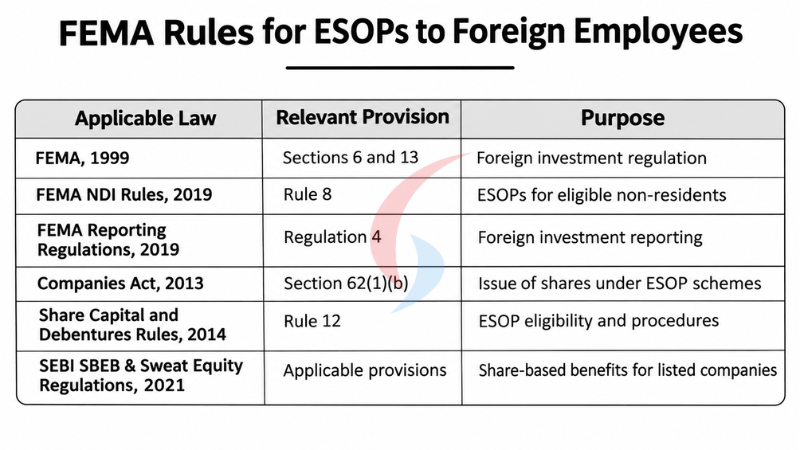
The Foreign Exchange Management Act, 1999 regulates certain cross-border investments and foreign exchange transactions. When an Indian company offers stock options to a person resident outside India, FEMA provisions become relevant because the employee may eventually acquire shares in an Indian company. Rule 8 of the FEMA (Non-Debt Instruments) Rules, 2019 specifically deals with employee stock options, sweat equity shares and share-based employee benefits issued to persons resident outside India.
The following provisions are important for companies planning foreign employee ESOPs.
|
Applicable law |
Relevant provision |
Purpose |
|---|---|---|
|
FEMA, 1999 |
Sections 6 and 13 |
Foreign investment regulation and contraventions |
|
FEMA NDI Rules, 2019 |
Rule 8 |
ESOPs for eligible non-residents |
|
FEMA Reporting Regulations, 2019 |
Regulation 4 |
Foreign investment reporting |
|
Companies Act, 2013 |
Section 62(1)(b) |
Issue of shares under ESOP schemes |
|
Share Capital and Debentures Rules, 2014 |
Rule 12 |
ESOP eligibility and procedures |
|
SEBI SBEB & Sweat Equity Regulations, 2021 |
Applicable provisions |
Share-based benefits for listed companies |
Companies must remember that FEMA compliance and corporate compliance are separate responsibilities. Obtaining shareholder approval under the Companies Act does not automatically complete RBI reporting requirements. Similarly, filing Form ESOP does not replace statutory records, share allotment procedures or other company law obligations.
For a broader explanation of applicable foreign exchange laws, read FEMA Compliance 2026: Latest Rules & Updates.
Eligibility Requirements for Foreign Employee ESOPs
Not every overseas employee automatically qualifies for an ESOP grant. Companies must first examine whether the proposed employee falls within the categories permitted under the FEMA rules and applicable employee stock option scheme. The company's scheme should identify eligible employees, directors and qualifying group-company personnel. For unlisted companies, Rule 12 of the Companies (Share Capital and Debentures) Rules, 2014 also provides eligibility conditions and restrictions, including those relating to certain promoters and directors holding substantial share capital. Eligible startups may benefit from specified exemptions, subject to the applicable conditions.
Another important consideration is the employee's residential status under FEMA. A person holding Indian citizenship may still be treated as a person resident outside India, depending on the circumstances. Consider an Indian employee who moves to London for overseas employment. The employee may continue holding an Indian passport, but the relocation can change their FEMA residential status. If the employee receives stock options after becoming a person resident outside India, the company should examine the relevant non-resident ESOP provisions.
Similarly, a foreign national working and residing in India is not automatically treated as a non-resident under FEMA simply because they hold foreign citizenship. Therefore, companies should verify residential status rather than relying entirely on nationality.
Foreign Investment Limits and Government Approval
Foreign investment limits are among the most important considerations when issuing ESOPs to overseas employees. Under the FEMA rules, employee stock options issued to non-residents must comply with the applicable sectoral foreign investment cap. A sectoral cap represents the maximum foreign investment permitted in a particular business activity. Some sectors permit 100% foreign investment under the automatic route, while others have lower limits or require prior government approval.
For example, suppose an Indian company already has substantial foreign shareholding and operates in a sector with restricted foreign investment. If it grants additional options to overseas employees, the potential effect on foreign ownership must be examined before the grant. The RBI Master Direction requires foreign investment to be calculated on a fully diluted basis upfront for these covered share-based benefits. Therefore, companies should not assume that the absence of immediate share allotment means they can ignore foreign ownership restrictions.
Prior government approval is required where foreign investment in the company's sector falls under the approval route. Rule 8 also requires prior government approval for covered grants to citizens of Bangladesh or Pakistan. Other applicable investment restrictions should be examined wherever relevant.
Companies dealing with foreign shareholders can understand additional requirements through FEMA Due Diligence: Process, Checklist & Compliance.
ESOP Issuance Process for Foreign Employees
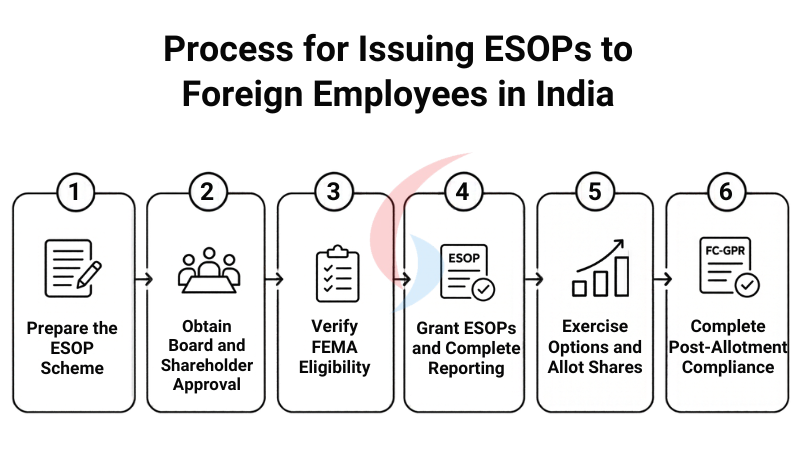
Issuing ESOPs to foreign employees involves corporate approvals, eligibility verification, FEMA reporting and share allotment procedures. Companies should complete these activities in a planned manner instead of treating the grant as an ordinary HR announcement.
Step 1: Prepare the ESOP Scheme
The company should prepare a written ESOP scheme explaining eligibility, number of options, exercise price, vesting conditions, exercise period and treatment of options after resignation or termination. The scheme should also address foreign employee participation, applicable regulatory approvals and restrictions on share transfers.
Step 2: Obtain Board and Shareholder Approval
The board of directors should approve the proposed scheme and related documentation. Shareholder approval must also be obtained where required under Section 62(1)(b) of the Companies Act, 2013. Applicable companies generally require a special resolution, subject to statutory exemptions. Relevant ROC filings should be completed.
Step 3: Verify FEMA Eligibility
Before granting options, the company should verify employee residential status, applicable sectoral caps and foreign investment conditions. Government approval must be obtained wherever required. The company should also examine the potential effect of ESOPs on its fully diluted shareholding structure.
Step 4: Grant ESOPs and Complete Reporting
Once the necessary approvals are obtained, the company can issue grant letters specifying the number of options, exercise price and vesting schedule. For reportable grants to persons resident outside India, Form ESOP must generally be filed within 30 days of the grant.
Step 5: Exercise Options and Allot Shares
After satisfying vesting conditions, employees may exercise eligible options and pay the exercise consideration. The company should complete share allotment procedures, update statutory registers and examine applicable valuation, tax and FEMA requirements.
Step 6: Complete Post-Allotment Compliance
Where the allotment constitutes reportable foreign direct investment, the company must generally file Form FC-GPR within 30 days of issuing the equity instruments. Relevant ROC filings and continuing reporting obligations should also be reviewed.
RBI Reporting Requirements for Foreign Employee ESOPs
One common mistake made by companies is assuming that RBI reporting is necessary only when employees become shareholders. In reality, the grant of stock options to eligible persons resident outside India can itself create a reporting obligation. Under the FEMA reporting regulations, Form ESOP is generally required within 30 days from the date of grant. The company should use the prescribed RBI reporting process and coordinate with its Authorised Dealer bank where required.
When employees subsequently exercise their options and shares are allotted, Form FC-GPR may also become applicable where the allotment is classified as foreign direct investment. Companies should additionally examine whether annual FLA reporting is necessary based on their outstanding foreign investment positions.
|
Form |
Reporting requirement |
Timeline |
|---|---|---|
|
Form ESOP |
Grant of eligible ESOPs to non-residents |
Within 30 days of grant |
|
Form FC-GPR |
Qualifying equity allotment constituting FDI |
Within 30 days of issue |
|
Form FC-TRS |
Applicable resident–non-resident share transfers |
Generally within 60 days |
|
FLA Return |
Reportable foreign liabilities and assets |
Generally by 15 July |
The company should maintain records of grant letters, exercise applications, allotment documents, valuation reports and filing acknowledgements. These records may be required during an RBI review, investor due diligence or subsequent share transfer.
Valuation of ESOPs Issued to Foreign Employees 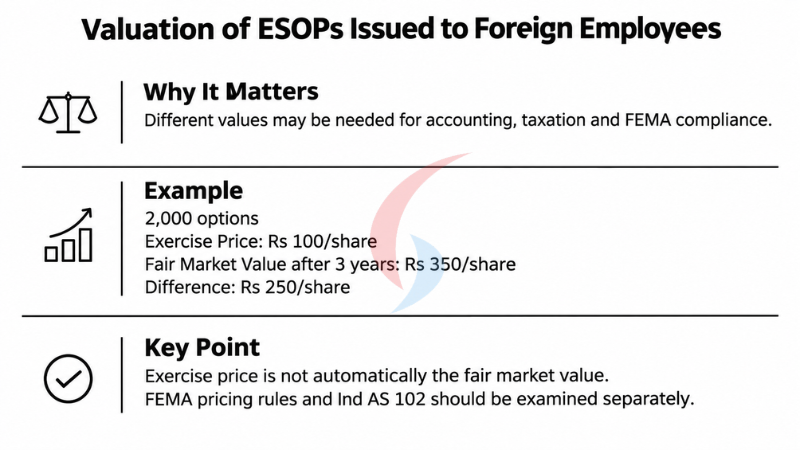
ESOP valuation is important because employees, management and regulators may need different values for accounting, taxation and applicable foreign investment compliance purposes. The exercise price fixed under an ESOP scheme should not automatically be treated as the fair market value of the underlying shares. Suppose an Indian startup grants 2,000 options at an exercise price of Rs 100 per share. After three years, the shares have a fair market value of Rs 350 each. The employee may exercise the options at the agreed price, subject to the scheme.
The difference of Rs 250 per share may be relevant for tax calculations, depending on the employee's tax status and applicable law. Companies must also consider accounting requirements under applicable standards, including Ind AS 102 wherever relevant. FEMA pricing rules for qualifying employee stock options must be examined under the specific applicable provisions rather than automatically applying the ordinary fresh FDI share issue pricing floor to every ESOP exercise.
For valuation methods and documentation requirements, read ESOP Valuation in India: Methods and Compliance.
Taxation of ESOPs for Foreign Employees
Taxation is another important issue because employees may be subject to tax in India, their country of residence or both, depending on the circumstances. Under Section 17(2)(vi) of the Income-tax Act, 1961, the difference between the prescribed fair market value and the amount paid by an employee can constitute a taxable perquisite where the relevant Indian tax provisions apply. The precise tax treatment depends on factors such as employment location, residential status, applicable treaty provisions and the period during which employment services were performed. When employees subsequently sell their shares, capital gains taxation may also arise. Indian tax consequences, overseas tax obligations and double taxation relief must be examined separately.
For example, an employee working in Singapore may receive options from an Indian company and later sell the resulting shares. The employee should not assume that taxation will arise only in Singapore or only in India. The relevant domestic tax laws and applicable Double Taxation Avoidance Agreement must be considered. Companies should also examine applicable employer withholding obligations and documentation requirements before employees exercise options.
For a detailed explanation, read ESOP Taxation for Employees and Startups in India.
What Happens When a Foreign Employee Resigns?
ESOP compliance does not end when an employee leaves the company. The treatment of vested and unvested options depends on the scheme conditions, applicable company law and any relevant FEMA restrictions. An employee who resigns before completing the vesting period may lose unvested options, subject to the scheme. Vested options may remain exercisable for a specified period, depending on the applicable terms and law.
If the employee has already exercised the options and received shares, subsequent sale or transfer must be examined separately. Transfers between residents and non-residents may attract FEMA pricing conditions and Form FC-TRS reporting, depending on the transaction. An additional rule applies where a person originally received options while resident in India but exercises them after becoming a person resident outside India. Under Rule 8, shares acquired in such circumstances are to be held on a non-repatriation basis.
For employee exit-related issues, read ESOPs on Resignation, Termination and Death.
Common FEMA Compliance Mistakes Companies Should Avoid
Many ESOP compliance problems arise from administrative mistakes rather than deliberate violations. A company may create a legally valid ESOP scheme but overlook Form ESOP reporting because its finance team believes no filing is required until shares are allotted. Other common problems include incorrect identification of an employee's FEMA residential status, failure to examine sectoral caps, incomplete grant records, missing approvals and delayed reporting following exercise.
Companies should also avoid using the same valuation document for every legal purpose without examining the applicable requirements. Corporate valuation, income-tax valuation and accounting valuation may involve different standards. Late reporting can result in applicable RBI late-submission fees or further regulatory proceedings, depending on the nature of the default. Maintaining an ESOP compliance register and reviewing outstanding grants regularly can help businesses identify these problems before they become significant.
Why Choose Compliance Calendar LLP for ESOP and FEMA Compliance?
Compliance Calendar LLP assists Indian businesses, startups and companies with ESOP-related corporate compliance, FEMA Advisory, foreign investment reporting and valuation-related requirements. Businesses expanding internationally may require coordinated support for ESOP documentation, RBI reporting, company law compliance and foreign shareholding reviews.
The team can assist companies in identifying applicable requirements, preparing supporting documentation and coordinating statutory reporting based on the nature of their transactions. Businesses can explore FEMA Advisory & Compliance Services and Valuation Services for related professional assistance.
Why Choose Compliance Calendar LLP?
ESOPs for foreign employees offer Indian companies an effective way to attract and retain international talent while allowing employees to participate in business growth. However, these arrangements involve more than simply granting stock options. Companies must consider employee eligibility, FEMA residential status, foreign investment limits, corporate approvals, valuation and RBI reporting.
Proper planning is especially important because ESOP grants, exercises, share allotments and subsequent transfers can create different legal obligations. A carefully structured ESOP scheme supported by timely compliance can help companies avoid unnecessary regulatory complications while building a stronger relationship with their international employees.
If your company is planning to issue ESOPs to foreign employees and needs assistance with FEMA Compliance, ESOP Scheme Compliance, RBI Reporting or valuation requirements, contact Compliance Calendar LLP at +91 9988424211 or info@ccoffice.in
Frequently Asked Questions (FAQs)
Q1. Can an Indian company issue ESOPs to foreign employees?
Ans. Yes. Indian companies can grant ESOPs to eligible employees and directors who are persons resident outside India, subject to Rule 8 of the FEMA Non-Debt Instruments Rules, 2019, applicable company law and foreign investment restrictions.
Q2. Is RBI approval mandatory for foreign employee ESOPs?
Ans. Separate prior RBI approval is not generally required for every eligible ESOP grant. However, prior government approval is necessary in specified circumstances, including where foreign investment is under the approval route.
Q3. What is Form ESOP under FEMA?
Ans. Form ESOP is a prescribed RBI reporting form used by Indian companies issuing employee stock options to eligible persons resident outside India. It is generally required within 30 days of the grant.
Q4. Is Form FC-GPR required after ESOP exercise?
Ans. Form FC-GPR is generally required when shares allotted following ESOP exercise constitute reportable foreign direct investment. The applicable filing deadline is normally 30 days from the issue of equity instruments.
Q5. Can NRIs receive ESOPs from Indian companies?
Ans. Yes. Eligible Non-Resident Indians may receive ESOPs from Indian companies, provided the applicable scheme requirements, FEMA rules and other legal conditions are satisfied.
Q6. Can foreign employees sell shares acquired through ESOPs?
Ans. Yes, subject to applicable restrictions. Share transfers may require compliance with FEMA pricing guidelines, reporting requirements, scheme conditions and relevant tax provisions.
Q7. What happens if Form ESOP is filed late?
Ans. Delayed Form ESOP reporting may attract applicable RBI late-submission fees or other regulatory consequences. Companies should identify the default and follow the prescribed regularisation procedure.
Q8. Are ESOPs taxable for foreign employees?
Ans. ESOPs may create taxable employment benefits and subsequent capital gains. Tax treatment depends on the employee's residential status, employment circumstances, applicable domestic tax laws and relevant tax treaties.
Q9. Can foreign employees exercise ESOPs after resignation?
Ans. Exercise after resignation depends on the ESOP scheme, vesting status and applicable law. Employees may be permitted to exercise vested options within a specified period, subject to relevant restrictions.
Q10. Which RBI portal is used for ESOP reporting?
Ans. Relevant FEMA foreign investment reporting is handled through the RBI's FIRMS system, subject to the current prescribed process and applicable Authorised Dealer bank requirements.
Article last updated on : 21 Nov 2026.













































































_learn_crop10_thumb.jpg)