



When a company is registered in India, it must follow certain rules about the people who manage its affairs. One important rule is that every company must have at least one director who stays in India for at least 182 days during the financial year. This is known as the resident director requirement under the Companies Act, 2013.
This rule also applies when an Indian company is owned by foreign individuals or businesses. For example, a foreign company setting up a subsidiary in India must make sure that at least one director of the Indian company meets this condition. The person does not have to be an Indian citizen. A foreign national can also become a resident director if they meet the required stay period and other conditions for becoming a director.
A company does not always need to appoint a new person for this purpose. If one of its existing directors already meets the 182-day condition, that person can fulfil the requirement. This article explains the resident director rules, eligibility, appointment process, documents, responsibilities and penalties for not following the requirement.
What Is a Resident Director Under the Companies Act, 2013?
A resident director is a director who stays in India for a total period of at least 182 days during a financial year. Section 149(3) of the Companies Act, 2013 requires every company to have at least one director who meets this condition.
In simple words, an Indian company must have at least one director who spends the required number of days in India during the financial year. The person does not have to be an Indian citizen or a shareholder of the company. The law mainly checks the person's stay in India, not their nationality or ownership in the business.
A resident director is not a separate type of director with fewer responsibilities. Once appointed, the person has the same general duties as other directors under the Companies Act. The additional requirement is that they must meet the 182-day stay condition.
Is It Mandatory to Appoint a Resident Director in Every Indian Company?
Yes. Every company registered under the Companies Act, 2013 must have at least one director who meets the resident director requirement. This applies to private limited companies, public limited companies and One Person Companies (OPCs). The rule also applies to companies that are fully owned by foreign shareholders.
For example, imagine a company incorporated in India by a parent company based in the United States. All its shareholders and other directors may live outside India. Even then, the Indian company must have at least one director who meets the 182-day stay requirement. The company can appoint an eligible person in India or check whether an existing director already meets the condition.
|
Type of company |
Resident director requirement |
|
Private Limited Company |
At least one director must meet the stay condition |
|
Public Limited Company |
At least one director must meet the stay condition |
|
One Person Company (OPC) |
At least one director must meet the stay condition |
|
Wholly foreign-owned Indian company |
At least one director must meet the stay condition |
|
Newly incorporated company |
The requirement applies proportionately in its first financial year |
A company does not have to appoint an additional director only because it needs to meet this rule. If one of its existing directors already fulfils the stay condition, the company can count that person towards the requirement. It should, however, keep proper records to support its compliance.
What Is the 182-Day Rule Under Section 149(3)?
Section 149(3) of the Companies Act, 2013 states that every company must have at least one director who stays in India for a total period of not less than 182 days during the financial year. In India, a financial year normally starts on 1 April and ends on 31 March.
The director does not have to stay in India for 182 continuous days. Different periods of stay can be added together to meet the requirement. For example, if a director stays in India for 100 days between April and September and another 82 days between October and March, the total stay becomes 182 days. The company should maintain travel records and other supporting documents to check the director's stay during the year.
What if the company is newly incorporated?
A newly incorporated company also has to follow the resident director rule. However, Section 149(3) provides that the requirement will apply proportionately at the end of the financial year in which the company is incorporated. This means the company does not have to meet the full 182-day requirement as if it had existed from 1 April.
For example, if a company is incorporated in January, it has only a short period before the financial year ends on 31 March. The required stay will be calculated proportionately for that first financial year. The company should consider its actual incorporation date while checking the requirement rather than automatically applying the full 182 days.
Who Is Eligible to Become a Resident Director?

A person who is legally eligible to become a director under the Companies Act, 2013 can fulfil the resident director requirement if they also meet the 182-day stay condition. The person must not be disqualified from becoming a director and must complete the required appointment formalities.
The proposed director does not have to be a shareholder, promoter or owner of the company. For example, a private limited company may have two directors who live outside India. It can appoint another eligible person who stays in India and meets the required number of days. That person can become a director even without holding any shares in the company.
Before making the appointment, the company should check the person's Director Identification Number (DIN), eligibility and willingness to take up the role. A person should not agree to become a resident director only to lend their name to a company. The position carries legal duties, and the person must understand the responsibilities involved.
Can a Foreign National Become a Resident Director in India?
Yes. A foreign national can become a resident director of an Indian company. Section 149(3) does not say that the person must be an Indian citizen. The main condition is that the director must stay in India for the required number of days during the financial year and meet the other legal conditions for appointment.
For example, a foreign business may set up a subsidiary in India and appoint a person who is already living in India as one of its directors. If that person is eligible and meets the stay requirement, they can fulfil the resident director condition. However, a foreign national who lives outside India for most of the year may find it difficult to complete 182 days. In that situation, the company should consider another eligible person who can meet the requirement.
Foreign nationals may also need to complete additional formalities for obtaining a DIN and Digital Signature Certificate (DSC). Their passport, overseas address proof and other documents may need to be properly certified or apostilled, depending on the country and applicable MCA requirements. The company should check the document requirements before starting the appointment process.
Steps to Appoint a Resident Director in India
The appointment of a resident director must follow the normal director appointment rules under the Companies Act, 2013. A company cannot simply add someone's name to its records and treat that person as a director. It must check the person's eligibility, obtain consent, complete the required approval and report the appointment to the Registrar of Companies (ROC).
The appointment route depends on the company's Articles of Association (AOA) and the type of appointment. For example, an additional director may be appointed by the Board if the AOA allows it under Section 161(1). In other cases, the appointment may need approval from shareholders. The general process is explained below.
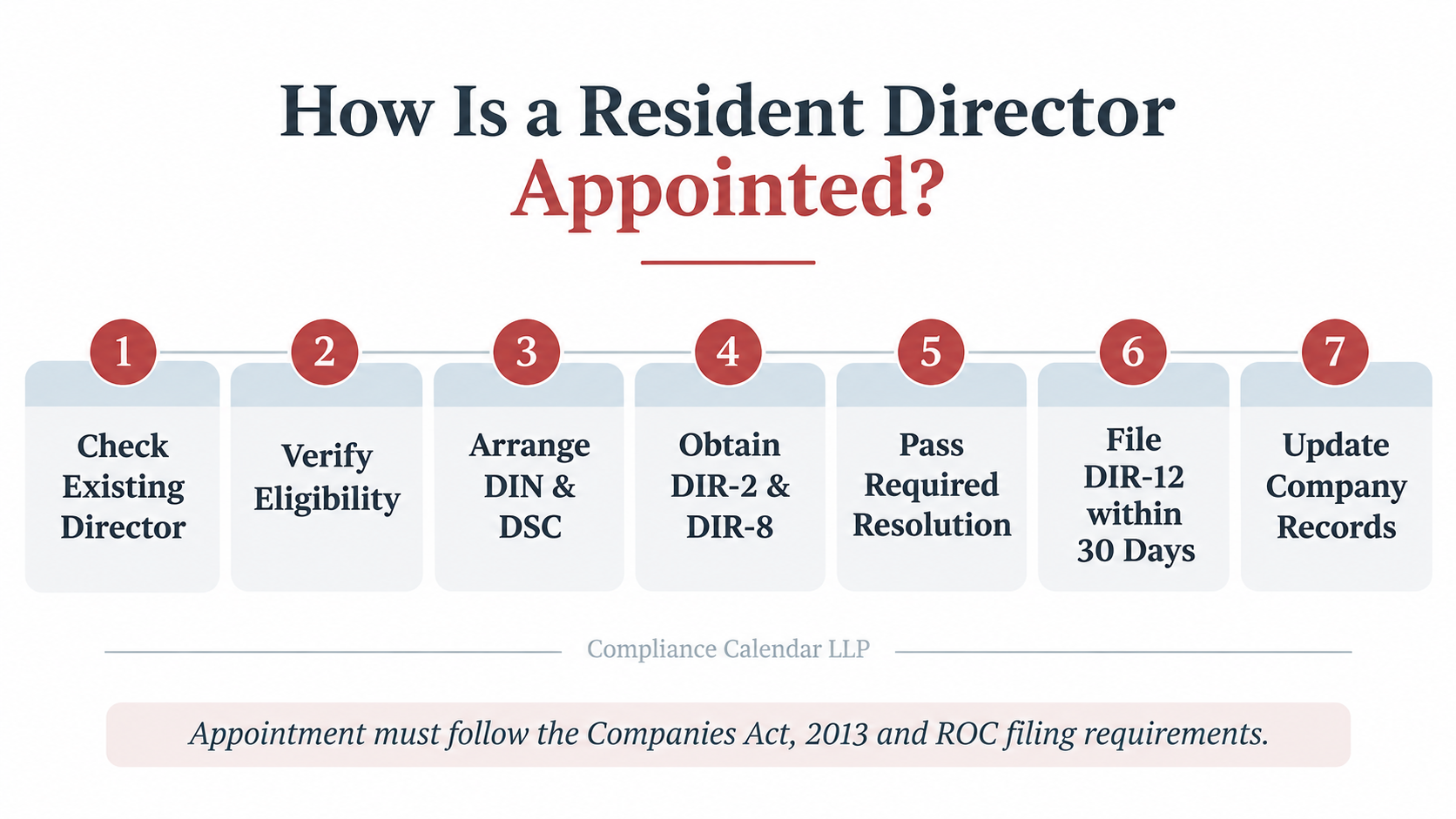
Step 1: Check Whether an Existing Director Meets the Requirement
Before appointing a new person, the company should check whether any existing director already stays in India for the required number of days. It should review the person's travel dates and stay during the financial year.
If an existing director meets the 182-day condition, the company may not need another appointment for this purpose. If no existing director qualifies, the company should identify a suitable person who can meet the requirement.
Step 2: Check the Proposed Director's Eligibility
The company should check whether the proposed person can legally become a director. This includes checking their DIN, disqualification status and other conditions under the Companies Act. The person should also agree to take up the position and understand the duties that come with it.
Step 3: Arrange DIN and DSC
A Director Identification Number (DIN) is required for a person to become a director. If the proposed director does not already have one, the company must follow the applicable DIN allotment process. A Digital Signature Certificate (DSC) is also generally needed to sign and submit the relevant forms electronically on the MCA portal.
Step 4: Obtain Consent and Declarations
The proposed director must give written consent to act as a director in Form DIR-2. The company should also obtain the required declarations, including Form DIR-8, which relates to disqualification. The company should collect the person's identity, address and other required details before moving ahead with the appointment.
Step 5: Pass the Required Resolution
The company must follow the appointment procedure given under the Companies Act and its AOA. Depending on the type of appointment, the company may need to pass a resolution at a general meeting. Where the AOA permits it, the Board may appoint an additional director under Section 161(1).
The company should record the decision in the minutes of the relevant Board or general meeting. It should also issue an appointment letter where applicable and keep the related documents safely.
Step 6: File Form DIR-12 with the ROC
After the appointment, the company must file Form DIR-12 with the Registrar of Companies within 30 days of the appointment. This form reports the appointment and provides the director's details to the ROC. The company should attach the required documents and check the information carefully before submitting the form on the MCA portal.
For a better understanding of the filing, you can read our well explained article on MCA Form DIR-12: Particulars of Appointment of Directors and KMP.
Step 7: Update Company Records
After completing the appointment, the company should update its register of directors and key managerial personnel. It should keep the appointment resolution, consent, declarations and supporting documents safely. The company should also track the director's stay in India during the financial year because completing the appointment process does not automatically mean that the 182-day condition has been met.
If you want to understand the general appointment process in more detail, you can also read our article on How to Appoint Director in a Company?.
Documents Required for Resident Director Appointment
The company should collect the proposed director's documents before starting the appointment process. The exact list may vary depending on whether the person is an Indian citizen or a foreign national. The company should also check the latest MCA filing requirements because the documents may differ based on the type of appointment.
|
Document |
Why it is required |
|
PAN Card |
Identity and tax-related identification for an Indian individual |
|
Passport |
Identity and nationality proof, particularly for foreign nationals |
|
Address proof |
To confirm the person's residential address |
|
Recent photograph |
For director-related records and filings |
|
DIN |
Director Identification Number required for appointment |
|
Digital Signature Certificate (DSC) |
For signing MCA forms electronically |
|
Form DIR-2 |
Written consent to act as a director |
|
Form DIR-8 |
Declaration regarding disqualification |
|
Form MBP-1 |
Disclosure of interest in other companies or entities, as applicable |
The company may also need a Board Resolution, appointment letter and other supporting records, depending on the appointment method. Form MBP-1 is generally obtained for disclosure of the director's interests as required under the Companies Act.
For foreign nationals, additional documents may be required. These can include overseas address proof and properly certified or apostilled documents. It is better to check these requirements before filing so that the company does not face avoidable delays.
What Are the Responsibilities of a Resident Director?
A resident director is not appointed only to fulfil the 182-day condition. Once appointed, the person becomes a director of the company and must follow the duties given under the Companies Act, 2013. Section 166 explains the main duties of directors and applies to resident directors as well as other directors.
A resident director must act in good faith and work in the interest of the company, its members and other stakeholders. The person should use reasonable care and independent judgment while taking part in company decisions. They should also avoid situations where their personal interests conflict with the company's interests and disclose their interests in other entities as required by law.
In practical terms, the director should take part in Board meetings, understand important company decisions, review matters placed before the Board and help the company follow the laws that apply to its business. They should protect company information and avoid using their position for personal benefit. A resident director should understand the company's activities instead of accepting the position only for name or record purposes.
Can One Person Become a Resident Director in Multiple Companies?
Yes. A person can become a director in more than one company, subject to the limits under Section 165 of the Companies Act, 2013. Generally, a person can hold directorships in up to 20 companies at the same time. Out of these, the number of public companies cannot exceed 10. Certain private companies that are holding or subsidiary companies of public companies are also counted for this purpose.
However, being appointed in multiple companies does not automatically mean that the person can meet the resident director requirement for all of them. The person must stay in India for the required number of days during the relevant financial year. The company should also check whether the person has enough time to understand the business and perform their duties properly.
For example, a person may be a director in three Indian companies. If the person meets the stay requirement during the relevant financial year for each company, they may fulfil the resident director condition in all three, subject to the other legal requirements.
Consequences of Not Having a Resident Director
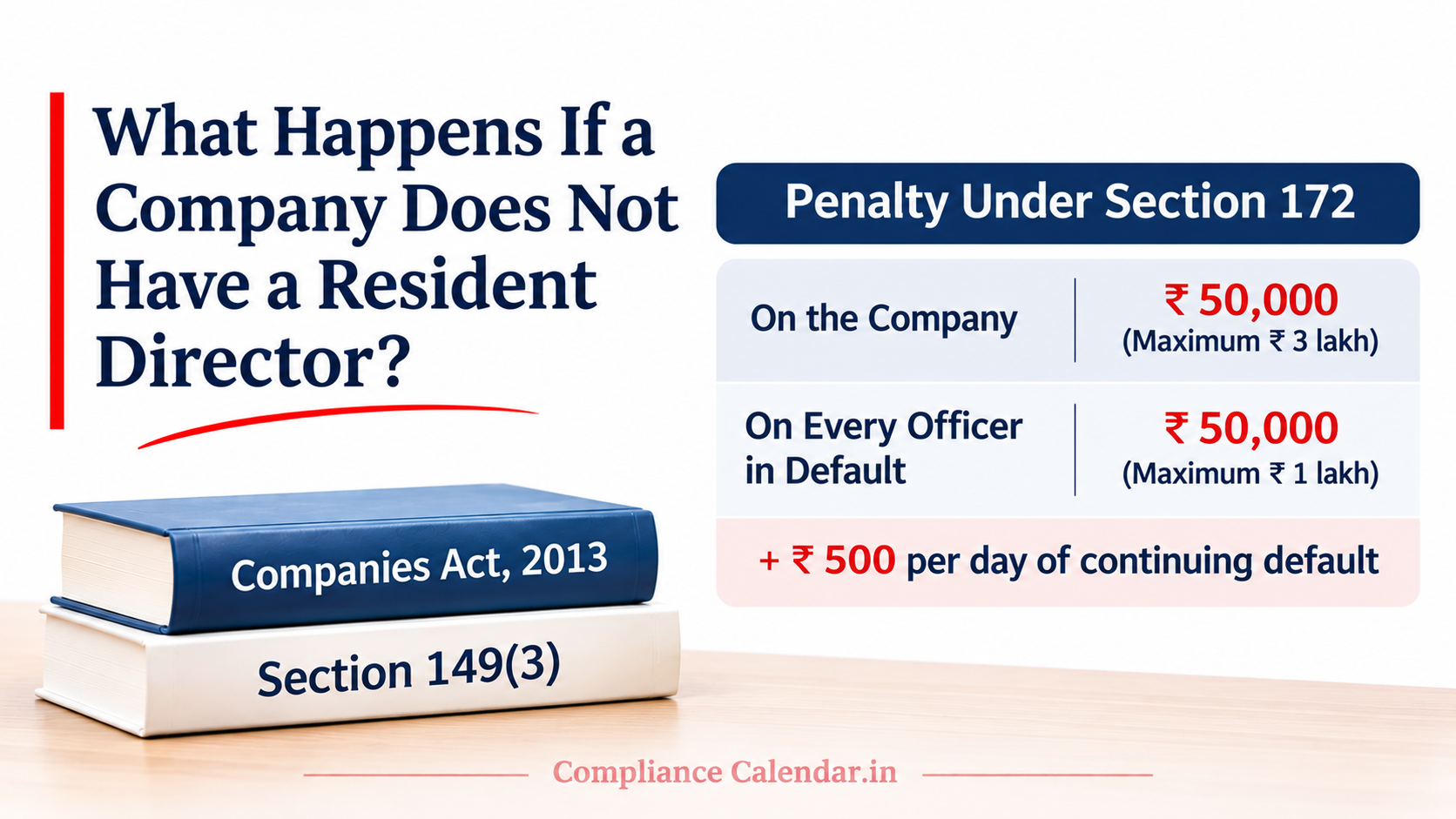
If a company does not have at least one director who meets the resident director requirement, it may be in violation of Section 149(3) of the Companies Act, 2013. The company should not ignore this condition because its business is small, inactive or owned by foreign shareholders. The requirement applies to companies covered by the section.
A failure to follow this requirement can attract a penalty under Section 172 of the Companies Act, where no separate penalty is provided for the default. The section provides for a penalty of Rs 50,000 on the company and every officer in default, with an additional Rs 500 for each day the failure continues. The maximum penalty is Rs 3 lakh for the company and Rs 1 lakh for an officer in default.
Non-compliance can also create difficulties during company audits, due diligence, business transactions and other compliance checks. If the only director who meets the requirement resigns or can no longer fulfil the stay condition, the company should review its Board structure and arrange a suitable replacement where needed.
How Can a Company Change Its Resident Director?
A company may need to change its resident director if the person resigns, becomes disqualified, passes away or can no longer meet the required stay condition. The company should first check whether another existing director already fulfils the 182-day requirement. If no other director qualifies, it should identify a suitable replacement and complete the appointment process under the Companies Act.
When a director resigns, the company must report the change to the ROC through the applicable filing. Form DIR-12 is generally used to report the resignation within 30 days. The company should also update its register of directors and keep the resignation and appointment records safely.
For example, if a company has only one director who meets the 182-day requirement and that person plans to resign, the company should plan the replacement carefully. This helps avoid a situation where the company is left without any director who fulfils the resident director condition.
You can also read our article on Post Incorporation Compliance of Private Limited Companies to understand other important duties after setting up a company.
Resident Director vs Other Director: What Is the Difference?
A resident director is also a director of the company. The main difference is that the resident director must meet the stay requirement under Section 149(3). Other directors do not have to meet the 182-day condition simply because they hold the position of director.
|
Basis |
Resident Director |
Other Director |
|
Meaning |
A director who meets the required stay condition in India |
A director who may or may not meet the stay condition |
|
Legal provision |
Section 149(3) |
General provisions relating to directors |
|
Stay in India |
At least 182 days during the financial year, subject to the first-year proportionate rule |
No 182-day requirement merely because of being a director |
|
Nationality |
Can be an Indian citizen or foreign national |
Can be an Indian citizen or foreign national |
|
Duties |
Must follow the duties under Section 166 |
Must follow the duties under Section 166 |
|
Company requirement |
Every company must have at least one qualifying director |
The number depends on the company's Board structure and other legal requirements |
The resident director does not have fewer responsibilities than other directors. The person has the same general duties and must also meet the stay condition. A company should therefore appoint someone who understands the role and is willing to take responsibility for the position.
How Can Compliance Calendar LLP Help with Resident Director Appointment?
Appointing a resident director involves more than finding a person who stays in India. The company must check the person's eligibility, collect the required documents, follow the correct appointment procedure and complete the necessary MCA filing. A mistake in the appointment or filing process can lead to delays and additional compliance work.
Compliance Calendar LLP can assist companies with understanding the resident director requirement, preparing appointment documents, organising the required information and handling the applicable ROC filing process.
If your company needs help with appointing a director, you can explore our Appointment of Director service.
Whether you are setting up a new company in India or managing an existing company with directors based outside India, proper planning can help you avoid appointment and compliance mistakes.
For assistance, contact Compliance Calendar LLP at +91 9988424211 or info@ccoffice.in
Frequently Asked Questions (FAQs)
1. Is a resident director compulsory for every company in India?
Yes. Section 149(3) of the Companies Act, 2013 requires every company to have at least one director who stays in India for at least 182 days during the financial year. A proportionate rule applies to a newly incorporated company in its first financial year.
2. Can a foreign national become a resident director in India?
Yes. A foreign national can become a resident director if they meet the legal conditions for appointment and stay in India for the required number of days during the financial year.
3. Does a resident director need to hold shares in the company?
No. A resident director does not have to be a shareholder. An eligible person can become a director even if they do not own any shares in the company.
4. Does the 182-day stay have to be continuous?
No. The director does not have to stay in India for 182 days without leaving the country. Different periods of stay can be added together to meet the total requirement during the financial year.
5. Can an existing director fulfil the resident director requirement?
Yes. If an existing director meets the 182-day stay condition, the company can count that person towards the resident director requirement. A separate appointment is not necessary just for this purpose.
6. Does a newly incorporated company need a resident director?
Yes. A newly incorporated company must also follow the requirement. However, the stay condition is calculated proportionately for the first financial year in which the company is incorporated.
7. Which form is used for resident director appointment?
Form DIR-12 is filed with the Registrar of Companies to report the appointment of a director. The company must also obtain the person's consent in Form DIR-2 and other applicable documents and declarations.
8. Can one person be a resident director in multiple companies?
Yes. A person can become a director in multiple companies, subject to the directorship limits under Section 165 and other legal conditions. The person must also meet the resident director stay requirement for the relevant financial year.
9. What is the difference between a resident director and a nominee director?
A resident director is a director who meets the stay requirement under Section 149(3). A nominee director is appointed to represent the interests of a particular institution, shareholder or other person, where permitted by law. A nominee director can also fulfil the resident director requirement if they meet the required stay period.
10. What happens if a company does not have a resident director?
A company that fails to meet Section 149(3) may face penalties under the Companies Act, 2013. It should review its Board structure and arrange for an eligible director to meet the requirement.
Article last updated on : 21 Nov 2026.













































































_learn_crop10_thumb.jpg)