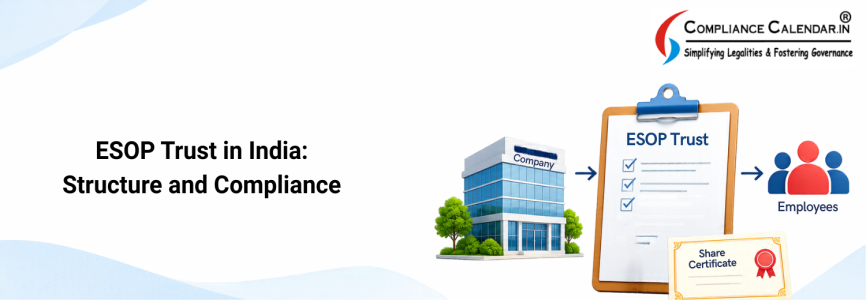



Employee Stock Option Plans (ESOPs) have become an important part of employee compensation in India, especially among startups and growing businesses. Companies are no longer relying only on salary increments and annual bonuses to retain talented employees. Many businesses now offer employees an opportunity to participate in the company's future growth through equity ownership. However, managing employee stock options becomes challenging when a company has hundreds of employees, multiple vesting schedules and frequent changes in its shareholding structure.
An ESOP Trust in India can help companies administer employee share benefits through a structured arrangement. Instead of managing every share transaction directly, a company may establish a trust that holds and administers shares for eligible employees under an approved scheme. The trust operates through trustees who are responsible for managing its assets and ensuring that employee benefits are distributed according to the scheme's conditions. However, establishing an ESOP Trust involves legal, financial, taxation and corporate compliance requirements that companies must carefully evaluate.
Understanding the ESOP Trust structure is particularly important for companies considering employee equity incentives, secondary share acquisitions or long-term employee retention programmes. The legal requirements also differ considerably between listed and unlisted companies, making proper planning essential before establishing a trust.
Companies planning to introduce employee stock options must understand the legal approvals, scheme documentation and ongoing compliance requirements. Explore our ESOP Scheme Compliance services for professional assistance.
What Is an ESOP Trust in India?
An ESOP Trust is a legal arrangement established to administer employee share benefits under an approved employee stock option or share-based benefit scheme. It generally involves trustees holding shares for the benefit of eligible employees and managing their distribution in accordance with the trust deed and applicable regulations.
For example, suppose a technology company has 300 employees and wants to reward its senior managers, engineers and business development professionals through employee stock options. As more employees become eligible for benefits, the company may find it difficult to manage vesting records, share acquisitions and employee transactions individually. A properly structured ESOP Trust may help centralise these administrative functions.
However, the creation of a trust does not automatically permit the company to finance share purchases or transfer shares without restrictions. Companies must examine the legal provisions applicable to their proposed arrangement, including restrictions on financial assistance, share acquisitions and employee eligibility.
Why Do Companies Establish an ESOP Trust?
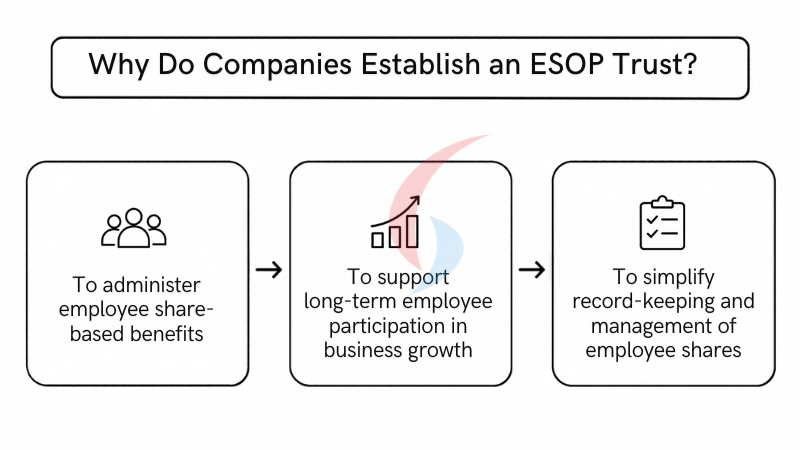
Companies establish ESOP Trusts primarily to administer employee share-based benefits and support long-term employee participation in business growth. A properly designed trust may simplify record-keeping and the management of shares intended for employees, particularly when the company has a large workforce or different categories of employee incentive schemes.
One important consideration is the method through which shares are provided to employees. In a direct ESOP scheme, fresh shares may be issued when employees exercise their vested options. Under a permitted trust-based arrangement, shares already held by the trust may be transferred to employees, depending on the scheme's structure. Where existing shares are used, the transfer does not itself involve issuing additional shares, although the original acquisition and financing arrangements must still comply with the law. Companies must also consider administrative expenses, trustee responsibilities and the possibility of conflicts of interest. An ESOP Trust may provide operational benefits, but it is not necessarily the most suitable arrangement for every startup or private company.
Startups introducing employee ownership programmes should first understand how stock options support hiring and long-term business growth. Read our article on ESOP for Startups in India for further guidance.
Structure of an ESOP Trust in India
The ESOP Trust structure generally involves the company establishing the employee benefit scheme, trustees administering the trust and eligible employees receiving benefits according to approved conditions. Each participant has a separate responsibility, and the arrangement must clearly define how shares will be acquired, held and transferred.
|
Participant |
Role in ESOP Trust |
|---|---|
|
Company |
Establishes the employee benefit scheme and obtains applicable approvals |
|
ESOP Trust |
Holds and administers shares for employee benefits |
|
Trustees |
Manage trust assets and carry out fiduciary responsibilities |
|
Employees |
Receive benefits according to vesting and exercise conditions |
|
Board of Directors |
Oversees company-level approvals and governance |
|
Compensation Committee |
Performs prescribed functions where applicable |
|
Auditors and Valuers |
Support financial reporting, valuation and compliance |
The trust deed should clearly identify the purpose of the trust, its beneficiaries, trustee powers, share administration procedures and conditions governing the distribution of benefits. It should also address record maintenance, treatment of trust assets and circumstances requiring changes to the arrangement. For listed companies, additional requirements apply under the SEBI (Share Based Employee Benefits and Sweat Equity) Regulations, 2021. Unlisted companies must separately examine the Companies Act, 2013 and other applicable laws before deciding whether the proposed trust structure is permissible.
Legal Provisions Governing ESOP Trusts in India
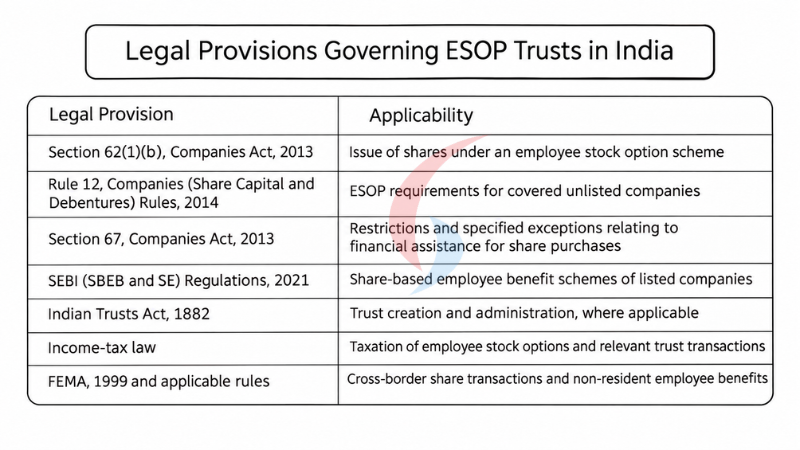
The legal requirements applicable to ESOP Trusts depend on whether the company is listed or unlisted, how the trust acquires shares and how employee benefits are delivered. Companies must consider more than the general ESOP provisions because trust funding and secondary share acquisitions may raise additional legal questions.
|
Legal Provision |
Applicability |
|---|---|
|
Section 62(1)(b), Companies Act, 2013 |
Issue of shares under an employee stock option scheme |
|
Rule 12, Companies (Share Capital and Debentures) Rules, 2014 |
ESOP requirements for covered unlisted companies |
|
Section 67, Companies Act, 2013 |
Restrictions and specified exceptions relating to financial assistance for share purchases |
|
SEBI (SBEB and SE) Regulations, 2021 |
Share-based employee benefit schemes of listed companies |
|
Indian Trusts Act, 1882 |
Trust creation and administration, where applicable |
|
Income-tax law |
Taxation of employee stock options and relevant trust transactions |
|
FEMA, 1999 and applicable rules |
Cross-border share transactions and non-resident employee benefits |
Companies Act, 2013
Section 62(1)(b) permits companies to issue shares to employees under an employee stock option scheme, subject to the applicable conditions and approvals. Rule 12 of the Companies (Share Capital and Debentures) Rules, 2014 prescribes requirements concerning employee eligibility, scheme disclosures, vesting, exercise and record maintenance for covered unlisted companies. However, these provisions should not be interpreted as unrestricted permission to establish and finance an ESOP Trust. Where company funds are proposed to be used for acquiring its own shares, Section 67 and other applicable provisions must be examined. The legal treatment may vary depending on the company's category and the specific arrangement.
SEBI Regulations for Listed Companies
Listed companies implementing employee share-based benefit schemes are governed by the SEBI (Share Based Employee Benefits and Sweat Equity) Regulations, 2021, as amended. These regulations prescribe requirements for direct and trust-based implementation, trustee eligibility, secondary acquisitions, shareholder approvals, accounting and disclosures. A trust-based route is mandatory for schemes involving secondary acquisition or gifts under the circumstances prescribed by the regulations. The relevant requirements must be reviewed before the scheme is implemented.
For ESOP approvals and compliance requirements, read ESOPs Compliance Checklist and Procedure under the Companies Act, 2013.
How Does an ESOP Trust Work? A Practical Example
Consider the example of Rohan, the founder of a growing software company in Bengaluru. He started his business with five employees, but within four years, the company expanded to more than 200 professionals. Several early employees played an important role in developing the company's products and attracting customers. Rohan wanted to reward these employees for their contribution without depending entirely on large salary increases.
After discussing the proposal with his legal and financial advisers, Rohan decided to evaluate an ESOP Trust. His team examined whether the company could legally use a trust-based arrangement, how shares would be acquired and which approvals would be necessary. They also prepared an employee incentive scheme containing vesting conditions, exercise procedures and eligibility requirements. Under a legally permitted arrangement, the trust would administer the relevant shares through appointed trustees. Employees who satisfied their vesting requirements could exercise their options and receive shares according to the approved scheme. The company would maintain the necessary accounting records, while the trustees would maintain records of trust-held shares and their distribution.
This example highlights an important point: creating an ESOP Trust is not simply about preparing a trust deed. Companies must consider the full process, from initial approvals and share acquisition to employee taxation and ongoing administration.
Step-by-Step Process to Establish an ESOP Trust in India
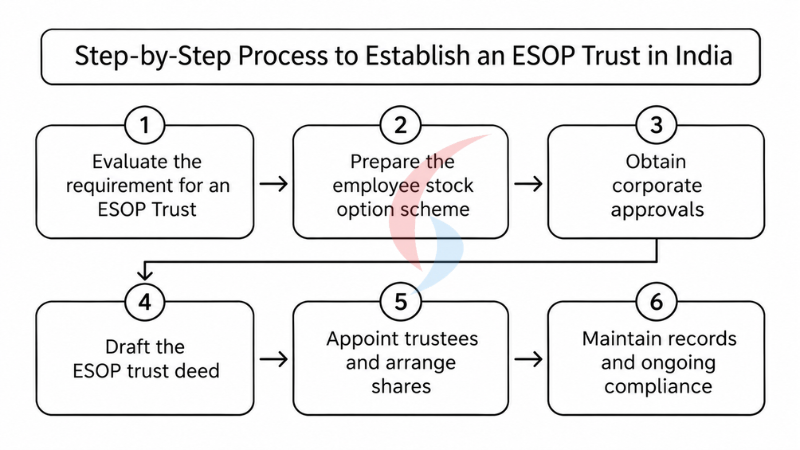
Establishing an ESOP Trust requires careful consideration of the company's ownership structure, intended employee benefits and applicable legal requirements. The process may vary depending on whether the company is listed, the proposed funding arrangements and the nature of the employee benefit scheme.
Step 1: Evaluate the Requirement for an ESOP Trust
The company should first determine whether a trust structure offers a practical advantage over a direct ESOP scheme. Management should evaluate the number of participating employees, expected option grants, administrative costs and proposed methods of acquiring shares. For private companies, the legal permissibility of the arrangement should be examined before proceeding with documentation.
Step 2: Prepare the Employee Stock Option Scheme
The company must prepare an ESOP scheme explaining employee eligibility, the number of options, exercise price, vesting conditions, exercise period and treatment of options when employment ends. The scheme should also specify how employees will receive shares and whether the trust will be responsible for their administration.
Step 3: Obtain Corporate Approvals
The Board of Directors must consider the proposed scheme and obtain the required shareholder approvals. Under Section 62(1)(b) and Rule 12, an ESOP scheme generally requires approval through a special resolution for covered unlisted companies, subject to applicable statutory exemptions. Additional approvals may be necessary depending on the proposed trust structure and transactions.
Step 4: Draft the ESOP Trust Deed
The trust deed should clearly define the objectives of the trust, trustee powers, beneficiaries and procedures governing trust-held shares. It should also establish how the trust will maintain records, manage assets and distribute benefits. The deed must be consistent with applicable law and the employee benefit scheme.
Step 5: Appoint Trustees and Arrange Shares
Eligible trustees should be appointed to administer the trust. The company must then determine how shares will be acquired or made available to the trust. Any proposed financial assistance, secondary market acquisition or share transfer must comply with the applicable legal requirements.
Step 6: Maintain Records and Ongoing Compliance
Once the scheme becomes operational, the company and trustees must maintain records of employee grants, vesting, exercises, share transfers and trust transactions. Taxation, accounting and disclosure requirements must also be reviewed periodically to ensure that the arrangement continues to comply with applicable law. Share transfers under employee benefit arrangements must follow applicable statutory requirements and the company's governing documents. Businesses can explore our Transfer of Shares services for professional assistance.
ESOP Trust Compliance Requirements for Listed Companies
Listed companies must satisfy the trust-related conditions prescribed under the SEBI (SBEB and SE) Regulations, 2021. These requirements cover trust administration, secondary share acquisitions, trustee eligibility and the distribution of employee benefits. They are intended to promote transparency and prevent misuse of employee benefit arrangements.
The regulations impose restrictions on trustees and the handling of shares held by the trust. For example, trustees cannot exercise voting rights in respect of shares held by the trust. Secondary acquisitions are subject to prescribed limits, and companies must comply with applicable holding periods, disclosures and shareholder approval requirements. Companies should also ensure that the compensation committee and trustees maintain clear records of decisions concerning employee benefits. Periodic compliance reviews are important because changes in the scheme, share acquisitions or employee entitlements may create additional regulatory obligations.
ESOP Trust Compliance for Private Limited Companies
Private limited companies frequently consider ESOPs when they want to reward employees but cannot offer compensation packages comparable to larger businesses. However, establishing a trust-based arrangement requires particular care because the rules applicable to listed-company ESOP Trusts cannot automatically be extended to unlisted companies.
A private company must examine whether the proposed trust funding and share acquisition arrangements are permissible under the Companies Act, 2013. In particular, Section 67 and other relevant provisions may apply depending on the transaction. Certain exemptions or exceptions may be relevant, but their availability must be evaluated against the company's specific circumstances. Companies should also review their Articles of Association, shareholder agreements and existing investor rights before finalising the scheme. Where the trust structure creates unnecessary complexity or legal restrictions, a direct ESOP arrangement may be more appropriate.
Creating an ESOP pool requires planning because employee equity incentives can affect existing shareholders and future fundraising. Read our article on ESOP Pool in Startups: Creation and Dilution.
Taxation of ESOP Trusts in India
Taxation is an important consideration when implementing an ESOP Trust because different transactions can produce different tax consequences. The treatment of trust funding, share acquisitions, employee benefits and subsequent share sales must be examined separately. The trust's legal structure and relevant income-tax provisions also influence its tax treatment.
For employees, a taxable perquisite generally arises when options are exercised and shares are allotted or transferred. The taxable amount is ordinarily calculated using the applicable fair market value of the shares minus the amount paid by the employee. When employees subsequently sell those shares, capital gains tax may arise, subject to the applicable provisions. Special tax deferral provisions may apply to employees of qualifying eligible startups. Companies must also examine their tax deduction, withholding and reporting obligations rather than assuming that placing shares in a trust changes the normal taxation of employee stock options.
ESOP Valuation and Accounting Requirements
Valuation is essential because companies must determine the value of employee benefits for accounting, taxation and certain share transactions. The appropriate valuation method depends on the company's status, share characteristics and applicable legal provisions. For unlisted companies, valuation can be particularly important because there may be no readily available market price.
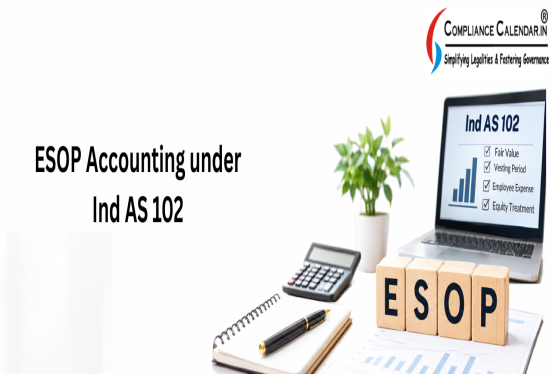
Companies covered by Ind AS must examine the accounting requirements prescribed under Ind AS 102, Share-based Payment. Under an equity-settled arrangement, employee compensation expense is generally recognised over the relevant vesting period using the applicable measurement principles. Companies outside the Ind AS applicability requirements must follow the accounting standards and professional guidance relevant to them. An ESOP Trust does not automatically remove the company's responsibility to recognise employee compensation costs. The company and its auditors must examine the substance of the arrangement, including the role of the trust and how employee benefits are settled.
Determining the fair market value of employee stock options is important for taxation, financial reporting and share transactions. Read ESOP Valuation in India: Methods and Compliance.
Companies must recognise and disclose employee share-based payments according to the applicable accounting requirements. Explore our article on ESOP Accounting under Ind AS 102. Businesses requiring professional valuation assistance can also explore our Valuation Services.
ESOP Trust vs Direct ESOP Scheme
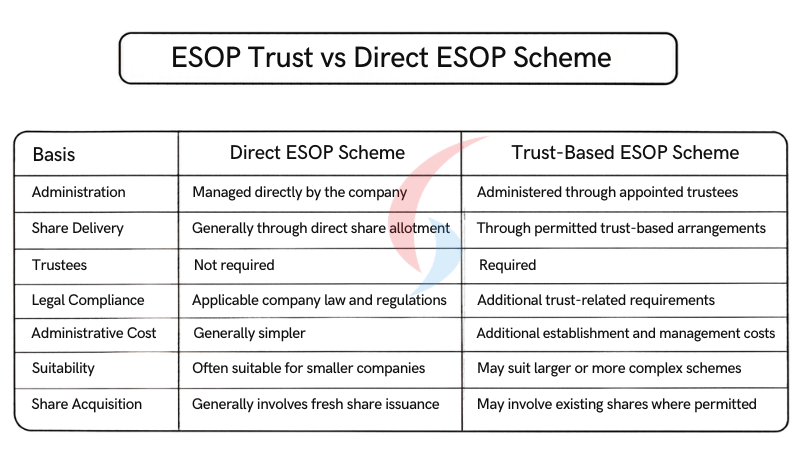
Companies planning employee ownership benefits often need to decide whether to implement a direct ESOP scheme or establish a trust-based arrangement. Both methods can support employee incentives, but their legal structure, administrative requirements and share delivery mechanisms differ.
|
Basis |
Direct ESOP Scheme |
Trust-Based ESOP Scheme |
|---|---|---|
|
Administration |
Managed directly by the company |
Administered through appointed trustees |
|
Share Delivery |
Generally through direct share allotment |
Through permitted trust-based arrangements |
|
Trustees |
Not required |
Required |
|
Legal Compliance |
Applicable company law and regulations |
Additional trust-related requirements |
|
Administrative Cost |
Generally simpler |
Additional establishment and management costs |
|
Suitability |
Often suitable for smaller companies |
May suit larger or more complex schemes |
|
Share Acquisition |
Generally involves fresh share issuance |
May involve existing shares where permitted |
A direct ESOP scheme may be easier for an early-stage startup with a limited workforce. A trust-based arrangement may provide greater administrative flexibility in appropriate circumstances, particularly for listed companies using permitted secondary acquisitions. However, the choice should be based on legal permissibility and commercial requirements rather than administrative convenience alone.
What Happens to ESOP Trust Shares When Employees Resign?
Employee resignation, termination or retirement can affect stock option entitlements, depending on whether the options have vested and the conditions contained in the approved scheme. Unvested options may lapse when an employee leaves the organisation, while vested options may remain exercisable for a specified period. The applicable legal provisions must also be considered.
An ESOP Trust must administer employee benefits according to the approved scheme rather than making independent decisions about eligibility. Companies should clearly explain the treatment of options when employees leave so that there is less scope for confusion or disputes.
Employee resignation or termination may affect vested and unvested stock options depending on the approved ESOP scheme. Read ESOPs on Resignation, Termination and Death to understand the applicable treatment.
Can Employees Sell Shares Received Through an ESOP Trust?
Employees who receive shares through an ESOP Trust may eventually seek liquidity by selling their holdings. However, their ability to sell depends on the company's status, applicable law, shareholder agreements and the availability of a buyer. Shares of unlisted companies may be difficult to sell because they are not traded on a recognised stock exchange.
Liquidity opportunities may arise through an investor purchase, permitted share transfer, acquisition or legally compliant company buyback. Employees should understand that receiving shares does not guarantee an immediate financial return, and the value of their holdings may increase or decrease with the company's performance.
Employee equity ownership may create future liquidity opportunities through share transfers or permitted buyback arrangements. Read ESOP Buyback in India: Rules and Tax Implications for further information.
Common Mistakes Companies Should Avoid
One of the most common mistakes is establishing an ESOP Trust without examining the legal restrictions on acquiring shares and arranging finance. Companies sometimes focus on drafting the trust deed while overlooking financial assistance provisions, shareholder approvals and the specific requirements applicable to listed or unlisted entities. Another mistake is maintaining incomplete employee records. Since options may vest over several years, companies need reliable information about grants, exercises, lapsed options and share transfers. Poor documentation may create difficulties during financial audits, fundraising transactions or employee exits. Businesses should also avoid postponing valuation and taxation planning until employees begin exercising their options. These matters should be evaluated while designing the scheme so that employees understand the potential tax implications and the company can properly account for its obligations.
Why Choose Compliance Calendar LLP?
An ESOP Trust in India can provide a structured arrangement for administering employee share benefits and supporting long-term employee ownership. However, companies must carefully evaluate the proposed trust structure, share acquisition methods and funding arrangements before implementation. The requirements applicable to listed companies differ from those applicable to unlisted businesses, making legal and financial planning particularly important.
For growing startups and established businesses, employee stock options can help encourage retention and create a stronger connection between employees and business performance. A properly designed ESOP scheme, supported by transparent administration and timely compliance, can contribute to these objectives without creating unnecessary regulatory difficulties.
For professional assistance with ESOP Scheme Compliance, trust structuring, share valuation and related corporate compliance, contact Compliance Calendar LLP at +91 9988424211 or info@ccoffice.in
Frequently Asked Questions (FAQs)
Q1. What is an ESOP Trust in India?
Ans. An ESOP Trust is an arrangement established to administer employee share-based benefits under an approved scheme. It may hold and transfer shares to eligible employees according to the trust deed and applicable law. Its structure and regulatory requirements depend on the company's status and proposed transactions.
Q2. Is an ESOP Trust mandatory for every company?
Ans. No, an ESOP Trust is not mandatory for every company offering employee stock options. Companies may use direct ESOP schemes where legally permitted. However, certain employee benefit arrangements involving secondary acquisitions or gifts by listed companies require trust-based implementation under SEBI regulations.
Q3. Can a private limited company establish an ESOP Trust?
Ans. A private limited company may evaluate a trust-based employee benefit arrangement, but its legal permissibility depends on the proposed structure. It must examine the Companies Act, 2013, financial assistance restrictions and applicable approvals before proceeding. Establishing a trust alone does not make every proposed share transaction lawful.
Q4. Who can become a trustee of an ESOP Trust?
Ans. Trustees are responsible for managing trust assets and administering employee benefits. Their eligibility depends on the applicable law and the company's status. Listed-company ESOP Trusts must comply with the specific trustee eligibility and governance requirements prescribed by SEBI.
Q5. Can an ESOP Trust purchase existing shares?
Ans. An ESOP Trust may acquire existing shares where the applicable law permits such transactions. Listed companies must comply with SEBI's secondary acquisition requirements, while unlisted companies must examine company law restrictions, funding arrangements and share transfer procedures.
Q6. Are employees shareholders immediately after receiving ESOP grants?
Ans. No, receiving an ESOP grant generally does not immediately make an employee a shareholder. The employee must normally satisfy the vesting conditions and exercise the options. Shareholder rights arise when shares are legally allotted or transferred according to the applicable arrangement.
Q7. Is valuation mandatory for ESOP Trust transactions?
Ans. Valuation may be required for employee taxation, accounting and share transactions, depending on the applicable provisions. The valuation methodology must be appropriate for the transaction and the company's status. Proper valuation records help companies support their tax calculations and financial reporting.
Q8. Can an ESOP Trust reduce company taxation?
Ans. An ESOP Trust does not automatically reduce a company's tax liability. Different tax consequences may arise from trust funding, employee benefits and share transactions. Companies should evaluate the applicable income-tax provisions rather than treating the trust as a guaranteed tax-saving arrangement.
Q9. What happens to ESOPs when an employee resigns?
Ans. The treatment depends on whether the options are vested or unvested and the provisions of the approved scheme. Unvested options may lapse, while vested options may remain exercisable within the prescribed period. Applicable legal requirements and any relevant exceptions must also be considered.
Q10. What are the major compliance requirements of an ESOP Trust?
Ans. Major requirements may include preparation of the trust deed, appointment of eligible trustees, company and shareholder approvals, lawful share acquisition, maintenance of records, valuation, accounting and taxation. Listed companies must also comply with applicable SEBI requirements concerning secondary acquisitions, governance and disclosures.
Article last updated on : 21 Nov 2026.













































































_learn_crop10_thumb.jpg)