


Employee Stock Option Plans (ESOPs) have become an important part of employee compensation in India, especially among companies listed on stock exchanges. Instead of rewarding employees only through salaries, bonuses and promotions, listed companies can offer them an opportunity to become shareholders. This allows employees to participate in the financial growth of the business while encouraging them to remain associated with the company for a longer period. However, when shares are listed on the stock market, employee stock options involve more than simply rewarding staff members. They also require proper approvals, transparent disclosures, fair governance and compliance with securities laws.
Imagine working for a listed technology company that grants you 2,000 stock options at an exercise price of Rs. 100 per share. Three years later, the company's market price reaches Rs. 350. You may have an opportunity to acquire shares at the agreed price and benefit from the difference in value. Although this sounds attractive, employees cannot simply receive or sell shares without understanding the vesting conditions, exercise process and applicable trading restrictions. This is where SEBI regulations for ESOPs in listed companies become important. These regulations protect employees and investors while ensuring that companies operate employee benefit schemes transparently.
What Are ESOPs in Listed Companies?
An Employee Stock Option Plan (ESOP) is an employee benefit arrangement that gives eligible employees the right to purchase or subscribe to company shares at a predetermined price after satisfying specified conditions. The employee does not become a shareholder merely because options have been granted. Share ownership generally arises when the vested options are exercised and the corresponding shares are allotted or transferred. In listed companies, these shares are traded on recognised stock exchanges such as the National Stock Exchange (NSE) and Bombay Stock Exchange (BSE), subject to applicable restrictions.
Listed companies introduce ESOP schemes to improve employee retention, encourage performance and build a sense of ownership among their workforce. Employees who receive stock options may become more interested in the company's long-term financial performance because an increase in share value can improve the potential benefit available to them. At the same time, the company must ensure that its scheme is properly structured and that employees understand both the opportunities and the financial risks involved. Businesses introducing employee ownership programmes can obtain professional assistance through ESOP Scheme Compliance services.
To understand how employee stock options help businesses retain skilled professionals and encourage long-term growth, read our article on ESOPs: A Powerful Incentive for Employee Retention and Business Growth.
Key SEBI Rules Applicable to ESOPs in Listed Companies
The principal regulations governing share-based employee benefit schemes of listed companies are the SEBI (Share Based Employee Benefits and Sweat Equity) Regulations, 2021, commonly called the SEBI SBEB & SE Regulations. These regulations replaced the earlier SEBI Share Based Employee Benefits Regulations, 2014 and combined the regulatory provisions relating to employee benefit schemes and sweat equity shares. They cover important matters such as employee eligibility, shareholder approvals, scheme administration, minimum vesting requirements, accounting, disclosures and trust-based arrangements.
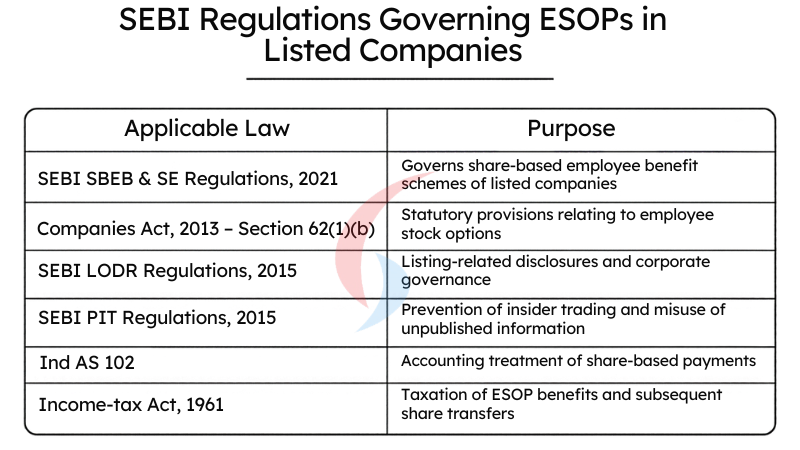
The regulations must be read with the Companies Act, 2013, applicable accounting standards, SEBI Listing Obligations and Disclosure Requirements Regulations, 2015, and SEBI Prohibition of Insider Trading Regulations, 2015. A listed company must examine these requirements together because obtaining approval under one law does not automatically satisfy its obligations under another. As of November 2026, SEBI's published consolidated SBEB & SE Regulations reflect amendments through December 4, 2025.
|
Applicable Law |
Purpose |
|---|---|
|
SEBI SBEB & SE Regulations, 2021 |
Governs share-based employee benefit schemes of listed companies |
|
Companies Act, 2013 – Section 62(1)(b) |
Statutory provisions relating to employee stock options |
|
SEBI LODR Regulations, 2015 |
Listing-related disclosures and corporate governance |
|
SEBI PIT Regulations, 2015 |
Prevention of insider trading and misuse of unpublished information |
|
Ind AS 102 |
Accounting treatment of share-based payments |
|
Income-tax Act, 1961 |
Taxation of ESOP benefits and subsequent share transfers |
Companies handling employee stock options alongside other securities-related obligations should also review their ongoing SEBI Listing Compliance requirements.
Who Is Eligible to Receive ESOPs in Listed Companies?
Employee eligibility is an important part of the SEBI ESOP compliance process. Under the SBEB & SE Regulations, eligible employees generally include qualifying permanent employees working in India or outside India, eligible directors other than independent directors, and employees or directors of qualifying group, subsidiary or associate companies, subject to the prescribed conditions. However, the regulations exclude certain categories of persons, including promoters and promoter-group members, from ordinary employee eligibility.
A director who directly or indirectly holds more than 10% of the outstanding equity shares is also generally excluded, subject to the regulatory provisions. Companies must verify the employment relationship, shareholding and promoter classification before making grants. A senior management position alone does not automatically make a person eligible or ineligible. The company must examine the person's actual status under the regulations and the terms of its approved scheme.
An important development came through SEBI's September 2025 amendment introducing Regulation 9A. It permits specified employees identified as promoters or promoter-group members in an IPO draft offer document to continue holding or exercising eligible share-based benefits granted at least one year before filing that document, subject to the conditions of the regulation. This is a limited exception and does not create unrestricted eligibility for new promoter grants.
How ESOPs Work in Listed Companies: A Practical Example
Consider a fictional listed IT company, BrightTech Limited, which introduces an ESOP scheme to reward employees who have contributed to its business expansion. Under the approved scheme, an employee named Rohan receives 2,000 stock options at an exercise price of Rs. 100 per share. The options vest over three years, provided he satisfies the applicable service and performance conditions.
After three years, the company's market price increases to Rs. 350 per share. Rohan decides to exercise all his vested options by paying Rs. 2,00,000. The market value of the corresponding shares at that assumed price would be Rs. 7,00,000. Therefore, the difference between the market value and exercise cost is Rs. 5,00,000 before applicable taxes, charges and changes in market price.
For a detailed explanation of the tax payable when employees exercise options and sell their shares, read ESOP Taxation for Employees and Startups in India.
Shareholder Approval for ESOP Schemes Under SEBI Regulations
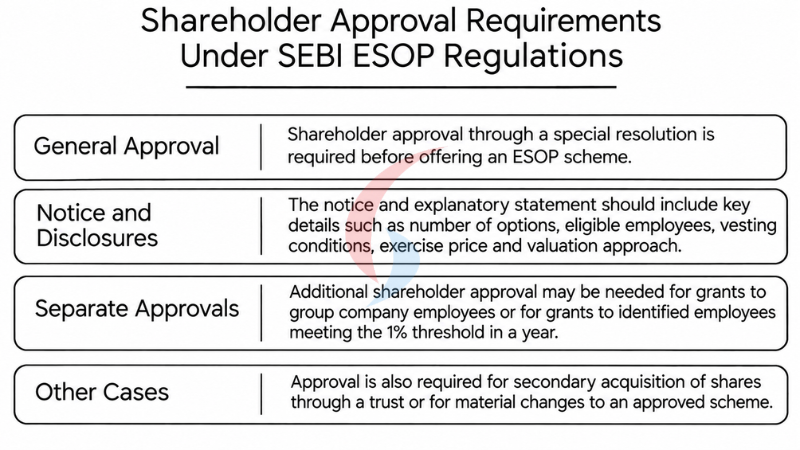
A listed company cannot introduce an employee stock option scheme without following the approval requirements prescribed under SEBI regulations. Regulation 6 generally requires shareholder approval through a special resolution before a scheme can be offered to employees. The notice and explanatory statement should provide sufficient information for shareholders to understand the proposed scheme, including the number of options, eligible employees, vesting conditions, exercise price, valuation approach and other required particulars.
Separate shareholder approvals may also be necessary in specified circumstances, such as grants to employees of group companies or grants to identified employees meeting the prescribed 1% threshold during a year. This threshold is assessed using the regulatory test relating to issued capital at the time of grant. Companies must also consider additional approvals for secondary acquisition of shares through a trust or material changes to approved schemes, where applicable.
These requirements are intended to prevent companies from making significant share-based awards without adequate shareholder oversight. They are particularly important because ESOP schemes may affect the company's equity capital and the ownership interests of existing shareholders.
Minimum Vesting Period and Exercise Price Under SEBI Rules
The vesting period is the time an employee must complete before becoming entitled to exercise the options granted under an ESOP scheme. Under Regulation 18 of the SEBI SBEB & SE Regulations, an employee stock option scheme ordinarily requires a minimum period of one year between the grant and vesting of options, subject to specified exceptions. Companies may prescribe longer periods and performance conditions depending on their compensation policies and business requirements.
Once options have vested, employees may exercise them during the period specified in the scheme. The company generally has flexibility to determine the exercise price for an employee stock option scheme, subject to the applicable accounting and regulatory requirements. However, the exercise price should be clearly communicated to employees before they make their financial decisions.
An employee should understand that vesting and exercise are two separate events. Completing the vesting period does not automatically transfer shares into the employee's demat account. The employee must follow the exercise procedure and satisfy the conditions specified in the scheme.
Direct ESOP Scheme vs Trust-Based ESOP Scheme
Listed companies can implement eligible share-based employee benefit schemes directly or through an irrevocable trust, subject to SEBI regulations. Under a direct scheme, the company generally administers options and issues shares to employees when they exercise their vested rights. Under a trust-based arrangement, a properly constituted trust may acquire, hold and transfer shares for implementing the approved employee benefit scheme.
Trust-based arrangements require additional regulatory controls because they may involve secondary acquisition of shares from the market. SEBI places conditions on trust administration, eligible trustees, acquisition limits, voting rights and permitted transactions. A trust cannot be treated as an ordinary trading vehicle, and its trustees are generally prohibited from voting on the shares held by the trust under the relevant regulations.
|
Basis |
Direct ESOP Scheme |
Trust-Based ESOP Scheme |
|---|---|---|
|
Administration |
Company-administered |
Managed through trustees |
|
Share delivery |
Generally through fresh allotment |
Through permitted trust arrangements |
|
Trustees |
Not required |
Required |
|
Secondary acquisition |
Not ordinarily involved |
Permitted subject to SEBI conditions |
|
Compliance |
Scheme approvals and disclosures |
Additional trust-related restrictions |
|
Cost and complexity |
Generally simpler |
May involve additional administration |
Choosing the correct arrangement depends on the company's proposed share-delivery mechanism, available resources and employee benefit objectives. Companies must also examine the possible dilution of existing shareholders and the financial implications of each arrangement.
ESOP Accounting and Valuation Requirements in Listed Companies
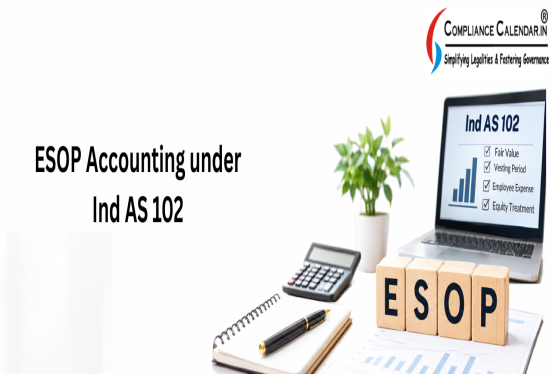
Listed companies must account for employee stock options according to the applicable accounting standards. Ind AS 102, Share-based Payment, generally requires companies to recognise the cost of equity-settled employee share-based compensation using the grant-date fair value of the relevant equity instruments, with the expense recognised over the applicable vesting period. This accounting treatment ensures that the financial statements reflect the economic cost of employee benefits even where the company does not pay the amount directly as cash salary.
For example, if a company grants 10,000 options having an estimated grant-date fair value of Rs. 80 per option and the required service period is four years, the total indicative grant-date value is Rs. 8,00,000. The company generally recognises the corresponding expense over the vesting period, taking account of relevant vesting conditions and estimates. The actual expense depends on the specific terms and applicable accounting requirements.
To understand how listed companies recognise share-based compensation expenses and prepare accounting entries, read ESOP Accounting under Ind AS 102.
SEBI Disclosure and Reporting Requirements for Listed Company ESOPs
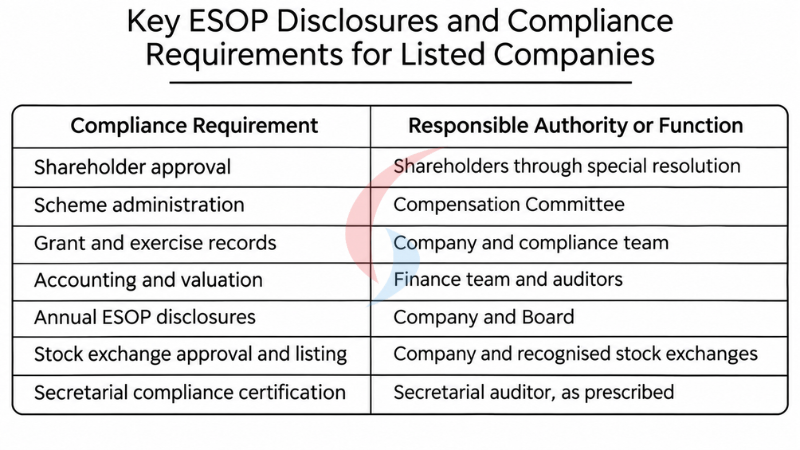
Transparency is one of the most important responsibilities of a listed company operating an ESOP scheme. Regulation 14 of the SEBI SBEB & SE Regulations requires prescribed disclosures relating to share-based employee benefit schemes. Companies must provide the relevant information in their financial statements and make specified disclosures available as required under the regulations, including on their websites. These disclosures help shareholders understand the number of options granted, exercised, forfeited or outstanding and the potential impact of employee benefit schemes.
Listed companies must also consider applicable stock exchange filings and other requirements when new shares are issued under an ESOP scheme. Regulation 10 deals with obtaining the prescribed in-principle approval of recognised stock exchanges for fresh share issuances under schemes, while the relevant provisions also govern the listing of shares arising from employee benefit arrangements. The precise filings depend on whether the scheme involves fresh allotment, existing shares or a previously approved arrangement.
|
Compliance Requirement |
Responsible Authority or Function |
|---|---|
|
Shareholder approval |
Shareholders through special resolution |
|
Scheme administration |
Compensation Committee |
|
Grant and exercise records |
Company and compliance team |
|
Accounting and valuation |
Finance team and auditors |
|
Annual ESOP disclosures |
Company and Board |
|
Stock exchange approval and listing |
Company and recognised stock exchanges |
|
Secretarial compliance certification |
Secretarial auditor, as prescribed |
Role of the Compensation Committee in ESOP Compliance
The Compensation Committee plays a central role in administering employee share-based benefit schemes. Under Regulation 5, the committee is responsible for administering and supervising the schemes and determining their detailed terms in accordance with the regulations. The Nomination and Remuneration Committee may perform the relevant functions where permitted under the applicable corporate governance provisions.
The committee may decide matters such as employee eligibility, vesting criteria, exercise procedures, performance requirements and treatment of benefits when employees leave the organisation. Its responsibilities are particularly important because employee stock options may involve substantial financial benefits for senior executives. Proper committee oversight helps maintain fairness and ensures that decisions are supported by approved policies rather than informal arrangements.
Insider Trading Restrictions on Listed Company ESOPs
One important difference between ESOPs in listed and unlisted companies is the possibility of insider trading concerns. Employees of listed companies may possess unpublished price-sensitive information relating to financial results, acquisitions, business developments or other important corporate matters. Consequently, they must consider the SEBI (Prohibition of Insider Trading) Regulations, 2015 when dealing in company securities.
The ESOP scheme itself does not provide unrestricted permission to trade in company shares. Certain ESOP exercise-related transactions receive specific treatment under insider trading regulations, but subsequent sales of shares must be examined separately under the applicable trading restrictions, disclosure requirements and the company's code of conduct. Employees who qualify as designated persons may also be subject to trading-window controls and pre-clearance procedures.
For example, a senior finance employee holding company shares acquired through an ESOP cannot assume that selling those shares is permissible merely because the shares came from an employee benefit scheme. The employee must examine whether they possess unpublished price-sensitive information and whether the proposed trade satisfies applicable restrictions.
What Happens to ESOPs After Resignation or Termination?
Employees often worry about losing their stock options when changing jobs. Under SEBI regulations, the treatment of ESOPs depends on whether the options are vested or unvested and the circumstances in which employment ends. The regulations generally provide that unvested options lapse on resignation or termination, while vested options may be exercised within the period specified in the scheme, subject to applicable conditions.
Different provisions may apply in cases involving retirement, death or permanent incapacity. Companies should clearly explain these situations in their ESOP documents so that employees understand their rights before accepting a grant or leaving the organisation. Ambiguous clauses relating to exercise deadlines, lapse of options and post-employment benefits can lead to disputes between employers and employees.
For a detailed explanation of employee stock option rights after leaving a job, read ESOPs on Resignation, Termination and Death.
Common ESOP Compliance Mistakes Made by Listed Companies
Despite having experienced legal and finance teams, listed companies may face difficulties when implementing employee benefit schemes. One common mistake is introducing or modifying a scheme without obtaining the necessary shareholder approvals. Another is failing to maintain accurate records of grants, vesting, exercise and lapses. Problems can also arise where companies misunderstand employee eligibility, provide incomplete disclosures or fail to account for share-based payments correctly.
Trust-based schemes create additional responsibilities because secondary market acquisitions, trust documentation and share transfers must comply with prescribed conditions. Companies should also avoid assuming that all employee transactions are exempt from insider trading restrictions. Inadequate communication with employees can create unrealistic expectations about potential returns, particularly where employees overlook income-tax liabilities or exercise deadlines.
Strong internal coordination between the company secretary, finance department, human resources team and compliance officers can help prevent these issues before they become regulatory or employee-related disputes.
Step-by-Step Process to Implement ESOPs in Listed Companies
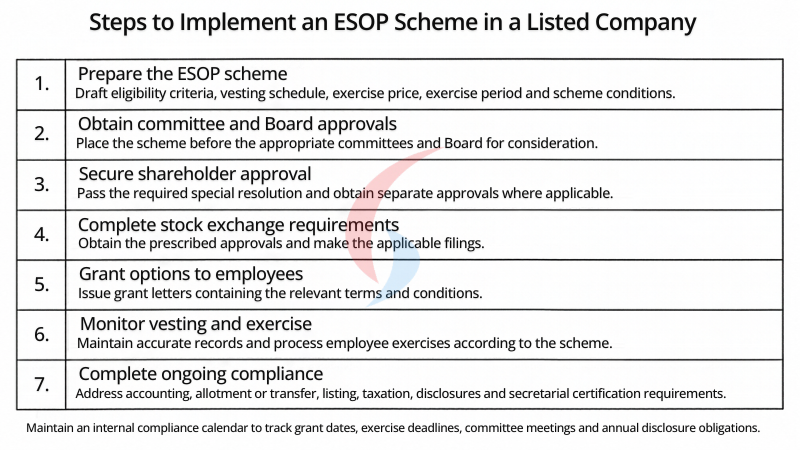
Implementing a listed-company ESOP scheme requires a structured process that brings together corporate approvals, employee compensation policies, financial reporting and stock exchange requirements. The company should begin by identifying the objectives of the proposed scheme, the employees who may participate, the number of options to be offered and the expected financial impact. This preparation should be followed by the necessary corporate approvals and compliance checks.
-
Prepare the ESOP scheme: Draft the eligibility criteria, vesting schedule, exercise price, exercise period and other scheme conditions.
-
Obtain committee and Board approvals: Place the scheme before the appropriate committees and Board for consideration.
-
Secure shareholder approval: Pass the required special resolution and obtain separate approvals where applicable.
-
Complete stock exchange requirements: Obtain the prescribed approvals and make the applicable filings.
-
Grant options to employees: Issue grant letters containing the relevant terms and conditions.
-
Monitor vesting and exercise: Maintain accurate records and process employee exercises according to the scheme.
-
Complete ongoing compliance: Address accounting, allotment or transfer, listing, taxation, disclosures and secretarial certification requirements.
A listed company should also maintain an internal compliance calendar to monitor grant dates, exercise deadlines, committee meetings and annual disclosure obligations. Proper planning makes the scheme easier for employees to understand and reduces the possibility of missed filings.
Why Choose Compliance Calendar LLP?
ESOPs in listed companies provide employees with an opportunity to participate in the growth of the organisations they work for. For employers, these schemes can improve retention, reward performance and strengthen long-term employee commitment. However, operating an ESOP scheme in a listed company requires careful compliance with SEBI regulations, shareholder approvals, accounting standards, disclosure obligations and applicable insider trading restrictions.
A successful employee stock option scheme should be transparent, legally compliant and easy for employees to understand. Businesses planning to introduce or revise an ESOP scheme can seek assistance from Compliance Calendar LLP for ESOP Scheme Compliance, corporate approvals, documentation and related regulatory requirements.
If your company is planning to implement an ESOP scheme and requires assistance with SEBI compliance, shareholder approvals, documentation and regulatory filings, contact Compliance Calendar LLP at +91 9988424211 or info@ccoffice.in
Frequently Asked Questions (FAQs)
Q1. Which SEBI regulations govern ESOPs in listed companies?
Ans. ESOPs in listed companies are primarily governed by the SEBI (Share Based Employee Benefits and Sweat Equity) Regulations, 2021, as amended. Companies must also comply with relevant provisions of the Companies Act, SEBI LODR Regulations, SEBI insider trading regulations and applicable accounting standards.
Q2. Is shareholder approval mandatory for ESOPs in listed companies?
Ans. Yes. Regulation 6 generally requires shareholder approval through a special resolution before introducing an employee stock option scheme. Separate shareholder approvals may be necessary for specified employee grants or other transactions covered by the regulations.
Q3. What is the minimum vesting period for ESOPs under SEBI regulations?
Ans. The minimum vesting period for an employee stock option scheme is ordinarily one year between the grant and vesting of options, subject to prescribed exceptions. Companies may establish longer vesting schedules based on service requirements, employee performance and the terms of their schemes.
Q4. Can promoters receive ESOPs in listed companies?
Ans. Promoters and promoter-group members are generally excluded from ordinary ESOP eligibility under the SEBI regulations. However, Regulation 9A, introduced in September 2025, provides a limited exception for certain pre-IPO share-based benefits granted at least one year before filing the draft offer document.
Q5. Can independent directors receive ESOPs in listed companies?
Ans. No. Independent directors are excluded from employee eligibility for ESOP grants under the applicable SEBI regulations. Listed companies must verify the status of each director before offering share-based compensation benefits.
Q6. Are ESOPs taxable for employees of listed companies?
Ans. Yes. ESOPs generally result in a taxable salary perquisite when qualifying options are exercised and shares are allotted or transferred, based on the applicable fair market value rules. When employees subsequently sell the shares, capital gains tax may also arise depending on the relevant tax provisions.
Q7. Can a listed company implement ESOPs through a trust?
Ans. Yes. SEBI permits eligible employee benefit schemes to be implemented through irrevocable trusts, subject to prescribed regulatory conditions. Trust arrangements may involve secondary acquisition of shares and additional obligations concerning trustees, acquisition limits, share transfers and disclosures.
Q8. Can employees sell ESOP shares immediately after exercise?
Ans. Employees may generally sell shares acquired through an ESOP after the applicable restrictions have been satisfied. However, insider trading regulations, trading-window restrictions, applicable lock-in provisions and company policies must be considered before any sale.
Q9. What happens to vested ESOPs when an employee resigns?
Ans. Vested options may generally be exercised within the period specified in the approved ESOP scheme, subject to applicable SEBI requirements. Unvested options ordinarily lapse upon resignation or termination, although different provisions may apply in special circumstances such as retirement, death or permanent incapacity.
Q10. How can Compliance Calendar LLP assist with ESOP compliance for listed companies?
Ans. Compliance Calendar LLP can assist businesses with ESOP scheme documentation, shareholder approval procedures, corporate compliance, regulatory filings and related employee share-based benefit requirements.
Article last updated on : 21 Nov 2026.













































































_learn_crop10_thumb.jpg)