


What Is a Conflict of Interest in Insurance Broking?
A conflict of interest arises when an insurance broker's financial, personal, ownership or business interests may interfere with its responsibility to provide suitable and impartial services to clients. Such conflicts can arise during insurance product selection, commission arrangements, related-party transactions, policy placement or claims assistance.
For example, an Insurance Broker may receive different commission rates from different insurance companies. Receiving commission is not automatically a conflict or violation. However, recommending an unsuitable policy merely because it offers higher remuneration may raise concerns under the broker's professional obligations.
Conflicts may also arise where an insurance broker and insurer belong to the same promoter group. In such cases, the broker must consider specific related-party and disclosure requirements rather than treating the transaction as an ordinary independent placement. Under Regulation 30, read with Schedule I – Form H of the IRDAI (Insurance Brokers) Regulations, 2018, insurance brokers must follow prescribed professional conduct standards, including avoiding conflicts of interest.
Legal Provisions Governing Conflict of Interest Rules for Insurance Brokers
The legal requirements are primarily drawn from the Insurance Act, 1938, the IRDAI Act, 1999 and the IRDAI (Insurance Brokers) Regulations, 2018, as amended.
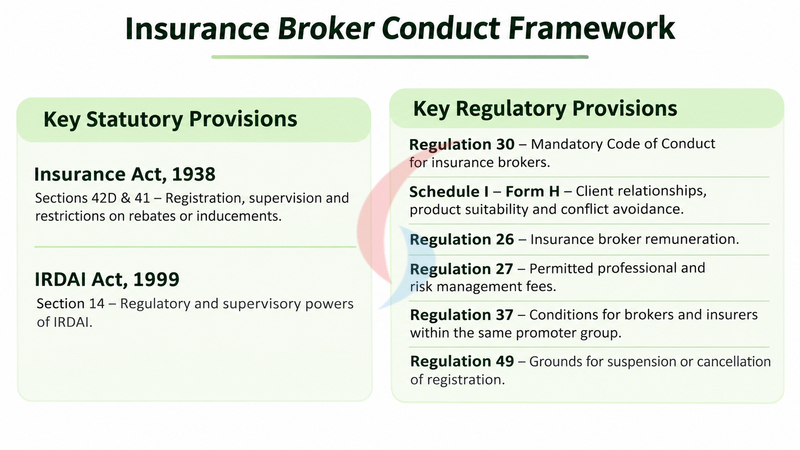
| Legal provision | Relevance to conflict of interest |
| Insurance Act, 1938 – Section 42D | Registration and supervision of insurance intermediaries |
| Insurance Act, 1938 – Section 41 | Restrictions on prohibited rebates and inducements |
| IRDAI Act, 1999 – Section 14 | IRDAI's regulatory and supervisory powers |
| Insurance Brokers Regulations – Regulation 30 | Mandatory Code of Conduct |
| Schedule I – Form H | Client relationships, product suitability and conflict avoidance |
| Regulation 26 | Insurance broker remuneration |
| Regulation 27 | Permitted professional and risk management fees |
| Regulation 37 | Conditions concerning insurers and brokers within the same promoter group |
| Regulation 49 | Grounds for suspension or cancellation of registration |
| IRDAI Insurance Intermediaries Amendment Regulations, 2026 | Updated intermediary registration, disclosure and compliance provisions |
The Code of Conduct is central to these requirements. It expects brokers to act with care and diligence, provide appropriate product explanations, avoid misleading sales practices and ensure that clients understand the broker's role. Importantly, the law does not treat every commercial relationship as prohibited. Instead, it establishes specific restrictions, duties and disclosure requirements that must be considered according to the nature of the relationship.
For regulatory duties and professional conduct standards, explore our IRDAI Insurance Broker Compliance
Common Types of Conflicts of Interest in Insurance Broking
Conflicts of interest may arise in several situations, even where the insurance broker does not intend to mislead the customer.
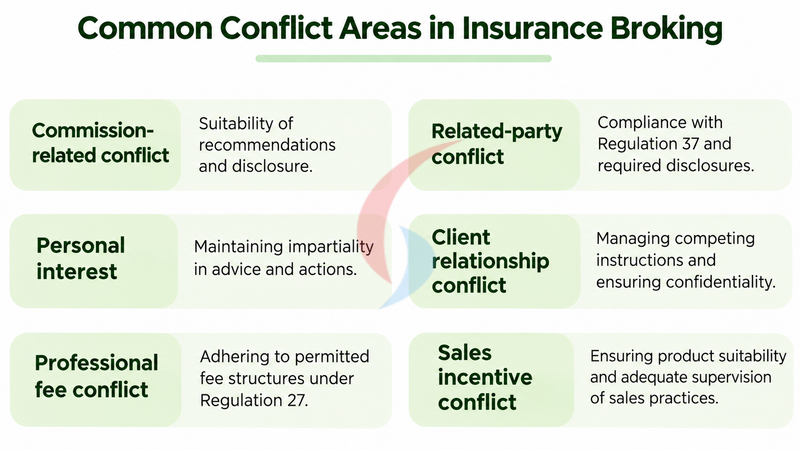
| Type of conflict | Practical example | Compliance concern |
| Commission-related conflict | Recommending an insurer offering higher brokerage | Policy suitability and disclosure |
| Related-party conflict | Recommending an insurer within the same promoter group | Regulation 37 restrictions |
| Personal interest | Employee has a financial interest in a recommended insurer | Impartiality and internal controls |
| Client relationship conflict | Broker receives competing instructions from clients | Confidentiality and representation |
| Professional fee conflict | Charging overlapping fees for the same risk management service | Regulation 27 restrictions |
| Sales incentive conflict | Rewarding staff only for high-commission business | Product suitability and supervision |
A conflict does not necessarily mean that an unlawful transaction has already occurred. It may be an actual, potential or perceived situation requiring assessment. For instance, a broker may have a legitimate commercial relationship with an insurer while still providing suitable advice. The relevant question is whether the arrangement affects professional judgment or triggers specific disclosure or regulatory restrictions.
Insurance Broker Commission and Conflict of Interest Rules
Commission arrangements are an important area of potential conflict because insurance brokers generally earn revenue from insurance placement activities. The remuneration offered by different insurers may vary according to the product, distribution agreement and applicable regulatory requirements. Consider Pari’s manufacturing. One insurer offers a policy with broad machinery breakdown protection, while another pays higher commission but excludes certain equipment. If Rajesh recommends the second policy without explaining the material coverage difference, the client may receive unsuitable protection.
Schedule I – Form H requires brokers to explain their services, recommend suitable policies and provide appropriate comparisons involving price, coverage and service. It also requires disclosure, when requested by the client, of the remuneration received, its basis and any relationship between the broker and insurer. Furthermore, Regulation 27 places conditions on charging separate professional fees for permitted risk management services. Brokers must not improperly receive both commission and separate fees for the same service in circumstances prohibited by the regulations.
To understand brokerage payments and disclosure obligations, read our Insurance Broker Commission and Remuneration Rules
Conflict of Interest Between Insurance Brokers and Group Insurance Companies
A particularly important situation arises when an insurance broker and Insurance Company belong to the same promoter group. Regulation 37 of the Insurance Brokers Regulations, 2018 contains specific conditions for such arrangements. The regulation addresses the proportion of business placed with group insurers, disclosures to clients, remuneration practices and the relationship between the broker and insurer.
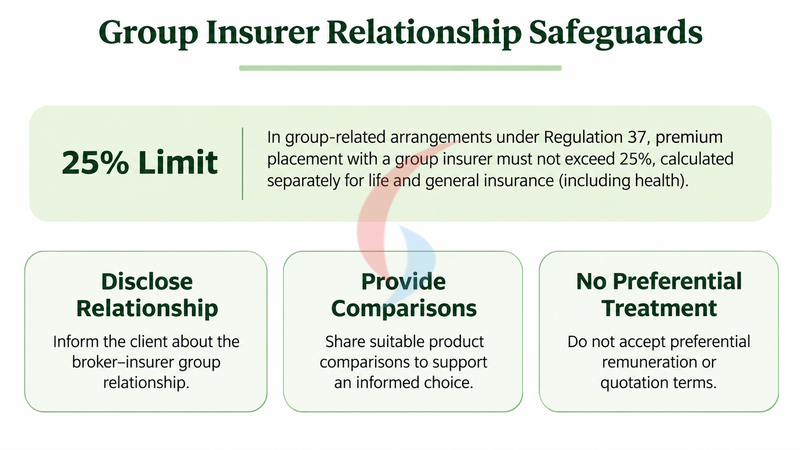
Under the published provision, a qualifying broker promoted by a corporate house having an insurance company within its group is subject to a 25% limit on insurance premiums placed with that group insurer, calculated separately for life and general insurance, including health business, in a financial year.
The regulation also contains an important set of safeguards. The related insurer must not provide preferential remuneration or more favourable quotation terms for the same proposal merely because of the group relationship, and the broker must disclose that relationship and explain recommendations involving the group insurer. For example, suppose a broker and a general insurance company are promoted by the same corporate group. If the broker recommends the group insurer's product, it must satisfy the relevant disclosure and comparison obligations. The broker should not assume that common ownership permits preferential treatment.
Learn how brokers and corporate agents differ in our Difference Between Insurance Broker and Corporate Agent
Disclosure Requirements Under the Insurance Broker Code of Conduct
Transparency is an important part of insurance broker compliance. Schedule I – Form H establishes conduct standards concerning client relationships, sales practices, advertisements, documents and remuneration. Brokers are expected to explain the services they provide, identify the insurer or insurers involved and help clients understand important policy conditions. Where a customer requests information about the commission received, the broker must provide the relevant remuneration details and basis, along with any relationship with the insurer.
For group-related insurance arrangements, additional disclosure requirements apply under Regulation 37. Such requirements can include explaining why a related insurer's product is recommended and providing information about the next-best option offered by an unrelated insurer. These disclosures are especially important when the client might otherwise believe that the broker has no financial or ownership connection with the recommended insurer.
A broker should preserve records of material disclosures, customer instructions and the reasons supporting significant insurance recommendations. Proper records can help establish how the broker identified and managed a potential conflict.
Importance of Client Agreement and Mandate Letter
A written client agreement or mandate letter can help establish the insurance broker's responsibilities and reduce uncertainty about the services being provided. It identifies the client's instructions, the scope of representation and the broker's authority to approach insurance companies.
Schedule I – Form H generally requires brokers to obtain a written mandate to represent a client, subject to the prescribed exceptions. Under the published provisions, a mandate without a specified validity period is generally valid for one year. Certain pre-underwritten and retail or individual policies are treated differently.
Suppose Amit authorises Rajesh to obtain quotations for factory insurance. The written mandate can identify the risks to be insured, the insurer selection process and the agreed responsibilities. It can also help the broker document how potential conflicts were addressed. A mandate, however, does not excuse unsuitable advice or override any regulatory requirement. Brokers must continue to act in accordance with their Code of Conduct even after obtaining written client authorisation.
To understand client authorisation and documentation requirements, read our Insurance Broker Client Agreement and Mandate Letter. It explains the importance of proper client consent, agreements, and mandate documentation in insurance broking.
How Can Insurance Brokers Manage Conflicts of Interest?
Insurance brokers should establish a practical system for identifying, reviewing and managing conflicts before they affect customers. The procedure should be proportionate to the company's size, business model and relevant regulatory obligations.
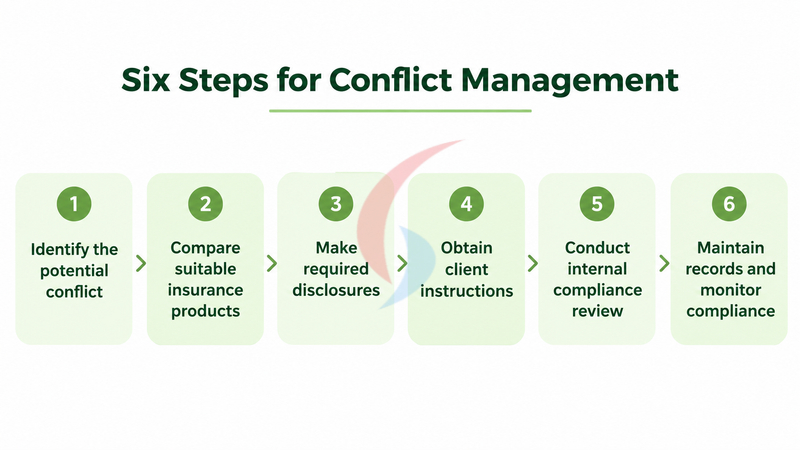
Step 1: Identify the Potential Conflict
Review whether the proposed insurance placement involves higher commissions, related-party relationships or personal financial interests. The broker should identify any circumstance that may affect independent professional judgment. Employees should report potential conflicts before recommending or placing a policy.
Step 2: Compare Suitable Insurance Products
Assess relevant products using the client's risk profile, coverage requirements, exclusions and premium considerations. Compare suitable alternatives where available rather than relying only on commercial incentives. Record the reasons supporting the recommendation.
Step 3: Make Required Disclosures
Provide the client with disclosures required under the applicable IRDAI regulations. Explain relevant remuneration and insurer relationships when disclosure is required. Where a group insurer is involved, satisfy the additional requirements under Regulation 37.
Step 4: Obtain Client Instructions
Document the client's requirements and obtain the prescribed written mandate where applicable. Explain significant policy limitations and important differences between proposed insurance options. Keep records of the client's instructions and final decision.
Step 5: Conduct Internal Compliance Review
Refer material conflicts to the compliance officer or another authorised reviewer before completing the transaction. Check whether the proposed arrangement meets regulatory restrictions and company policies. If the conflict cannot be appropriately managed, the broker should avoid the affected arrangement.
Step 6: Maintain Records and Monitor Compliance
Preserve quotations, comparison statements, disclosure records and relevant communications. Periodically review commission arrangements and related-party insurance placements. Update internal policies when regulations, ownership structures or business arrangements change. These steps are practical compliance measures informed by the Code of Conduct; they are not a separate six-step statutory filing procedure.
Role of the Principal Officer and Broker Qualified Persons
The Principal Officer and Broker Qualified Persons (BQPs) play an important role in maintaining appropriate standards of insurance broking. The Principal Officer has responsibility for the management and regulatory supervision of the insurance brokerage business. BQPs perform permitted insurance solicitation and procurement activities after satisfying the applicable qualification, training and examination requirements.
For example, if a BQP repeatedly recommends policies from one insurer despite less suitable coverage, the Principal Officer should examine whether the pattern reflects customer requirements or an inappropriate commercial incentive. Schedule I – Form H requires brokers to maintain competent staff and arrangements to monitor the quality of advice provided by qualified personnel. Therefore, conflict-of-interest training should form part of the company's professional supervision practices.
Understand professional eligibility and staff responsibilities through our Qualified Persons in Insurance Broking
Related-Party Transactions and Ownership Changes
Changes in the ownership of an insurance brokerage company can create new conflicts of interest. For example, a new investor may also hold a significant ownership interest in an insurance company or another financial services business. Where the broker and insurer become part of the same promoter group, Regulation 37 may become relevant.
The company may also need to assess whether the ownership transaction triggers prior IRDAI approval under the share transfer provisions. Such situations should be reviewed before implementing the proposed investment. A company should not assume that disclosures made during its original registration remain sufficient after a material ownership change.
For ownership changes and regulatory approval requirements, explore our Change in Shareholding of an IRDAI-Registered Broker
What Happens If an Insurance Broker Violates Conflict of Interest Rules?
Failure to manage conflicts of interest can expose an insurance broker to regulatory and commercial consequences. The seriousness of the outcome depends on whether the broker has breached a specific regulation, misled a customer or failed to comply with its professional obligations.
Regulation 49 of the Insurance Brokers Regulations, 2018 provides grounds for suspension or cancellation of registration following the prescribed procedure. These include violations of applicable laws, misconduct inconsistent with the Code of Conduct, prohibited inducements and failures relating to regulatory obligations.
A client who suffers financial loss because of inappropriate professional advice may also pursue remedies depending on the facts and applicable law. However, a conflict of interest does not automatically establish professional negligence or guarantee that a compensation claim will succeed. The broker's records, disclosure practices, advice and contractual responsibilities may become important when evaluating a dispute.
For regulatory reporting and continuing obligations, refer to our Insurance Broker Compliances in India
Latest IRDAI Regulatory Developments
India's insurance regulatory environment underwent significant changes following the Sabka Bima, Sabki Raksha (Amendment of Insurance Laws) Act, 2025. The reforms affected several aspects of insurance regulation and intermediary compliance. On 30 July 2026, IRDAI notified the Insurance Intermediaries (Amendment) Regulations, 2026, which amended regulations governing insurance brokers, Corporate Agent, Insurance Marketing Firms and Web Aggregators.
These developments have implications for intermediary registration, regulatory accountability, reporting and disclosure requirements. Insurance brokers should therefore examine their existing compliance arrangements against the updated regulations. However, the 2026 amendments should not be interpreted as replacing the entire insurance broker Code of Conduct or eliminating existing conflict-of-interest obligations. Regulation 30, Schedule I – Form H and the applicable group-insurer provisions remain important references, subject to subsequent amendments and directions.
For updated intermediary compliance requirements, read our IRDAI Compliance Requirements for Insurance Intermediaries
Case Study: How Rajesh Managed a Conflict Without Losing His Client
Returning to Rajesh's insurance brokerage company, the three quotations for Amit's factory insurance are ready. The policy offering the highest commission has an important exclusion for a category of manufacturing machinery. The group-related insurer offers reasonable coverage, but its relationship with Rajesh's investors creates additional considerations.
Rather than making an immediate recommendation, Rajesh asks his team to prepare a comparison of all three policies. The comparison considers premium amounts, fire protection, machinery breakdown coverage, business interruption benefits, deductibles and significant exclusions.
Rajesh also reviews the applicable remuneration and relationship disclosures. His compliance officer examines the connection with the group insurer and checks whether the relevant regulatory conditions have been satisfied.
When Amit attends the next meeting, Rajesh explains the advantages and limitations of the available policies. He identifies the product offering better protection for the factory's particular risks and explains the material differences.
Amit chooses the policy that best meets his business needs. Although Rajesh's company does not receive the highest available commission, the customer appreciates the transparency and continues working with the broker.
This fictional example demonstrates that managing conflicts of interest is not simply about avoiding penalties. It can strengthen customer confidence and support long-term professional relationships.
Common Conflict of Interest Mistakes Insurance Brokers Should Avoid
One common mistake is assuming that receiving a legitimate commission means the broker has no further responsibility to consider potential conflicts. Although commission is an accepted part of insurance distribution, the broker must still provide appropriate advice and comply with disclosure requirements. Another mistake is recommending products from group insurers without examining the additional restrictions under Regulation 37. Businesses may also overlook personal or financial interests held by their employees, directors or related entities.
Poor documentation can create additional difficulties. Even where a broker makes a suitable recommendation, missing comparisons, incomplete client instructions or undocumented disclosures can make it difficult to demonstrate proper conduct during an inspection or dispute. Regular internal reviews should therefore cover commission arrangements, insurer relationships, client mandates, product suitability and the quality of advice provided by qualified personnel.
Learn how conflicts may arise in acquisitions through our IRDAI Approval for Insurance Broker Takeover
Why Choose Compliance Calendar LLP for Insurance Broker Compliance?
Managing conflicts of interest is an important responsibility for businesses operating in India's regulated insurance sector. Insurance brokers must understand their permitted activities, remuneration arrangements, disclosure requirements and the duties prescribed under the IRDAI Code of Conduct.
Compliance Calendar LLP assists businesses with insurance broker registration, regulatory documentation and related compliance requirements. Our team can help organisations understand applicable IRDAI provisions, review supporting documentation and identify procedural obligations relevant to their insurance business.
For professional assistance with insurance broker registration and compliance requirements, contact Compliance Calendar LLP at +91 9988424211 or info@ccoffice.in
Frequently Asked Questions (FAQs)
Q1. What is a conflict of interest in insurance broking?
Ans. A conflict arises when a broker's financial or personal interests may interfere with client responsibilities. It may involve commission, related-party relationships or unsuitable insurance recommendations. Brokers must manage such situations under applicable IRDAI regulations.
Q2. Which IRDAI regulation governs conflict of interest for insurance brokers?
Ans. Regulation 30 requires insurance brokers to follow the prescribed Code of Conduct. Schedule I – Form H includes obligations relating to client interests and conflict avoidance. Regulation 37 contains additional provisions for certain group-related insurance arrangements.
Q3. Can insurance brokers receive commission from insurance companies?
Ans. Yes, brokers may receive commission for permitted insurance broking activities. The payment must comply with applicable remuneration rules and insurer policies. Brokers must not allow commission incentives to compromise suitable advice.
Q4. Must insurance brokers disclose their commission to clients?
Ans. Under Schedule I – Form H, brokers must disclose remuneration and its basis when requested by a client. The disclosure also includes relevant relationships between the broker and insurer. Additional disclosure requirements may apply to group-related arrangements.
Q5. Can an insurance broker recommend policies from a related insurance company?
Ans. Yes, subject to the applicable restrictions under Regulation 37. The broker must comply with relevant placement, comparison and disclosure requirements. The recommendation should be supported by the client's insurance needs.
Q6. What is the role of a Principal Officer in conflict management?
Ans. The Principal Officer supervises the insurance broker's regulatory and professional operations. This includes oversight of staff conduct and applicable compliance arrangements. Material conflicts should be examined through the company's internal supervision procedures.
Q7. Can a broker charge both commission and risk management fees?
Ans. Regulation 27 permits certain professional fees subject to prescribed conditions. The broker cannot improperly receive both remuneration and separate fees for the same service. Written client documentation and the applicable restrictions must be considered.
Q8. Is a client mandate letter mandatory?
Ans. A written mandate is generally required for applicable insurance broking representation. The regulations provide exceptions for certain pre-underwritten and retail or individual policies. The broker should follow the applicable mandate and client authorisation requirements.
Can an insurance broker face penalties for a conflict of interest?
Ans. Yes, regulatory action may follow where a conflict results in a breach of applicable requirements. The consequences depend on the nature and seriousness of the violation. Serious misconduct may lead to suspension or cancellation under the prescribed procedure.
How can brokers prevent conflicts of interest?
Ans. Brokers should compare suitable policies and identify relevant financial relationships. Required disclosures, client instructions and insurance recommendations should be documented. Regular staff training and compliance monitoring can help reduce potential conflicts.
Article last updated on : 19 Nov 2026.













































































_learn_crop10_thumb.jpg)