


A company may be registered but may not start its business for a long time. It may have no customers, no sales, no income and no bank transactions during the financial year. Sometimes, the directors may keep the company inactive because they are waiting for funds, looking for business opportunities or planning to start operations later. In such situations, they may feel that there is nothing to discuss in an Annual General Meeting (AGM).
However, a company generally must hold its AGM even if it has no revenue, sales or business activity. Section 96 of the Companies Act, 2013 requires every company other than a One Person Company (OPC) to hold an AGM every year. The rule does not provide a general exemption simply because a company has not earned money or carried out transactions. It must also prepare its financial statements and complete the annual filings that apply to it. Therefore, having no business activity does not mean that a company can ignore its yearly responsibilities.
Does a Company Need to Hold an AGM If It Has No Revenue?
Yes. A company must generally hold an AGM even if it has not started business, made any sales or earned any income during the year. The AGM is not held only to discuss profits, sales or business growth. It is also a yearly meeting where members review the company's financial position and consider important company matters.
For example, imagine a private limited company registered in April. Its owners have not started operations because they are still arranging funds and planning the business. The company has no customers, sales or income during the year. Even then, it cannot skip its AGM just because it has not started earning money. It must follow the AGM rules and complete the annual compliances that apply to it.
It is important to understand that the following situations do not automatically remove the AGM requirement:
- The company has not started its business.
- The company has not issued any invoices or made any sales.
- The company has earned no income during the financial year.
- The company has no customers or employees.
- The company has not used its bank account.
- The company has only paid basic expenses, such as filing fees or professional charges.
A One Person Company is a specific exception under Section 96. It does not have to hold an AGM, although it must complete its other applicable annual compliances.
Why Does a Company Need an AGM Even When There Is No Business?
A company is a separate legal entity. Its legal responsibilities do not stop just because it has no business activity. It still has members, directors, share capital and financial records that need attention. The AGM gives members an opportunity to review the company's position and consider the matters placed before them.
Even a company with no revenue may have some expenses during the year. For example, it may have paid bank charges, office rent, professional fees or government filing fees. These amounts need to be recorded in its accounts. The financial statements help members understand what the company owns, what it owes and what expenses it has incurred.
There is also a difference between having no revenue and having no financial activity at all. A company may not have made any sales, but it may still have paid expenses or received money from its directors. It may also have share capital, an unpaid amount from members or other financial balances. These details need to be properly recorded.
The AGM helps members understand such matters. It also gives them an opportunity to ask questions about the company's financial position and future plans. In simple words, the AGM is a yearly company meeting, not a meeting that is required only when the company earns a profit.
What Are the Main Matters to Be Covered in a No-Business AGM?
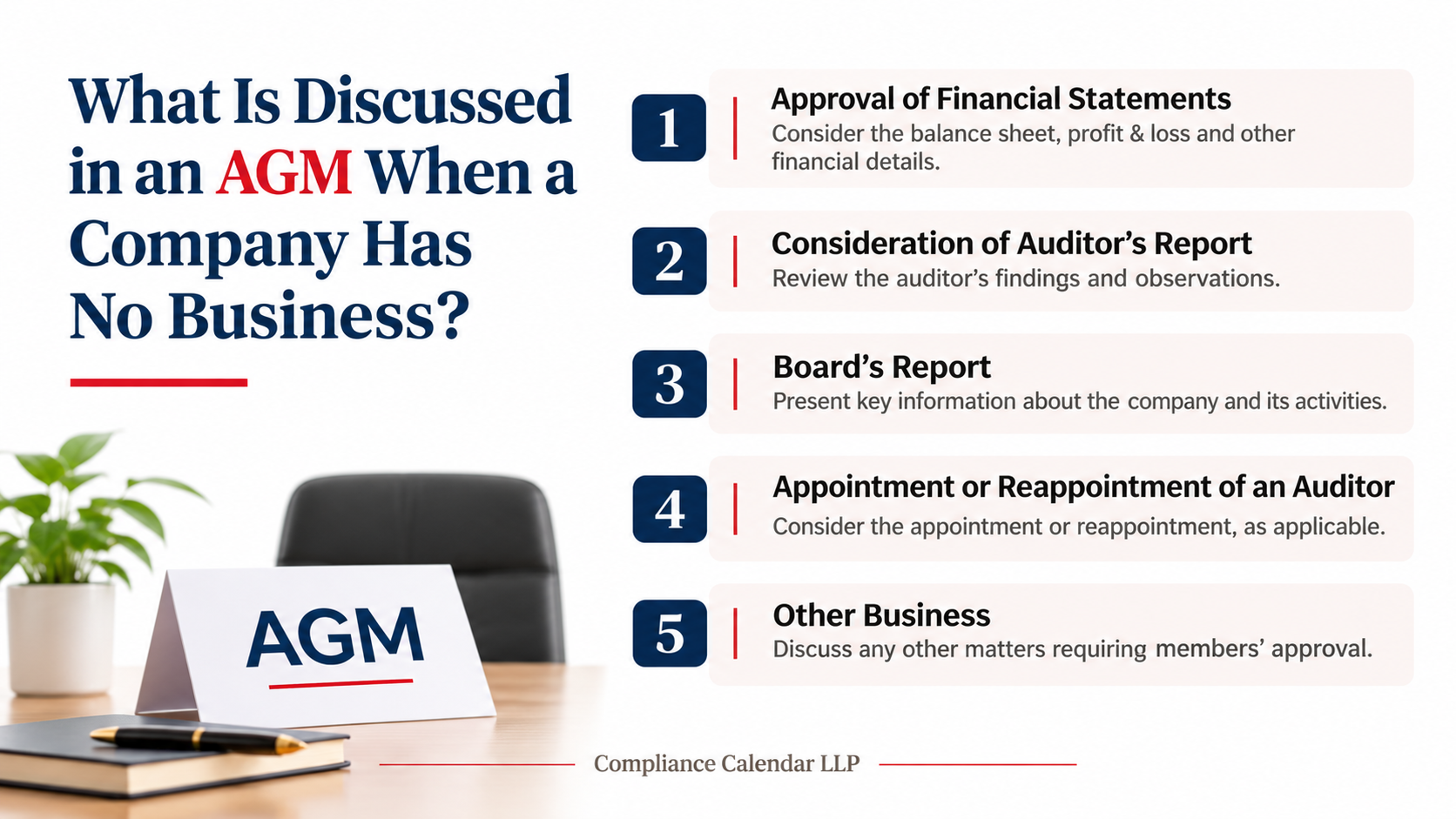
A company does not need to show profits or sales to hold an AGM. It needs to discuss the matters that apply to its financial year. The main purpose is to place the company's financial position before its members and complete the business required under the Companies Act.
Some common matters may include:
- Approval of financial statements
The company must prepare its financial statements for the financial year. These statements show its assets, liabilities, share capital, expenses and other financial details. If there is no revenue, the financial statements should show the actual position rather than leaving out the records.
- Consideration of the auditor's report
The auditor's report is placed along with the financial statements. It helps members understand whether the auditor has identified any issues or made any observations while checking the accounts.
- Board's Report
The Board's Report explains important information about the company and its activities during the year. Even if the company has not started operations, it may still need to prepare the report in the required form.
- Appointment or reappointment of an auditor
Members may need to consider the appointment or reappointment of an auditor, depending on the company's circumstances and the applicable provisions.
- Other matters requiring members' approval
There may be other matters to discuss depending on the company's structure, Articles of Association and legal requirements.
Not every company will have all these matters in every AGM. For example, a company that has not made a profit may have no dividend to declare. Similarly, an appointment may not be due in that particular year. The company should discuss the matters that actually apply to it instead of adding unnecessary business to the meeting.
When Should a Company Hold Its AGM?
Section 96 of the Companies Act, 2013 sets the time limit for holding an AGM. The deadline depends on whether the company is holding its first AGM or an AGM in a later year. For most Indian companies, the financial year ends on 31 March, so the usual deadline for an existing company is 30 September.
The following table explains the main time limits:
|
Situation |
Time limit |
|
First AGM |
Within 9 months from the end of the first financial year |
|
AGM in later years |
Within 6 months from the end of the financial year |
|
Gap between two AGMs |
Not more than 15 months |
|
Extension by ROC |
Up to 3 months for an AGM other than the first AGM, for a special reason |
Example: If a company's financial year ends on 31 March 2026, its AGM for that year will generally need to be held by 30 September 2026. If it is the company's first financial year, the nine-month rule applies instead.
There is also a special rule for a newly incorporated company. If it holds its first AGM within the required time, it does not need to hold another AGM in the calendar year in which it was incorporated. This gives a newly registered company enough time to complete its first financial year and hold its first AGM.
The ROC may extend the deadline for an AGM other than the first AGM by up to three months if there is a special reason. This extension is not automatic. The company must obtain the required approval and should not assume that it can simply hold the meeting later.
Where Should the AGM Be Held?
Section 96 also provides rules about the time and place of an AGM. Generally, the meeting must be held:
- During business hours, between 9 a.m. and 6 p.m.
- On a day that is not a National Holiday.
- At the registered office or another place within the same city, town or village where the registered office is situated.
An unlisted company may hold its AGM at any place in India if all members give their consent in advance in writing or through electronic mode. Companies should check the applicable rules and any relevant exemptions before finalising the meeting arrangements.
Does a Company With No Revenue Still Need to Complete Annual Filings?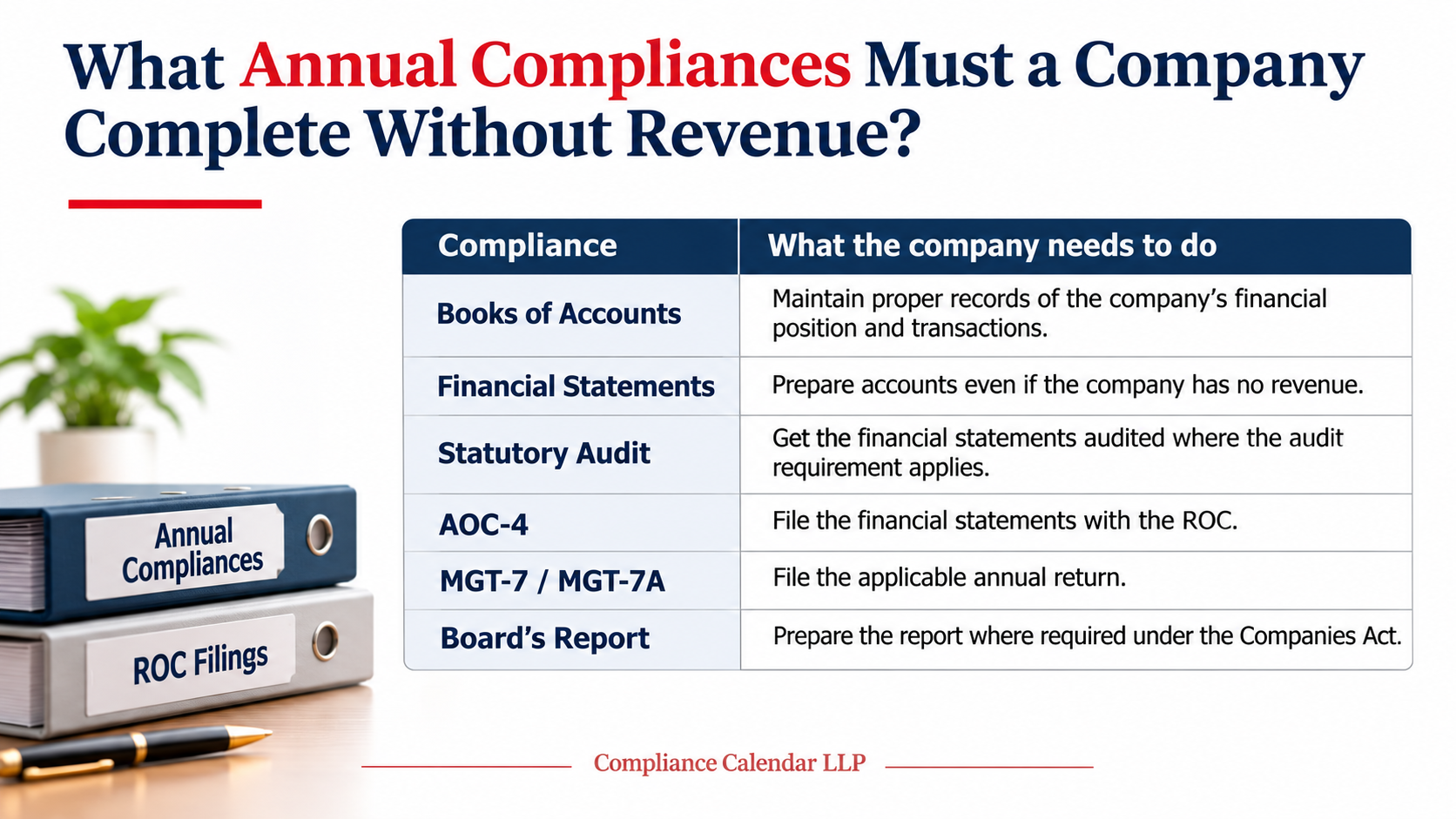
Holding an AGM is only one part of a company's annual responsibilities. A company with no income must still prepare its financial statements and complete the filings that apply to it. The forms and deadlines may depend on the type of company, but having zero revenue does not remove the general filing requirements.
Here are some important annual compliances:
|
Compliance |
What the company needs to do |
|
Books of Accounts |
Maintain proper records of the company's financial position and transactions |
|
Financial Statements |
Prepare accounts even if the company has no revenue |
|
Statutory Audit |
Get the financial statements audited where the audit requirement applies |
|
AOC-4 |
File the financial statements with the ROC |
|
MGT-7 / MGT-7A |
File the applicable annual return |
|
Board's Report |
Prepare the report where required under the Companies Act |
Let us understand these requirements in a little more detail.
Books of Accounts: Section 128 requires companies to maintain proper books of account. If the company has no business transactions, its records should still reflect its actual financial position. For example, any money received from members, expenses paid by directors on behalf of the company or bank charges should be recorded correctly.
Financial Statements and Audit: The company must prepare its financial statements under Section 129 and complete the statutory audit where applicable. No revenue does not automatically mean that an audit is not required. The accounts should show the company's actual position, even if the figures are very small or there is no income.
Form AOC-4: Under Section 137, the company generally files its financial statements with the ROC within 30 days of the AGM. The form must be filed with the required attachments. The exact form and attachments depend on the company and the applicable filing rules.
Form MGT-7 or MGT-7A: Every company must prepare and file its annual return, subject to the applicable exemptions. MGT-7A is the abridged annual return form used by OPCs and small companies, where applicable. The annual return contains information about the company's registered office, shareholding, directors, members and other details.
To understand why companies need to file an annual return and what information it contains, read our article on the purpose of filing annual return in Form MGT-7 and MGT-7A.
Board's Report: The company must prepare the Board's Report as required under Section 134. The report may cover the company's financial position and other matters that need to be disclosed, even if the company has not carried out business.
For most companies, the financial statements are filed within 30 days of the AGM, while the annual return is filed within 60 days of the AGM. If the AGM is not held, Sections 92 and 137 provide separate filing requirements. The company must give the reasons for not holding the meeting and file the required documents within the prescribed time. These filings do not replace the AGM requirement.
For more information about the annual filing process, readers can also refer to Annual Filings of Company.
Does a Dormant Company Also Need to Hold an AGM?
A dormant company is a company that has received dormant status from the ROC under Section 455 of the Companies Act. A company may apply for this status if it is not carrying on business or has no significant accounting transactions and meets the other conditions under the law. This option is useful for a company that wants to remain registered but is not currently carrying on business.
However, simply having no business activity does not make a company a dormant company. It must apply for the status and receive approval from the ROC. The company must also meet the conditions for obtaining and retaining dormant status.
Does dormant status remove the AGM requirement?
Dormant status does not create a general exemption from the AGM requirement under Section 96. A company should not assume that it can stop all annual compliance work after becoming dormant. It must check the AGM requirement along with the separate filing conditions that apply to dormant companies.
A dormant company also needs to pay attention to the following:
- It must maintain the required number of directors.
- It must file Form MSC-3 every year to retain its dormant status.
- It must pay the applicable annual fee.
- It must continue to follow the conditions linked to its dormant status.
A company that is inactive but has not received formal dormant status should not treat itself as a dormant company. It must first understand whether it is eligible to apply and complete the required process.
What Are the Consequences of Not Holding an AGM?
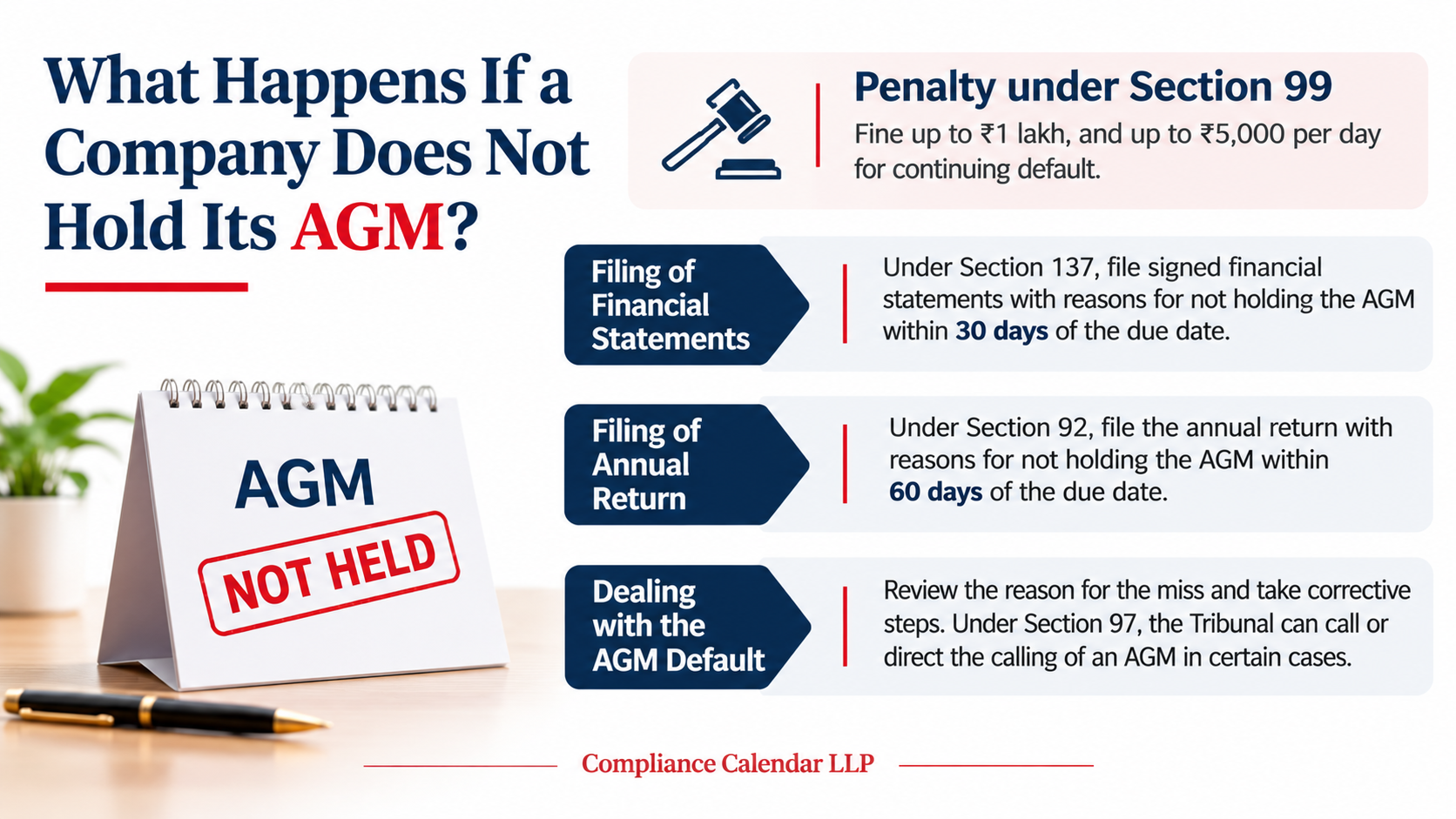
A company that fails to hold its AGM within the required time may face a penalty under Section 99 of the Companies Act, 2013. The company and every officer responsible for the default may be fined up to Rs 1 lakh. If the default continues, an additional fine of up to Rs 5,000 for every day of continuing default may apply.
Apart from the penalty, the company must also deal with its pending ROC filings. The law explains what needs to be filed when an AGM has not been held.
- Filing of financial statements
Under Section 137, the company must file its signed financial statements and the required attachments along with a statement explaining the facts and reasons for not holding the AGM. This filing must be completed within 30 days of the last date on which the AGM should have been held.
- Filing of annual return
Under Section 92, the company must file its annual return within 60 days from the date on which the AGM should have been held, along with reasons for not holding it.
- Dealing with the AGM default
The company should review why the meeting was missed and take appropriate steps to deal with the default. If members need the meeting to be called, Section 97 also gives the Tribunal power to call or direct the calling of an AGM in certain situations.
These filings and steps do not make the missed AGM acceptable. They help the company address its reporting and legal responsibilities. Companies should avoid leaving the matter pending simply because they have no business activity.
Companies should also understand the consequences of not filing AOC-4 and MGT-7, as delays in annual filings can create additional compliance problems.
Can a One Person Company Skip an AGM?
Yes. A One Person Company (OPC) is not required to hold an AGM under Section 96 of the Companies Act, 2013. Since an OPC has only one member, the law provides a simpler way to record decisions that would otherwise be discussed at a general meeting.
However, an OPC is not free from annual compliance requirements. It must still prepare its financial statements, complete the applicable audit and file the required documents with the ROC. The sole member's decisions must also be recorded in the minutes book as required under Section 122.
For example, when the sole member approves the financial statements, the decision must be recorded and signed and dated as required by law. This keeps a proper record of the member's decision even though a formal AGM is not required.
If you run an OPC, you can also read our OPC Compliance Checklist 2026 to understand the annual filings and other requirements that may apply to your company.
Need Help With Your Company's Annual Compliance?
Even if your company has not started business or earned any income, it is important to keep its annual compliance up to date. Missing an AGM or ROC filing can lead to penalties and extra work later. The correct requirements also depend on the company's type, financial year and current compliance status.
Compliance Calendar LLP can help you understand your AGM requirements, prepare the necessary documents, organise annual ROC filings and follow up on the compliance process. Our team can also help you check which annual requirements apply to your company.
For assistance, call +91 9988424211 or email info@ccoffice.in.
Frequently Asked Questions
1. Is an AGM compulsory if a company has zero revenue?
Yes. Every company other than an OPC must generally hold an AGM every year, even if it has earned no revenue or carried out no business activity.
2. Does a company with no bank transactions need to hold an AGM?
Yes. Having no bank transactions does not remove the AGM requirement. The company must follow the applicable rules under Section 96.
3. Can a private limited company skip its AGM if it has not started business?
No. A private limited company cannot skip its AGM only because it has not started business. It must hold the meeting within the prescribed time.
4. Is an AGM required if a company has no profit or loss?
Yes. The AGM requirement does not depend on whether the company has made a profit or suffered a loss. The company must still follow its annual meeting requirements and place the required financial statements before its members.
5. What is the last date for holding an AGM in India?
For most existing companies with a financial year ending on 31 March, the AGM is due by 30 September. The first AGM has a different time limit of nine months from the end of the first financial year.
6. Does a dormant company need to hold an AGM?
Dormant status does not create a general exemption from Section 96. A dormant company should check and meet the AGM requirement as well as the filings required to retain its dormant status.
7. Can an OPC skip its AGM?
Yes. An OPC is not required to hold an AGM under Section 96. However, it must record the sole member's decisions and complete its other annual compliances.
8. What is the penalty for not holding an AGM?
Under Section 99, the company and every officer in default may face a fine of up to Rs 1 lakh. An additional fine of up to Rs 5,000 per day may apply if the default continues.
9. Does filing AOC-4 and MGT-7 remove the need to hold an AGM?
No. Filing these forms does not replace the AGM. They are separate annual filing requirements. If the AGM is not held, the company must follow the special filing rules and give the required reasons.
10. Can the ROC extend the time for holding an AGM?
Yes. The ROC may extend the time for an AGM other than the first AGM by up to three months if there is a special reason. This extension is not available for the first AGM.
Article last updated on : 21 Nov 2026.













































































_learn_crop10_thumb.jpg)