




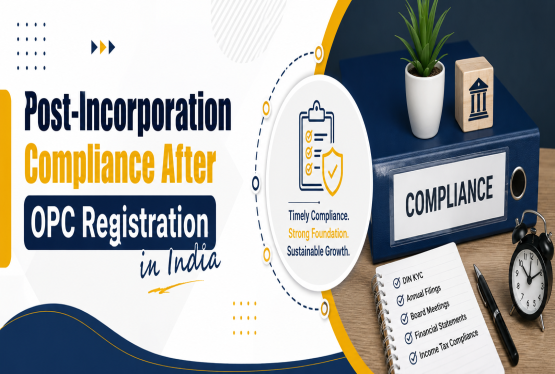
A One Person Company (OPC) is a business structure introduced under the Companies Act, 2013, that allows a single individual to incorporate a company while enjoying the benefits of limited liability and a separate legal identity. It is an ideal option for entrepreneurs who want to start and manage a business independently without involving multiple shareholders. Although an OPC has only one member and comparatively fewer compliance requirements than a Private Limited Company, it is still required to follow mandatory statutory obligations prescribed under company law.
These compliances include annual MCA filings, maintenance of statutory records, audit requirements, director-related filings, and income tax obligations. With increasing scrutiny by regulatory authorities, maintaining timely compliance has become essential for OPC owners. Non-compliance may result in additional fees, penalties, inactive status of the company, and other legal consequences. Therefore, understanding the OPC Compliance Checklist 2026 helps business owners ensure that all mandatory filings and regulatory requirements are completed within the prescribed timelines.
What is OPC Compliance?
OPC Compliance refers to the process of fulfilling all legal, regulatory, and statutory obligations applicable to a One Person Company under the Companies Act, 2013, rules notified by the Ministry of Corporate Affairs (MCA), and other applicable laws. Even though an OPC is managed by a single shareholder, it is considered a separate legal entity from its owner. Therefore, the company must maintain proper books of accounts, prepare financial statements, file annual returns, and update MCA records whenever any changes occur in the company structure.
OPC compliance can broadly be divided into two categories: annual compliance and event-based compliance. Annual compliance includes regular filings such as financial statement filing, annual return filing, and director KYC. Event-based compliance becomes applicable when specific changes take place, such as appointment of directors, change in registered office, allotment of shares, or creation of charges.
OPC Compliance Checklist 2026
Filing of Financial Statements – Form AOC-4
Every One Person Company is required to prepare and file its financial statements with the Registrar of Companies (ROC) through Form AOC-4. This filing provides details about the financial position and performance of the company during the financial year. The financial statements generally include the Balance Sheet, Statement of Profit and Loss, notes to accounts, Board Report, and Auditor’s Report.
Since an OPC is required to maintain proper financial records, filing AOC-4 ensures that the company’s financial information is officially recorded with MCA. For the financial year ending on 31 March 2026, the OPC must ensure that its financial statements are prepared, audited, and filed within the prescribed timeline. Delay in filing AOC-4 attracts additional fees and may create compliance issues for the company.
Annual Return Filing – Form MGT-7A
An OPC is required to file its annual return through Form MGT-7A, which is a simplified annual return form specifically applicable to One Person Companies and small companies. The annual return contains important information regarding the company’s registered office, shareholding pattern, details of directors, changes that occurred during the financial year, and other corporate information.
The purpose of filing MGT-7A is to provide transparency regarding the company’s structure and activities. Even if an OPC has no business operations or turnover during the year, filing of the annual return remains mandatory. Failure to file the annual return within the prescribed period may result in additional filing fees and penalties under the Companies Act.
Director KYC Compliance – Form DIR-3 KYC
Every individual holding a Director Identification Number (DIN) is required to complete annual KYC verification through Form DIR-3 KYC or web-based KYC verification. This compliance ensures that MCA maintains updated information about directors associated with companies.
The process requires verification of personal details, registered mobile number, email address, and authentication through a Digital Signature Certificate (DSC). The annual DIR-3 KYC filing must generally be completed by 30 September every year. If a director fails to complete KYC within the prescribed timeline, the DIN may become inactive, preventing the director from signing further MCA forms.
Income Tax Return Filing
Apart from MCA compliance, an OPC must also comply with income tax regulations. Since an OPC is treated as a company under the Income Tax Act, it is required to file its income tax return using the applicable company return form. Generally, an OPC files its income tax return through ITR-6, along with necessary financial information, tax computation details, and audited financial statements.
Income tax filing enables the company to report its income, expenses, profits, losses, and tax liabilities to the Income Tax Department. Timely filing helps avoid interest, penalties, and unnecessary notices from tax authorities.
Statutory Audit of OPC
Every One Person Company is required to conduct a statutory audit of its books of accounts by a Chartered Accountant. The audit requirement applies irrespective of whether the company has generated revenue, incurred losses, or remained inactive during the financial year.
During the audit process, the auditor examines financial records, accounting transactions, supporting documents, and compliance with applicable accounting standards. The auditor provides an independent opinion on whether the financial statements present a true and fair view of the company’s financial position. The audited financial statements are then used for MCA filings and income tax compliance.
Maintenance of Books of Accounts
An OPC must maintain accurate and complete books of accounts as required under the Companies Act, 2013. Proper maintenance of financial records helps the company prepare correct financial statements and complete statutory filings smoothly.
The books of accounts generally include details of sales, purchases, expenses, bank transactions, fixed assets, investments, loans, and other financial activities. Maintaining proper records also helps during statutory audits, tax assessments, loan applications, and future business expansion.
Board Meeting Compliance
Although an OPC has only one shareholder, it is still required to follow certain board meeting requirements under company law. An OPC must conduct at least one Board Meeting in each half of the calendar year, with a minimum gap of 90 days between two meetings.
However, where the OPC has only one director, certain relaxations are available regarding meeting requirements. Proper documentation of decisions taken by the director should still be maintained through appropriate records and minutes.
Maintenance of Statutory Registers
An OPC is required to maintain statutory registers as prescribed under the Companies Act, 2013. These registers act as official records of important company information. The Register of Members contains details about the shareholder, shareholding pattern, and related changes. Since an OPC has only one member, maintaining accurate ownership records remains essential.
The Register of Directors contains information about directors, including their DIN, appointment details, and changes in directorship. Where applicable, companies must also maintain a Register of Charges containing details of loans secured against company assets.
Event-Based MCA Filings
Apart from annual filings, OPCs are required to file specific forms whenever certain changes occur in the company. For example, Form DIR-12 is filed when there is appointment or resignation of a director. Form PAS-3 is filed when the company issues new shares.
Form INC-22 is required when there is a change in the registered office address. These filings ensure that MCA records remain updated with the latest information about the company. Failure to file event-based forms within the prescribed period may result in penalties.
Appointment of Auditor – Form ADT-1
An OPC must appoint a statutory auditor within the prescribed timeline after incorporation. The appointment details are filed with MCA through Form ADT-1. The auditor plays an important role in examining the company’s financial records and ensuring compliance with accounting and auditing standards. The company must ensure that the auditor appointment remains valid and that necessary filings are completed whenever there is a change in auditor.
Importance of Maintaining OPC Compliance in 2026
Maintaining timely compliance is essential for a One Person Company (OPC) to ensure its legal existence and maintain an active status with the Registrar of Companies (ROC). Regular completion of MCA filings, tax compliances, audit requirements, and statutory record maintenance helps establish transparency and reliability in the eyes of investors, banks, customers, and government authorities. A properly compliant OPC reflects good corporate governance practices and creates confidence among stakeholders who are associated with the business.
Following compliance requirements also helps an OPC avoid additional fees, penalties, legal notices, and other regulatory issues that may affect business operations. Proper documentation and updated records keep the company prepared for future opportunities such as business expansion, raising funds, obtaining financial support, or converting into another company structure. A compliant OPC also improves credibility while entering into contracts, applying for loans, and building long-term professional relationships with stakeholders.
Conclusion
A One Person Company (OPC) offers entrepreneurs the advantage of operating a business with a separate legal identity, limited liability protection, and improved credibility in the market. However, despite having a single shareholder, an OPC is not free from statutory obligations. The company must comply with various requirements under the Companies Act, 2013, including annual MCA filings, maintenance of financial records, statutory audits, director-related compliances, and other applicable regulatory requirements. Proper compliance management helps the company maintain its active status and avoid unnecessary penalties or legal complications.
Following the OPC Compliance Checklist 2026 enables business owners to complete all mandatory filings and regulatory obligations within the prescribed timelines. Timely compliance also strengthens business credibility, improves transparency, and creates a strong foundation for future expansion. Entrepreneurs should regularly track important due dates, maintain accurate records, and take professional guidance whenever required to ensure smooth and legally compliant operations of their OPC.
Frequently Asked Questions (FAQs)
Q1. What is OPC Compliance?
Ans. OPC Compliance refers to the mandatory legal and regulatory requirements that a One Person Company (OPC) must fulfil under the Companies Act, 2013, MCA rules, Income Tax Act, and other applicable laws. These compliances include filing annual returns, financial statements, maintaining statutory records, completing director KYC, conducting audits, and filing event-based forms whenever required.
Q2. Is annual compliance mandatory for a One Person Company?
Ans. Yes, annual compliance is mandatory for every One Person Company, irrespective of its business activity, turnover, or profitability. Even if an OPC has not conducted any business during the financial year, it must still complete required MCA filings such as filing financial statements, annual returns, and other applicable compliance requirements.
Q3. Which MCA forms are required to be filed by an OPC annually?
Ans. An OPC is mainly required to file the following annual MCA forms:
-
Form AOC-4: For filing financial statements with the Registrar of Companies (ROC).
-
Form MGT-7A: For filing the annual return of an OPC.
-
Form DIR-3 KYC: For annual verification of the Director Identification Number (DIN) holder.
Apart from these, other forms may become applicable depending on changes or events occurring in the company.
Q4. Is statutory audit compulsory for an OPC?
Ans. Yes, statutory audit is compulsory for every One Person Company under the Companies Act, 2013. The company must get its books of accounts audited by a Chartered Accountant, irrespective of whether it has generated revenue, incurred losses, or remained inactive during the financial year.
Q5. What is the due date for filing OPC annual return?
Ans. An OPC is required to file its annual return in Form MGT-7A within the prescribed timeline specified under the Companies Act, 2013. The due date depends on the applicable financial year and MCA filing requirements.
Q6. What is the due date for filing financial statements of an OPC?
Ans. An OPC must file its financial statements through Form AOC-4 within the prescribed period after the end of the financial year. Since OPCs are provided certain relaxations, the filing timeline differs from other companies and must be followed according to applicable MCA provisions.
Q7. Does an OPC need to file income tax returns?
Ans. Yes, an OPC is required to file income tax returns as it is treated as a company under the Income Tax Act. Generally, an OPC files its return using ITR-6 along with applicable financial statements and tax details.
Q8. Is holding an Annual General Meeting (AGM) mandatory for an OPC?
Ans. No, an OPC is not required to conduct an Annual General Meeting (AGM). The Companies Act, 2013 provides exemption to OPCs from conducting AGM due to their single-member structure.
Q9. How many Board Meetings are required for an OPC?
Ans. An OPC is required to conduct at least one Board Meeting in each half of the calendar year, with a gap of not less than 90 days between two meetings. However, certain relaxations are available where the OPC has only one director.
Q10. What happens if an OPC does not complete MCA filings on time?
Ans. If an OPC fails to complete MCA filings within the prescribed timeline, it may face additional filing fees, penalties, and compliance issues. Continuous non-compliance may also lead to ROC action, restrictions on filings, or initiation of strike-off proceedings against the company.


_crop10_thumb.jpg)


_crop10_thumb.jpg)


-Form_crop10_thumb.jpg)

_crop10_thumb.jpg)


_learn_crop10_thumb.jpeg)


_crop10_thumb.jpg)

_crop10_thumb.jpg)


_crop10_thumb.jpg)




_for_Foreign_Directors_learn_crop10_thumb.jpeg)


_Act,_2015_learn_crop10_thumb.jpg)










_learn_crop10_thumb.jpg)








































_crop10_thumb.jpg)

_crop10_thumb.jpg)

_(1)_crop10_thumb.jpg)










_crop10_thumb.png)











_crop10_thumb.jpg)


_crop10_thumb.jpg)






_crop10_thumb.png)
_crop10_thumb.jpg)





_crop10_thumb.png)








_crop10_thumb.jpg)
