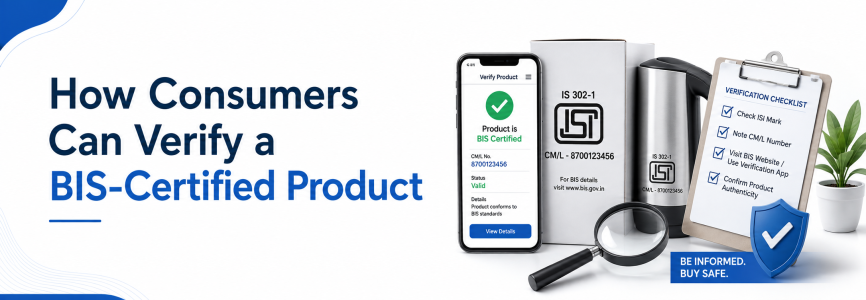



When buying electrical appliances, household products, electronics, construction materials, packaged products or other regulated goods, consumers often come across terms such as BIS Certified, ISI Mark, BIS Standard Mark, or BIS Registration. These markings are intended to help identify products that fall within conformity-assessment schemes administered by the Bureau of Indian Standards (BIS), India’s National Standards Body.
However, simply seeing an ISI-style symbol or the words “BIS Certified” on packaging should not be the end of the verification process. Consumers should check whether the licence or registration is genuine, whether it is currently valid, whether it belongs to the manufacturer shown on the product, and whether the particular product is actually covered within the scope of that licence. BIS provides consumer-facing verification tools, including the BIS Care App, through which users can verify ISI licence details, CRS registration numbers and Hallmark Unique Identification numbers. Understanding how to perform these checks can help consumers make safer and better-informed purchasing decisions.
What Does BIS Certification Mean?
BIS develops Indian Standards and operates different conformity-assessment schemes under which manufacturers may receive licences, registrations or certificates after satisfying applicable requirements. BIS states that product certification is generally voluntary; however, the Central Government can make conformity to Indian Standards compulsory for specified products through Quality Control Orders (QCOs) and other regulatory measures. For products brought under compulsory certification, the applicable Standard Mark must be used under a valid BIS licence, registration or Certificate of Conformity, depending on the relevant conformity-assessment scheme. This means consumers should not assume that every product follows exactly the same BIS verification method. A traditional ISI-marked product may have a CM/L licence number, while certain electronics and IT products regulated under the Compulsory Registration Scheme use an R-number. Hallmarked jewellery follows another verification method using its HUID.
Why Should Consumers Verify BIS Certification?
Counterfeit or improperly marked products may carry logos or claims that visually resemble legitimate certification markings. Therefore, visual appearance alone is not always sufficient to establish whether a product is genuinely covered by a valid BIS licence. Verification can help consumers determine whether the licence or registration details correspond with the product being purchased. BIS itself provides functionality in the BIS Care App for checking the authenticity of ISI-marked products and electronic products registered under CRS. Verification becomes particularly important when purchasing products where quality or safety can have serious consequences, such as electrical equipment, household appliances, protective equipment or construction-related products.
Step 1: Look for the BIS Standard Mark
The first step is to inspect the product and its packaging carefully. For products certified under the traditional Scheme-I product certification system, consumers commonly encounter the BIS Standard Mark popularly known as the ISI Mark. A genuine certified product should carry the prescribed Standard Mark in accordance with the applicable marking requirements. BIS also requires the relevant licence number to be indicated suitably along with the Standard Mark, preferably below it in the format:
CM/L-XXXXXXXXXX
BIS specifically states that the licence number should accompany the Standard Mark. The CM/L number is extremely important because it enables the licence associated with the product to be identified. A product displaying an ISI symbol without sufficient licence information should therefore be checked carefully.
Step 2: Check the Indian Standard Number
Consumers may also find an Indian Standard number, commonly written as an “IS” number, on an ISI-certified product or its packaging. The Indian Standard identifies the technical standard applicable to that particular product category. Consumers can use BIS's Know Your Standard facility to search using either an Indian Standard number or a product keyword. BIS states that this facility provides access to information including the applicable standard, amendments, notifications, licences and laboratories connected with a selected standard.
For example, if a product claims conformity to a particular IS number, consumers can check whether that standard actually relates to the type of product being purchased. An unrelated or suspicious standard number can be a reason to investigate the certification claim further.
Step 3: Use the BIS Care App
One of the easiest ways for an ordinary consumer to check a certification claim is through the official BIS Care App. BIS describes the app as a consumer tool that allows users to check the authenticity of products using the “Verify Licence Details” feature. The app also provides separate facilities for verifying electronic products under CRS and hallmarked jewellery. For an ISI-marked product, the consumer can open the relevant verification facility and enter the CM/L licence number printed on the product or packaging. The verification result should then be compared with the actual product in hand. Consumers should not merely check whether a licence number exists. They should also examine whether the information shown through the verification system is logically consistent with the manufacturer, product and certification claim.
Step 4: Match the Manufacturer Details
Finding a valid licence number is only one part of the process. The licence should belong to the manufacturer responsible for the certified product. BIS certification licences are linked to particular manufacturing facilities and specified product scopes. BIS's licensing guidance states that a licence is granted in relation to the manufacturer's identified factory premises and is not transferable to another manufacturing unit merely because the same brand or business group is involved. Therefore, consumers should compare available verification information with the manufacturer's name and details printed on the product or package. A significant mismatch between the product manufacturer and the licence holder may require further verification. This is particularly important when products are manufactured under contract, sold under private labels, or imported and marketed under a different brand name.
Step 5: Check Whether the Licence Is Valid
A manufacturer having once obtained a BIS licence does not automatically mean that the licence remains valid permanently. BIS states that a Scheme-I product certification licence may initially be granted for a period of up to two years and may subsequently be renewed, subject to the applicable requirements. The licence is valid only for the varieties included within its approved scope. Accordingly, consumers should pay attention to the current status of the licence rather than relying solely on proof that the manufacturer received certification at some point in the past. A licence can also be suspended or cancelled in certain circumstances. BIS's guidelines on product non-conformity provide for suspension and cancellation where applicable certification requirements are not maintained. This is why online verification is more reliable than relying on an old certificate image displayed by a seller.
Step 6: Check Whether the Product Is Covered by the Licence
A valid manufacturer and a valid licence still do not necessarily prove that every product sold by the company is BIS certified. BIS expressly states that a Scheme-I licence is valid for the product varieties included within the scope of that licence. A manufacturer may produce several models, sizes, grades or varieties, while its BIS licence may cover only specific ones. Consumers purchasing safety-sensitive or technically regulated goods should therefore confirm, wherever possible, that the product or variety being purchased falls within the scope of the verified licence. This is especially useful where the same brand sells multiple versions of a product.
How to Verify Electronics and IT Products Under CRS
Certain electronics and IT products are regulated under the Compulsory Registration Scheme (CRS) rather than the conventional Scheme-I ISI licensing system. BIS maintains a list of notified electronics and IT goods falling under Scheme-II registration. For such products, consumers should look for the applicable BIS registration marking and R-number. The BIS Care App provides a dedicated function titled “Verify R-Number under CRS” for checking the authenticity of electronic products registered under this scheme. Consumers should therefore avoid searching only for a CM/L number when buying an electronic product that falls under CRS. The correct verification method depends upon the conformity-assessment scheme applicable to that product.
Difference Between ISI Licence Number and CRS R-Number
This distinction can prevent considerable confusion. For many Scheme-I products, consumers will see the BIS Standard Mark along with a licence number formatted as CM/L-XXXXXXXXXX. BIS specifically requires the CM/L number to accompany the Standard Mark. Under CRS, certain notified electronics, IT goods and other specified products operate under the registration system, and consumers can verify the R-number through the separate CRS verification facility available in BIS Care. Therefore, the absence of a CM/L number does not automatically mean every electronic product is non-compliant. Consumers must first identify which BIS scheme applies.
How to Check Whether BIS Certification Is Mandatory for a Product
Not every product sold in India requires compulsory BIS certification. BIS explains that its certification system is generally voluntary, but various products are brought under mandatory certification by the Central Government through QCOs and other regulatory notifications. Consumers can refer to BIS's official Products under Compulsory Certification information to understand whether a particular category is subject to mandatory conformity requirements. BIS also allows users to explore standards and related information through its Know Your Standard facility. This is particularly helpful where a seller claims that BIS certification is “not required.” Instead of relying entirely on that statement, consumers can check the official classification and applicable regulatory information.
Check the Product Label Carefully
Even when online verification succeeds, the physical product should still be inspected.
Compare information such as:
- Manufacturer's name
- Model or product description
- BIS Standard Mark or applicable registration marking
- CM/L or R-number
- Applicable Indian Standard number, where required
- Manufacturing or batch information
- Other mandatory product-specific markings
Exact marking requirements differ depending on the relevant product standard and certification scheme. BIS publishes product-specific manuals and certification guidelines for different product categories. A consumer should become cautious where markings are poorly printed, incomplete, altered, covered by another sticker, or inconsistent across the product and packaging.
Common Warning Signs of a Suspicious BIS Claim
Several situations should encourage consumers to conduct additional checks. For example, an ISI symbol may appear without a CM/L number, the number may fail to return a corresponding licence, or the manufacturer shown during verification may differ from the manufacturer printed on the product. BIS's 2026 post-market surveillance guidelines specifically recognize situations involving products bearing an ISI Mark without a CM/L number or IS number, products bearing marks associated with a licence that was not operative, and cases where the manufacturing-unit address on the product does not match the licensed address. Consumers should also be careful when a seller only shows a photograph of a BIS certificate but does not allow verification of the actual licence or registration number appearing on the product. The most useful rule is simple: verify the number, not merely the logo.
Verify Before Buying Online
Online shopping can make physical inspection difficult because consumers may only see photographs or generic product descriptions before placing an order. When BIS certification is important for the product, check whether the seller has clearly displayed the certification or registration number. If a number is available, verify it before purchase through BIS's official verification facilities. After delivery, inspect the physical product and packaging again. The number printed on the actual product should correspond with the information that was verified. If the delivered product carries different or missing certification information, consumers should preserve the invoice, packaging, photographs and online listing details. These records may become useful if the matter needs to be reported to BIS or taken up with the seller.
What If the Product Claims “As Per IS” but Has No BIS Mark?
Consumers should distinguish between a manufacturer's general claim that a product is made “as per” an Indian Standard and an actual claim of BIS certification. Where a product is required to carry a BIS Standard Mark under compulsory certification, merely stating that the product complies with an Indian Standard is not a substitute for the required certification. BIS states that products covered by mandatory certification through QCOs are required to use the applicable Standard Mark under a BIS licence or Certificate of Conformity. Therefore, marketing language should not replace verification of the actual certification status.
What Should Consumers Do If Certification Appears Fake?
If the BIS marking, licence number or registration details appear suspicious, consumers should preserve evidence before reporting the matter. Useful evidence may include photographs of the product, packaging, certification marking, licence or registration number, invoice, seller details, online product listing and correspondence with the seller. BIS allows consumers to submit complaints both online and offline. Its official complaint facility states that online complaints can be made through the BIS Care App or the Standard Promotion Portal, and complaints received by BIS are recorded and investigated under its complaint redressal procedure. BIS lists complaint categories including the quality of BIS-certified products, misuse of the BIS Standard Mark, violation of Quality Control Orders and misleading claims of conformity to Indian Standards.
BIS Verification for Hallmarked Jewellery
Consumers should remember that BIS hallmarking of precious-metal jewellery follows a separate verification mechanism. For hallmarked jewellery carrying a Hallmark Unique Identification (HUID) number, BIS provides the “Verify HUID” facility through the BIS Care App. BIS states that consumers can use this function to verify the authenticity of hallmarked jewellery before purchase. Therefore, a jewellery buyer should use HUID verification rather than the CM/L verification process applicable to conventional ISI-marked products.
A Simple Consumer Verification Checklist
Before purchasing a BIS-regulated product, consumers can follow this practical sequence:
- Identify the certification mark appearing on the product.
- Locate the CM/L number, R-number or HUID, depending upon the applicable scheme.
- Use BIS Care to verify the relevant number.
- Compare the manufacturer's details with the physical product.
- Confirm that the licence or registration is current.
- Check whether the relevant product or variety is covered.
- Confirm the applicable Indian Standard, where necessary, through Know Your Standard.
- Inspect the actual product after delivery, particularly for online purchases.
- Keep the invoice and product photographs.
- Report suspicious certification claims to BIS using the official complaint mechanism.
Conclusion
BIS certification can provide valuable information about whether products are covered under recognized Indian conformity-assessment requirements, but consumers should not rely only on the appearance of an ISI or BIS logo. A proper verification involves checking the relevant licence or registration number, matching the manufacturer's details, examining the status and scope of certification, and confirming that the correct BIS scheme applies to the product. The BIS Care App has made this process considerably more accessible by providing separate tools for ISI licence verification, CRS R-number verification and HUID verification. A few minutes spent verifying certification before purchasing a product can help consumers identify suspicious claims and make more informed buying decisions.
FAQs
Q1. How can I check whether an ISI Mark is genuine?
Ans. Find the CM/L licence number printed with the BIS Standard Mark and use the “Verify Licence Details” function in the BIS Care App. BIS requires the licence number to be indicated suitably along with the Standard Mark.
Q2. What does CM/L mean on a BIS-certified product?
Ans. CM/L is the identification used for a BIS certification-mark licence under the relevant Scheme-I framework. It helps associate the Standard Mark with the licensed manufacturer and certification scope.
Q3. Is an ISI logo without a licence number sufficient?
Ans. Consumers should not rely on the logo alone. BIS states that the licence number is required to be indicated suitably along with the Standard Mark, and BIS surveillance guidance specifically recognizes ISI-marked products without CM/L information as a situation requiring attention.
Q4. How do I verify BIS certification for electronic products?
Ans. Certain electronics and IT products come under the Compulsory Registration Scheme. Consumers can enter the product's R-number in the “Verify R-Number under CRS” feature of the BIS Care App.
Q5. Is BIS certification mandatory for every product in India?
Ans. No. BIS states that certification is generally voluntary, although specified products are made subject to compulsory certification through QCOs or other regulatory measures.
Q6. Can a genuine BIS licence expire?
Ans. Yes. Scheme-I licences have defined validity periods and require renewal. BIS states that such licences may initially be granted for up to two years and subsequently renewed subject to applicable requirements.
Q7. If a company has a BIS licence, are all its products certified?
Ans. Not necessarily. BIS states that a licence is valid for the varieties included within its scope. Consumers should therefore verify that the relevant product or variety is actually covered.
Q8. How can I find which Indian Standard applies to a product?
Ans. BIS provides the Know Your Standard facility, through which consumers can search using an IS number or product keyword and access information relating to the standard, licences, laboratories and related documents.
Q9. How can I report a fake ISI Mark or suspicious BIS claim?
Ans. Complaints can be filed online through the BIS Care App or Standard Promotion Portal. BIS accepts complaints relating to misuse of the Standard Mark, quality of certified products, QCO violations and misleading claims of conformity.
Q10. Can BIS Care also verify hallmarked gold jewellery?
Ans. Yes. BIS Care provides a separate Verify HUID facility that consumers can use to verify hallmarked jewellery carrying a HUID number.


_crop10_thumb.jpg)


_crop10_thumb.jpg)


-Form_crop10_thumb.jpg)

_crop10_thumb.jpg)


_learn_crop10_thumb.jpeg)


_crop10_thumb.jpg)

_crop10_thumb.jpg)


_crop10_thumb.jpg)




_for_Foreign_Directors_learn_crop10_thumb.jpeg)


_Act,_2015_learn_crop10_thumb.jpg)










_learn_crop10_thumb.jpg)




































_crop10_thumb.jpg)

_crop10_thumb.jpg)
_(1)_crop10_thumb.jpg)








_crop10_thumb.png)







_crop10_thumb.jpg)

_crop10_thumb.jpg)







_crop10_thumb.png)
_crop10_thumb.jpg)









_crop10_thumb.png)