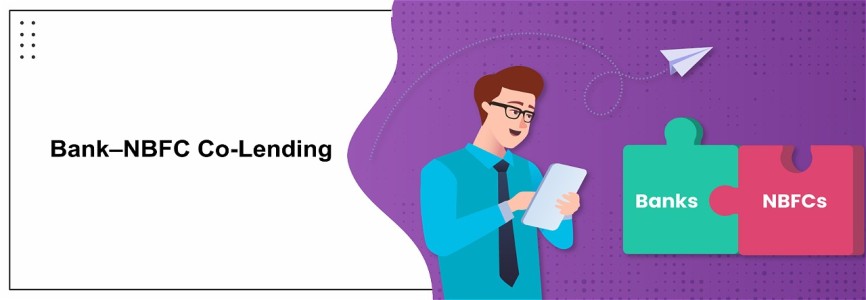



Co-lending arrangements between banks and Non-Banking Financial Companies have become an important credit delivery model in India. Banks generally have access to low-cost funds and strong financial resources, but they may not have sufficient reach in rural, semi-urban or specialised borrower segments. NBFCs, on the other hand, often have better local presence, flexible underwriting methods, digital lending capabilities and experience in serving MSMEs, farmers, professionals and first-time borrowers.
Through co-lending, banks and NBFCs jointly provide loans in a pre-decided ratio and share the income, responsibilities and credit risk. The Reserve Bank of India introduced the Co-Lending Arrangements Directions, 2025 on August 6, 2025, which became effective from January 1, 2026. The context expanded co-lending beyond priority-sector loans and introduced rules on minimum loan retention, blended interest rates, escrow accounts, borrower disclosures, asset classification, Default Loss Guarantees and financial reporting, making the model more transparent, accountable and borrower-friendly.
What Is a Co-Lending Arrangement?
A co-lending arrangement is a structured lending partnership between two regulated financial entities. One entity originates the loan, while the other entity agrees in advance to fund a specified share of eligible loans originated under the arrangement.
Ex-Ante Lending Agreement
An important characteristic of co-lending is that the agreement between the participating entities is executed before the loans are originated. It is therefore referred to as an ex-ante agreement. The agreement establishes the categories of borrowers, eligible loan products, funding ratio, operational responsibilities, pricing methodology, customer-service obligations and risk-sharing mechanism. It is not merely an informal referral or post-disbursement purchase arrangement.
Under the RBI context, a co-lending arrangement is formalised through an ex-ante agreement between an originating regulated entity and a partner regulated entity. They jointly fund a portfolio of secured or unsecured loans in a pre-agreed proportion while sharing the related revenue and credit risk.
Originating Regulated Entity
The originating regulated entity is responsible for sourcing or originating the loans covered under the arrangement. In many bank-NBFC co-lending models, the NBFC performs this function because it may have stronger customer-acquisition networks, digital lending platforms, local branches or specialised sector knowledge. The originating entity may identify potential borrowers, collect loan applications, complete preliminary verification, obtain KYC documents, analyse repayment capacity and process the loan proposal.
It may also be responsible for loan servicing, repayment collection, customer communication and recovery. However, the originating entity’s responsibilities must be specifically documented in the master co-lending agreement. The originating entity cannot assume that every operational function automatically belongs to it merely because it sourced the borrower.
Partner Regulated Entity
The partner regulated entity is the financial institution that agrees to fund its predetermined portion of eligible loans originated under the arrangement. In many cases, a bank acts as the partner entity and contributes a larger share of the loan. The partner entity is not merely an investor purchasing a loan after disbursement.
It makes an irrevocable commitment under the co-lending agreement to take its agreed share of qualifying individual loans into its books on a back-to-back basis. The partner entity must also conduct appropriate due diligence. It should ensure that the borrower-selection process, underwriting standards, loan documentation and regulatory compliance are consistent with the agreed criteria and its internal policies.
Joint Funding of Individual Loans
Under a co-lending arrangement, both regulated entities fund the same underlying borrower loan. Each entity records only its respective share of the loan in its books. For example, where a loan of Rs.10 lakh is funded in an 80:20 ratio, the bank may record an exposure of Rs.8 lakh and the NBFC may record an exposure of Rs.2 lakh. The borrower receives a single loan facility, but the economic exposure is divided between the two lenders.
Sharing of Revenue and Risk
Co-lending involves both revenue sharing and risk sharing. The participating entities earn interest and permitted fees according to their contractual arrangement and bear credit losses according to their respective exposure. A lender cannot ordinarily enjoy the income from a co-lending portfolio while transferring its complete credit risk to the other lender. The RBI’s minimum retention requirement is intended to ensure that both entities retain a genuine financial interest in the quality and performance of the loans.
RBI Regulatory Context for Co-Lending
The current context is governed by the Reserve Bank of India (Co-Lending Arrangements) Directions, 2025.
Effective Date of the Directions
The Directions came into force on January 1, 2026. A regulated entity could also decide to implement the context before that date through its internal policy. Any new co-lending arrangement entered into after the applicable effective date must comply with the 2025 Directions. Existing arrangements executed before the Directions were issued, and new arrangements entered into before the applicable effective date, continue to be governed by the regulations that applied to them at that time.
Entities Covered by the Context
The context applies to eligible commercial banks, All-India Financial Institutions and Non-Banking Financial Companies, including Housing Finance Companies. Commercial banks covered by the context exclude Small Finance Banks, Local Area Banks and Regional Rural Banks. Therefore, the eligibility of an institution must be verified before a co-lending arrangement is structured.
Digital Co-Lending Arrangements
Where loans are originated or serviced through digital platforms, the arrangement must comply with both the Co-Lending Arrangements Directions and the Reserve Bank of India’s Digital Lending Directions. Digital co-lending may involve the use of mobile applications, websites, automated underwriting systems, Lending Service Providers or digital documentation. The use of technology does not reduce the regulatory responsibilities of the bank or NBFC.
The participating entities must ensure that digital customer acquisition, fund flows, Key Facts Statements, data collection, recovery practices and grievance redressal comply with the applicable digital lending requirements. RBI has also clarified that the permitted fund-flow treatment for co-lending can extend to non-priority-sector digital loans, provided no third party controls the flow of funds between the regulated entities and the borrower.
Arrangements Not Covered
The Co-Lending Arrangements Directions do not apply to loans sanctioned under multiple banking arrangements, consortium lending or loan syndication. These structures involve different legal, operational and risk-sharing mechanisms. Therefore, an arrangement should not be described as co-lending merely because more than one lender is associated with the same borrower.
Difference Between Co-Lending and Other Lending Structures
Understanding the distinction between co-lending and similar financial arrangements is important because different structures attract different regulatory requirements.
Co-Lending and Loan Referral
In a loan referral arrangement, one entity merely introduces a borrower to a bank or NBFC. The referring entity may receive a referral or sourcing fee but does not necessarily fund the loan or assume credit risk. In co-lending, both participating lenders fund the loan and maintain their respective exposure in their books. Therefore, co-lending involves a deeper financial and regulatory relationship than a simple referral arrangement.
Co-Lending and On-Lending
Under an on-lending structure, a bank provides funds to an NBFC, which subsequently lends those funds to ultimate borrowers. The bank’s direct credit exposure is generally to the NBFC rather than to every underlying borrower. Under co-lending, the bank and NBFC each maintain a direct borrower-level exposure for their respective shares. Both lenders must account for and report their portions of the same loan.
Co-Lending and Direct Assignment
Direct assignment generally involves the transfer of an existing loan or pool of loans from one regulated entity to another after origination. The purchasing entity may exercise discretion regarding whether it wishes to acquire the loans. In a co-lending arrangement, the partner entity makes an ex-ante and irrevocable commitment to take its agreed share of eligible loans into its books. RBI has clarified that where the bank retains discretion to accept or reject loans after origination, the structure may resemble direct assignment rather than co-lending.
Co-Lending and Consortium Lending
Under consortium lending, multiple lenders may collectively provide a large credit facility to a corporate borrower. The arrangement is commonly used for substantial working-capital, infrastructure or project-finance requirements. Co-lending usually involves a portfolio of retail, MSME, housing, agricultural or other individual loans originated according to predetermined criteria. The operational model, borrower interface and loan-level accounting are therefore different.
How a Bank-NBFC Co-Lending Model Works
A co-lending arrangement is generally implemented through several interconnected stages.
Selection of the Lending Product
The participating entities first determine the types of loans that will be covered by the arrangement. The selected product should be suitable for joint funding and capable of being administered through the systems of both entities. Co-lending products may include MSME business loans, agricultural loans, affordable housing loans, education loans, vehicle finance, personal loans, consumer loans or loans against property. The parties should define the maximum and minimum loan amounts, repayment tenure, borrower profile, geographical coverage, security requirements and permitted end use.
Identification of Target Borrowers
The bank and NBFC should identify the borrower segments they intend to serve. This may include micro-enterprises, self-employed professionals, small traders, manufacturers, farmers or salaried borrowers. The target segment should be incorporated into the regulated entity’s internal credit policy. RBI requires the credit policy to contain provisions regarding target borrowers, internal co-lending limits, partner due diligence, customer service and grievance redressal.
Execution of the Master Agreement
Before loans are originated, the bank and NBFC must execute a comprehensive master co-lending agreement. The agreement should define the commercial and operational relationship between the entities. It should specify the criteria for borrower selection, eligible products, areas of operation, lending-service fees, segregation of responsibilities, information-sharing timelines, customer-interface arrangements and grievance-redressal mechanisms.
Customer Acquisition
The originating entity ordinarily acquires customers through its branches, digital platforms, field teams, business correspondents or authorised agents. Customer acquisition must be conducted fairly and transparently. Borrowers should not be misled into believing that the loan is being provided exclusively by one entity when it is actually funded under a co-lending structure. Agents and service providers should not make unauthorised promises regarding interest rates, loan approval, waiver of charges or restructuring.
Loan Application and Documentation
The borrower submits the loan application and supporting documents to the originating entity. Depending upon the type of loan, the documentation may include identity proof, address proof, financial statements, bank statements, GST returns, income-tax returns, business registrations, salary records, property documents or security-related records. The originating entity should verify the completeness and authenticity of the documents before forwarding the proposal for further processing.
Credit Assessment and Underwriting
The creditworthiness of the borrower must be evaluated in accordance with the approved credit policy. The assessment may include credit-bureau checks, repayment-capacity analysis, cash-flow assessment, income verification, collateral valuation, business verification and fraud-risk screening. Although the originating entity may perform the primary assessment, the partner entity should retain sufficient oversight. It may conduct automated validations, independent checks or sample-based reviews depending upon the agreed model.
Sanction of the Loan
Once the borrower satisfies the eligibility and underwriting conditions, the loan is sanctioned. The sanction terms should include the loan amount, tenure, interest rate, repayment schedule, security, processing fee, penal charges and other conditions. The borrower must also be informed that the facility is being provided under a co-lending arrangement involving more than one regulated entity.
Execution of Borrower-Facing Documents
The borrower should receive and execute the loan agreement, sanction letter, Key Facts Statement, security documents and other required forms. The loan agreement must disclose the division of roles between the participating entities. It should clearly identify which entity is responsible for sourcing, servicing and acting as the single point of contact for the borrower. Any later change in the customer interface can be made only after the borrower has received prior intimation.
Disbursement of the Loan
After the documentation is completed, the loan is disbursed according to the agreed mechanism. Depending upon the nature of the loan, the amount may be credited to the borrower’s bank account or directly paid to a seller, educational institution, property developer or other end beneficiary. The fund-flow arrangement must comply with the co-lending and digital lending requirements applicable to the transaction.
Minimum Loan Retention Requirement
The RBI requires each participating regulated entity to retain a minimum share of every individual loan.
Minimum 10% Retention
Each regulated entity must retain at least 10% of the individual loan in its own books. This requirement ensures that both participating lenders have a meaningful financial interest in the performance of the loan. It discourages arrangements where one entity earns sourcing or servicing income without retaining sufficient credit exposure.
No Mandatory 80:20 Ratio
The RBI does not prescribe a universal 80:20 funding ratio under the current context. Banks and NBFCs may agree on ratios such as 90:10, 80:20, 70:30, 60:40 or 50:50, provided each entity retains at least 10% of the individual loan. The selected ratio should be stated in the master agreement and consistently reflected in the borrower documents, accounting systems and repayment-allocation process.
Illustration of Funding Allocation
Assume that a borrower is sanctioned a loan of Rs.20 lakh under a 75:25 co-lending arrangement. The bank will fund and record Rs.15 lakh, while the NBFC will fund and record Rs.5 lakh. Each lender will earn income and bear losses according to its exposure, subject to any legally permissible service-fee or DLG arrangement.
Loan-Level Retention
The minimum retention requirement applies to each individual loan and not merely to the overall co-lending portfolio. Therefore, an entity cannot retain 20% of some loans and no exposure in other loans while claiming that the average portfolio-level retention satisfies the requirement.
Irrevocable Commitment and Loan Booking
The partner entity’s commitment is a central feature of the co-lending model.
Irrevocable Commitment of the Partner
The co-lending agreement must involve an irrevocable commitment by the partner entity to take its agreed share of eligible individual loans into its books on a back-to-back basis. This commitment is subject to the borrower and loan meeting the predefined criteria established in the agreement. The originating entity should not disburse loans outside the agreed parameters with the expectation that the partner will automatically accept them.
Fifteen-Day Booking Requirement
The respective shares of the loan must be reflected in the books of both entities without delay and no later than 15 calendar days from the date on which the originating entity disburses the loan to the borrower.
Failure to Transfer within Fifteen Days
Where the originating entity is unable to transfer the partner’s agreed share within 15 calendar days, the entire loan must remain in the books of the originating entity. The loan may subsequently be transferred to another eligible lender only in accordance with the RBI context governing the transfer of loan exposures. It cannot simply be allocated to another institution under the original co-lending arrangement.
Separate Borrower Accounts
Each regulated entity must maintain an individual borrower account for its respective share of the loan. Although the borrower may experience the facility as one loan, the bank and NBFC must separately account for their principal, interest, outstanding amount, repayment status and asset classification.
Blended Interest Rate
The interest charged to the borrower must reflect the funding participation of both lenders.
Meaning of Blended Interest Rate
A blended interest rate is a weighted average of the rates applicable to the participating entities. Each lender may determine its internal rate according to its credit policy, cost of funds and assessment of the borrower’s risk. These rates are then weighted according to the funding ratio.
Illustration of the Blended Rate
Suppose a bank funds 80% of a loan at an internal rate of 10% per annum and the NBFC funds 20% at 15% per annum. The weighted bank component will be 8%, calculated as 80% multiplied by 10%. The weighted NBFC component will be 3%, calculated as 20% multiplied by 15%. The blended interest rate charged to the borrower will therefore be 11% per annum. The RBI requires the final interest rate to be calculated as the weighted average of the rates charged by the respective entities in accordance with their internal lending policies and the borrower’s risk profile.
Revision of Interest Rates
Where either entity revises its applicable rate in accordance with its credit policy and regulatory requirements, the change must be reflected in the updated blended interest rate. The revised rate must be communicated to the borrower. The lenders should also explain any resulting impact on the instalment amount, repayment period or total interest payable.
Fees and Charges
The borrower may also be required to pay processing fees, documentation charges, valuation expenses, insurance costs or other permitted charges. All borrower-payable charges in addition to the blended interest rate must be included in the calculation of the Annual Percentage Rate and disclosed in the Key Facts Statement.
Lending-Service Fees
One participating entity may perform services such as customer acquisition, underwriting, servicing, monitoring or recovery for the arrangement. The fee paid for such services should be based on objective criteria stated in the regulated entity’s credit policy. The fee cannot directly or indirectly contain an unauthorised credit-enhancement or guarantee component.
Key Facts Statement and Borrower Protection
Borrower transparency is especially important where two lenders are involved.
Purpose of the Key Facts Statement
The Key Facts Statement provides the borrower with a standardised summary of the most important loan terms. It enables the borrower to understand the actual cost of the loan and compare the facility with other lending options before accepting it.
Information to Be Disclosed
The KFS should clearly disclose the sanctioned amount, tenure, interest rate, Annual Percentage Rate, repayment schedule, processing fee, contingent charges, penal charges and grievance-redressal details. It should also appropriately disclose that the loan is being provided through a co-lending arrangement and identify the role of the participating entities. The RBI’s CLA Directions specifically require the relevant details to be disclosed in accordance with the KFS context.
Single Point of Contact
The borrower should not be expected to determine independently whether a query belongs to the bank or the NBFC. The loan agreement must identify the entity that will act as the single point of interface. This entity may handle repayment queries, account statements, prepayment requests, complaints and other service requirements.
Change in Customer Interface
Where the designated servicing or customer-contact entity changes, the borrower must be informed in advance. This requirement protects borrowers from making repayments to an incorrect account or sharing personal information with an unauthorised party.
Grievance Redressal
The agreement and borrower documents should explain the process for raising and escalating complaints. Both lenders remain responsible for complying with the fair-practice and grievance-redressal requirements applicable to them. They should not repeatedly redirect the borrower from one institution to another without resolving the complaint.
Escrow Account Requirement
The escrow account is central to the operational management of co-lending transactions.
Meaning of an Escrow Account
An escrow account is a designated bank account through which funds connected with the co-lending arrangement are routed. It helps ensure transparency in the movement of funds and enables the participating entities to allocate disbursements and repayments according to their respective shares.
Mandatory Routing of Transactions
All disbursements and repayments between the regulated entities, as well as transactions involving the borrower, must be routed through an escrow account maintained with a bank. The bank maintaining the escrow account may also be one of the entities participating in the co-lending arrangement.
Appropriation Mechanism
The co-lending agreement should clearly specify how amounts received in the escrow account will be allocated between the originating entity and the partner entity. The appropriation mechanism may address principal repayment, interest income, prepayment amounts, foreclosure proceeds, overdue amounts, refunds and recovery receipts.
Reconciliation of Escrow Transactions
The participating entities should reconcile the escrow account regularly. Reconciliation helps identify failed transactions, incorrect allocations, duplicate entries, delayed settlements or differences between the systems of the bank and NBFC. Unresolved reconciliation issues may lead to incorrect borrower balances, inaccurate credit-bureau reporting and inconsistent asset classification.
KYC and Customer Due Diligence
Both participating entities remain subject to the RBI’s Know Your Customer requirements.
Customer Identification Process
The borrower’s identity, address and other required particulars must be verified using approved documents or digital verification methods. For companies, partnerships and other business borrowers, the lenders should also verify incorporation records, authorised representatives, beneficial owners and the nature of the business.
Reliance on the Originating Entity
The partner entity may rely on the originating entity for carrying out the Customer Identification Process where such reliance is permitted under the RBI KYC Directions. However, reliance does not mean that the partner entity has no regulatory responsibility. It should have access to the relevant KYC information and should ensure that the process meets the applicable requirements.
Ongoing Due Diligence
KYC compliance continues after the loan has been sanctioned. The participating entities should monitor changes in the borrower’s risk profile, repayment behaviour, ownership, business activity and transaction patterns.
AML and Suspicious Transaction Monitoring
Where relevant, the entities should identify unusual or suspicious activities and comply with the applicable reporting obligations. The master agreement should explain how material KYC, sanctions-screening and fraud-related information will be shared between the lenders.
Reporting to Credit Information Companies
Credit-information reporting must accurately reflect each lender’s share.
Reporting by Both Entities
Each participating entity must report its respective share of the loan account to the Credit Information Companies in accordance with the applicable requirements. The bank reports the exposure recorded in its books, while the NBFC reports its corresponding portion.
Prevention of Duplicate Exposure
Improper system configuration may cause the entire loan amount to be reported by both lenders, making the borrower appear to have twice the actual debt. The entities should use coordinated account identifiers, reporting logic and reconciliation controls to prevent duplication.
Consistent Repayment Status
The overdue amount, payment history, closure status and outstanding principal reported by both lenders should be consistent with the underlying repayment records. A difference between the reports of the bank and NBFC may adversely affect the borrower’s credit score and create customer complaints.
Correction of Errors
Where reporting errors are identified, the participating entities should coordinate to investigate and correct the information within the applicable regulatory timelines. The borrower should not be required to independently pursue two lenders for correcting the same underlying error.
Asset Classification and NPA Recognition
A coordinated asset-classification mechanism is required because both lenders are exposed to the same borrower.
Borrower-Level Classification
The RBI requires borrower-level asset classification for co-lending exposures. Where either participating entity classifies its CLA exposure as a Special Mention Account or Non-Performing Asset due to default in the co-lending exposure, the corresponding exposure of the other entity must receive the same classification.
Importance of Classification Alignment
Without alignment, the same borrower loan could be shown as performing in the books of one lender and non-performing in the books of the other. Such inconsistency could affect provisioning, income recognition, regulatory reporting and the reliability of financial statements.
Near-Real-Time Information Sharing
The bank and NBFC must establish a robust mechanism for sharing repayment defaults and classification-related information on a near-real-time basis. The relevant information must, in any case, be shared no later than the end of the next working day.
Provisioning by Each Entity
Each lender must make provisions for its own exposure in accordance with the prudential requirements applicable to it. Although the provisioning calculation may depend upon the regulatory category of the entity, the borrower-level classification should remain aligned.
Default Loss Guarantee
A Default Loss Guarantee may be incorporated into the arrangement within the limits prescribed by the RBI.
Meaning of DLG
A DLG is a contractual arrangement under which the originating entity agrees to compensate the partner entity for losses caused by borrower defaults, subject to an agreed limit. The guarantee provides limited protection to the partner but does not remove the need for proper underwriting and ongoing monitoring.
Maximum Permitted Limit
The originating regulated entity may provide a DLG of up to 5% of the loans outstanding under the co-lending arrangement. The DLG is governed, with necessary modifications, by the RBI’s Digital Lending Directions.
Portfolio Identification
The portfolio covered by the DLG should be identified and measurable. The documentation should state the covered loans, guarantee amount, validity period, invocation procedure and treatment of recoveries.
DLG Does Not Prevent NPA Classification
The existence or invocation of a DLG does not permit the lender to delay recognition of a default or avoid applicable provisioning requirements. Asset classification must be based on the borrower’s repayment performance and not on the availability of guarantee protection.
No Reinstatement after Invocation
Under the RBI’s DLG context, an amount already invoked cannot ordinarily be reinstated merely because a later recovery is made from the borrower. This prevents the DLG cover from being repeatedly replenished and used as an unlimited credit guarantee.
Priority Sector Lending Treatment
Co-lending arrangements may include loans eligible for priority sector classification.
Eligibility of the Underlying Loan
A loan can be treated as priority sector lending only when it satisfies the applicable borrower, activity, amount and end-use standards. A loan does not become eligible merely because it is originated through a bank-NBFC co-lending arrangement.
Classification of Each Lender’s Share
Each participating entity may claim priority sector status only in respect of its own share of eligible credit under the arrangement. For example, where a bank contributes 80% to an eligible Rs.10 lakh MSME loan, the bank may claim PSL treatment for its Rs.8 lakh exposure, subject to the applicable PSL rules.
End-Use Monitoring
The participating entities should preserve adequate documents to demonstrate that the borrower used the loan for the qualifying activity. Where a loan is classified as agricultural, MSME, housing or another PSL category, the records should support the relevant classification during audit or RBI inspection.
Accounting Treatment
Proper accounting is necessary because both entities recognise separate portions of the same loan.
Recognition of Loan Assets
The bank and NBFC should record their respective portions of the loan as assets in their books. Principal repayment, interest income, overdue amounts, provisions and write-offs should be accounted for according to each entity’s exposure and the applicable accounting context.
Unrealised Profit of NBFCs
Where an NBFC records unrealised profit arising from a co-lending arrangement, it must follow the applicable accounting standards. The RBI Directions further provide that such unrealised profit should be deducted from CET 1 capital or net owned funds for regulatory capital adequacy purposes until maturity of the relevant loans.
Income Recognition
Interest income should be recognised in accordance with the repayment performance and applicable prudential norms. Once the account becomes non-performing, the lender should not continue recognising income merely because another entity is servicing the loan or a DLG is available.
Internal Policy and Governance
A regulated entity should not begin co-lending operations without an appropriate internal context.
-
Internal Exposure Limits: The credit policy should prescribe the maximum proportion of the lending portfolio that may be originated through co-lending arrangements. Separate limits may also be established according to the partner institution, product, geography, industry or borrower category.
-
Approval of Partners: The process for selecting and approving co-lending partners should be documented. Senior management or the appropriate committee should review the partner’s financial condition, compliance history, management quality and operational capability.
-
Product Approval: Each co-lending product should be approved through the entity’s internal governance process. The approval should cover the borrower segment, underwriting method, pricing, loan documentation, servicing arrangement, system integration and risk controls.
-
Portfolio Monitoring: The portfolio should be monitored for disbursement trends, approval rates, delinquency, fraud, complaints, concentration risk and profitability. Material deviations from the approved programme should be reported to the appropriate management or board-level committee.
Due Diligence of the Co-Lending Partner
Thorough partner due diligence is essential because the conduct of one lender can create risk for the other.
-
Regulatory Due Diligence: The institution should verify the proposed partner’s RBI registration, permitted activities and regulatory status. It should also examine material regulatory actions, penalties, restrictions and unresolved compliance observations.
-
Financial Due Diligence: The review should consider capital adequacy, net worth, profitability, liquidity, asset quality, leverage and funding concentration. A financially weak partner may be unable to fund its agreed share or continue servicing the portfolio during stress.
-
Operational Due Diligence: The parties should assess loan-origination systems, underwriting controls, document management, collections, reconciliation and grievance handling. A high-volume originator with weak operational controls may expose both lenders to fraud, customer disputes and regulatory violations.
-
Technology and Cybersecurity: The technology systems of the two lenders should be capable of secure and timely data exchange. The review should include access controls, encryption, system availability, backup arrangements, cybersecurity incidents and business-continuity capabilities.
-
Customer-Conduct Review: The proposed partner’s sales, marketing, recovery and grievance-redressal practices should be evaluated. Mis-selling or coercive recovery by one entity can damage the reputation of both participants, even where the other entity was not directly involved.
Master Co-Lending Agreement
The master agreement should comprehensively regulate the relationship between the participating entities.
-
Borrower Eligibility: The agreement should specify the characteristics that a borrower must satisfy. These may include minimum income, business vintage, credit score, repayment capacity, industry, geographical location and security coverage.
-
Product Terms: The agreement should define the loan amount, tenure, repayment frequency, permitted end use, collateral requirements and pricing methodology. It should also identify prohibited borrowers, activities or geographical areas.
-
Funding Ratio: The respective funding contributions should be clearly stated. The agreement should also explain how the ratio will apply to disbursements, repayments, prepayments, recoveries and write-offs.
-
Underwriting Responsibility: The agreement must identify the entity responsible for primary underwriting and the level of validation to be performed by the partner. It should also specify the treatment of applications that fail to satisfy the agreed criteria.
-
Servicing Responsibility: The entity responsible for issuing statements, collecting repayments, processing foreclosure requests and handling complaints should be identified. The servicing standards should remain consistent with the fair-practice requirements applicable to both lenders.
-
Information-Sharing Timelines: The agreement should establish clear timelines for sharing loan applications, sanction data, disbursement details, repayments, defaults, fraud alerts and asset-classification information. The next-working-day requirement for classification-related information should be incorporated into the operational process.
-
Representations and Warranties: Each party should confirm that it possesses the regulatory authority, systems, staff and approvals required to perform its obligations. Representations may also address the accuracy of information, validity of documentation and compliance with applicable laws.
-
Indemnity: The agreement may allocate responsibility for losses caused by negligence, fraud, data breaches, documentation defects or regulatory violations. However, contractual indemnity cannot be used to exclude obligations that a regulated entity owes directly to the borrower or the RBI.
-
Audit Rights: Each lender should have access to the records necessary to verify compliance with the arrangement. The agreement should permit internal audit, statutory audit and regulatory inspection of relevant processes and records.
-
Termination and Exit: The agreement should explain the events that permit termination, including material breach, regulatory restriction, insolvency, fraud or repeated service failure. Termination should not interrupt the servicing of existing loans.
Audit and Business Continuity
The co-lending portfolio must remain subject to continuous oversight.
-
Internal and Statutory Audit: Loans originated under a CLA must be included within the scope of internal and statutory audit of each regulated entity. The audit should examine compliance with internal policies, the master agreement and applicable regulatory requirements.
-
Business Continuity Plan: Both entities must implement a business-continuity plan to ensure uninterrupted borrower service if the co-lending agreement is terminated. Existing borrowers should continue receiving account statements, repayment facilities, complaint handling and closure services until their loans are repaid.
-
Servicing after Termination: The termination of the commercial relationship does not automatically terminate the underlying borrower loans. The agreement should determine which entity will continue servicing the portfolio and how funds, records and borrower communications will be managed.
-
Disclosure Requirements: Transparency is required not only for borrowers but also for regulators and financial-statement users.
-
Website Disclosure: Each participating entity must prominently disclose on its website the list of all active co-lending partners.
-
Financial-Statement Disclosure: The regulated entities must provide appropriate aggregate disclosures regarding their co-lending arrangements in the Notes to Accounts. The disclosures may include the total quantum of CLAs, weighted average interest rate, fees charged or paid, sectors financed, portfolio performance and DLG details. These disclosures must be made quarterly or annually, depending upon the reporting context applicable to the entity.
Benefits of Co-Lending
A properly structured co-lending model can create benefits for banks, NBFCs and borrowers.
-
Wider Credit Access: NBFCs may have better access to borrowers in semi-urban, rural or specialised markets. By partnering with an NBFC, a bank can extend credit to customers who may not ordinarily approach or qualify through its traditional branch network.
-
Lower Funding Cost: Banks generally have access to comparatively lower-cost funds. When bank funding forms a significant portion of the loan, the blended interest rate may be lower than the rate that the NBFC would have charged if it had funded the entire loan independently.
-
Specialised Underwriting: NBFCs may have expertise in assessing informal income, small-business cash flows, vehicle operators, affordable housing customers or other specialised borrower categories. Banks can benefit from this expertise while retaining direct exposure and regulatory oversight.
-
Capital Efficiency for NBFCs: An NBFC can originate a larger volume of loans without funding every loan entirely from its own balance sheet. This may support business growth and allow capital to be deployed across a wider borrower base.
-
Risk Sharing: Credit risk is distributed between the participating entities according to their funding shares. However, risk sharing does not eliminate the need for sound underwriting, monitoring and recovery practices.
-
Financial Inclusion: Co-lending can support the formalisation of credit for borrowers who might otherwise depend on informal or high-cost lenders. A well-designed product can improve access to business, agricultural, housing and personal finance.
Risks in Co-Lending Arrangements
The involvement of two lenders can also create additional risks.
-
Credit Risk: Weak borrower selection or inadequate underwriting may result in higher defaults. The partner entity should not rely blindly upon the originating entity merely because the loans satisfy basic system-based criteria.
-
Operational Risk: Errors in disbursement, account creation, repayment allocation or escrow reconciliation can affect both lenders. Strong standard operating procedures and system controls are required to minimise these risks.
-
Technology Risk: Co-lending depends upon the timely exchange of accurate data. System downtime, data mismatches or cyber incidents may result in delayed booking, incorrect asset classification or inaccurate customer information.
-
Customer-Service Risk: Borrowers may become confused regarding which entity is responsible for their loan. Clear documentation and a reliable single point of contact are necessary to prevent this confusion.
-
Regulatory Risk: Non-compliance with the KFS, KYC, CIC reporting, escrow, NPA classification or disclosure requirements may result in supervisory action. Each lender remains responsible for the regulatory obligations applicable to it.
-
Reputational Risk: Mis-selling, excessive charges, data misuse or unfair recovery practices by one entity may damage the reputation of both lenders. Regular monitoring of customer complaints and third-party conduct is therefore important.
-
Concentration Risk: A lender may become excessively dependent upon one co-lending partner, product, industry or geographical market. Internal limits should be used to control concentration and ensure portfolio diversification.
Co-Lending Compliance Checklist
Before launching a co-lending arrangement, the participating entities should confirm that the regulatory and operational structure is complete.
-
Internal Policy Approval: The credit policy should incorporate co-lending limits, target borrowers, partner due diligence, customer service and grievance redressal. The appropriate board or management approval should be obtained before the arrangement becomes operational.
-
Partner Due Diligence: The regulatory, financial, operational, technology and customer-conduct position of the proposed partner should be reviewed. The due-diligence process should be repeated periodically and not treated as a one-time exercise.
-
Master Agreement: The bank and NBFC should execute a comprehensive master agreement before originating loans. The agreement should clearly allocate responsibilities and establish information-sharing timelines.
-
Borrower Documentation: The loan agreement, sanction letter and Key Facts Statement should disclose the co-lending structure and identify the single point of contact. All rates, fees and charges should be communicated transparently.
-
Escrow Mechanism: The designated escrow account and appropriation process should be operational before disbursements commence. The reconciliation frequency and responsibility should be documented.
-
Technology Integration: The loan-management, accounting, repayment, CIC and asset-classification systems should be integrated and tested. Both entities should be capable of exchanging critical information within the required timelines.
-
KYC and AML Compliance: The Customer Identification Process, document sharing and ongoing monitoring responsibilities should be defined. The partner’s reliance on the originating entity should be consistent with the RBI KYC context.
-
Asset-Classification Alignment: The bank and NBFC should establish a near-real-time mechanism for exchanging default and classification information. The systems should permit alignment no later than the end of the next working day.
-
Audit and Monitoring: The co-lending portfolio should be included within internal audit, statutory audit and compliance monitoring. Management reports should cover disbursement, delinquency, complaints, DLG, reconciliation and concentration.
-
Website and Financial Disclosures: The list of active partners should be displayed on the entities’ websites. The required aggregate details should also be included in the financial statements.
Conclusion
Co-lending arrangements have become an important part of India’s credit ecosystem because they combine the financial strength of banks with the reach, technology and specialised underwriting capabilities of NBFCs. Under this model, both lenders jointly finance borrowers, maintain their respective exposure and share income and credit risk. The arrangement can improve access to finance for MSMEs, farmers, professionals and first-time borrowers while supporting competitive pricing and financial inclusion.
The Reserve Bank of India (Co-Lending Arrangements) Directions, 2025 provide a structured context for these partnerships. Each lender must retain at least 10% of every loan, record the partner’s share within 15 calendar days, route transactions through an escrow account and maintain consistent borrower-level asset classification. Banks and NBFCs should therefore adopt internal policies, conduct partner due diligence, execute comprehensive agreements and implement reliable systems. Proper compliance can support sustainable growth, while weak controls may create regulatory, accounting, customer-service and reputational risks.
Frequently Asked Questions
Q1. What is a co-lending arrangement?
Ans. A co-lending arrangement is an ex-ante agreement under which two eligible regulated entities jointly fund a portfolio of secured or unsecured loans. Each entity records its respective share of the individual loan and shares the related income and credit risk.
Q2. Which entities can participate in co-lending?
Ans. Eligible commercial banks, All-India Financial Institutions and NBFCs, including Housing Finance Companies, may participate. Small Finance Banks, Local Area Banks and Regional Rural Banks are excluded from the specified commercial-bank category under the 2025 Directions.
Q3. Is an 80:20 ratio mandatory?
Ans. No fixed 80:20 ratio is mandatory under the current context. The entities may mutually determine the ratio, provided each of them retains at least 10% of every individual loan.
Q4. Within how many days must the partner’s share be booked?
Ans. The respective shares of the participating entities must be reflected in their books without delay and no later than 15 calendar days from the date of disbursement by the originating entity.
Q5. What happens when the partner’s share is not transferred within 15 days?
Ans. The loan must remain entirely in the books of the originating entity. Any later transfer to another eligible lender must comply with the RBI’s Transfer of Loan Exposures context.
Q6. Is an escrow account mandatory?
Ans. Yes. Disbursements and repayments involving the borrower and participating entities must be routed through an escrow account maintained with a bank.
Q7. How is the interest rate calculated?
Ans. The borrower is charged a blended interest rate. It is calculated by taking the weighted average of the rates applicable to the participating entities according to their respective funding shares.
Q8. Who handles borrower complaints?
Ans. The loan agreement must clearly identify the entity acting as the single point of contact. The responsibilities for complaint handling and escalation should also be stated in the master agreement.
Q9. Who is responsible for KYC?
Ans. Both participating entities remain responsible for compliance. The partner may rely upon the originating entity for the Customer Identification Process where permitted under the RBI KYC context.
Q10. Who reports the loan to credit bureaus?
Ans. Each entity reports its respective share of the loan account to the Credit Information Companies. Their reporting systems should be coordinated to prevent duplicate or inconsistent reporting.


_crop10_thumb.jpg)


_crop10_thumb.jpg)


-Form_crop10_thumb.jpg)

_crop10_thumb.jpg)


_learn_crop10_thumb.jpeg)


_crop10_thumb.jpg)

_crop10_thumb.jpg)


_crop10_thumb.jpg)





_for_Foreign_Directors_learn_crop10_thumb.jpeg)


_Act,_2015_learn_crop10_thumb.jpg)










_learn_crop10_thumb.jpg)



































_crop10_thumb.jpg)


_crop10_thumb.jpg)

_(1)_crop10_thumb.jpg)











_crop10_thumb.png)












_crop10_thumb.jpg)


_crop10_thumb.jpg)







_crop10_thumb.png)

_crop10_thumb.jpg)