
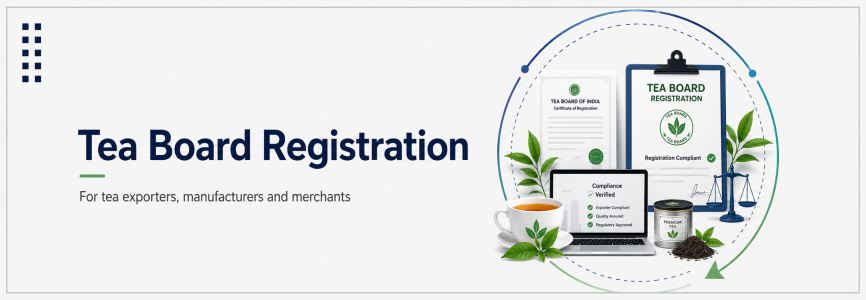



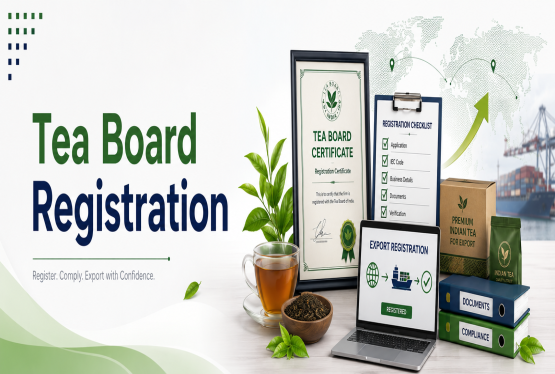
Starting a tea business in India involves more than registering a company, obtaining GST registration and launching a brand. Depending on the activities undertaken, a business may also need registration, a licence, permission or a certificate from the Tea Board of India.
The expression “Tea Board Registration” is commonly used as a general term, but it does not refer to one universal registration. A tea grower, buyer, manufacturer, warehouse operator, exporter, importer, auction broker and flavoured-tea brand may each require a different approval. Consequently, the documents needed depend on what the applicant plans to do with the tea.
The Tea Board’s supporting-document portal currently identifies separate categories for buyer registration, exporter licences, flavoured-tea registration, garden registration, manufacturing-unit registration, RCMC, warehouse licences, tea-waste licences, auction-related licences, changes in ownership and other regulatory approvals.
Understanding Tea Board Registration
Tea Board registration is an activity-based regulatory approval issued under the Tea Act, 1953 and the control orders, guidelines and notifications framed under it. A business must first map its operations before choosing the application category.
For example, a company that buys finished tea, blends it at a rented facility, packs it under its own brand and exports it may have to examine buyer registration, warehouse licensing, flavoured-tea registration, an exporter licence and RCMC. One approval does not automatically replace another.
The Tea Board’s official licensing information states that tea manufacturers, commercial buyers, auction brokers, auction organisers, exporters, importers, tea-waste dealers and warehouse operators are governed through separate registration or licensing mechanisms.
Legal Provisions Regulating Tea Board Registration in India
The Tea Act, 1953
The Tea Act, 1953 is the principal central legislation governing the tea industry. It provides for Union control over tea cultivation, production, marketing and export and establishes the Tea Board as the statutory authority responsible for administering several regulatory and developmental functions.
Section 4 provides for the establishment and constitution of the Tea Board. Section 10 sets out the functions of the Board, while Chapter III deals with control over the extension of tea cultivation. Sections 12 to 14 are particularly relevant where tea is to be planted on new land or a new tea garden is being established.
Section 30 empowers the Central Government to regulate the price and distribution of tea and tea waste. It permits regulation through licences, permits or other measures relating to the production, storage, transport and distribution of tea or tea waste. Orders issued under this power may also require businesses to maintain books, records and accounts and produce them for inspection.
Section 33 provides the statutory foundation for licensing certain persons engaged as tea brokers, manufacturers, tea-waste dealers or in the business of blending tea. Sections 34 and 35 deal with inspection and the power to call for returns, while Sections 37 and 38 provide consequences for false returns, obstruction and failure to produce books or records. Liability can also extend to companies and the persons responsible for conducting their business under Section 43.
Tea (Marketing) Control Order, 2003
The Tea (Marketing) Control Order, 2003 regulates tea manufacturers, buyers, auction organisers and tea brokers. It is one of the most important instruments for businesses involved in purchasing green leaves, manufacturing tea or participating in the organised tea-auction system.
The updated Order requires covered manufacturers and buyers to obtain registration and prescribes applications, returns, records, regulatory supervision and grounds for suspension or cancellation. Registered buyers must submit returns, while manufacturers may be required to maintain records of production, procurement, sales, stock and other business information.
The Tea Board’s website published a consolidated Tea (Marketing) Control Order updated up to 2024 on 6 May 2026. Applicants should therefore refer to the consolidated version and the current online guidelines rather than relying only on old application checklists circulated privately.
Tea (Distribution and Export) Control Order, 2005
The Tea (Distribution and Export) Control Order, 2005 governs significant aspects of tea import, distribution and export. A person, firm, company, cooperative society or association intending to export tea from India must examine the exporter-licence requirement.
Similarly, a person intending to import tea into India must examine the permission, licensing, quality-control and reporting requirements applicable under the Order and subsequent directions. An Importer Exporter Code issued by DGFT does not, by itself, replace a Tea Board exporter or importer approval.
Tea Warehouses (Licensing) Order, 1989
A business operating a warehouse for storing tea for auction, blending, packaging or export must examine the Tea Warehouses (Licensing) Order, 1989. The approval is premises-specific and requires evidence relating to possession, dimensions, suitability and use of the warehouse.
The latest Tea Board guidelines also prescribe physical conditions relating to ventilation, damp proofing, pest protection, hygiene, fire safety, access, stacking and storage. A warehouse licence is therefore not granted only on the strength of the business entity’s incorporation documents.
Common Documents Required for Tea Board Applications
Although every registration category has its own checklist, applicants should normally keep a common master file ready. This should contain the entity’s incorporation or constitution documents, PAN, GST registration, registered-office proof, details of proprietors, partners or directors, authorisation of the signatory, premises documents and the relevant activity-specific licences.
Every document should carry the same legal name, constitution and address. Differences between the GST certificate, IEC, FSSAI licence, incorporation certificate, lease deed and Tea Board application frequently lead to clarification notices.
The system-generated application must generally be signed by the proprietor, partner, director or authorised signatory and bear the date and business seal. Where an authorised signatory signs the application, an authorisation letter should also be enclosed. Tea Board’s revised warehouse and flavoured-tea guidelines expressly recognise this requirement.
Documents for Tea Buyer Registration
A person or entity commercially buying or procuring tea must examine buyer registration under the Tea (Marketing) Control Order, 2003. This may include traders, wholesalers, packers, blenders and other businesses that procure tea for commercial purposes.
The Tea Board’s published supporting-document checklist requires a GST Registration Certificate together with documents demonstrating that tea is one of the commodities proposed to be dealt with by the applicant. The portal also provides space for any additional document or payment-related instrument required during scrutiny.
The GST registration and supporting business documents should clearly establish the applicant’s legal identity and connection with the tea trade. Where the GST registration contains only a general description, additional evidence such as invoices, business-object documents, product details or a declaration may be sought.
Registration does not end the buyer’s compliance obligations. Under the updated Tea (Marketing) Control Order, registered buyers may be required to submit quarterly returns and furnish further information called for by the registering authority.
Documents for a New Tea Exporter Licence
A business intending to export tea from India must apply for an exporter licence under the Tea (Distribution and Export) Control Order, 2005. The application is submitted through the Tea Board’s online licensing portal.
For a new exporter licence, the official checklist requires Form A, duly completed and signed with the date and seal of the proprietor, partner or director. The applicant must also upload a self-attested copy of the Importer Exporter Code issued by DGFT.
The address appearing on the IEC must match the address stated in Form A. This is an express requirement in the Tea Board’s exporter guidelines and is one of the most important document-verification points. The applicable application fee must also be paid through the online portal.
In practice, the exporter should also keep its GST registration, PAN, bank details, FSSAI licence, entity-constitution documents and signatory authorisation ready. These documents may be relevant under customs, food-safety or portal-verification requirements even where they are not expressly listed in the short Tea Board exporter checklist.
Documents for Tea Board RCMC
An exporter may also require a Registration-Cum-Membership Certificate, commonly known as RCMC. The certificate serves a different purpose from the exporter licence and is relevant under the Foreign Trade Policy framework. Tea Board’s legacy supporting-document guideline lists the prescribed application, a copy of the IEC issued by DGFT and payment of the application fee. It also requires the documents to be self-attested and sealed.
Applicants should note that DGFT now operates a common electronic e-RCMC module for exporters. Therefore, the live DGFT procedure should be followed for a fresh or renewal application, even though some older Tea Board documents continue to refer to the Tea Board’s eGICCS portal. The exporter should ensure that its IEC profile, business name, address, product details and authorised signatory information are fully updated before filing.
Documents for Registration of a Tea Manufacturing Unit
A new tea manufacturing unit is registered under the Tea (Marketing) Control Order, 2003. The documentary requirements are broader because the Tea Board must verify both the applicant’s constitution and the manufacturing infrastructure.
The applicant must submit Form A, duly signed and sealed, together with a list of machinery and equipment installed and the dates of installation. A copy of the Tea Board NOC issued for setting up the tea factory is also required.
A company must submit its Memorandum and Articles of Association certified by a director. A partnership firm must provide a court- or notary-certified partnership deed, while a registered firm must provide the certificate issued by the Registrar of Firms. A cooperative must submit its registration certificate from the Registrar of Cooperative Societies.
A sole proprietor must submit a notarised declaration on non-judicial stamp paper valued at not less than ?100, stating the proprietor’s name and residential address. A self-help group of small tea growers must provide the society-registration certificate issued by the appropriate State Government authority.
Documents for Tea Garden Registration
A new large tea garden must be recorded with the Tea Board by providing complete details of the grower, estate and plantation area. This requirement must also be considered alongside the Tea Act provisions regulating the extension of tea cultivation.
The applicant must provide the name and address of the company, firm, partnership or proprietorship, the name and address of the tea estate and the details of directors or partners. These details include their names, addresses, contact numbers and email addresses.
The applicant must also disclose the estate’s total land area, the total area planted with tea and the year in which the estate was established. The application fee must be paid electronically through the Tea Board portal.
Where the application involves new planting rather than merely recording an existing estate, land title, survey records, State Government permissions and Tea Board permission under the cultivation-control provisions may become relevant. The applicant should not treat garden recording as a substitute for permission required to plant tea on previously unplanted land.
Documents for Flavoured-Tea Registration
Flavoured-tea registration has one of the most detailed documentary checklists. Tea Board’s revised guidelines state that tea with added flavour cannot be manufactured without a valid registration for each covered factory or manufacturing arrangement.
The marketing company under whose brand the flavoured tea is sold must apply as the manufacturer of flavoured tea. The premises where blending and packaging take place must be recorded as authorised premises in the applicant’s FSSAI licence.
The applicant must upload the signed and sealed system-generated application form. A proprietorship must provide a notarised declaration on non-judicial stamp paper of at least ?100. A partnership must provide its partnership deed, while a company must submit its Memorandum and Articles of Association and Certificate of Incorporation, duly certified by a director.
A complete and valid FSSAI licence must be submitted with every page of its product annexure. Tea must be shown as an authorised food product under the appropriate food category, and the blending or manufacturing premises must be correctly recorded.
Product-specific test reports are also mandatory. Testing must cover biochemical parameters, pesticide residues and metal contaminants under the applicable food-safety regulations. The reports must come from a Tea Board-enlisted, NABL-accredited laboratory and should mention the precise name of the flavoured tea, such as masala tea.
The applicant must provide the names, residential addresses, email addresses and contact numbers of the present proprietor, partners or directors on the business letterhead. A notarised declaration on stamp paper of at least ?100 must confirm that the tea conforms to FSSAI standards and that the flavouring materials satisfy the prescribed conditions.
Where a processed flavour, essence, oil or liquid is used, a declaration from the flavour manufacturer is required. Where natural spices are used directly, the applicant should provide a detailed method of preparation on its letterhead. Additional documents may include the MSME certificate and supporting product declarations.
Documents for a Tea Warehouse Licence
A new warehouse application must include the signed and sealed Form A and documentary evidence establishing ownership or lawful possession of the premises. This may include ownership documents, a registered lease deed or a notarised rent agreement.
An auction organiser’s recommendation is required where the premises will function as an auction warehouse. The applicant must also submit a notarised declaration on ?100 non-judicial stamp paper confirming that the warehouse complies with the prescribed specifications and that no relevant allegation exists against the warehouse from brokers or seller members.
The application form requires the complete warehouse address, floor area, a scaled map, ownership or lease status, intended activities and details of any principal on whose behalf operations will be carried out.
Where a lease does not cover the full licence period, an undertaking regarding timely renewal may be required. A sub-lessee must obtain an NOC from the actual owner, while a private warehouse must declare that it will be used only for private storing, blending and packaging and not for auction purposes.
Change of Ownership Documents
When a tea garden or factory is transferred, the new owner must apply to record the change with the Tea Board. The required documents include the signed application, the original Tea Board registration certificate and a registered sale deed, transfer deed, court order or registered lease deed.
Where the original certificate has been lost, a notarised indemnity bond on ?100 non-judicial stamp paper may be submitted. The new owner must also provide entity-constitution documents appropriate to a company, partnership or proprietorship.
The Tea Board issued revised change-of-ownership guidelines for factories and gardens on 1 June 2026. These guidelines also address cases involving government land, receivers appointed by government authorities and outstanding Tea Board loans.
Recent Updates Applicants Should Know
As of July 2026, the Tea Board has issued or published several important updates affecting documentation and processing. Revised flavoured-tea guidelines were issued on 4 February 2026, revised warehouse guidelines on 11 February 2026 and revised change-of-ownership guidelines on 1 June 2026.
A notice dated 8 January 2026 introduced stated disposal timelines for complete applications. It provides ten working days for exporter licences and buyer registrations, twenty working days for flavoured-tea registration and manufacturing-unit registration, and twenty-five working days for warehouse licences and mini tea factories. These periods begin when a complete application is received.
The same notice states that only one opportunity may be given to submit missing documents or respond to a clarification. Failure to provide the requested material can lead to rejection and forfeiture of the application fee. Applicants should therefore conduct a full document audit before final submission.
In July 2026, the Tea Board also introduced guidelines for “Tea Mark” certification. This is a separate certification and does not replace the underlying Tea Board registration. Its documentation includes the signed application, TMCO certificate, relevant QR-code cards, GST certificate and FSSAI certificate.
Conclusion
The documents required for Tea Board registration depend entirely on the applicant’s operations. A buyer may begin with GST-based evidence, while an exporter needs Form A and IEC details. A manufacturer must establish its machinery, constitution and Tea Board NOC, while a flavoured-tea brand must provide FSSAI records, laboratory reports and notarised declarations. A warehouse operator must establish lawful possession and compliance with physical storage standards.
The safest approach is to map every stage of the business—cultivation, procurement, manufacture, blending, packing, storage, import and export—and identify the approval applicable at each stage. Documents should then be checked for consistency in the legal name, address, constitution, authorised signatory and activity description.
Because the Tea Board regularly revises its guidelines, fees, forms and portal procedures, applicants should always check the latest category-specific checklist available on the filing date. A complete and accurately prepared application can reduce clarification notices, prevent fee forfeiture and help the business begin its tea operations on a legally compliant foundation.
Frequently Asked Questions (FAQs)
Q1. Is Tea Board registration mandatory for every tea business?
Ans: No. The requirement depends on whether the business grows, manufactures, buys, blends, stores, imports or exports tea. Different activities require different licences or registrations.
Q2. What is the main document required for a tea exporter licence?
Ans: A tea exporter must generally submit the prescribed Form A and a self-attested copy of the active IEC. The address in both documents should match.
Q3. Is GST registration required for Tea Board buyer registration?
Yes, GST registration is generally required for buyer registration. The documents should also show that the applicant is engaged in the tea trade.
Q4. What documents are needed for a tea manufacturing unit?
Ans: The applicant must submit the prescribed form, machinery details, Tea Board NOC and entity-constitution documents. Additional factory and premises records may also be required.
Q5. Is an FSSAI licence required for flavoured-tea registration?
Ans: Yes. A valid FSSAI licence must include tea as an authorised food product and correctly mention the blending or manufacturing premises.
Q6. Are laboratory reports required for flavoured tea?
Ans: Yes. Product-specific reports covering biochemical parameters, pesticide residues and metal contaminants are required from an approved accredited laboratory.
Q7. What premises documents are needed for a warehouse licence?
Ans: Ownership papers, a registered lease deed or a notarised rent agreement may be submitted. The warehouse must also meet prescribed storage, safety and hygiene standards.
Q8. Is IEC enough to export tea from India?
Ans: No. IEC is required for export activities, but it does not replace the Tea Board exporter licence, RCMC or other product-specific approvals.
Q9. Can Tea Board registration be transferred after a business sale?
Ans: The new owner must apply for recording the change of ownership. The application should include the transfer deed, original registration certificate and updated entity documents.
Q10. What happens if documents are incomplete?
Ans: The Tea Board may issue a clarification or ask for missing documents. Failure to respond properly may lead to rejection and forfeiture of the application fee.


_crop10_thumb.jpg)


_crop10_thumb.jpg)


-Form_crop10_thumb.jpg)

_crop10_thumb.jpg)


_learn_crop10_thumb.jpeg)


_crop10_thumb.jpg)

_crop10_thumb.jpg)


_crop10_thumb.jpg)




_for_Foreign_Directors_learn_crop10_thumb.jpeg)


_Act,_2015_learn_crop10_thumb.jpg)










_learn_crop10_thumb.jpg)



























_crop10_thumb.jpg)

_crop10_thumb.jpg)
_(1)_crop10_thumb.jpg)





_crop10_thumb.png)

_crop10_thumb.jpg)

_crop10_thumb.jpg)





_crop10_thumb.png)
_crop10_thumb.jpg)





_crop10_thumb.png)






_crop10_thumb.jpg)
