
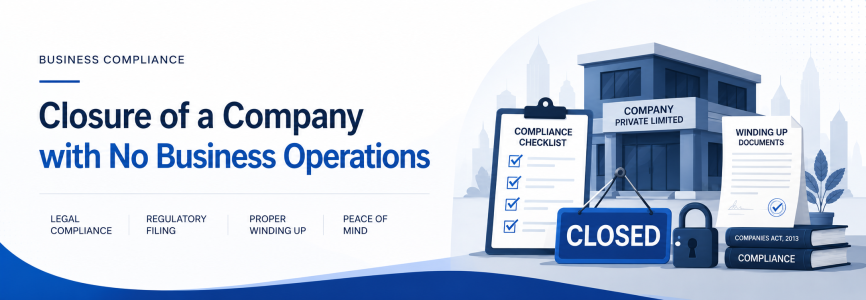



Many companies are incorporated with a business plan, but due to financial issues, change in strategy, lack of clients, funding problems, promoter disputes or market conditions, they may never start operations or may stop business after some time. Even if a company is not doing any business, it continues to exist legally until it is formally closed under the Companies Act, 2013.
A company with no business operations cannot simply be ignored. It may still be required to maintain statutory records, file annual returns, financial statements, income tax returns and other applicable forms. If the company remains inactive without proper closure, it may attract penalties, late fees and notices from the Registrar of Companies. For such companies, the most practical route is usually strike off under Section 248 of the Companies Act, 2013. Section 248 allows the Registrar of Companies to remove the name of a company from the register if it is not carrying on business or operation for the prescribed period, or the company itself may apply for voluntary strike off.
Meaning of Company Closure
Company closure means legally ending the existence of a company. Once the company is closed and its name is struck off from the register of companies, it is treated as dissolved. After dissolution, the company cannot normally carry on business, operate bank accounts, enter into contracts or hold itself out as an active company. Closure is different from simply stopping business. A company may stop sales, stop invoicing and stop operations, but unless the name is removed from MCA records, the company continues to exist as a legal entity. Therefore, business owners should complete the legal closure process instead of keeping an inactive company pending for years.
When Can a Company Be Closed for No Business Operations?
A company may apply for closure when it has no business operations and no intention to continue its business. Under Section 248, strike off may apply where a company has not commenced business within the prescribed period or has not carried on any business or operation for two immediately preceding financial years and has not applied for dormant company status under Section 455. This route is generally suitable for companies that have no assets, no liabilities, no ongoing business, no pending litigation and no regulatory complications. If the company has loans, creditors, tax dues, employees, assets or legal disputes, those matters must be settled before applying for closure.
Strike Off as a Simple Closure Route
Strike off is one of the simplest methods to close a company that has no business operations. It is commonly used for private limited companies, OPCs and other companies that have become inactive or defunct. In voluntary strike off, the company itself files an application with the Registrar of Companies through Form STK-2. The application is made after taking approval of shareholders and completing the required documentation. Form STK-2 is the prescribed form for voluntary removal of the company’s name from the register. Once the ROC is satisfied that the company is eligible and that its liabilities have been cleared or properly provided for, the ROC may proceed to strike off the name of the company. After publication of notice in the Official Gazette, the company stands dissolved.
Key Conditions for Closure
Before filing for strike off, the company should ensure that it meets the basic eligibility conditions. The company should not be carrying on any business or operation. It should not have any outstanding liabilities. It should not have ongoing litigation, prosecution or regulatory proceedings. It should not have active bank transactions except closure-related entries.
The company should also ensure that all necessary internal approvals are completed. The directors must confirm that the company has no dues and that there is no intention to defraud creditors, members or government authorities. If any liability is discovered later, the responsibility may still fall on directors, officers or members who were managing the company.
Documents Required for Company Closure
For closing a company with no business operations, the following documents are generally required:
- Board resolution approving closure
- Special resolution or consent of shareholders
- Form STK-2
- Indemnity bond by directors in Form STK-3
- Affidavit by directors in Form STK-4
- Statement of accounts
- Auditor-certified financial statement or statement of assets and liabilities
- PAN and identity proof of directors
- Digital signature certificate of authorised director
- Copy of pending or completed annual filings, if applicable
- Bank account closure proof, if available
- No-objection documents, if required in specific cases
The statement of accounts is important because it shows whether the company has assets or liabilities at the time of closure. The ROC may examine whether the company has made sufficient provision for payment or discharge of all liabilities before allowing strike off.
Step-by-Step Process for Closure
The first step is to check whether the company is eligible for strike off. The company’s MCA status, filings, liabilities, bank accounts, tax dues and legal matters should be reviewed.
The second step is to clear pending dues and close business matters. Any creditor payment, loan settlement, tax payment, employee dues or statutory liability should be completed before applying.
The third step is to hold a board meeting. The board should approve the proposal for closure and authorise one director or professional to complete the filing process.
The fourth step is to obtain shareholder approval. In most cases, a special resolution or consent of members is required before filing Form STK-2.
The fifth step is to prepare the required documents, including affidavit, indemnity bond and statement of accounts. These documents should be accurate because false declarations may create liability for directors.
The sixth step is to file Form STK-2 with the ROC along with prescribed attachments and government fee.
The seventh step is ROC examination. The ROC may issue notice, ask for clarification or require additional documents.
The final step is publication of strike off notice. Once approved, the ROC publishes notice and the company is dissolved.
What If the Company Never Started Business?
If the company was incorporated but never started business, it may still be closed through strike off if it satisfies the legal conditions. However, the company must carefully check whether commencement of business declaration, bank account, share capital, statutory filings and other compliances are pending. Even if there was no income or business transaction, the company should not assume that no compliance is required. A company remains a separate legal person until its name is removed from the MCA register.
What If Annual Filings Are Pending?
In many cases, inactive companies have pending annual filings because promoters stop using the company and ignore compliance. Before closure, the filing position must be reviewed. As a practical rule, the company should complete essential filings up to the period required under applicable MCA guidance and ROC practice. If the company had business activity in earlier years, filings for those years may need to be completed before strike off. If the company had no activity for later years, professional review is recommended before filing STK-2.
Difference Between Strike Off and Winding Up
Strike off is generally suitable for companies that have no business, no assets and no liabilities. It is a simpler and cost-effective closure route. Winding up or liquidation is a more detailed process used where the company has assets, liabilities, creditors, disputes or insolvency-related issues. If the company owes money or has pending claims, strike off may not be appropriate. Therefore, for a company with no business operations and clean records, strike off is usually the preferred option.
Liabilities After Strike Off
Strike off does not automatically remove all past liabilities of directors or officers. If any fraud, misstatement, unpaid liability or statutory default is discovered later, action may still be taken against persons responsible for the company. The law also allows restoration of the company’s name in certain cases. Therefore, directors should ensure that the closure application is genuine, complete and supported by proper records.
Common Mistakes to Avoid
Many promoters delay closure because the company has no business. This is a mistake because ROC penalties and filing defaults may continue. Another common mistake is filing closure without checking liabilities. If there are unpaid creditors, loans or tax dues, the application may be rejected or future liability may arise. Some companies also fail to close bank accounts or maintain proper records. Before filing STK-2, the company should keep all financial statements, bank statements, resolutions and declarations ready.
Conclusion
Closure of a company with no business operations is an important legal step. If a company is not active and promoters do not wish to continue it, they should not leave it unattended on MCA records. Voluntary strike off under Section 248 of the Companies Act, 2013 provides a practical way to close an inactive company.
However, closure should be done carefully. The company must ensure that there are no pending liabilities, disputes, statutory dues or business operations. Proper documentation, accurate declarations and timely filing of Form STK-2 can help promoters close the company smoothly and avoid future compliance burden.
FAQs
Q1. Can a company with no business operations be closed?
Ans. Yes, a company with no business operations can be closed through strike off if it meets the eligibility conditions under the Companies Act, 2013. The company should generally have no assets, liabilities, disputes or active operations.
Q2. Which form is used for voluntary strike off?
Ans. Form STK-2 is used for voluntary strike off of a company. It is filed with the Registrar of Companies along with required documents and declarations.
Q3. Is strike off suitable for every inactive company?
Ans. No, strike off is mainly suitable for companies with no business, no liabilities and no pending disputes. If the company has creditors, assets or legal matters, another closure route may be required.
Q4. Can a company be closed if annual filings are pending?
Ans. It depends on the facts of the case. The company must review its filing history and complete required filings before applying for closure, especially for years in which business activity existed.
Q5. Is shareholder approval required for company closure?
Ans. Yes, shareholder approval is generally required for voluntary strike off. The approval may be taken through a special resolution or consent as applicable.
Q6. What happens after the company is struck off?
Ans. After strike off, the company’s name is removed from the register of companies and it stands dissolved. It can no longer carry on business as an active legal entity.
Q7. Are directors free from all liabilities after strike off?
Ans. Not always. If any fraud, unpaid dues, false declaration or statutory default is found later, directors and officers may still be held responsible.
Q8. Can a company with bank balance apply for closure?
Ans. Before closure, the company should settle or distribute its assets and close the bank account properly. A company with active assets may face objections during strike off.
Q9. How long does company closure take?
Ans. The timeline depends on ROC processing, document accuracy and whether any objections are raised. If the records are clean, the process is usually smoother.
Q10. Why should an inactive company be closed?
Ans. An inactive company should be closed to avoid annual filing burden, penalties, ROC notices and future legal complications. Formal closure gives promoters a clean exit.


_crop10_thumb.jpg)


_crop10_thumb.jpg)


-Form_crop10_thumb.jpg)

_crop10_thumb.jpg)


_learn_crop10_thumb.jpeg)


_crop10_thumb.jpg)

_crop10_thumb.jpg)


_crop10_thumb.jpg)




_for_Foreign_Directors_learn_crop10_thumb.jpeg)


_Act,_2015_learn_crop10_thumb.jpg)








_learn_crop10_thumb.jpg)





















_crop10_thumb.jpg)

_crop10_thumb.jpg)
_(1)_crop10_thumb.jpg)








_crop10_thumb.png)





_crop10_thumb.jpg)


_crop10_thumb.jpg)






_crop10_thumb.png)
_crop10_thumb.jpg)







_crop10_thumb.png)






_crop10_thumb.jpg)
