
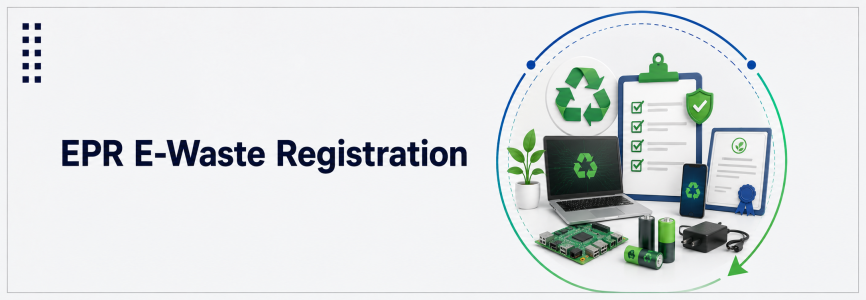



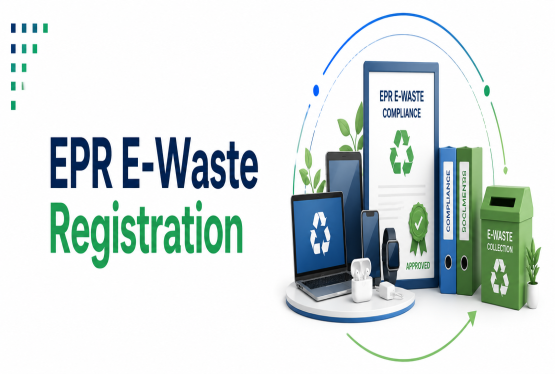
EPR E-Waste Registration is one of the most important legal compliances for businesses dealing with electrical and electronic equipment in India. With the fast growth of mobile phones, laptops, refrigerators, air conditioners, printers, televisions, solar panels, batteries, and other electronic items, the problem of e-waste has become serious. E-waste contains valuable materials like copper, aluminium, iron, gold and rare earth elements, but it also contains hazardous substances like lead, cadmium, mercury and other toxic materials. If e-waste is handled in an unsafe manner, it can harm human health, workers, soil, water and the environment.
In India, e-waste management is regulated under the E-Waste Management Rules, 2022, which came into force from 1 April 2023. These rules were issued under Sections 6, 8 and 25 of the Environment Protection Act, 1986, read with Rule 5 of the Environment Protection Rules, 1986. The 2022 Rules replaced the earlier E-Waste Management Rules, 2016, and introduced a more structured Extended Producer Responsibility framework through the CPCB EPR portal.
EPR means Extended Producer Responsibility. In simple words, it means that a producer of electrical and electronic equipment is responsible for ensuring that e-waste generated from its products is properly recycled through registered recyclers. The producer cannot simply sell electronic products and ignore their end-of-life disposal. Under the current law, covered producers must obtain EPR registration, meet recycling targets, purchase EPR certificates from registered recyclers, file returns and comply with hazardous substance limits.
Meaning of E-Waste and EPR
E-waste means electrical and electronic equipment, including solar photovoltaic modules, panels or cells, that are discarded as waste. It also includes rejects from manufacturing, refurbishment and repair processes. Electrical and electronic equipment means equipment that depends on electric current or electromagnetic field to work, including equipment used for generation, transfer or measurement of electricity.
Extended Producer Responsibility means the legal responsibility of producers of electrical and electronic equipment listed in Schedule I to meet recycling targets through registered recyclers. The EPR obligation is not only a moral duty but a legal duty under the E-Waste Management Rules, 2022. The rules clearly state that EPR must be fulfilled through registered recyclers so that e-waste is managed in an environmentally sound manner.
Legal Provisions Governing EPR E-Waste Registration
The main law governing EPR E-Waste Registration is the E-Waste Management Rules, 2022. These rules apply to manufacturers, producers, refurbishers, dismantlers and recyclers involved in manufacture, sale, transfer, purchase, refurbishing, dismantling, recycling and processing of e-waste or electrical and electronic equipment listed in Schedule I. The rules also cover components, consumables, parts and spares that make the product operational.
The rules do not apply to waste batteries covered under the Battery Waste Management Rules, 2022, packaging plastics covered under the Plastic Waste Management Rules, 2016, micro enterprises as defined under the MSME Development Act, 2006, and radioactive waste covered under the Atomic Energy Act, 1962. This means businesses must carefully check whether their product falls under e-waste rules or another waste management framework.
Rule 4 of the E-Waste Management Rules, 2022 deals with registration. It provides that manufacturers, producers, refurbishers and recyclers must register on the CPCB portal. If an entity falls under more than one category, it must obtain registration separately for each applicable category. Most importantly, no covered entity can carry on business without registration, and registered entities cannot deal with unregistered manufacturers, producers, recyclers or refurbishers.
Who Needs EPR E-Waste Registration?
EPR E-Waste Registration is required for producers of electrical and electronic equipment listed in Schedule I of the E-Waste Management Rules, 2022. A producer includes a person or entity that manufactures and sells electrical and electronic equipment under its own brand, sells equipment under its own brand even if made by another manufacturer, imports electrical and electronic equipment, or imports used electrical and electronic equipment.
This means EPR registration may apply to brand owners, importers, e-commerce sellers, electronic product companies, assembling units selling under their brand, and businesses importing components, consumables, parts or spares covered under the rules. The method of selling does not matter. Whether products are sold through dealers, retailers, distributors, online platforms or e-retailers, the producer may still fall under EPR compliance.
The rules cover many categories such as information technology equipment, telecommunication equipment, consumer electrical and electronics, photovoltaic panels, large electrical equipment, small electrical equipment, electrical and electronic tools, toys, leisure and sports equipment, medical devices, monitoring and control instruments, and laboratory instruments. The Second Amendment Rules, 2023 expanded and clarified several Schedule categories, including products like tablets, routers, UPS, inverters, modems, monitors, set-top boxes, solar panels, microwaves, electric fans and several other electronic items.
Step-by-Step Process for EPR E-Waste Registration
Step 1: Check Product Applicability
The first step is to identify whether the product is covered under Schedule I of the E-Waste Management Rules, 2022. The business should check the product category, product code, and whether the item is electrical or electronic equipment, component, consumable, part, or spare covered under the rules.
- Check whether the product falls under Schedule I
- Identify the correct product category and product code
- Verify whether the product is equipment, component, part, spare, or consumable
- Avoid wrong classification to prevent incorrect EPR targets or rejection
Step 2: Identify Applicant Category
The next step is to decide the correct applicant category. A business must check whether it is applying as a producer, manufacturer, recycler, or refurbisher. If the same business falls under more than one category, separate registration may be required.
- Decide whether the applicant is a producer, manufacturer, recycler, or refurbisher
- Importers selling electronic goods under their brand may need producer registration
- Recycling units may need recycler registration
- Separate registration may be required for multiple business roles
Step 3: Collect Business and Product Documents
After identifying the category, the applicant should collect all business and product-related documents. These documents help CPCB verify the legal status of the business, product details, sales data, import data, and compliance declarations.
- Certificate of incorporation or business registration proof
- PAN and GST registration certificate
- Authorised signatory details
- IEC certificate, if the applicant is an importer
- Product category, product details, and brand details
- Sales data, import data, and manufacturing details
- RoHS declaration and other required documents
Step 4: Create Account on CPCB EPR E-Waste Portal
The applicant must create an account on the CPCB EPR E-Waste portal and fill out the online application. The details entered on the portal should be accurate because EPR targets are calculated based on product data, sales or import figures, and the average life of the product.
- Create login on the CPCB EPR E-Waste portal
- Fill in business and applicant details
- Add product category and product code
- Enter year-wise sales or import data
- Submit estimated e-waste generation details
- Ensure all data is accurate and properly matched
Step 5: Submit Application and Pay Government Fee
Once the application is complete, the applicant must upload the required documents and pay the applicable government fee. CPCB may charge registration fees and annual maintenance charges based on the capacity of e-waste generated, recycled, or handled.
- Upload all required documents on the portal
- Review application details before submission
- Pay the applicable government fee
- Submit the application for CPCB review
- Keep acknowledgement or application reference for tracking
Step 6: CPCB Review and Grant of Registration
After submission, CPCB reviews the application, documents, and product details. If all details are correct, registration may be granted. If CPCB finds any mismatch, incomplete details, or incorrect classification, clarification or correction may be required.
- CPCB verifies application and documents
- Clarification may be raised in case of mismatch
- Applicant must correct errors and resubmit, if required
- Registration is granted after successful verification
- After approval, the producer must follow EPR targets, return filing, awareness duties, and other compliance rules
Documents Required for EPR E-Waste Registration
The documents required for EPR E-Waste Registration may vary depending on the category of the applicant. A producer, manufacturer, recycler, and refurbisher may need different documents based on their business activity, product category, and role under the E-Waste Management Rules, 2022.
Documents Required for Producers
A producer must submit business, product, and compliance-related documents on the CPCB EPR E-Waste portal. These documents help CPCB verify the legal identity of the business, product details, sales or import data, and EPR applicability.
- Certificate of incorporation or business registration proof
- PAN card of the business
- GST registration
- IEC certificate, if the applicant is an importer
- Authorised signatory proof
- Product details with category codes
- Brand details of electronic products
- Sales data and import data
- RoHS self-declaration
- Technical documents related to RoHS compliance
- Undertaking or declaration as required on the CPCB portal
Documents Required for Recyclers and Refurbishers
Recyclers and refurbishers may need additional documents because they are directly involved in handling, processing, refurbishing, dismantling, or recycling e-waste. These documents help CPCB and the Pollution Control Board verify the facility, machinery, capacity, and environmental safety arrangements.
- Consent to Establish from State Pollution Control Board or Pollution Control Committee
- Consent to Operate from State Pollution Control Board or Pollution Control Committee
- Details of recycling or refurbishing facility
- Machinery details
- Installed processing capacity
- Process flow chart
- Pollution control equipment details
- Hazardous waste handling details
- Details of storage area and processing area
- Facility-level compliance documents
Facility Requirements for Recyclers
CPCB requires recyclers to have proper infrastructure for safe e-waste handling and recycling. The facility should have enough space, proper machinery, and pollution control systems to manage e-waste in an environmentally safe manner.
- Space for dismantling and shredding
- Area for separation of materials
- Storage space for raw e-waste
- Storage space for recycled products
- Separate hazardous waste storage area
- Pollution control systems
- Proper record-keeping of material movement
- Safe disposal system for non-recyclable waste
Responsibilities of Producers
Rule 6 of the E-Waste Management Rules, 2022 lays down the responsibilities of producers. Producers must register on the portal, obtain and implement EPR targets as per Schedule III and Schedule IV, create awareness through media, publications, advertisements, posters or other means, and file annual and quarterly returns on the portal before the end of the month succeeding the relevant quarter or year.
Producers must fulfill EPR obligations by purchasing EPR certificates online from registered recyclers only. These certificates are submitted online through quarterly returns. The portal cross-checks details provided by the producer and recycler, and in case of difference, the lower figure is considered for fulfillment of EPR obligation. The certificates are also subject to environmental audit by CPCB or agencies authorised by CPCB.
EPR Recycling Targets
The EPR recycling targets are given in Schedule III and Schedule IV. For general producers, the target for financial year 2023-24 and 2024-25 is 60 percent of the quantity of electrical and electronic equipment placed in the market in year Y-X, where X is the average life of that product. For 2025-26 and 2026-27, the target is 70 percent. From 2027-28 onwards, the target becomes 80 percent. These targets may be reviewed and increased after 2028-29.
For producers who have started sales recently and whose number of sales operation years is less than the average life of their products, Schedule IV applies. For such producers, the target is 15 percent of the sales figure of financial year 2021-22 for 2023-24, 20 percent of the sales figure of financial year 2022-23 for 2024-25, and 20 percent of the sales figure of the financial year two years back from 2025-26 onwards. Importers of used electrical and electronic equipment have 100 percent EPR obligation for imported material after end of life if it is not re-exported.
EPR Certificates and Their Transaction
EPR certificates are generated through the CPCB portal in favour of registered recyclers. These certificates are based on the quantity of end products recovered from recycling. Under Rule 14, EPR certificates have a unique number and are issued in denominations such as 100 kg, 200 kg, 500 kg and 1000 kg or other denominations as may be approved. The certificate is valid for two years from the end of the financial year in which it is generated.
A producer can purchase EPR certificates only up to its current year liability, leftover liability of earlier years and an additional 5 percent of the current year liability. The EPR obligation must be fulfilled proportionately on a quarterly basis. Once a producer purchases an EPR certificate, it is automatically adjusted against liability, with earlier liability given priority.
The 2024 amendment inserted provisions for exchange or transfer platforms for EPR certificates. It also provides that CPCB shall fix the highest and lowest price for exchange of EPR certificates, linked to environmental compensation for non-fulfillment of EPR obligation. The portal exchange price must remain between such highest and lowest prices.
RoHS Compliance Under E-Waste Rules
RoHS means Reduction of Hazardous Substances. Under Rule 16, producers must ensure that new electrical and electronic equipment and their components, consumables, parts and spares do not contain lead, mercury, cadmium, hexavalent chromium, polybrominated biphenyls and polybrominated diphenyl ethers beyond prescribed limits. The limit is 0.1 percent by weight in homogeneous materials for lead, mercury, hexavalent chromium, polybrominated biphenyls and polybrominated diphenyl ethers, and 0.01 percent for cadmium.
The Second Amendment Rules, 2023 also clarified exemptions and timelines for certain electrical and electronic equipment. CPCB’s FAQ explains that certain Schedule II C equipment placed in the market on or before 1 April 2025 is exempt from Rule 16(1), and certain components, consumables, parts or spares for such equipment are exempt till 1 April 2028, subject to conditions. Producers must maintain declarations and technical documents for RoHS compliance and make them available for verification when required.
Solar PV Modules, Panels and Cells
Solar photovoltaic modules, panels and cells are also covered under the E-Waste Management Rules, 2022. However, the rules provide a special treatment for solar waste. Manufacturers and producers of solar photovoltaic modules, panels or cells must register on the portal, store solar PV waste generated up to the year 2034-35 as per CPCB guidelines, file annual returns, maintain a separate inventory on the portal and comply with CPCB standard operating procedures.
The EPR recycling targets under Schedule III and Schedule IV are not applicable to waste generated from solar photovoltaic modules, panels or cells. However, this does not mean solar businesses are free from compliance. They must still register, maintain inventory, store waste safely and comply with CPCB guidelines. CPCB has also listed updated technical guidelines for storage and handling of waste solar photovoltaic modules, panels or cells under the E-Waste Management Rules, 2022.
Responsibilities of Manufacturers, Recyclers, Refurbishers and Bulk Consumers
Manufacturers must register on the portal, collect e-waste generated during manufacturing, ensure recycling or disposal, and file quarterly and annual returns. After the Second Amendment Rules, 2023, manufacturers of refrigeration and air-conditioning equipment must also ensure safe, accountable and sustainable management of refrigerants generated during manufacturing through approved destruction technologies as per CPCB guidelines.
Refurbishers must register on the portal, collect e-waste generated during refurbishing, hand over waste to registered recyclers and upload information on the portal. They must also ensure that refurbished equipment complies with applicable standards under the Compulsory Registration Scheme of MeitY and BIS standards where applicable.
Recyclers must register on the portal, operate facilities according to CPCB standards and guidelines, maintain records, file returns and ensure that non-recycled fractions or residues are sent to appropriate registered recyclers or authorised treatment, storage and disposal facilities. CPCB’s guidelines require recyclers to maintain material flow records at every stage and to keep records of outputs such as metals, plastic, refrigerant gases, hazardous waste and residues.
Bulk consumers do not need to register on the portal, but they must ensure that e-waste generated by them is handed over only to registered producers, recyclers or refurbishers. This is important for companies, institutions, offices and e-retailers using large quantities of electronic equipment.
Environmental Compensation and Penalties
Non-compliance with EPR E-Waste Rules can lead to environmental compensation, cancellation of registration and prosecution under the Environment Protection Act, 1986. CPCB may impose environmental compensation for violation of the rules, non-fulfillment of EPR obligations, use of false EPR certificates, dealing without registration or other irregularities. Unregistered producers, manufacturers, refurbishers, recyclers and any entity aiding violation can also face environmental compensation.
Payment of environmental compensation does not remove the producer’s EPR obligation. If a producer fails to meet its EPR target, the unfulfilled liability is carried forward up to three years. If the shortfall is later addressed, part of the environmental compensation may be returned depending on the delay period. False information leading to excess generation of EPR certificates may result in revocation of registration and non-returnable environmental compensation. Repeated violations may even result in permanent revocation of registration.
Recent Updates in EPR E-Waste Compliance
The first important update was the E-Waste Management Amendment Rules, 2023, notified on 30 January 2023 and effective from 1 April 2023. This amendment made changes in Rule 16 and added entries related to cadmium and lead in solar panels, solar photovoltaic panels, cells or modules and lead in medical devices, subject to specified exemptions.
The second major update was the E-Waste Management Second Amendment Rules, 2023, notified on 24 July 2023. This amendment added provisions on safe management of refrigerants from refrigeration and air-conditioning equipment, clarified conversion factors for EPR certificate generation where recycling results in multiple end products, and introduced additional RoHS-related schedules and exemptions.
The 2024 amendment brought further changes. It revised the definition of dismantler, inserted Rule 9A allowing the Central Government to relax return or report filing timelines for up to nine months in public interest or for effective implementation of the rules, and introduced provisions for platforms for exchange or transfer of EPR certificates along with price band rules.
CPCB has also been updating technical guidelines. Its e-waste technical guidelines page shows updated guidance on solar PV waste storage and handling, determination of processing capacity of e-waste recycling facilities, environmental compensation guidelines and environmentally sound recycling of e-waste. This shows that compliance is not limited to registration only; businesses must also follow operational guidelines, portal updates and CPCB directions from time to time.
Conclusion
EPR E-Waste Registration is mandatory for covered producers, manufacturers, recyclers and refurbishers dealing with electrical and electronic equipment under the E-Waste Management Rules, 2022. It is not a one-time formality. After registration, producers must meet annual and quarterly EPR obligations, buy EPR certificates from registered recyclers, file returns, maintain RoHS compliance, create awareness and deal only with registered entities.
For businesses, proper EPR compliance helps avoid penalties, environmental compensation, cancellation of registration and business disruption. It also improves brand credibility because consumers, government authorities and corporate buyers are becoming more serious about responsible waste management. Any business dealing in electronic products, imported electronics, components, parts, spares, solar panels or refurbished electronics should check its EPR applicability at the beginning itself and complete registration before starting or continuing business in India.
Frequently Asked Questions (FAQs)
Q1. What is EPR E-Waste Registration?
Ans: EPR E-Waste Registration is mandatory for covered producers, manufacturers, recyclers and refurbishers.
It is taken through the CPCB E-Waste EPR Portal under the E-Waste Management Rules, 2022.
It ensures that electronic waste is collected and recycled through registered channels.
Q2. Who needs EPR E-Waste Registration?
Ans: Producers, manufacturers, recyclers and refurbishers dealing with covered electrical and electronic equipment need registration.
Importers and brand owners of electronic products may also need producer registration.
The requirement depends on the product category listed under Schedule I of the E-Waste Rules.
Q3. Is EPR Registration mandatory for importers?
Ans: Yes, importers of covered electrical and electronic equipment are treated as producers.
They must obtain EPR registration before placing such products in the Indian market.
They also have to meet recycling targets and file returns through the CPCB portal.
Q4. Which law governs EPR E-Waste Registration in India?
Ans: EPR E-Waste Registration is governed by the E-Waste Management Rules, 2022.
These rules are issued under the Environment Protection Act, 1986.
CPCB is the main authority managing registration and EPR compliance through the online portal.
Q5. What documents are required for EPR E-Waste Registration?
Common documents include PAN, GST, incorporation proof, IEC, product details and authorised signatory details.
Producers may also need sales data, import data, brand details and RoHS declaration.
Documents may vary based on whether the applicant is a producer, recycler, manufacturer or refurbisher.
Q6. What is the CPCB E-Waste EPR Portal?
Ans: The CPCB E-Waste EPR Portal is the official online platform for registration and compliance.
Applicants use it to apply for registration, submit data, file returns and manage EPR certificates.
Only registered entities can legally operate under the E-Waste Management Rules.
Q7. What are EPR targets in e-waste compliance?
Ans: EPR targets are recycling obligations assigned to producers based on products placed in the market.
Producers must fulfil these targets by purchasing EPR certificates from registered recyclers.
Targets are calculated as per the rules and product life mentioned in the E-Waste framework.
Q8. What is an EPR certificate?
Ans: An EPR certificate is generated by registered recyclers after proper recycling of e-waste.
Producers purchase these certificates to meet their EPR recycling obligations.
The certificate is managed online through the CPCB E-Waste EPR Portal.
Q9. Is RoHS compliance required under E-Waste Rules?
Ans: Yes, producers must ensure that covered electronic products follow RoHS substance limits.
RoHS restricts hazardous substances such as lead, mercury, cadmium and hexavalent chromium.
Proper technical documents and declarations should be maintained for compliance.
Q10. What happens if EPR E-Waste Registration is not obtained?
Ans: Operating without registration may lead to environmental compensation and regulatory action.
The business may also face restrictions on sale, import or handling of electronic products.
Repeated or serious violations can lead to cancellation of registration or prosecution.


_crop10_thumb.jpg)


_crop10_thumb.jpg)


-Form_crop10_thumb.jpg)

_crop10_thumb.jpg)


_learn_crop10_thumb.jpeg)


_crop10_thumb.jpg)

_crop10_thumb.jpg)


_crop10_thumb.jpg)




_for_Foreign_Directors_learn_crop10_thumb.jpeg)


_Act,_2015_learn_crop10_thumb.jpg)










_learn_crop10_thumb.jpg)
























_crop10_thumb.jpg)

_crop10_thumb.jpg)
_(1)_crop10_thumb.jpg)






_crop10_thumb.png)

_crop10_thumb.jpg)

_crop10_thumb.jpg)






_crop10_thumb.png)
_crop10_thumb.jpg)



_crop10_thumb.png)







_crop10_thumb.jpg)
