


India is one of the world’s major pharmaceutical-exporting countries, supplying medicines, active pharmaceutical ingredients, vaccines, biological products, surgical products and other healthcare products to international markets. For an Indian pharmaceutical business planning exports, obtaining an Importer Exporter Code (IEC) is an important starting point, but it may not complete the entire export-registration framework.
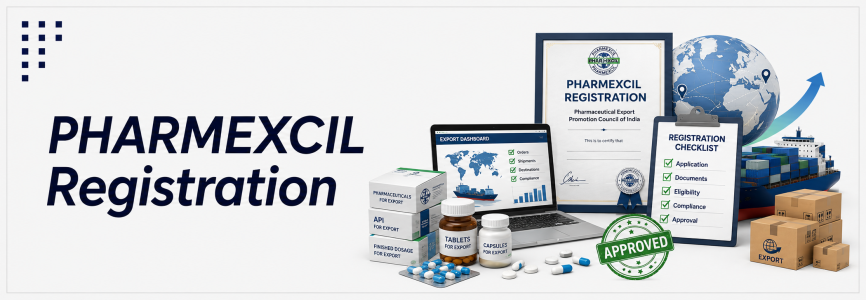
Another important registration for businesses operating in the pharmaceutical export sector is the Registration-cum-Membership Certificate (RCMC) issued through the Pharmaceuticals Export Promotion Council of India, commonly known as PHARMEXCIL.
PHARMEXCIL was established on 12 May 2004 under the Ministry of Commerce and Industry. DGFT Public Notice No. 61/2004-09 dated 16 March 2005 specifically provided that exporters of drugs and pharmaceuticals obtaining RCMC must obtain it from PHARMEXCIL. PHARMEXCIL continues to describe itself as the RCMC authority for pharmaceutical exporters.
Understanding PHARMEXCIL RCMC is particularly important because an exporter should not confuse it with a drug manufacturing licence, IEC, Certificate of Pharmaceutical Product, product registration in a foreign country or other regulatory approvals. Each serves a different legal purpose.
What Is PHARMEXCIL?
The Pharmaceuticals Export Promotion Council of India (PHARMEXCIL) is an Export Promotion Council established for promoting Indian pharmaceutical and healthcare exports. It works under the framework of the Ministry of Commerce and Industry and represents pharmaceutical exporters before Indian and overseas authorities.
The Council’s activities include issuing RCMC, organising international trade delegations and buyer-seller meetings, facilitating participation in export-promotion programmes, issuing Certificates of Origin, conducting seminars on regulatory and export matters and representing industry concerns before government authorities.
Why Was PHARMEXCIL Created?
India’s pharmaceutical industry covers a highly specialised range of regulated products. A dedicated Export Promotion Council was therefore created so that exporters operating in this sector could have a focused organisation for international market development, regulatory information and policy representation. DGFT subsequently made PHARMEXCIL the specific RCMC issuing body for exporters of drugs and pharmaceuticals through Public Notice No. 61 dated 16 March 2005.
What Is PHARMEXCIL RCMC?
RCMC stands for Registration-cum-Membership Certificate. It is the certificate through which an exporter becomes registered with the Export Promotion Council or other Registering Authority concerned with its principal line of business. Under Paragraph 2.79 of the current DGFT Handbook of Procedures, an exporter may apply in ANF 2C to become a member of the relevant Export Promotion Council. Once admitted to membership, the applicant is granted the RCMC of the concerned Council in the prescribed format. A manufacturer exporter must provide evidence supporting its manufacturing status. For an exporter whose principal business relates to drugs and pharmaceutical products falling within PHARMEXCIL’s jurisdiction, PHARMEXCIL is therefore the relevant Export Promotion Council for RCMC purposes.
Legal Basis of PHARMEXCIL RCMC
The RCMC system operates under India’s broader foreign-trade law. The principal statute is the Foreign Trade (Development and Regulation) Act, 1992, which provides the legal basis for development and regulation of India’s foreign trade.
Section 5 of the Act deals with the Foreign Trade Policy, while Section 6 deals with appointment and functions of the Director General of Foreign Trade. The current Foreign Trade Policy and Handbook of Procedures issued through DGFT operate within this statutory framework.
Paragraph 2.56 of Foreign Trade Policy 2023
Paragraph 2.56 of FTP 2023 recognises Export Promotion Councils as organisations established to promote and develop Indian exports. Each Council deals with specified products, projects or services, and eligible EPCs can function as Registering Authorities for issuance of RCMC to their members.
PHARMEXCIL therefore performs its RCMC function as part of the government-recognised Export Promotion Council system rather than merely as a private trade association.
Paragraph 2.57 – When RCMC Is Required
Paragraph 2.57(a) of FTP 2023 provides that a person applying for an authorisation to import or export under the Foreign Trade Policy, except in the specified case of restricted items, or applying for another benefit or concession under the FTP, is required to provide an RCMC issued by the competent authority unless specifically exempted.
This is an important distinction. RCMC should not be described simply as a substitute for IEC or as the sole legal permission needed to ship pharmaceutical products. Its principal legal role under the current FTP is connected with registration with the competent EPC and access to applicable FTP authorisations, benefits and concessions.
Public Notice No. 61 of 16 March 2005
PHARMEXCIL has a special historical position within the pharmaceutical sector because DGFT Public Notice No. 61/2004-09 dated 16 March 2005 specifically amended the then Handbook of Procedures. The Public Notice stated that, notwithstanding the general rule concerning selection of an Export Promotion Council, exporters of drugs and pharmaceuticals shall obtain RCMC from PHARMEXCIL only.
PHARMEXCIL’s current FAQ continues to state that exporters of pharmaceutical products should hold a valid RCMC issued by PHARMEXCIL with reference to this Public Notice. Therefore, where a pharmaceutical exporter requires RCMC, it should generally not select another EPC merely because it is more convenient. The main line of business and applicable product jurisdiction must be followed.
Paragraph 2.77 – Registering Authorities
Paragraph 2.77 of the current Handbook of Procedures defines a Registering Authority as a body notified by DGFT to register importers and exporters as its members by issuing RCMC. The list of recognised Registering Authorities is maintained through Appendix 2T. This provision is important because only the appropriate recognised body should issue an RCMC for the relevant export category.
Paragraph 2.79 – Grant of RCMC
Paragraph 2.79 provides the core procedural rule for RCMC. An exporter applies through the prescribed ANF 2C process to become a member of the relevant Export Promotion Council. Once admitted to membership, the exporter is granted RCMC. The same paragraph allows prospective or potential exporters to become associate members, which means a business does not necessarily have to wait until it has built a substantial export history before entering the EPC system.
Paragraph 2.80 – Main Line of Business
Paragraph 2.80 requires an exporter to declare its main line of business while applying for RCMC. The exporter is required to obtain the certificate from the Council concerned with the product forming that principal line of business. Where no specific Export Promotion Council or Commodity Board covers a product, FIEO may issue the RCMC. However, pharmaceutical exporters falling within PHARMEXCIL’s jurisdiction should use PHARMEXCIL rather than treating FIEO as a routine alternative.
What Products Come Under PHARMEXCIL?
PHARMEXCIL’s published sector coverage extends substantially beyond conventional finished tablets and capsules. The Council identifies products and services within its purview including bulk drugs and intermediates, formulations, herbal products, Ayurveda, Unani, Siddha and homeopathic medicines, biotechnology and biological products, diagnostics, surgical products and nutraceuticals. It also identifies pharma-related services such as collaborative research, contract manufacturing, clinical trials and consultancy within its broader sectoral activities.
APIs and Bulk Drugs
Manufacturers and exporters of Active Pharmaceutical Ingredients (APIs), bulk drugs and drug intermediates form an important category represented by PHARMEXCIL. Where these products constitute the exporter’s principal line of business and an RCMC is required for the applicable foreign-trade purpose, PHARMEXCIL is the relevant Council.
Pharmaceutical Formulations
Businesses exporting tablets, capsules, injections, syrups and other pharmaceutical formulations also fall within the pharmaceutical export sector represented by PHARMEXCIL. However, RCMC does not itself certify that a particular medicine is legally manufactured or approved for sale in the destination country. Separate pharmaceutical regulatory requirements continue to apply.
Biotech and Biological Products
PHARMEXCIL also covers biotechnology and biological products within its sectoral activities. Depending upon the specific product, exporters may additionally need approvals or licences under India’s drug regulatory system and may have to comply with the registration requirements of the importing country.
AYUSH and Herbal Products
Ayurvedic, Unani, Siddha, homeopathic and certain herbal products are also represented within PHARMEXCIL’s product scope. Exporters should nevertheless correctly classify the product because a medicinal herbal formulation and an unprocessed agricultural or botanical commodity may not necessarily be regulated in the same manner.
Diagnostics, Surgicals and Nutraceuticals
PHARMEXCIL also lists diagnostics, surgical products and nutraceuticals among its areas of coverage. Because these categories can overlap with other regulatory regimes—such as medical-device or food regulation—the exporter should determine both the correct RCMC authority and the separate product-specific regulatory requirements.
Who Should Obtain PHARMEXCIL RCMC?
PHARMEXCIL RCMC is relevant primarily to businesses whose principal export activity falls within the pharmaceutical and healthcare product categories assigned to the Council. Applicants may include manufacturer exporters, merchant exporters and eligible prospective exporters. The current PHARMEXCIL member directory itself reflects membership categories such as Small Scale Manufacturer and Merchant Exporter, while the Council’s published membership documentation also distinguishes manufacturer and merchant categories.
Manufacturer Exporters
A manufacturer exporter manufactures pharmaceutical or healthcare products and exports them directly. Under Paragraph 2.79 of the HBP, an exporter seeking registration as a manufacturer exporter must furnish evidence supporting that status. Manufacturer exporters must also separately maintain whatever manufacturing and product licences are required under the applicable pharmaceutical laws.
Merchant Exporters
A merchant exporter may procure pharmaceutical products from eligible manufacturers and export those products in its own name. Merchant exporters can also obtain PHARMEXCIL membership and RCMC, subject to applicable documentation and product requirements. The Council’s current member records contain numerous entities registered under the Merchant Exporter category.
Is IEC Required Before PHARMEXCIL RCMC?
Yes, the exporter should have an appropriate Importer Exporter Code and an updated DGFT profile before making an e-RCMC application. Under the current FTP, no export or import of goods can ordinarily be made without IEC unless the person or transaction falls within a specified exemption. IEC details are also integrated into DGFT’s electronic RCMC system. IEC and PHARMEXCIL RCMC are nevertheless different. IEC identifies the importer-exporter within India’s foreign-trade system, while RCMC connects the exporter with the competent Export Promotion Council.
Documents Required for PHARMEXCIL RCMC
To apply for PHARMEXCIL RCMC, the exporter must submit documents that establish the legal identity of the business, its IEC status, pharmaceutical activity and export credentials. The exact documentation may vary depending on whether the applicant is a manufacturer exporter or merchant exporter. Since the application is filed electronically, all details should match the records available with DGFT and other authorities.
The commonly required documents include:
- Importer Exporter Code (IEC) – A valid IEC issued by DGFT is generally required for the e-RCMC application.
- PAN of the Applicant Entity – PAN should correspond with the legal name and constitution of the exporter.
- Drug Licence – Applicable pharmaceutical manufacturing, wholesale or other drug licence may be required depending on the applicant’s activity.
- Manufacturing or Industrial Registration – Manufacturer exporters may need to provide Udyam Registration, factory-related records or other acceptable manufacturing proof.
- Banker’s Certificate – A certificate from the applicant’s bank may be required to establish the business and banking particulars.
- Previous-Year Export Turnover Details – Existing exporters may need to provide details or evidence of their export performance for the relevant period.
- Business Constitution Documents – Partnership deed, incorporation documents or other constitutional records may be required depending on the type of entity.
- Manufacturing Facility Details – Manufacturer exporters may have to provide documents establishing the manufacturing unit and applicable manufacturing status.
- Merchant Exporter Documents – Merchant exporters should provide records supporting their pharmaceutical trading and export activities, wherever required.
Applicants should ensure that the business name, address, IEC, PAN and other particulars remain consistent across all documents. Any mismatch may result in clarification or delay in processing.
As PHARMEXCIL RCMC applications are now handled electronically through the DGFT system, exporters should also check the live document checklist displayed during the application process, as the required documents may vary depending on the category and information selected in the application.
How to Apply for PHARMEXCIL RCMC Online?
The PHARMEXCIL RCMC application is processed electronically through the DGFT Common Digital Platform. Before starting the application, the exporter should ensure that the IEC profile and business details available on the DGFT portal are updated and accurate.
The online application process generally includes the following steps:
- Login to the DGFT Portal – Sign in using the credentials linked with the exporter’s IEC profile.
- Open the e-RCMC Service – Navigate to Services → e-RCMC → Apply for e-RCMC.
- Verify Exporter Profile – Check the legal name, address, constitution and other business details before proceeding.
- Select PHARMEXCIL – Choose the Pharmaceuticals Export Promotion Council of India (PHARMEXCIL) as the relevant Export Promotion Council.
- Enter RCMC Details – Provide the required membership, branch and other registration-related information.
- Select Export Products or Services – Choose the pharmaceutical products or services that form the applicant’s main export activity.
- Add Authorised Representative Details – Enter the details of the person authorised to represent the exporter, wherever applicable.
- Upload Supporting Documents – Attach the prescribed documents such as IEC, PAN, drug licence, manufacturing proof and other records applicable to the category.
- Accept the Declaration – Review the application carefully and accept the prescribed declaration confirming the correctness of the information.
- Sign and Pay the Applicable Fee – Complete the electronic signing process and make the required membership or registration payment.
After successful submission, the application is reviewed by the concerned authority. Once approved, the PHARMEXCIL e-RCMC is issued electronically and becomes available through the exporter’s DGFT profile.
Validity of PHARMEXCIL RCMC
Paragraph 2.81 of the current Handbook of Procedures provides that an RCMC is deemed valid from 1 April of the licensing year in which it is issued and remains valid for five financial years ending on 31 March, unless otherwise specified. This five-financial-year validity should be distinguished from any annual membership subscription or other Council-specific obligations. Exporters should keep both the RCMC validity and their PHARMEXCIL membership status under review.
Amendment of PHARMEXCIL RCMC
Business structures frequently change after registration. A pharmaceutical exporter may change its registered office, entity name, ownership or constitution. Paragraph 2.82 of the HBP makes it obligatory for an RCMC holder to intimate the Registering Authority about changes in ownership, constitution, name or address within one month from the date of change. The Registering Authority may condone delay on merits. DGFT’s electronic system also provides an online RCMC amendment facility through which an active RCMC holder can apply to amend certificate particulars.
De-Registration of PHARMEXCIL RCMC
RCMC is not immune from regulatory action. Under Paragraph 2.83 of the HBP, a Registering Authority can de-register an RCMC holder for a specified period where the conditions of registration have been violated. Before doing so, the exporter must receive a show-cause notice and a reasonable opportunity to make a representation against the proposed action. This requirement protects exporters from arbitrary de-registration while also allowing the Registering Authority to act where membership conditions are breached.
Appeal Against an RCMC Decision
Paragraph 2.84 provides a statutory-policy remedy for an exporter aggrieved by a decision concerning RCMC. The exporter may appeal to the DGFT or an officer designated for the purpose within 45 days of the relevant decision. The decision of the appellate authority is final under the prescribed RCMC procedure.
Why Is PHARMEXCIL RCMC Required?
The first reason is regulatory recognition. It establishes the exporter as a member of the government-recognised Export Promotion Council responsible for pharmaceutical exports. Secondly, Paragraph 2.57 makes RCMC relevant when an exporter seeks specified authorisations, benefits or concessions under the Foreign Trade Policy. Without the appropriate RCMC, an exporter may be unable to complete an application for such benefits where the requirement applies.
Thirdly, PHARMEXCIL membership provides practical export-development support. The Council issues Certificates of Origin, conducts buyer-seller meetings, organises delegations, represents exporter issues and supports participation in international promotional activities.
PHARMEXCIL RCMC Does Not Replace a Drug Licence
One of the most important legal distinctions is that RCMC is an export-promotion and membership registration; it is not a pharmaceutical manufacturing licence or product approval. A pharmaceutical manufacturer must separately comply with the applicable drug and healthcare regulatory laws governing manufacture, sale, testing and export of its products. Depending on the product, regulatory requirements may arise under the Drugs and Cosmetics law, medical-device framework, AYUSH rules or other sector-specific legislation.
Likewise, many importing countries require separate overseas product registration, marketing authorisation, GMP evidence, Free Sale Certificates, Certificates of Pharmaceutical Product or other regulatory documentation. Obtaining PHARMEXCIL RCMC does not automatically satisfy those requirements.
Recent 2026 Update – ?10,000 RCMC Exemption
A particularly important recent change appears in the currently updated Foreign Trade Policy 2023. Paragraph 2.57(c) now provides that, notwithstanding the general RCMC requirement under Paragraph 2.57(a), an RCMC or Certificate of Registration is not required for applying for the relevant FTP authorisation, benefit or concession where the FOB value of the export consignment is ?10,000 or less, except for items classified as restricted under ITC(HS).
This exemption needs to be interpreted carefully. It is a limited exemption from the RCMC requirement for the specified FTP application relating to qualifying low-value consignments. It should not automatically be interpreted as an exemption from pharmaceutical manufacturing licences, IEC requirements, Customs requirements, product approvals or any other laws governing the pharmaceutical product itself.
Recent 2026 Update – Track and Trace Provision Withdrawn
Another important development appears in the July 2026 version of the DGFT Handbook of Procedures. Paragraph 2.76, which relates to the Track and Trace system for export of drug formulations, is presently marked “Withdrawn.”
This is particularly relevant because many older compliance articles still describe DGFT’s previous track-and-trace or barcoding provisions as though they continue unchanged. Exporters should therefore use the current HBP and any applicable product-specific notification instead of relying on legacy guidance.
The withdrawal of Paragraph 2.76 does not mean that all packaging, labelling, serialization or traceability obligations have disappeared. Pharmaceutical exporters may still face separate requirements under domestic regulation, importing-country law, buyer specifications or other applicable systems.
Recent PHARMEXCIL Export-Promotion Developments
PHARMEXCIL continues to use RCMC credentials as part of its member-facing export-promotion ecosystem. For example, its 2026 circular concerning participation in CPhI Worldwide directed members to use their RCMC credentials for Trade Connect registration and referred to government-backed export-promotion support for eligible participants. This demonstrates that RCMC continues to have a practical role beyond obtaining the certificate itself. It connects the pharmaceutical exporter with government-supported market-access and trade-promotion infrastructure.
Common Mistakes in PHARMEXCIL RCMC Registration
One common mistake is applying to the wrong Export Promotion Council. Pharmaceutical exporters should examine their actual product classification and the special PHARMEXCIL position created by DGFT Public Notice No. 61 rather than automatically choosing FIEO or another Council. Another mistake is applying with outdated IEC, PAN, business-address or entity details. Because the e-RCMC platform integrates exporter information through DGFT, inconsistencies can create queries or require amendments.
Businesses also sometimes confuse RCMC validity with all other pharmaceutical approvals. A valid five-year PHARMEXCIL RCMC does not mean that a manufacturing licence, foreign product registration, GMP approval or destination-country licence will remain valid for the same period.
Compliance After Obtaining PHARMEXCIL RCMC
After registration, exporters should maintain correct business particulars, monitor renewal requirements, keep their IEC active and update any changes in ownership, constitution, name or address within the prescribed period. PHARMEXCIL’s website also provides a dedicated facility for members to submit quarterly reports, demonstrating the Council’s continuing collection of exporter information and trade data. Exporters participating in Council-supported programmes should additionally verify the eligibility conditions of the relevant scheme because holding an RCMC does not automatically guarantee financial assistance or reimbursement.
Conclusion
PHARMEXCIL RCMC is an important registration for businesses operating in India’s pharmaceutical export sector. It establishes membership with the Pharmaceuticals Export Promotion Council of India and confirms registration with the recognised Export Promotion Council responsible for pharmaceutical products.
Its legal foundation comes from the Foreign Trade (Development and Regulation) Act, 1992, the Foreign Trade Policy, DGFT’s Handbook of Procedures and the special position given to PHARMEXCIL through Public Notice No. 61 dated 16 March 2005. That Public Notice specifically directed exporters of drugs and pharmaceuticals seeking RCMC to obtain it from PHARMEXCIL. Under the current FTP, RCMC is particularly important when an exporter applies for specified authorisations, benefits or concessions. The current HBP also provides a general five-financial-year validity, requires changes in ownership, constitution, name or address to be reported within one month, permits de-registration after due process and gives exporters a 45-day appeal mechanism against relevant RCMC decisions.
The 2026 regulatory position also contains two notable developments. First, Paragraph 2.57(c) now provides a limited exemption from the RCMC requirement for applicable FTP authorisations, benefits or concessions for export consignments having an FOB value of ?10,000 or less, except restricted items. Second, Paragraph 2.76 of the current HBP relating to track and trace for exported drug formulations is marked withdrawn. For pharmaceutical businesses, the safest approach is therefore to treat PHARMEXCIL RCMC as one component of a larger export-compliance structure. Maintain an active IEC, obtain the appropriate RCMC, hold the applicable drug or manufacturing licences, verify the ITC(HS) export policy, satisfy Customs and foreign-exchange requirements and confirm the regulatory requirements of the destination country before shipment.
Frequently Asked Questions (FAQs)
Q1. What is PHARMEXCIL RCMC?
Ans: PHARMEXCIL RCMC is a Registration-cum-Membership Certificate issued to eligible pharmaceutical exporters.
It connects exporters with the Pharmaceuticals Export Promotion Council of India.
It is relevant for applicable export benefits, authorisations and trade-promotion activities.
Q2. Who needs PHARMEXCIL RCMC?
Ans: Exporters whose main line of business involves pharmaceutical and healthcare products may need PHARMEXCIL RCMC.
This includes eligible manufacturer exporters and merchant exporters.
The exact requirement depends on the product and applicable Foreign Trade Policy provisions.
Q3. Is IEC required for PHARMEXCIL RCMC?
Ans: Yes, an active Importer Exporter Code is generally required before applying for e-RCMC.
The IEC profile should contain correct business and address details.
IEC and PHARMEXCIL RCMC serve different regulatory purposes.
Q4. Is PHARMEXCIL RCMC mandatory for every pharma export?
Ans: RCMC is particularly relevant for specified FTP authorisations, benefits and concessions.
It should not be treated as a substitute for IEC, drug licences or product approvals.
Other export and destination-country requirements may also apply.
Q5. How can I apply for PHARMEXCIL RCMC?
Ans: The application can be made through the DGFT e-RCMC system.
The exporter selects PHARMEXCIL, provides business and product details and uploads documents.
The application is processed after submission and applicable payment.
Q6. What documents are required for PHARMEXCIL RCMC?
Ans: Common documents may include IEC, PAN, business details and relevant export information.
Manufacturer exporters may also need manufacturing and drug-licence related documents.
Requirements can vary according to the applicant category.
Q7. How long is PHARMEXCIL RCMC valid?
Ans: RCMC is generally valid for five financial years under the current DGFT procedure.
Its validity ordinarily starts from 1 April of the licensing year in which it is issued.
Exporters should also comply with applicable membership renewal requirements.
Q8. Can merchant exporters obtain PHARMEXCIL RCMC?
Ans: Yes, eligible merchant exporters dealing in pharmaceutical products can obtain PHARMEXCIL RCMC.
They must satisfy the applicable membership and documentation requirements.
Their product category should fall within PHARMEXCIL’s jurisdiction.
Q9. Does PHARMEXCIL RCMC replace a drug licence?
Ans: No, PHARMEXCIL RCMC does not replace any required drug manufacturing or product licence.
Pharmaceutical regulatory approvals must be obtained separately under applicable laws.
Foreign-country registration requirements may also need to be fulfilled.
Q10. What happens if business details change after RCMC?
Ans: Changes in ownership, constitution, name or address should be reported to the Registering Authority.
The current DGFT procedure generally requires intimation within one month.
Exporters should update their RCMC records promptly to avoid compliance issues.


_crop10_thumb.jpg)


_crop10_thumb.jpg)


-Form_crop10_thumb.jpg)

_crop10_thumb.jpg)


_learn_crop10_thumb.jpeg)


_crop10_thumb.jpg)

_crop10_thumb.jpg)


_crop10_thumb.jpg)





_for_Foreign_Directors_learn_crop10_thumb.jpeg)


_Act,_2015_learn_crop10_thumb.jpg)










_learn_crop10_thumb.jpg)






































_crop10_thumb.jpg)

_crop10_thumb.jpg)

_(1)_crop10_thumb.jpg)








_crop10_thumb.png)






_crop10_thumb.jpg)


_crop10_thumb.jpg)





_crop10_thumb.png)

_crop10_thumb.jpg)








_crop10_thumb.png)