


SEBI RIA Registration is required for individuals, firms, LLPs, companies or other entities that want to provide investment advisory services in India for a fee. RIA means Registered Investment Adviser. It allows the applicant to legally advise clients on securities, mutual funds, portfolio planning, asset allocation and other investment-related matters. Since investment advice affects the financial decisions of clients, SEBI checks whether the applicant is qualified, experienced, financially sound and capable of following proper advisory standards.
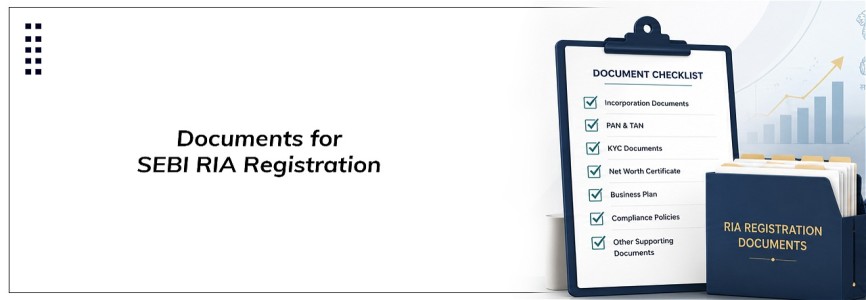
Documents are very important in the SEBI RIA Registration process because they prove the applicant’s eligibility and readiness. Educational certificates, NISM certificates, experience proof, net worth certificate, income tax records, business plan, client agreement, risk profiling format and compliance policies help SEBI verify the applicant’s background and advisory model. If documents are incomplete, outdated or incorrect, the application may face delays or queries. Therefore, applicants should prepare a complete and accurate document file before applying.
Meaning of SEBI RIA Registration
SEBI RIA Registration is a formal approval that allows a person or entity to provide investment advisory services legally in India. An investment adviser may provide advice related to securities, mutual funds, portfolio planning, asset allocation, financial planning and other investment products.
An individual can apply for RIA registration in their own name if they meet the required qualification, certification, experience and net worth criteria. A partnership firm can also apply, provided the partners and persons handling advisory work satisfy the conditions prescribed under SEBI regulations.
Similarly, an LLP or company may apply for SEBI RIA Registration. In such cases, SEBI checks not only the entity but also its principal officer, directors, partners, designated partners and persons associated with investment advice. The entity should have proper legal documents, financial strength, internal policies and a suitable advisory business model.
Why Documents Are Important for SEBI RIA Registration
Documents are important because they prove the identity, eligibility and credibility of the applicant. SEBI does not grant registration only on the basis of an application form. It verifies every major detail through supporting documents. Identity and address documents help establish who the applicant is and where the advisory business will operate from. Educational certificates and NISM certificates show whether the applicant has the required knowledge to provide investment advice. Experience documents help prove practical exposure in finance, securities market, wealth management, portfolio management or advisory work.
Financial documents such as net worth certificate, bank statement, income tax returns and financial statements help SEBI understand whether the applicant has the financial capacity to run the advisory business. Compliance documents such as client agreement, risk profiling format, suitability assessment format, conflict of interest policy and grievance redressal policy show whether the applicant is ready to follow SEBI regulations in actual practice.
Declarations and undertakings are also important because they confirm that the applicant will follow SEBI rules, avoid conflict of interest, disclose correct information and maintain proper records. In short, documents help SEBI decide whether the applicant is fit and proper to operate as a registered investment adviser.
Main Categories of Documents Required for SEBI RIA Registration
The documents required for SEBI RIA Registration can be divided into different categories. The first category is identity and address documents. These documents help verify the personal or legal identity of the applicant and the location of the advisory business. The second category is educational and certification documents. These include degree certificates, professional qualifications and NISM Investment Adviser certificates. These documents are necessary because SEBI wants investment advisers to have proper knowledge of financial products, securities market and advisory regulations.
The third category is financial documents. These documents include net worth certificate, financial statements, income tax returns, bank statements and credit reports. They help prove the financial soundness of the applicant. The fourth category is business structure documents. These are required mainly for companies, LLPs, firms and other body corporates. Incorporation certificate, MOA, AOA, LLP Agreement, partnership deed, board resolution and ownership details fall under this category.
The fifth category is compliance documents. These include business plan, client agreement, risk profiling form, suitability assessment format, conflict of interest policy, record maintenance policy and grievance redressal policy. These documents show that the applicant has a proper system to provide advisory services in a compliant way.
PAN Card of Applicant
PAN Card is one of the basic documents required for SEBI RIA Registration. It helps verify the tax identity of the applicant. For an individual applicant, the PAN Card of the individual is required. In case of a company, LLP or firm, the PAN Card of the entity is required.
Apart from the applicant, PAN Cards of directors, partners, designated partners, principal officer and persons associated with investment advice may also be required. The name mentioned on the PAN Card should match the name used in the application and other documents. Any mismatch in spelling or personal details should be corrected before filing the application.
Aadhaar Card or Identity Proof
Identity proof is required to verify the personal identity of the applicant and key persons involved in the advisory business. Aadhaar Card, passport, voter ID, driving licence and PAN Card are commonly used as identity proof documents.
For non-individual applicants, identity proof may be required for directors, partners, designated partners, principal officer, compliance officer and persons associated with investment advice. The documents should be clear and readable. If there is any change in name due to marriage or any other reason, proper supporting documents should also be attached.
Address Proof of Applicant
Address proof is required to confirm the residential address, registered office address or operational office address of the applicant. Common address proofs include Aadhaar Card, passport, voter ID, driving licence, bank statement, electricity bill, telephone bill, rent agreement, property tax receipt and ownership documents.
For an individual applicant, residential address proof and office address proof may be required. For a company or LLP, registered office proof and operational office proof may be required. If the office premises are rented, the applicant should keep rent agreement, utility bill and consent documents ready. The address proof should be recent and should match the details mentioned in the application.
Photograph of Applicant and Key Persons
Passport-size photographs may be required for individual applicants and key persons of non-individual applicants. These may include directors, partners, designated partners, principal officer, persons associated with investment advice and authorised signatory. The photograph should be recent, clear and professional. It should be used consistently in application documents, declarations and profiles wherever required.
Educational Qualification Documents
Educational qualification documents are required to prove that the applicant and advisory persons meet the qualification criteria prescribed under SEBI regulations. These documents may include degree certificates, postgraduate certificates, professional qualification certificates, mark sheets, university certificates and institute membership certificates.
The relevant education may be in finance, commerce, accountancy, economics, business management, banking, capital markets, insurance, actuarial science, financial planning, investment management or portfolio management. For an individual applicant, the applicant’s own educational documents are required. For a company or LLP, the educational documents of the principal officer and persons associated with investment advice are important. The documents should be clear and complete. If the qualification is from a foreign university or if the degree title is not directly related to finance, the applicant may need to provide an explanation or supporting proof.
NISM Investment Adviser Certification
NISM certification is one of the most important requirements for SEBI RIA Registration. Generally, applicants need NISM-Series-X-A Investment Adviser Level 1 and NISM-Series-X-B Investment Adviser Level 2 certifications, as applicable. These certificates show that the applicant has knowledge of investment advisory process, securities market, risk profiling, asset allocation, financial planning and regulatory requirements.
For an individual applicant, the individual should hold valid NISM certificates. For a company, LLP or firm, the principal officer and persons associated with investment advice should hold the required certifications. The certificates should be valid at the time of application. Expired certificates may lead to query or delay. Therefore, applicants should check the validity of NISM certificates before filing the application.
Experience Proof
Experience proof is required to show that the applicant or key persons have relevant practical exposure in investment advisory, financial planning, securities market, fund management, portfolio management, asset management, wealth management, research analysis or banking and financial services. Experience may be proved through experience certificates, appointment letters, relieving letters, salary slips, Form 16, employment contracts, client engagement letters, professional invoices, advisory assignments or self-declaration, depending on the applicant’s background.
For an individual applicant, personal experience documents are important. For a company or LLP, the experience of the principal officer and advisory persons is examined. The experience documents should clearly mention the role, duration and nature of work. Generic experience letters may not be sufficient if they do not show finance or advisory-related responsibilities.
Resume or Professional Profile
A resume or professional profile helps explain the applicant’s educational background, work experience, certifications and advisory expertise. It gives SEBI a clear view of the person’s professional journey and suitability for investment advisory services. The resume should include educational qualifications, professional certificates, previous roles, finance-related experience, advisory work, regulatory exposure and current business model.
For non-individual applicants, resumes of the principal officer, directors or partners involved in advisory activity and persons associated with investment advice may be required. The resume should not be too general. It should clearly highlight financial market experience and should match the dates and details mentioned in experience certificates and other documents.
Net Worth Certificate
A net worth certificate is a key financial document for SEBI RIA Registration. It is generally issued by a Chartered Accountant and confirms whether the applicant satisfies the prescribed net worth requirement. The certificate usually contains the name and PAN of the applicant, total assets, total liabilities, net worth calculation, date of certificate, CA details, signature and UDIN, wherever applicable. For an individual applicant, the certificate is prepared on the basis of personal assets and liabilities.
For a company or LLP, it is prepared from the books of accounts and financial statements of the entity. Supporting documents such as bank statements, investment statements, demat holding statements, property documents, loan statements and balance sheet may be used for preparing the net worth certificate. The certificate should be recent and properly calculated. Unsupported assets should not be included casually.
Financial Statements
Financial statements help SEBI check the financial position of the applicant. For a company or LLP, audited balance sheet, profit and loss account, audit report, notes to accounts, capital account and bank statements may be required. For individual applicants, income statements, asset and liability statements, bank statements, ITR records and investment holding statements may be required.
If the applicant is a newly incorporated company or LLP, provisional financial statements, CA-certified net worth statement, bank statement and capital contribution proof may be submitted. The financial statements should be signed and properly prepared. The figures mentioned in the financial statements should match the net worth certificate and other financial records.
Income Tax Returns
Income tax returns are required to verify the income profile and financial background of the applicant. They also help establish whether the applicant has been filing taxes properly. Documents may include ITR acknowledgement, computation of income, Form 26AS, Annual Information Statement and tax audit report, if applicable.
For an individual applicant, recent ITRs of the individual may be required. For a company, LLP or firm, ITRs of the entity may be required. The income tax details should match the PAN records. If the applicant has low income, no income or unusual income patterns, a proper explanation may be required.
Bank Account Proof
Bank account proof helps verify the banking details and financial operations of the applicant. A cancelled cheque, bank statement, bank certificate or bank account opening letter may be submitted. For individual applicants, the bank account should preferably be in the name of the individual applicant.
For companies and LLPs, the bank account should be in the name of the entity. A personal bank account should not be used for business fee collection of an entity applicant. The cancelled cheque should clearly show the name of the account holder, account number and IFSC code. Bank statements should be recent and readable.
CIBIL Report or Credit Report
A CIBIL report or credit report may be used to examine the financial discipline and credit behaviour of the applicant. It shows loan repayment history, defaults, settlements, written-off accounts and overall credit profile.
For individual applicants, the personal credit report may be relevant. For non-individual applicants, credit reports of the entity, promoters, directors, partners or key persons may be required depending on the facts. If there is any default, settlement or closed loan issue, the applicant should give a proper explanation with supporting documents. A clean and updated credit report helps strengthen the application.
Certificate of Incorporation
Certificate of Incorporation is required when the applicant is a company or LLP. It proves that the applicant is legally registered and validly existing. For a company, the certificate is issued by the Registrar of Companies and contains the Corporate Identity Number. For an LLP, the certificate contains the LLP Identification Number. The name on the certificate should match PAN, MCA records and other entity documents.
MOA and AOA for Company
For a company applicant, Memorandum of Association and Articles of Association are important documents. The Memorandum of Association contains the object clause of the company, while the Articles of Association contain internal management rules.
The MOA should allow the company to carry out investment advisory or financial advisory activity. If the object clause does not cover advisory services, the company may need to amend its MOA before applying. Filing an application with unrelated business objects may lead to a query.
LLP Agreement for LLP Applicant
An LLP applicant must submit its LLP Agreement. This agreement contains the business activity, partner details, capital contribution, profit-sharing ratio, management rights and authorisation clauses. The LLP Agreement should permit investment advisory or financial advisory services. If the agreement does not mention such activity, amendment may be required before filing the SEBI RIA application. The details in the LLP Agreement should also match MCA records.
Partnership Deed for Partnership Firm
A partnership firm must submit its partnership deed. The deed should mention the name of the firm, partner details, business activity, capital contribution, profit-sharing ratio and management rights.
The partnership deed should clearly permit the firm to provide investment advisory services. If the firm is registered, firm registration proof should also be attached. If the deed is old, the applicant should check whether partner details and business clauses are updated.
Board Resolution or Partner Resolution
For a company, LLP or firm, internal approval is required before applying for SEBI RIA Registration. A company usually passes a board resolution, while an LLP or partnership firm may pass partner consent or partner resolution.
The resolution authorises filing of the SEBI RIA application, appointment of authorised signatory, appointment of principal officer, submission of documents, payment of fees and execution of undertakings. The resolution should be signed properly and dated before the application filing.
Details of Directors, Partners and Designated Partners
For non-individual applicants, SEBI examines the persons who control or manage the applicant entity. Therefore, details of directors, partners and designated partners are required.
These details may include PAN, identity proof, address proof, photograph, resume, educational qualification, experience proof, DIN or DPIN details and fit and proper declaration. The information should match MCA records and internal documents of the entity. Any recent appointment or resignation should be updated before filing the application.
Principal Officer Documents
The principal officer is responsible for supervising the investment advisory activities of a non-individual applicant. SEBI checks whether the principal officer is qualified, experienced and certified.
Documents of the principal officer may include PAN Card, address proof, photograph, resume, educational qualification certificates, NISM certificates, experience proof, fit and proper declaration, appointment letter and role description. The principal officer should not be appointed only for formality. They should have actual authority and responsibility over advisory operations.
Documents of Persons Associated with Investment Advice
Persons associated with investment advice are employees or professionals who provide advice, assist in giving advice or deal with clients in relation to advisory services. Their documents are also important for SEBI RIA Registration.
The required documents may include PAN, identity proof, address proof, qualification certificate, NISM certificate, resume, experience proof, appointment letter and declaration. Every person involved in advisory activity should hold valid certification. Non-certified staff should not provide investment advice to clients.
Shareholding Pattern and Ownership Details
For companies and LLPs, ownership details help SEBI understand who owns and controls the advisory entity. Shareholding pattern, list of shareholders, promoter details, beneficial ownership details, group structure and capital contribution details may be required.
In case of LLPs, contribution ratio and profit-sharing ratio should be clear. If the applicant has group entities involved in financial services or distribution, those details should be disclosed properly. Ownership should be transparent and easy to verify.
Business Plan
A business plan explains how the applicant will provide investment advisory services after registration. It is an important document because it reflects the seriousness and preparedness of the applicant. The business plan should explain the nature of advisory services, target clients, revenue model, fee structure, client onboarding process, risk profiling process, suitability assessment method, research process, technology used, compliance mechanism, grievance handling system and record keeping process.
The business plan should be practical and regulation-friendly. It should not mention assured returns, guaranteed profits or risk-free investment advice. It should clearly show that advice will be provided in the client’s best interest.
Advisory Service Model Note
An advisory service model note explains the exact way in which advisory services will be provided. It may mention whether advice will be given online, offline or through a hybrid model. It may also explain whether the adviser will provide one-time advice, ongoing advice, financial planning, model portfolios or research-based recommendations.
This note helps remove confusion between advisory, research, execution support and distribution activity. The applicant should ensure that the model does not look like portfolio management service unless the applicant has the required registration for that activity.
Client Agreement Draft
A draft client agreement is one of the most important compliance documents for SEBI RIA Registration. It defines the legal relationship between the investment adviser and the client. The agreement should mention the scope of services, duties of adviser, duties of client, fee structure, risk disclosure, conflict of interest disclosure, confidentiality, termination clause, grievance redressal mechanism and dispute resolution clause.
It should also clearly state that investment advice does not guarantee returns. The language of the agreement should be clear and simple. It should not contain misleading promises such as fixed income, guaranteed profit or assured return.
Risk Profiling Format
Risk profiling is required to understand the risk appetite and financial condition of the client before giving investment advice. A risk profiling format helps the adviser collect important client details in a structured manner.
The form may cover age, income, financial dependents, investment objective, investment horizon, existing investments, liquidity requirement, investment experience, risk tolerance and loss-bearing capacity. This helps the adviser decide whether the client is conservative, moderate or aggressive in terms of risk. Risk profiling should not be treated as a formality. It should be properly recorded and reviewed from time to time.
Suitability Assessment Format
Suitability assessment connects the client’s risk profile with the investment advice given. It ensures that the recommendation is suitable for the client’s financial condition, objective and risk capacity. A suitability assessment format may include client risk category, investment objective, suggested product category, reason for recommendation, risk involved, time horizon and client confirmation.
For example, a high-risk investment should not be suggested to a low-risk client unless there is a strong and documented reason. This document helps prove that the adviser has given client-specific advice and not general or unsuitable recommendations.
KYC and Client Onboarding Policy
A KYC and client onboarding policy explains how the adviser will verify and onboard clients before providing advisory services. It may cover identity verification, address verification, PAN verification, risk profiling, agreement execution, fee disclosure, consent process and client communication method.
A proper onboarding policy helps ensure that no client is advised without proper documentation. It also helps maintain clear records from the beginning of the client relationship.
Conflict of Interest Policy
A conflict of interest policy explains how the applicant will identify, disclose and manage situations where personal or business interest may affect advisory independence. Conflict may arise when an adviser receives commission, recommends products of a group entity, has personal interest in recommended securities or is involved in distribution activity.
The policy should explain how such conflicts will be avoided or disclosed. This document is important because SEBI expects investment advisers to act in the best interest of clients. The policy should be customised according to the applicant’s actual business model.
Declaration Regarding Distribution Activity
SEBI requires proper separation between investment advisory and distribution activity. Therefore, applicants may need to submit declarations regarding whether they are involved in mutual fund distribution, insurance distribution, securities distribution or any other commission-based activity.
If the applicant or any group entity is involved in distribution, it should be disclosed clearly. The applicant should also explain how advisory clients will be kept separate from distribution clients. Non-disclosure of distribution activity can create serious compliance issues.
Fee Structure Document
A fee structure document explains how the investment adviser will charge clients. The fee may be fixed, hourly, annual, retainer-based or one-time consultation-based, subject to applicable SEBI norms. The fee structure should be transparent and should match the client agreement. There should be no hidden charges. Clients should clearly understand what they are paying for and how the fee will be collected.
Grievance Redressal Policy
A grievance redressal policy explains how client complaints will be received, recorded, reviewed and resolved. It may cover complaint registration, response timelines, escalation process, complaint records and communication with clients. This policy shows that the applicant has a proper system to handle client issues. A complaint register should also be maintained after registration.
Record Maintenance Policy
Investment advisers are required to maintain proper records of their advisory activity. A record maintenance policy explains how the adviser will store, protect and retrieve these records. Records may include client agreements, risk profiling forms, suitability assessments, investment advice records, client communication, invoices, payment records, complaint records, research notes and compliance documents. The records should be maintained in a safe and organised manner. Digital records should be backed up and protected from unauthorised access.
Data Privacy and Confidentiality Policy
Investment advisers collect sensitive financial information from clients. Therefore, data privacy and confidentiality are very important. The policy should explain how client data will be collected, stored, accessed, shared and protected.
It should also cover confidentiality obligations of employees, data backup, cybersecurity controls and restrictions on unauthorised sharing. Client information should not be shared without proper consent, except where required by law or regulation.
Code of Conduct
A code of conduct defines the professional behaviour expected from the investment adviser and advisory team. It should require the adviser to act honestly, fairly and in the best interest of clients.
The code should cover fair advice, proper disclosure, confidentiality, avoidance of conflict of interest, no misleading statements, no guaranteed return claims and professional communication. It should apply to all persons involved in investment advisory services.
Fit and Proper Declaration
Fit and proper declaration confirms that the applicant and key persons are suitable to operate in the securities market. It generally covers matters such as no conviction for economic offences, no fraud-related history, no regulatory ban, no insolvency, no wilful default and no serious disciplinary action. This declaration should be truthful and complete. If there is any past issue, it should be disclosed with proper explanation instead of being hidden.
Regulatory History Declaration
If the applicant, promoter, director, partner or group entity has any past or present registration with SEBI, AMFI, IRDAI, RBI, PFRDA, stock exchange or any other regulator, the details should be disclosed.
Copies of registration certificates, membership certificates, surrender letters, renewal certificates or regulatory correspondence may be required. If there has been any warning, penalty or disciplinary action, it should be explained with supporting documents.
Infrastructure Details
Infrastructure details help SEBI understand whether the applicant has the basic setup to provide investment advisory services. The applicant should explain office premises, computer systems, internet facility, research tools, financial planning tools, client record system, data storage system and compliance tracking method.
Supporting documents may include rent agreement, utility bill, office photographs, software details and IT policy. Even if the applicant operates from a small office or home office, the setup should be explained properly.
Website and Digital Platform Details
If the applicant plans to provide advisory services through a website, mobile app or digital platform, details of the platform should be provided. This may include website URL, app details, screenshots, client onboarding flow, fee payment process, risk profiling flow, terms and conditions, privacy policy and disclaimer.
The website or platform should not contain misleading claims. It should not promise guaranteed returns or risk-free investment income. All disclosures should be clear and investor-friendly.
Application Form and Fee Proof
The applicant must submit the prescribed application form along with applicable fee. Proof of payment, application acknowledgement, receipt and regulatory communication should be maintained properly. The details in the application form should match all supporting documents. If the applicant receives any query during processing, the reply and supporting documents should also be saved for future reference.
Documents Required for Individual SEBI RIA Registration
An individual applicant should generally keep the following documents ready:
-
PAN Card
-
Aadhaar Card or identity proof
-
Address proof
-
Photograph
-
Educational qualification certificates
-
NISM Level 1 and Level 2 certificates
-
Experience proof
-
Resume
-
Income Tax Returns
-
Net worth certificate
-
Bank statement
-
Cancelled cheque
-
CIBIL report
-
Business plan
-
Client agreement draft
-
Risk profiling format
-
Suitability assessment format
-
Compliance policies
-
Fit and proper declaration
-
Distribution activity declaration
-
Fee structure note
-
Grievance redressal policy
-
Record maintenance policy
Documents Required for Company SEBI RIA Registration
A company applicant should generally keep the following documents ready:
-
Certificate of Incorporation
-
PAN Card of company
-
MOA and AOA
-
MCA master data
-
Registered office proof
-
Board resolution
-
Shareholding pattern
-
Details of directors
-
PAN and address proof of directors
-
Details of principal officer
-
Qualification and NISM certificates of principal officer
-
Details of persons associated with investment advice
-
Financial statements
-
Net worth certificate
-
Bank account proof
-
Business plan
-
Client agreement draft
-
Risk profiling format
-
Suitability assessment format
-
Compliance policies
-
Conflict of interest policy
-
Distribution activity declaration
-
Fit and proper declarations
-
Regulatory history declaration
-
Website details, if applicable
-
Fee payment proof
Documents Required for LLP SEBI RIA Registration
An LLP applicant should generally prepare the following documents:
-
Certificate of Incorporation
-
PAN Card of LLP
-
LLP Agreement
-
MCA master data
-
Registered office proof
-
Partner resolution
-
Details of designated partners
-
PAN and address proof of partners
-
Contribution details
-
Principal officer documents
-
NISM certificates
-
Experience proof
-
Financial statements
-
Net worth certificate
-
Bank proof
-
Business plan
-
Client agreement draft
-
Risk profiling format
-
Suitability assessment format
-
Compliance policies
-
Conflict of interest declaration
-
Distribution activity declaration
-
Fit and proper declaration
-
Regulatory history details
Common Mistakes in SEBI RIA Documentation
One common mistake is submitting expired NISM certificates. Since certification is a key eligibility requirement, expired certificates can delay the application. Another mistake is providing weak experience proof. A generic experience letter that does not show finance or investment advisory work may not be sufficient. Applicants should provide clear documents showing relevant roles and responsibilities.
Incorrect net worth certificate is also a common issue. The certificate should be recent, properly calculated and supported by financial documents. It should include CA details and UDIN wherever applicable. Companies and LLPs often face queries when their MOA or LLP Agreement does not clearly allow investment advisory activity. Therefore, entity documents should be reviewed before application.
Applicants also make the mistake of using copy-pasted policies. Policies should match the actual advisory model. Another serious mistake is using assured return language in business plans, websites or client agreements. Investment advisers should avoid any promise of guaranteed profit or risk-free returns.
Practical Tips Before Filing SEBI RIA Application
Before filing the application, the applicant should prepare a master document folder with separate sections for identity documents, qualification documents, financial documents, entity documents, compliance policies and declarations. The validity of NISM certificates, address proofs, CA certificates and credit reports should be checked. Companies and LLPs should review their object clauses and agreements to ensure that investment advisory activity is permitted.
The applicant should also prepare customised policies instead of using generic formats. Advisory and distribution activity should be properly separated. Website content, business plan and client agreement should be reviewed to remove any misleading or guaranteed return language. All details such as name, address, PAN, qualification, experience and financial figures should match across documents. A professional review before filing can help avoid queries and improve the quality of the application.
Conclusion
SEBI RIA Registration requires detailed documentation because SEBI examines the applicant’s identity, qualification, certification, experience, financial strength, business model, infrastructure and compliance readiness. The documents help prove that the applicant is fit to provide investment advisory services in India. For individual applicants, the main focus is on personal eligibility, NISM certification, relevant experience, net worth and advisory process. For companies, LLPs and firms, the documentation is wider because it also includes incorporation documents, ownership details, principal officer documents, advisory team documents and internal compliance policies.
A properly prepared document file can reduce delays and make the registration process smoother. Any applicant planning to apply for SEBI RIA Registration should first check eligibility, collect all required documents and ensure that the advisory business model follows SEBI regulations.
Frequently Asked Questions (FAQs)
Q1. What are the main documents required for SEBI RIA Registration?
Ans. The main documents required for SEBI RIA Registration include PAN Card, address proof, identity proof, educational certificates, NISM Investment Adviser certificates, experience proof, net worth certificate, income tax returns, bank details, business plan, client agreement draft, risk profiling format, suitability assessment format, compliance policies and required declarations.
Q2. Is PAN Card mandatory for SEBI RIA Registration?
Ans. Yes, PAN Card is mandatory for SEBI RIA Registration. For an individual applicant, the PAN Card of the individual is required. For a company, LLP or firm, the PAN Card of the entity is required. PAN Cards of directors, partners, principal officer and advisory persons may also be required.
Q3. Is NISM certification required for SEBI RIA Registration?
Ans. Yes, NISM certification is required for SEBI RIA Registration. Generally, NISM-Series-X-A Investment Adviser Level 1 and NISM-Series-X-B Investment Adviser Level 2 certificates are required, as applicable. The certificates should be valid at the time of application.
Q4. Is a net worth certificate required for SEBI RIA Registration?
Ans. Yes, a net worth certificate is an important document for SEBI RIA Registration. It is generally issued by a Chartered Accountant and confirms whether the applicant meets the prescribed financial requirement. The certificate should be recent and properly supported by financial records.
Q5. What documents are required for an individual SEBI RIA applicant?
Ans. An individual applicant generally needs PAN Card, Aadhaar Card or identity proof, address proof, photograph, educational certificates, NISM certificates, experience proof, resume, income tax returns, net worth certificate, bank proof, credit report, business plan, client agreement draft, risk profiling format, suitability format and declarations.
Q6. What documents are required for a company applying for SEBI RIA Registration?
Ans. A company applicant generally needs Certificate of Incorporation, PAN Card, MOA, AOA, MCA master data, registered office proof, board resolution, shareholding pattern, financial statements, net worth certificate, bank proof, details of directors, principal officer documents, advisory team documents, compliance policies and declarations.
Q7. What documents are required for an LLP applying for SEBI RIA Registration?
Ans. An LLP applicant generally needs Certificate of Incorporation, PAN Card, LLP Agreement, MCA master data, registered office proof, partner resolution, details of designated partners, contribution details, financial statements, net worth certificate, bank proof, principal officer documents, advisory team documents, business plan, client agreement draft and compliance policies.
Q8. Is experience proof necessary for SEBI RIA Registration?
Ans. Yes, experience proof is important because SEBI checks whether the applicant or key persons have relevant practical exposure in investment advisory, financial planning, securities market, fund management, portfolio management, wealth management or related financial services.
Q9. What can be submitted as experience proof for SEBI RIA Registration?
Ans. Experience proof may include experience certificate, appointment letter, relieving letter, salary slips, Form 16, employment contract, client engagement letters, professional invoices, advisory assignment records or self-declaration, depending on the applicant’s background.
Q10. Is a business plan required for SEBI RIA Registration?
Ans. Yes, a business plan is usually required. It explains the proposed advisory services, target clients, fee structure, risk profiling process, suitability assessment, client onboarding process, compliance system, grievance redressal process and record maintenance system.


_crop10_thumb.jpg)


_crop10_thumb.jpg)


-Form_crop10_thumb.jpg)

_crop10_thumb.jpg)


_learn_crop10_thumb.jpeg)


_crop10_thumb.jpg)

_crop10_thumb.jpg)


_crop10_thumb.jpg)




_for_Foreign_Directors_learn_crop10_thumb.jpeg)


_Act,_2015_learn_crop10_thumb.jpg)










_learn_crop10_thumb.jpg)


































_crop10_thumb.jpg)

_crop10_thumb.jpg)
_(1)_crop10_thumb.jpg)








_crop10_thumb.png)








_crop10_thumb.jpg)

_crop10_thumb.jpg)







_crop10_thumb.png)
_crop10_thumb.jpg)








_crop10_thumb.png)