




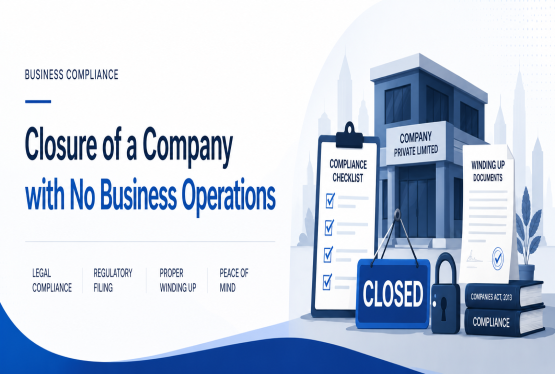
Closing a company in India is not just a business decision; it is a legal process governed by the Companies Act, 2013 and rules issued by the Ministry of Corporate Affairs. A company is treated as a separate legal entity from its shareholders and directors. Therefore, even if the business has stopped operations, the company continues to exist in the records of the Registrar of Companies until it is legally closed, struck off or wound up. Many business owners believe that simply stopping operations, closing bank accounts or discontinuing GST registration is enough to close a company. However, this is not correct. A company must complete statutory filings, clear liabilities, settle creditors, pass proper resolutions and file the prescribed forms with the MCA. If the company is not legally closed, it may continue to attract annual filing requirements, additional fees, penalties, notices and director-related compliance issues.
Company closure in India may take place through different routes depending on the condition of the company. The most common route for non-operational or inactive companies is voluntary strike off under Section 248(2) of the Companies Act, 2013 by filing Form STK-2. In other cases, closure may happen through Registrar-initiated strike off, voluntary liquidation under the Insolvency and Bankruptcy Code, 2016, or winding up by the National Company Law Tribunal under Section 271 of the Companies Act, 2013.
Meaning of Company Closure
Company closure means legally ending the existence of a company. Once the name of the company is removed from the register of companies and the company is dissolved, it cannot carry on business in its own name. Its Certificate of Incorporation becomes ineffective except for limited purposes such as payment of liabilities or realization of dues that may remain pending. In simple words, company closure is the formal process of removing a company from the MCA records after complying with the applicable legal requirements. It is different from temporary non-operation. A company may have no sales, no employees and no transactions, but unless it is struck off or wound up, it continues to exist legally.
Legal Guidelines for Company Closure in India
Company closure is mainly governed by the following provisions:
Section 248 of the Companies Act, 2013
Section 248 deals with removal of the name of a company from the register of companies. It provides two broad situations. First, the Registrar of Companies may remove the name of a company if it has failed to commence business or is not carrying on business for a prescribed period. Second, a company may voluntarily apply for removal of its name if it has extinguished all liabilities and obtained shareholders’ approval.
Section 249 of the Companies Act, 2013
Section 249 places restrictions on making an application for strike off. A company cannot apply for closure if it has, in the previous three months, changed its name, shifted its registered office from one state to another, disposed of property for value, engaged in business activity, applied to NCLT for compromise or arrangement, or is being wound up.
Section 250 of the Companies Act, 2013
Section 250 states the effect of company dissolution after publication of notice in the Official Gazette. Once the company is dissolved, it ceases to operate as a company, although liability of directors, managers, officers and members may continue and can be enforced as if the company had not been dissolved.
Section 251 of the Companies Act, 2013
Section 251 deals with fraudulent applications. If it is found that an application for removal of name was made with intent to evade liabilities, deceive creditors or defraud any person, responsible persons may be liable for action, including restoration and other consequences.
Section 252 of the Companies Act, 2013
Section 252 provides for appeal and restoration of the company’s name. If a company, member, creditor or workman is aggrieved by strike off, an appeal or application for restoration may be made before the NCLT within the applicable limitation period.
Section 271 of the Companies Act, 2013
Section 271 covers circumstances in which a company may be wound up by the Tribunal. This route is different from simple strike off and applies in serious cases such as fraudulent conduct, default in financial statements or annual returns for five consecutive financial years, special resolution for winding up by Tribunal, or where the Tribunal considers it just and equitable.
Companies (Removal of Names of Companies from the Register of Companies) Rules, 2016
These Rules prescribe the procedural requirements for strike off, including Form STK-2, notices, indemnity bond, statement of accounts, affidavits and publication process.
Recent Update: C-PACE for Faster Company Closure
A major recent update in company closure is the introduction of C-PACE, which stands for Centre for Processing Accelerated Corporate Exit. It was introduced to centralize and speed up voluntary strike off applications filed under Section 248(2). Earlier, such applications were handled by jurisdictional Registrars of Companies. Now, voluntary strike off applications are processed through C-PACE. This update has made the closure process more structured and centralized. It has also reduced the time involved in processing voluntary closure applications. Companies applying for closure must now ensure that documents are accurate, pending filings are completed and liabilities are cleared before filing Form STK-2.
Types of Company Closure in India
There are different methods of closing a company in India. The correct route depends on the company’s status, liabilities and business condition.
Voluntary Strike Off by Company
Voluntary strike off is the most common method for closing a private limited company that is inactive, non-operational or has no business activity. Under Section 248(2), a company may apply to remove its name from the register after clearing all liabilities and obtaining approval from shareholders. This method is suitable for companies that have no assets, no liabilities, no ongoing litigation and no business operations. The company must pass a board resolution and special resolution or obtain consent of 75% members in terms of paid-up share capital.
Strike Off by Registrar of Companies
The Registrar may initiate strike off under Section 248(1) if the company has not commenced business within one year of incorporation or has not carried on business for two immediately preceding financial years and has not applied for dormant status. Before striking off the name, the Registrar issues notice to the company and its directors. The company is given an opportunity to respond. If no valid objection is received, the Registrar may proceed with removal of name.
Voluntary Liquidation
Voluntary liquidation is generally used when a solvent company wants to close after settling all liabilities. It is governed under the Insolvency and Bankruptcy Code, 2016 and related regulations. This route is more formal than strike off and usually involves appointment of an insolvency professional as liquidator. Voluntary liquidation is preferred where the company has assets, creditors, business operations or a more detailed settlement process. It is not as simple as STK-2 strike off.
Winding Up by Tribunal
Winding up by Tribunal is a legal process before the NCLT. It may apply where the company has acted fraudulently, defaulted in statutory filings for five consecutive financial years, passed a special resolution for winding up by Tribunal, or where the Tribunal considers winding up just and equitable. This process is more complex and time-consuming than voluntary strike off. It is generally not used for simple inactive companies.
Eligibility for Voluntary Strike Off
A company may apply for voluntary strike off if it satisfies the following conditions:
-
The company has no active business operations.
-
The company has extinguished all liabilities.
-
The company has no pending litigation.
-
The company has no pending statutory dues.
-
The company has completed applicable annual filings.
-
The company has closed or settled bank accounts.
-
The company has obtained shareholder approval.
-
The company has no ongoing inspection, inquiry or investigation.
-
The company is not listed.
-
The company is not governed by any special restriction.
Companies Not Eligible for Strike Off
A company cannot generally apply for strike off if:
-
It changed its name in the last three months.
-
It shifted registered office from one state to another in the last three months.
-
It disposed of property for value in the last three months, except in ordinary course.
-
It carried on business activity in the last three months.
-
It has filed an application for compromise or arrangement.
-
It is being wound up.
-
It has pending loans, creditors or statutory dues.
-
It has pending prosecution or regulatory proceedings.
-
It has not completed mandatory filings, wherever applicable.
-
It is a listed company or a company restricted under rules.
Documents Required for Company Closure
The documents required for voluntary strike off are generally as follows:
-
Board resolution approving closure.
-
Special resolution or consent of 75% shareholders.
-
Form STK-2.
-
Indemnity bond in Form STK-3.
-
Affidavit in Form STK-4.
-
Statement of accounts.
-
No liability declaration.
-
Copy of latest financial statements.
-
Copy of latest annual return, if applicable.
-
PAN of company.
-
Certificate of Incorporation.
-
Bank account closure letter or bank statement.
-
Consent of creditors, if applicable.
-
NOC from regulatory authority, if applicable.
-
Digital Signature Certificate of authorized director.
-
Professional certification by CA, CS or CMA.
-
Income tax, GST or other tax closure proof, where applicable.
-
Details of pending litigation, if any.
-
Authorization letter for professional filing.
Process for Company Closure in India
Step 1: Review Company Status
Before applying for closure, the company must review its legal and financial status. This includes checking whether the company has any assets, liabilities, bank balances, loans, creditors, debtors, tax dues, pending notices, prosecutions or annual filing defaults. A company with pending liabilities should not directly file for strike off. All dues must be settled before filing the application.
Step 2: Complete Pending Annual Filings
The company should check whether Form AOC-4 and Form MGT-7 or MGT-7A are pending. In many cases, pending annual filings create practical issues during closure. The company should regularize its compliance before applying for closure. If the company never commenced business, the filing requirement may depend on the facts and MCA status. Professional review is recommended before filing STK-2.
Step 3: Clear Liabilities
All liabilities must be extinguished before filing voluntary strike off. This includes trade creditors, employee dues, statutory dues, tax dues, bank loans, unsecured loans, director loans and any other outstanding obligation. Directors must ensure that the closure application is not filed to avoid payment of dues. If closure is obtained fraudulently, directors and officers may remain personally liable.
Step 4: Close Bank Account
The company should close its current account or ensure that there is no balance except for limited closure-related requirements. A bank closure letter or final bank statement is generally kept as supporting proof.
Step 5: Prepare Statement of Accounts
A statement of accounts is required showing that the company has no assets and no liabilities. It must be prepared up to a date not older than the prescribed period before filing and certified by a Chartered Accountant. This document is very important because it confirms the financial position of the company at the time of closure.
Step 6: Hold Board Meeting
The Board of Directors must pass a resolution approving the closure of the company and authorizing one director to make the application. The board may also approve calling of an extraordinary general meeting for shareholder approval.
Step 7: Obtain Shareholder Approval
The company must pass a special resolution or obtain consent of members holding 75% of paid-up share capital. This approval confirms that the shareholders agree to remove the company’s name from the register. Where a special resolution is passed, Form MGT-14 may be required depending on the nature of resolution and company category.
Step 8: Prepare Affidavit and Indemnity Bond
Every director must execute an affidavit in Form STK-4 confirming that the company has no dues and that the information given is true. An indemnity bond in Form STK-3 is also required to indemnify authorities against future claims. These documents are critical because they create personal responsibility on directors for the correctness of the closure application.
Step 9: File Form STK-2
Form STK-2 is filed with the MCA along with prescribed attachments and government fee. The form is digitally signed by the authorized director and certified by a practicing professional. The application is processed through C-PACE. If any discrepancy is found, resubmission or clarification may be required.
Step 10: Public Notice and Objection Period
After review, notice is issued inviting objections from stakeholders. Tax authorities and other regulators may also be informed. If no objection is received within the prescribed period, the process moves forward.
Step 11: Final Strike Off and Dissolution
After completion of the process, the name of the company is removed from the register and notice is published in the Official Gazette. From the date mentioned in the notice, the company stands dissolved. However, dissolution does not automatically remove liability of directors, officers or members for past acts, fraud, dues or misstatements.
Important Compliance Points Before Closure
A company should not file for closure casually. The directors should first check whether there are any pending statutory dues, GST returns, income tax demands, TDS defaults, PF/ESI dues, professional tax, labour law dues or contractual obligations. The company should also review whether there are any pending legal cases, vendor claims, employee disputes or government notices. If any such issue exists, it should be settled before filing STK-2. If the company has GST registration, it should apply for GST cancellation and file final returns as applicable. If the company has IEC, shops and establishment registration, MSME registration, FSSAI license or other registrations, those should also be closed or surrendered wherever required.
Effect of Company Closure
Once the company is struck off and dissolved, it ceases to exist as a legal entity. It cannot enter contracts, operate bank accounts, own property, issue invoices, appoint employees or carry on business. However, the liability of directors, managers, officers and members continues and may be enforced as if the company had not been dissolved. This means closure cannot be used as a tool to escape liability. If any fraud, misrepresentation or unpaid liability is discovered later, the company may be restored by order of NCLT.
Restoration of Closed Company
A struck off company may be restored under Section 252. An appeal may be filed before the NCLT by the company, member, creditor or workman if the strike off was improper or if restoration is necessary in the interest of justice. Once restored, the company is deemed to have continued in existence as if its name had not been struck off. The company may then be required to complete pending filings and compliances.
Difference Between Strike Off and Winding Up
Strike off is suitable for inactive companies with no assets and liabilities. It is a simpler, faster and less expensive process. Winding up is a more detailed legal process generally used where there are assets, liabilities, disputes, creditors or regulatory issues. Strike off removes the company’s name from the register, while winding up involves realization of assets, settlement of liabilities and distribution of surplus. Therefore, every company should choose the correct closure route based on its facts.
Professional Certification and Responsibility
Form STK-2 must be certified by a professional such as a Chartered Accountant, Company Secretary or Cost Accountant in practice. The professional checks the documents, financial position and legal compliance before certification. Directors should provide complete and accurate information to the professional. Any false declaration may result in legal consequences.
Common Mistakes in Company Closure
Many companies face delays or rejection because of avoidable mistakes. Common mistakes include filing STK-2 without clearing liabilities, not completing annual filings, mismatch in financial statements, non-closure of bank account, incorrect affidavits, missing shareholder approval, pending tax dues and wrong attachments. Another common mistake is assuming that a non-operational company does not require compliance. Until the company is legally closed, annual compliance obligations continue.
Conclusion
Company closure in India is a structured legal process and must be handled carefully. For inactive and debt-free companies, voluntary strike off under Section 248(2) through Form STK-2 is usually the most practical route. However, the company must first clear liabilities, complete pending filings, prepare proper documents, obtain shareholder approval and submit the application through the MCA system. The introduction of C-PACE has made voluntary company closure faster and more centralized, but documentation accuracy remains very important. Directors must ensure that the closure application is not filed to avoid debts, taxes or legal obligations. Even after dissolution, the liabilities of directors, officers and members may continue for past acts.
A properly planned closure helps business owners avoid future penalties, notices and unnecessary compliance burden. Therefore, before closing a company, it is advisable to conduct a complete legal, financial and tax review and follow the correct process under the Companies Act, 2013. Compliance Calendar LLP assists businesses in managing company closure, ROC filings, documentation and legal compliance in a smooth and professional manner.
Frequently Asked Questions (FAQs)
Q1. What is company closure in India?
Ans. Company closure means legally ending the existence of a company by removing its name from the register of companies. It must be done through the MCA process. Simply stopping business does not close the company.
Q2. Which form is used for voluntary strike off?
Ans. Form STK-2 is used for voluntary strike off under Section 248(2) of the Companies Act, 2013. It is filed with the prescribed documents and government fee. The form is processed through C-PACE.
Q3. Can a company be closed without annual filing?
Ans. In many cases, pending filings may create issues in closure. The company should check and complete applicable AOC-4 and MGT-7/MGT-7A filings before applying. A professional review is recommended.
Q4. Can a company with liabilities apply for strike off?
Ans. No, a company should not apply for voluntary strike off unless all liabilities are cleared. The directors must declare that the company has extinguished all liabilities. False declaration can lead to legal action.
Q5. Is shareholder approval required for company closure?
Ans. Yes, shareholder approval is required. The company must pass a special resolution or obtain consent of members holding 75% of paid-up share capital. This approval is attached with the closure application.
Q6. What is C-PACE?
Ans. C-PACE means Centre for Processing Accelerated Corporate Exit. It is a centralized processing centre for voluntary strike off applications. It was introduced to make company closure faster and more efficient.
Q7. How long does company closure take?
Ans. The time may vary depending on documentation, resubmission, objections and department processing. After C-PACE, voluntary closure has become faster than the earlier system. However, accurate documentation is still necessary.
Q8. Can a closed company be restored?
Ans. Yes, a struck off company can be restored by order of NCLT under Section 252. Restoration may be sought by the company, member, creditor or workman. Once restored, the company is treated as continuing in existence.
Q9. Are directors liable after company closure?
Ans. Yes, directors and officers may remain liable for past acts, dues, fraud or false declarations. Closure does not protect directors from genuine claims or legal consequences.
Q10. What is the difference between strike off and winding up?
Ans. Strike off is used for inactive companies with no assets and liabilities. Winding up is a more detailed legal process used where there are assets, liabilities, disputes or serious legal grounds. The correct route depends on the company’s condition.


_crop10_thumb.jpg)


_crop10_thumb.jpg)


-Form_crop10_thumb.jpg)

_crop10_thumb.jpg)


_learn_crop10_thumb.jpeg)


_crop10_thumb.jpg)

_crop10_thumb.jpg)


_crop10_thumb.jpg)




_for_Foreign_Directors_learn_crop10_thumb.jpeg)


_Act,_2015_learn_crop10_thumb.jpg)








_learn_crop10_thumb.jpg)





















_crop10_thumb.jpg)

_crop10_thumb.jpg)
_(1)_crop10_thumb.jpg)








_crop10_thumb.png)










_crop10_thumb.jpg)


_crop10_thumb.jpg)







_crop10_thumb.png)
_crop10_thumb.jpg)







_crop10_thumb.png)







_crop10_thumb.jpg)
