


The private security industry in India has grown rapidly due to increasing demand for guards, supervisors, bouncers, personal security staff, event security, corporate security, industrial security and residential security services. However, no person or business can legally run a private security agency in India without obtaining a PSARA License. PSARA stands for the Private Security Agencies Regulation Act, 2005. This law regulates private security agencies and ensures that only eligible, verified and trained agencies are allowed to provide security services.
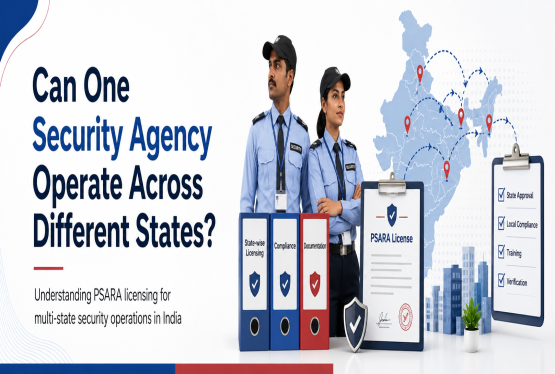
The most important thing to understand is that PSARA licensing is state-wise. This means a security agency cannot take one licence and operate anywhere in India. The licence is granted by the Controlling Authority of the concerned State or Union Territory. If an agency wants to operate in Delhi, Haryana and Uttar Pradesh, it must obtain licence approval as per the rules applicable in those respective States. Some States allow district-wise, division-wise or whole-State licence coverage depending on the local rules and fee structure. The purpose of PSARA is not only to issue a licence but also to regulate the conduct, training, background verification, uniform, supervision and record maintenance of private security agencies. The law protects public interest and ensures that private security agencies do not misuse their position or employ unverified persons.
Meaning of PSARA License
A PSARA License is a legal permission issued to a private security agency to carry on the business of providing security services. These services may include deployment of security guards, security supervisors, armed or unarmed guards, personal security staff, event security, office security, residential security, industrial security and security-related manpower services. The licence is mandatory before starting operations. Even if a company is registered under the Companies Act or an LLP is registered under the LLP Act, it cannot start private security services unless it has a PSARA License. Company registration and PSARA License are different legal requirements. Company registration only creates a business entity, while PSARA License authorises that entity to provide security services.
Legal Framework Governing PSARA License
The main law governing private security agencies is the Private Security Agencies Regulation Act, 2005. This Act applies across India and provides the basic legal structure for licensing, eligibility, training, renewal, cancellation and compliance. Under the Act, every State Government appoints a Controlling Authority to process applications and grant licences. The State Government also frames rules for implementation of the Act. Therefore, while the central law remains common, the practical process may differ from State to State. For example, the documents, police verification format, training institute requirements, online portal process, government fee and timeline may vary depending on the State. The Central Model Rules provide general guidance on training standards, forms, verification and operational requirements. Many States have adopted similar rules with local modifications.
Why PSARA License is State-wise
PSARA licensing is state-wise because law and order is mainly administered at the State level. Security agencies directly deal with public safety, manpower verification, local police coordination and deployment of guards at various locations. Therefore, each State has its own Controlling Authority to verify the background, documents and operational capacity of the applicant. A licence granted in one State does not automatically authorise operations in another State. For example, a PSARA License obtained in Rajasthan does not allow the agency to deploy guards in Maharashtra unless the agency also obtains permission for Maharashtra. This makes state-wise compliance very important for agencies working across multiple locations.
Who Needs PSARA License?
Any person, firm, LLP, partnership firm, private limited company, one person company or other business entity planning to provide private security services must obtain a PSARA License. The licence is required before offering or advertising security guard services. The requirement applies to agencies providing guards to offices, factories, housing societies, malls, hospitals, schools, colleges, warehouses, hotels, events, construction sites and personal security assignments. Even if the agency deploys only a small number of guards, licence is still required. A business that only hires guards for its own internal security generally does not require a PSARA License. However, if it supplies guards or security manpower to another person or business for commercial consideration, PSARA License becomes necessary.
Eligibility for PSARA License
The applicant must satisfy legal, financial, character and operational eligibility conditions before applying for a licence. The basic eligibility requirements are:
- The applicant must be an Indian citizen, company, LLP, partnership firm, proprietorship firm or association legally allowed to do business in India.
- The applicant entity should be properly registered under applicable law, such as the Companies Act, LLP Act, Partnership Act or Shops and Establishment law, as applicable.
- The promoters, directors, partners or proprietor should not have been convicted for offences involving moral turpitude, fraud, violence, national security, money laundering or serious criminal conduct.
- The applicant should not have links with any organisation banned under law or involved in activities against national security or public order.
- The applicant should be financially sound enough to operate a security agency and pay salaries, statutory dues and operational expenses.
- The applicant should have a proper office address in the State where licence is being applied for.
- The applicant should enter into an agreement or Memorandum of Understanding with a recognised security training institute, wherever required under State rules.
- The agency should be capable of providing proper training to guards and supervisors before deployment.
- The applicant should be compliant with labour laws, minimum wages, provident fund, ESI and other employment-related obligations, wherever applicable.
- The agency should maintain proper records of guards, supervisors, clients, training, verification, wages and deployment.
- The name of the agency should not be misleading, offensive or similar to any government, police, military or public authority name.
State-wise PSARA Licensing Process
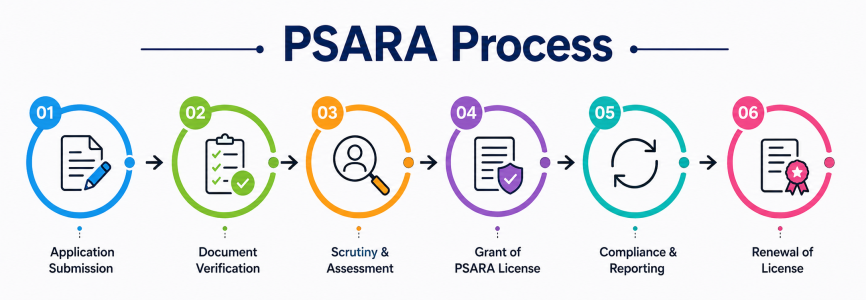
The PSARA licensing process generally follows a similar structure across India, but each State may have its own portal, fee, format and verification method. The applicant must always check the rules of the State where operations are planned.
Step 1: Decide the State and Area of Operation
The first step is to decide in which State the agency wants to operate. If the agency wants to operate in one district, the application may be limited to that district if the State allows such category. If the agency wants to operate in the entire State, it must apply accordingly and pay the applicable fee. Some States provide licence options based on one district, multiple districts or whole State. The applicant must choose the correct jurisdiction because operating outside the approved area may be treated as non-compliance.
Step 2: Register the Business Entity
Before applying for a PSARA License, the applicant should have a legally registered business structure. It may be a proprietorship, partnership firm, LLP, private limited company or one person company. For better credibility, many agencies prefer LLP or private limited company registration. The business object should include security services, manpower supply, private security agency services or related activities. If the object clause does not support security business, amendment may be required before filing the PSARA application.
Step 3: Arrange Basic Registrations
The applicant should arrange basic business registrations such as PAN, TAN, GST registration if applicable, Shops and Establishment registration, professional tax registration where applicable, PF and ESI registration depending on employee strength, and bank account details. These registrations help prove that the agency is a genuine business entity and is ready to comply with employment and tax laws.
Step 4: Prepare Documents
The applicant must collect all required documents before filing the application. Incomplete documents are one of the most common reasons for delay or objection. The documents must be accurate, updated and properly signed. The Controlling Authority may ask for entity documents, identity proof, address proof, office proof, affidavit, undertaking, police verification forms, training agreement and financial documents.
Step 5: Training Institute Agreement
A private security agency is required to ensure proper training of guards and supervisors. Many States require the applicant to enter into an agreement or MOU with a recognised training institute. This training covers physical security, fire safety, crowd control, access control, identification of suspicious objects, basic legal knowledge, conduct with public, emergency response and discipline. The purpose is to ensure that guards are not deployed without basic professional training.
Step 6: Filing Application before State Controlling Authority
The application is filed before the Controlling Authority of the concerned State or Union Territory. In many States, the process is online through a State portal or the PSARA licensing portal. In some cases, physical submission may also be required. The applicant must fill in details of the entity, owners, directors or partners, area of operation, office address, training arrangement, staff details and other declarations. Government fee must be paid as per the licence category.
Step 7: Police Verification
Police verification is one of the most important parts of PSARA licensing. The background of the proprietor, directors, partners, key managerial persons and sometimes other responsible persons is verified by the police. The police may verify criminal records, residential address, office address, reputation, local references and other relevant details. If there is an adverse police report, the application may be rejected or kept pending until clarification is provided.
Step 8: Scrutiny by Controlling Authority
After police verification, the Controlling Authority examines the application and documents. The authority checks whether the applicant satisfies eligibility conditions, whether documents are complete, whether the training agreement is valid, and whether there are any legal objections. If there is any deficiency, the authority may raise a query or ask for additional documents. The applicant must respond within the prescribed time.
Step 9: Grant of PSARA License
If the Controlling Authority is satisfied, the PSARA License is granted for the approved area. The licence mentions the name of the agency, address, licence number, validity period and area of operation. Once the licence is issued, the agency can start operations only within the approved State or area. The agency must follow all conditions mentioned in the licence and applicable State rules.
Step 10: Post-License Compliance
Obtaining the licence is not the end of compliance. The agency must maintain records, train guards, follow labour laws, issue identity cards, ensure police verification of employees, maintain registers and comply with inspection requirements. Any violation can lead to suspension or cancellation of licence.
Documents Required for PSARA License
The required documents may vary from State to State, but commonly include certificate of incorporation or registration certificate, MOA and AOA in case of company, LLP agreement in case of LLP, partnership deed in case of partnership firm, PAN card, GST certificate if applicable, address proof of registered office, rent agreement or ownership proof, utility bill, photographs of directors or partners, identity proof, address proof, police verification forms, affidavit, undertaking, training institute agreement, financial documents, labour registration documents and details of employees. The applicant may also need to submit an affidavit stating that the promoters are not convicted, not involved in anti-national activities, not disqualified under PSARA and will comply with the Act and State rules.
State-wise Differences in PSARA Process
Although the basic law is the same, each State may have different operational requirements. Some States have fully online filing, while others may require physical documents. Some States require district-level police verification, while others process it through the Home Department or Police Commissioner office. The government fee may also differ depending on whether the licence is for one district, multiple districts or the whole State. The documentation format and affidavit language may also differ. Therefore, applicants should not use a single standard checklist blindly for every State.
For example, Delhi, Haryana, Uttar Pradesh, Maharashtra, Gujarat, Rajasthan, Karnataka, Tamil Nadu, Telangana, West Bengal and other States may have their own State rules and administrative practices. If an agency wants multi-State operations, it should prepare a separate compliance plan for every State.
Validity and Renewal of PSARA License
A PSARA License is generally valid for a prescribed period as per the Act and State rules. The agency must apply for renewal before expiry. Renewal should not be delayed because operating after expiry may be treated as operating without a valid licence. For renewal, the authority may ask for existing licence copy, compliance records, guard details, training records, police verification status, labour law compliance, tax records and updated documents of the entity. If there were violations during the licence period, renewal may become difficult.
Conditions After Getting PSARA License
After receiving the licence, the agency must follow several legal conditions. It must employ only eligible guards and supervisors, ensure training, issue identity cards, maintain proper records, follow uniform rules, submit information when asked by authorities, and cooperate during inspections. The agency should not misrepresent itself as police, army or government authority. Guards should not use uniforms similar to armed forces, police or paramilitary forces. The agency should also ensure that guards behave professionally with the public and clients.
Labour Law Compliance for Security Agencies
PSARA compliance is closely connected with labour law compliance. A security agency usually employs multiple guards and supervisors, so it must comply with minimum wages, payment of wages, provident fund, ESI, bonus, gratuity, leave rules, working hours and other employment obligations. Non-payment of wages or statutory dues can create legal risk and may affect licence renewal. Clients also prefer agencies that comply with labour laws because non-compliance may create liability for the client as principal employer.
Police Verification of Guards
Security guards are placed at sensitive locations such as offices, societies, warehouses, factories and events. Therefore, their background verification is very important. Agencies should verify identity, permanent address, present address, previous employment, criminal record and references before deployment. Many States require police verification of guards. Even where it is not strictly demanded at the initial stage, maintaining verification records is a good compliance practice.
Training Requirements for Guards
Training is a core requirement under PSARA. Guards should be trained in basic security duties, access control, patrolling, visitor management, emergency response, fire safety, crowd management, discipline, communication and legal limitations. Security supervisors should also understand supervision, reporting, incident handling, client coordination, record keeping and deployment management. A trained guard improves service quality and reduces legal risk.
Refusal, Suspension and Cancellation of License
The Controlling Authority may refuse a licence if the applicant is not eligible, documents are false, police verification is adverse, or the applicant is connected with unlawful activities. The authority may also suspend or cancel an existing licence if the agency violates licence conditions, employs unverified guards, submits false information, misuses uniform, operates outside permitted area or acts against public interest. Before cancellation, the agency is generally given an opportunity to explain, unless immediate action is required in public interest. Once cancelled, the agency may face difficulty in obtaining a fresh licence.
Penalty for Operating Without PSARA License
Operating a private security agency without a valid PSARA License is a serious legal violation. The agency may face penalty, prosecution, closure of business operations and reputational damage. Clients may also refuse to continue contracts with an unlicensed agency. Therefore, no agency should start security deployment before receiving the licence. Even advertising services without licence may create compliance risk if it shows intention to operate illegally.
Practical Tips for Smooth State-wise PSARA Licensing
A private security agency should first identify the exact State and districts where it wants to operate. It should keep its business object clear, maintain a proper office address, prepare all documents carefully and complete police verification requirements on time. The agency should also select a valid training institute, maintain labour law registrations, prepare affidavits properly and respond quickly to authority queries. For multi-State expansion, it should prepare a separate document checklist for each State.
Conclusion
PSARA State-wise Licensing is a mandatory legal requirement for every private security agency in India. The licence is not a one-time formality; it is a complete regulatory approval that checks the background, eligibility, training capacity and operational readiness of the agency.
Since PSARA is implemented through State Controlling Authorities, every agency must understand the rules of the State where it wants to operate. A licence in one State does not automatically allow business in another State. Proper documentation, police verification, training arrangement and labour compliance are essential for approval. For security agencies, PSARA compliance builds trust, improves client confidence and protects the business from penalties. A legally licensed agency can grow professionally, work with corporate clients and expand across States with better credibility.
FAQs
Q1: What is PSARA License?
Ans. PSARA License is a legal permission required to run a private security agency in India. It is issued under the Private Security Agencies Regulation Act, 2005. Without this licence, an agency cannot legally provide security guards or security services to clients.
Q2: Is PSARA License required in every State?
Ans. Yes, PSARA License is state-wise. If an agency wants to operate in more than one State, it must apply for licence approval in each concerned State or Union Territory. A licence issued in one State is not automatically valid in another State.
Q3: Who issues PSARA License?
Ans. PSARA License is issued by the Controlling Authority appointed by the concerned State Government or Union Territory administration. The authority reviews the application, documents, police verification report and eligibility before granting the licence.
Q4: Can a company start security services without PSARA License?
Ans. No, a company cannot start private security services without obtaining a valid PSARA License. Company registration only creates the legal entity. PSARA License gives legal permission to provide security agency services.
Q5: What documents are required for PSARA License?
Ans. Common documents include business registration proof, PAN, GST certificate if applicable, office address proof, identity and address proof of directors or partners, photographs, police verification forms, affidavit, undertaking and training institute agreement. State-specific documents may also be required.
Q6: Is police verification mandatory for PSARA License?
Ans. Yes, police verification is an important part of the PSARA licensing process. The background of the applicant, directors, partners or key persons is verified. In many States, guard verification is also required before deployment.
Q7: Can one PSARA License be used across India?
Ans. No, one PSARA License cannot be used across India unless the applicable law and authority specifically allow such coverage, which is not the usual practice. Generally, the agency must obtain licence State-wise and operate only in the approved area.
Q8: What is the role of a training institute in PSARA License?
Ans. A training institute helps train security guards and supervisors as per PSARA requirements. Many States require the applicant to have an agreement with a recognised training institute before licence approval. Training ensures guards understand security duties and emergency response.
Q9: What happens if an agency operates without PSARA License?
Ans. Operating without PSARA License can lead to penalty, prosecution, business closure, cancellation of contracts and reputational loss. It may also create legal problems for clients who hire unlicensed security agencies.
Q10: When should PSARA License be renewed?
Ans. PSARA License should be renewed before its expiry as per the State rules. The agency should start renewal preparation in advance and keep compliance records, training records, police verification details and labour law documents ready.


_crop10_thumb.jpg)


_crop10_thumb.jpg)


-Form_crop10_thumb.jpg)

_crop10_thumb.jpg)


_learn_crop10_thumb.jpeg)


_crop10_thumb.jpg)

_crop10_thumb.jpg)


_crop10_thumb.jpg)




_for_Foreign_Directors_learn_crop10_thumb.jpeg)


_Act,_2015_learn_crop10_thumb.jpg)








_learn_crop10_thumb.jpg)

































_crop10_thumb.jpg)


_crop10_thumb.jpg)
_(1)_crop10_thumb.jpg)








_crop10_thumb.png)













_crop10_thumb.jpg)


_crop10_thumb.jpg)







_crop10_thumb.png)

_crop10_thumb.jpg)









_crop10_thumb.png)