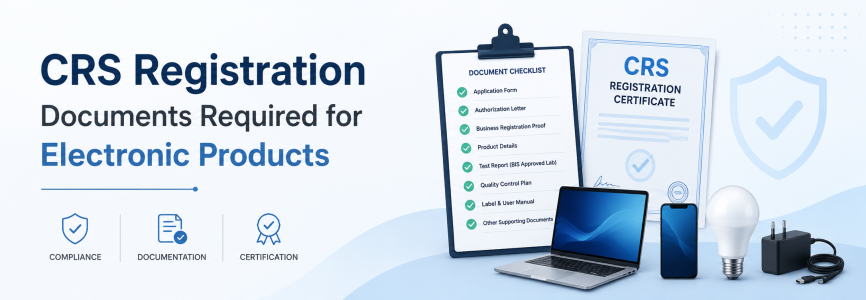



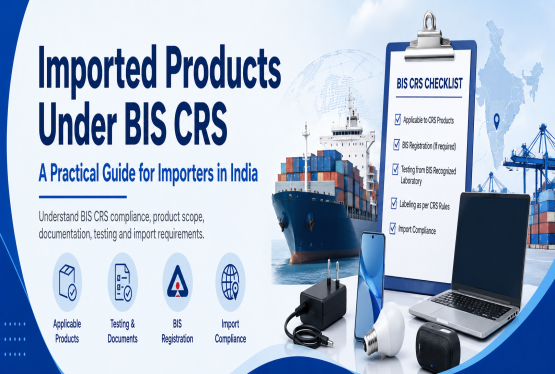
Electronic products are used everywhere today, from homes and offices to factories, shops and online marketplaces. Because these products directly affect consumer safety, the Government of India has made BIS CRS Registration mandatory for several electronic and IT products. CRS stands for Compulsory Registration Scheme. It is operated by the Bureau of Indian Standards. Under this scheme, notified electronic products must follow the relevant Indian Standard before they are manufactured, imported, sold or distributed in India. BIS states that manufacturers of notified products must get their product tested from a BIS-recognised laboratory and then apply for registration.
For businesses, one of the most important parts of CRS Registration is documentation. If the documents are incomplete, incorrect or mismatched, the application may face delay, query or rejection. This article explains the main documents required for CRS Registration for electronic products in simple words.
What is CRS Registration?
CRS Registration is a product compliance approval under BIS for notified electronic and IT products. It is based on self-declaration of conformity. This means the manufacturer declares that the product conforms to the applicable Indian Standard after testing from a BIS-recognised lab. The scheme mainly covers electronic and IT goods notified by the Ministry of Electronics and Information Technology. BIS lists these products under Scheme II, also called the Registration Scheme. Examples of products covered under CRS include laptops, mobile phones, power banks, LED products, printers, scanners, CCTV cameras, adapters and other notified electronic products. The exact applicability depends on the product category and Indian Standard.
Why Documents Matter in CRS Registration
Documents are the backbone of the CRS application. BIS checks the manufacturer details, factory address, product details, brand details, test report, authorised signatory details and other supporting records. Even a small mismatch in name, address, model number or brand name can create a problem. For example, if the factory address in the test report is different from the address in the business license, BIS may raise a query.
Basic Documents Required for CRS Registration
The following documents are generally required for CRS Registration of electronic products:
1. Business License of Manufacturer
A valid business license of the manufacturer is required. This document proves that the manufacturing unit legally exists. For Indian manufacturers, documents like Certificate of Incorporation, GST registration, factory license or other business registration documents may be used. For foreign manufacturers, business registration certificate, company registration certificate or factory registration documents may be required.
2. Factory Address Proof
The factory address proof is needed to confirm the actual place where the product is manufactured. The address should be clear and complete. Common documents include factory license, utility bill, lease deed, ownership document or government-issued registration proof.
3. Test Report from BIS-Recognised Lab
This is one of the most important documents for CRS Registration. The electronic product must be tested from a BIS-recognised laboratory as per the applicable Indian Standard. As per the BIS CRS registration process, the applicant has to generate a test request, get the product tested from a BIS-recognised lab, verify the test report and apply on the portal using the verified test report within 90 days of its issue. The test report should contain correct details such as product name, model number, brand name, manufacturer name, factory address, Indian Standard and test results.
4. Product Details
Detailed product information is required for CRS Registration. This helps BIS identify the product and its technical features.
Product details may include:
- Product name
- Model number
- Brand name
- Rated voltage
- Rated current
- Power rating
- Product category
- Indian Standard number
- Series model details, if applicable
All product details should match with the test report.
5. Brand Authorization Letter
If the brand owner and manufacturer are different, a Brand Authorization Letter is required.
For example, if a foreign manufacturer is manufacturing electronic products under an Indian brand name, the brand owner must authorise the manufacturer to use the brand for CRS Registration. The letter should be properly signed and should mention the brand name, product category and manufacturer details.
6. Trademark Certificate or Brand Proof
BIS may require proof of brand ownership or brand use. This may include a trademark registration certificate, trademark application acknowledgement or brand authorization document. The brand name mentioned in the application should match the test report and product marking.
7. Authorization Letter for Indian Representative
For foreign manufacturers, an Authorized Indian Representative is required. The AIR acts as the local representative for BIS-related communication and compliance. An authorization letter must be issued by the foreign manufacturer in favour of the Indian representative. The AIR details should be accurate because BIS may communicate with the AIR during and after registration.
8. Identity and Address Proof of Authorized Signatory
The person signing the application must provide identity and address proof. This may include PAN, Aadhaar, passport or other valid identification documents. For foreign applicants, passport details and other identity documents may be required. The authorised signatory should have proper authority to sign documents on behalf of the company.
9. Undertaking and Affidavit
Certain undertakings and affidavits may be required as part of the CRS application. These documents confirm that the applicant will follow BIS rules, maintain product conformity and use the Standard Mark as per applicable conditions.
10. Nomination Form
In case of foreign manufacturers, a nomination form for the Authorized Indian Representative may be required. This form confirms that the AIR will be responsible for communication and compliance in India.
11. Product Label or Marking Details
Product marking details are also important. The product label should usually include details such as brand name, model number, rating, manufacturer details and other required markings. After registration, the BIS registration number must be marked on the product as per BIS guidelines.
12. User Manual or Technical Manual
For many electronic products, a user manual or technical manual may be required. It helps understand the product features, safety instructions, usage conditions and technical specifications.
13. Circuit Diagram or Technical Construction File
Depending on the product, technical documents such as circuit diagram, PCB layout, critical component list or construction details may be required. These documents help the lab and BIS understand the product design and safety aspects.
14. Critical Component List
For electronic products, critical components play an important role in safety testing. Components like power supply units, batteries, adapters, cables, fuses, switches and transformers may be checked. The critical component list should match the tested sample. If components change later, the manufacturer may need to follow BIS rules for change or update.
15. ISO Certificate, If Available
An ISO certificate is not always mandatory for every CRS application, but it can support the manufacturer’s quality system. If available, it may be added to the documentation set.
Documents Required for Indian Manufacturers
For Indian manufacturers, the usual documents include company registration certificate, factory address proof, GST certificate, test report, product details, brand proof, authorised signatory documents, undertaking, affidavit and product label details. The applicant should also ensure that the details in MCA, GST and factory records are consistent.
Documents Required for Foreign Manufacturers
Foreign manufacturers generally need more documents because they must appoint an Authorized Indian Representative. Documents may include business registration certificate, factory license, address proof, AIR nomination, AIR authorization letter, test report from BIS-recognised lab, brand authorization, trademark proof, product details, undertaking, affidavit and authorised signatory documents. Foreign documents may need notarisation, apostille or legalisation depending on the requirement.
CRS Registration Process in Brief
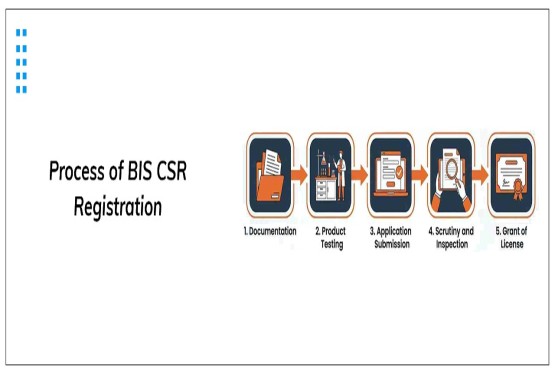
The CRS Registration process starts with product identification. The applicant must first check whether the product is covered under CRS. After that, the applicable Indian Standard is identified. The product sample is then sent to a BIS-recognised lab for testing. Once the test report is issued and verified, the application is filed online through the BIS CRS portal. BIS mentions that the applicant must apply using the verified test report within 90 days of its issue. After submission, BIS checks the documents. If everything is proper, the registration is granted. If any issue is found, BIS may raise a query.
Common Mistakes in CRS Documents
Many CRS applications get delayed because of avoidable mistakes. Some common issues include wrong model number, mismatch in brand name, unclear factory address, expired test report, incorrect authorization letter, missing AIR details and incomplete product label. Another common mistake is filing the application without checking whether the product is actually covered under CRS. BIS maintains the list of products covered under the Compulsory Registration Scheme, including product names and applicable Indian Standards.
How to Prepare Documents Properly
Before filing, make a checklist of all documents. Check the manufacturer name, factory address, brand name, model number and product category in every document. The test report should be reviewed carefully. If the test report contains wrong information, it should be corrected before filing the application. Foreign manufacturers should also ensure that the AIR documents are properly prepared. The AIR should understand the responsibility because BIS may contact the AIR for compliance matters.
Importance of Model Number in CRS Registration
Model number is very important in CRS Registration. BIS registration is linked with the product model and product category. If a company has multiple models, it must check whether they can be covered under one test report or whether separate testing is required.
Importance of Brand Name in CRS Registration
Brand name should be the same in the application, test report, product label and brand authorization letter. If the brand is written differently in different documents, BIS may raise a query.
For example, if the brand name in the test report is “ABC” but the authorization letter says “ABC Electronics,” clarification may be needed.
Validity of Test Report
The test report should be used within the applicable timeline. As per the CRS portal process, the application should be made using the verified test report within 90 days of its issue.
Why Professional Support Helps
CRS Registration is technical and document-heavy. Product category selection, Indian Standard identification, lab coordination, document preparation and BIS reply handling require careful work. A professional can help reduce delays by checking documents before filing, coordinating testing, preparing authorization formats and responding to BIS queries properly.
Conclusion
CRS Registration is mandatory for many electronic products in India. It ensures that notified products meet Indian safety and quality standards before they reach consumers. For a smooth CRS Registration process, documents must be accurate, updated and consistent. The most important documents include business license, factory proof, BIS lab test report, product details, brand authorization, trademark proof, AIR documents, undertaking, affidavit, product label and technical documents. Businesses should prepare all records carefully before filing the application. Proper documentation saves time, avoids BIS queries and helps manufacturers sell electronic products legally in India.
FAQs
Q1. What is CRS Registration?
Ans. CRS Registration is BIS approval for notified electronic and IT products under the Compulsory Registration Scheme.
Q2. Is CRS Registration mandatory for electronic products?
Ans. Yes, it is mandatory for electronic products notified under the CRS scheme before sale, import or distribution in India.
Q3. Who needs CRS Registration?
Ans. Manufacturers of notified electronic products need CRS Registration. For foreign manufacturers, an Authorized Indian Representative is also required.
Q4. What is the most important document for CRS Registration?
Ans. The BIS-recognised lab test report is one of the most important documents.
Q5. Is brand authorization required?
Ans. Yes, if the brand owner and manufacturer are different, a Brand Authorization Letter is required.
Q6. Is trademark certificate mandatory?
Ans. Brand proof may be required. A trademark certificate or trademark application proof can support brand ownership.
Q7. Can a foreign manufacturer apply for CRS Registration?
Ans. Yes, but the foreign manufacturer must appoint an Authorized Indian Representative in India.
Q8. What is AIR in CRS Registration?
Ans. AIR means Authorized Indian Representative. The AIR represents a foreign manufacturer before BIS in India.
Q9. How long is the test report valid for filing?
Ans. The application should be filed using the verified test report within 90 days of its issue, as per the CRS portal process.
Q10. Why does BIS raise queries?
Ans. BIS may raise queries due to document mismatch, wrong model details, unclear address, missing authorization or incomplete technical documents.


_crop10_thumb.jpg)


_crop10_thumb.jpg)


-Form_crop10_thumb.jpg)

_crop10_thumb.jpg)


_learn_crop10_thumb.jpeg)


_crop10_thumb.jpg)

_crop10_thumb.jpg)


_crop10_thumb.jpg)




_for_Foreign_Directors_learn_crop10_thumb.jpeg)


_Act,_2015_learn_crop10_thumb.jpg)










_learn_crop10_thumb.jpg)










































_crop10_thumb.jpg)


_crop10_thumb.jpg)
_(1)_crop10_thumb.jpg)









_crop10_thumb.png)








_crop10_thumb.jpg)

_crop10_thumb.jpg)








_crop10_thumb.png)

_crop10_thumb.jpg)








_crop10_thumb.png)