
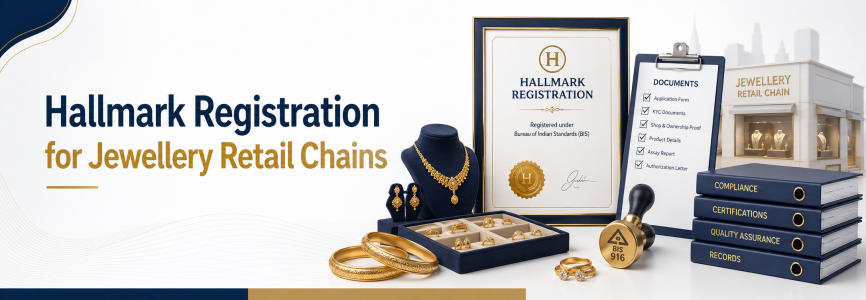



For a jewellery retail chain, customer trust is built on more than beautiful designs and attractive showrooms. When a customer purchases gold or silver jewellery, one of the most important questions is whether the purity stated on the invoice is actually reflected in the article being sold.
This is where BIS Hallmark Registration becomes important.
The Bureau of Indian Standards (BIS) operates the hallmarking framework in India to provide third-party assurance regarding the purity or fineness of precious-metal articles. At present, BIS hallmarking covers gold and silver jewellery and artefacts. For businesses operating multiple jewellery stores, however, compliance is slightly different from that of a single-shop jeweller because the head office, individual outlets, procurement systems, HUID records and consumer-facing displays all need to work together. This article explains Hallmark Registration from the perspective of jewellery retail chains, including corporate registration, outlet-level requirements, mandatory hallmarking, HUID compliance, invoicing, surveillance and practical steps for maintaining compliance.
What is Hallmark Registration?
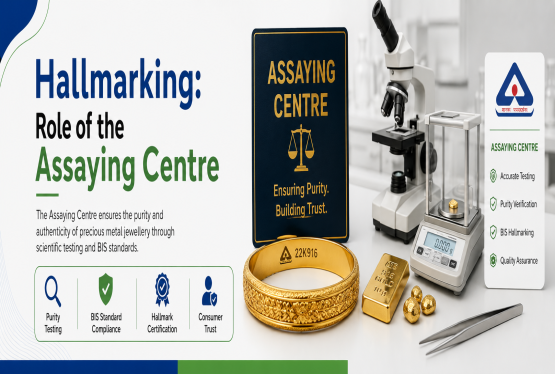
Hallmarking is the official determination and recording of the proportionate content of precious metal in jewellery or artefacts. In simple terms, it provides assurance that the purity claimed for a gold or silver jewellery article corresponds to the prescribed standard.
A jewellery business that intends to sell hallmarked gold or silver jewellery can obtain a Certificate of Registration from BIS. BIS currently states that jewellers can apply online and that registration is granted instantly without payment of a registration fee. BIS also states that the registration remains valid for the lifetime of the registration, subject of course to continued compliance with the applicable law and conditions. For large chains, BIS provides a Corporate Certificate of Registration, which makes management of multiple retail outlets more structured.
Why Hallmark Registration Matters for Jewellery Retail Chains
For a jewellery chain operating one store in Delhi and another twenty stores across different states, hallmark compliance cannot be treated as a one-time head-office filing. Each sales outlet interacts directly with customers and may be subject to BIS surveillance. Jewellery displayed at the store must match the purity and HUID details recorded in the BIS system, required consumer information must be displayed, invoices must carry relevant information, and staff should know how customers can verify hallmarked jewellery. A compliance failure at one outlet can also create reputational problems for the entire jewellery brand. This makes standardised compliance procedures particularly important for retail chains.
Corporate Hallmark Registration for Multiple Jewellery Stores
The revised Guidelines for Jewellers issued by BIS in July 2026 specifically address corporate registration. Where a jewellery business has multiple outlets, its registered or head office can apply for a Corporate Certificate of Registration and provide the list of retail outlets proposed to be covered. Importantly, every retail outlet covered under the corporate registration is issued an independent certificate document containing that particular outlet's address. This structure is particularly useful for jewellery brands with stores in malls, high streets or multiple cities because it allows the group to manage its BIS registration centrally while maintaining outlet-specific certification.
For example, if a company has stores in:
- Delhi
- Gurugram
- Jaipur
- Mumbai
- Bengaluru
- Hyderabad
the head office can organise corporate registration while ensuring that each included outlet has its own certificate reflecting the correct address. Whenever a store is shifted, its contact details change, the firm's name changes or there is a relevant change in management, the jeweller should apply through the online system for the appropriate change or endorsement in the registration.
Who Needs BIS Registration?
BIS states that a manufacturer, wholesaler, distributor or retailer engaged in selling hallmarked precious-metal articles is required to obtain registration/certification. The framework also recognises a distinction for artisans or manufacturers performing only job work who are not themselves selling jewellery in the supply chain; such persons may qualify for exemption from registration where the applicable conditions are satisfied. This distinction is important for a retail chain because its supply chain may involve several parties:
Manufacturer → Wholesaler → Distributor → Retail Chain → Consumer
Registration and actual responsibility for getting an article hallmarked are related but separate concepts. BIS clarifies that the responsibility to get an article hallmarked falls on the party making the first point of sale in the chain. Once a properly hallmarked article enters the chain, it does not need to be hallmarked repeatedly simply because ownership passes from one registered business to another.
What is the "First Point of Sale"?
For jewellery businesses, understanding this concept is extremely important. According to BIS, a point of sale exists when all three conditions are satisfied: ownership of the jewellery is transferred to the purchaser, a valid and compliant tax invoice is generated, and physical delivery of the jewellery article is ensured. Therefore, if a retail chain purchases already hallmarked jewellery from a manufacturer who was the first seller, the retail chain does not normally need to get that same article hallmarked again simply because it is making the final retail sale. However, where the jewellery chain itself gets jewellery manufactured on job work and becomes the first person selling that finished article, the responsibility to ensure hallmarking before the sale may fall on the chain. This is why jewellery retail chains should clearly document their procurement and first-sale model.
Mandatory Hallmarking and Outlet Location
Mandatory hallmarking of gold jewellery has been expanded district by district through government notifications. The Hallmarking of Gold Jewellery and Gold Artefacts (Second Amendment) Order, 2026, notified on 28 April 2026, replaced the annexure containing the districts covered by mandatory hallmarking. Jewellery chains should therefore check each outlet against the latest BIS district list instead of relying on older compliance information. This becomes particularly important for rapidly expanding chains. A head office may open a new outlet in a district where mandatory hallmarking applies even though another branch in a different district is operating under a different local position.
Before opening a new showroom, the compliance team should therefore verify:
- Whether the district is covered under the current mandatory hallmarking order.
- Whether the outlet has been included in the corporate registration.
- Whether the required outlet certificate is available.
- Whether jewellery inventory is appropriately hallmarked.
- Whether all required customer displays and verification facilities are available.
Gold Purities Permitted for Hallmarking
Under the current BIS information, IS 1417:2016 permits hallmarking of six specified gold grades:
- 14K – 585 fineness
- 18K – 750 fineness
- 20K – 833 fineness
- 22K – 916 fineness
- 23K – 958 fineness
- 24KS – 995 fineness
For silver jewellery and artefacts, BIS identifies six fineness grades under IS 2112:2014: 800, 835, 900, 925, 970 and 990. Retail chains should ensure that procurement teams, ERP systems, tags and invoices use the correct purity descriptions.
Understanding HUID in Jewellery Hallmarking
HUID stands for Hallmark Unique Identification.
For gold jewellery, BIS describes HUID as a unique six-digit alphanumeric code assigned to a hallmarked article. It enables traceability and allows customers to verify the jewellery through the Verify HUID feature of the BIS Care App.
The hallmark on gold jewellery currently includes:
- BIS Standard Mark;
- purity expressed through caratage and fineness; and
- six-digit alphanumeric HUID.
For a retail chain handling thousands of jewellery pieces, HUID should become part of inventory management rather than merely a marking visible on the physical article. When stock moves between warehouses and retail outlets, the business should maintain systems that allow jewellery details, weight, purity and HUID to be reconciled.
BIS Registration Process for Jewellery Retail Chains
The process is now largely online. BIS states that a jeweller seeking registration can apply through the National Single Window System (NSWS), which can also be accessed through the BIS online ecosystem. Registration is granted instantly and the applicant receives the registration number through email and SMS, after which the certificate can be downloaded. For a corporate jewellery chain, the registered or head office applies for corporate registration and specifies the outlets to be covered. Each included outlet then receives its outlet-specific certificate document.
Although the registration mechanism is simplified, businesses should not interpret instant registration as meaning that information can be entered casually. BIS guidelines provide for scrutiny of granted registrations, and discrepancies can be communicated to the jeweller for explanation. Unsatisfactory or unanswered discrepancies may ultimately be processed under the cancellation procedure. For retail chains, it is therefore advisable to verify outlet names, addresses, entity information and authorised details before filing.
Is There Any Government Fee for Hallmark Registration?
BIS currently states that no fee is charged for grant of registration/certification to jewellers. It also describes jeweller registration as being granted instantly through the online system. This should not be confused with charges associated with actual assaying and hallmarking of jewellery through BIS-recognised Assaying and Hallmarking Centres. Hallmark registration and the physical hallmarking of jewellery articles are two separate parts of the compliance process.
Sending Jewellery to an Assaying and Hallmarking Centre
Where a jeweller is responsible for getting jewellery hallmarked, the article is sent to a BIS-recognised Assaying and Hallmarking Centre (AHC). BIS provides an online facility through which the jeweller can create a new hallmarking request, choose an AHC and enter information such as article category, quantity, weight and declared purity. BIS also states that while use of the portal is preferred, an AHC can initiate a hallmarking request on behalf of the jeweller where the jewellery has been sent without the jeweller creating the request online. Retail chains dealing in high volumes should establish a central SOP for this process so that branch employees do not follow different practices.
What Must Be Displayed at Each Jewellery Store?
Outlet-level display requirements are one of the most important parts of corporate hallmark compliance. BIS's July 2026 guidelines require registered jewellers to display the prescribed BIS indication outside the outlet stating that hallmarked jewellery is available for sale. The BIS Certificate of Registration should also be prominently displayed inside the sales outlet. The outlet must additionally make prescribed information and facilities available, including information regarding hallmark components, a magnifying glass of at least 10X magnification, an appropriate weighing balance—preferably with 0.01 g accuracy—BIS contact information, hallmarking-charge information and information enabling consumers to verify HUID through the BIS Care App. For retail chains, the easiest solution is to create one standard Hallmark Compliance Kit and deploy it at every store.
Invoice Requirements for Hallmarked Jewellery
A jewellery invoice should not merely state "gold necklace" and the final price. BIS states that the bill or invoice for a hallmarked precious-metal article should include the description of each article, net weight of precious metal, purity in carat and fineness, and hallmarking charges. The invoice should also contain the prescribed information informing the consumer about the ability to get the purity verified through a BIS-recognised A&H Centre. Retail chains using centralised billing software should configure these fields directly into the ERP or POS system rather than depending upon staff to enter them manually.
Surveillance of Jewellery Retail Outlets
BIS registration is not the end of compliance. The July 2026 guidelines provide for market surveillance of registered jewellers, including businesses operating under corporate registration. BIS representatives may conduct visits without prior intimation and draw jewellery samples from articles displayed for sale. During surveillance, BIS may verify HUID details against the information available in its software, including jewellery type, purity, photograph, weight, jeweller and the relevant Assaying and Hallmarking Centre. The guidelines contemplate checking multiple hallmarked pieces during surveillance. This means a retail chain should be inspection-ready every day—not only when the head office expects an audit.
What Happens if Jewellery Fails Purity Testing?
The legal and business consequences can be significant. The BIS guidelines provide different regulatory responses depending on the extent of shortage in fineness. Serious purity shortages can result in cancellation proceedings against the jeweller that got the article hallmarked. Importantly for corporate chains, the July 2026 guidelines state that where a business has multiple outlets under the same or corporate registration, cancellation proceedings in certain serious failure cases can be initiated against the particular outlet concerned. Customers also have statutory protection. BIS states that where hallmarked jewellery is found to have lower purity than marked, the buyer may be entitled to compensation equal to twice the amount calculated for the shortage in purity, together with testing charges, under the applicable BIS framework.
Important Exemptions Under Mandatory Hallmarking
Not every gold article is subject to compulsory hallmarking. BIS identifies several exemptions, including certain articles meant for export, articles weighing less than two grams, articles intended for medical, dental, veterinary, scientific or industrial use, gold thread, unfinished articles intended for further manufacture, specified bullion forms and coins, certain exhibition jewellery, specified categories such as Kundan, Polki and Jadaau jewellery, and jewellers with annual turnover up to ?40 lakh, subject to the applicable conditions. Large organised retail chains will generally exceed the small-turnover exemption, but understanding product-specific exemptions remains important for inventory classification.
Common Hallmark Compliance Mistakes in Retail Chains
The biggest risk for a multi-store jewellery business is inconsistency. One branch may have the latest registration displayed while another is still displaying an old certificate. One outlet may provide HUID verification support while another may not have a magnifying glass. A central warehouse may correctly record jewellery weight while the store's billing software shows different information. Other common problems include opening a new store without adding it under corporate registration, failing to update an outlet address, accepting jewellery into retail stock without verifying hallmark details, incorrect invoice descriptions and inadequate training of sales staff. The best way to avoid these problems is to make hallmarking a centralised compliance function with outlet-level accountability.
Hallmark Compliance Checklist for Jewellery Retail Chains
A practical internal system should ensure that:
- every eligible outlet is covered by BIS registration;
- the correct outlet certificate is displayed;
- store addresses match BIS records;
- HUID details are verified before stock enters retail inventory;
- jewellery invoices carry required information;
- 10X magnification is available to customers;
- an appropriate weighing balance is maintained;
- BIS/HUID consumer information is displayed;
- staff cooperate with BIS surveillance;
- new outlets are added before commencement of relevant sales;
- outlet changes are promptly updated online; and
- procurement teams identify who is responsible for hallmarking at the first point of sale.
How Compliance Calendar LLP Can Assist
Compliance Calendar LLP can assist jewellery retailers, jewellery manufacturers and multi-location jewellery businesses with BIS Hallmark Registration and related compliance requirements. For jewellery retail chains, assistance can include evaluating the business structure, corporate registration planning, adding or organising retail outlets, reviewing registration information, understanding mandatory hallmarking applicability, coordinating documentation and helping establish outlet-level compliance procedures. The objective is not simply to obtain a BIS registration number. A retail chain needs a system in which procurement, inventory management, HUID verification, billing and showroom compliance work together so that each branch follows the same regulatory standards.
Conclusion
Hallmark Registration is an important part of operating a trusted jewellery business in India. For jewellery retail chains, its importance increases because regulatory compliance must remain consistent across every branch. BIS's corporate registration framework allows a head office to include multiple retail outlets while providing an independent certificate document for each covered outlet. At the same time, every showroom remains responsible for maintaining the required consumer displays, accurate jewellery records, proper billing practices and cooperation with BIS surveillance.
The most effective approach is to treat hallmarking as a continuous operating process rather than a one-time registration. When registration, HUID verification, stock movement, invoicing and outlet compliance are centrally monitored, jewellery chains can reduce compliance risk while strengthening the trust customers place in their brand.
FAQs
Q1. Is BIS Hallmark Registration mandatory for jewellery retailers?
Ans. A manufacturer, wholesaler, distributor or retailer selling hallmarked precious-metal articles is required to obtain BIS registration/certification. Mandatory hallmarking obligations for gold jewellery additionally depend on the applicable Hallmarking Order, district coverage and available exemptions.
Q2. Can one BIS registration cover multiple jewellery outlets?
Ans. Yes. BIS provides for Corporate Registration, under which the registered/head office applies along with the list of outlets to be covered. Each covered retail outlet receives its own certificate document mentioning that outlet's address.
Q3. What is the government fee for jeweller hallmark registration?
Ans. BIS currently states that no fee is charged for grant of registration/certification to jewellers. This is separate from charges associated with actual assaying and hallmarking of jewellery articles.
Q4. How long is BIS Hallmark Registration valid?
Ans. BIS states that the Certificate of Registration granted to a jeweller stands valid for the lifetime of the registration, subject to continued compliance with the regulatory requirements.
Q5. What is HUID in gold jewellery?
Ans. HUID is a unique six-digit alphanumeric Hallmark Unique Identification number attached to a hallmarked jewellery article. Consumers can verify it through the Verify HUID feature of the BIS Care App.
Q6. Does every retail outlet need to display its BIS certificate?
Ans. Yes. BIS's guidelines require the Certificate of Registration for sale of hallmarked articles to be prominently displayed at the sales outlet. Corporate-registration outlets receive an independent certificate document carrying the outlet address.
Q7. Who is responsible for getting jewellery hallmarked in a supply chain?
Ans. BIS states that the responsibility falls on the person making the first point of sale in the chain of manufacturer, wholesaler, distributor and retailer. Hallmarking therefore generally needs to occur only once before the relevant first sale.
Q8. Can customers verify a jewellery HUID themselves?
Ans. Yes. Consumers can use the BIS Care App and its Verify HUID function to check the authenticity and available details associated with a hallmarked jewellery item's HUID.
Q9. Can BIS inspect jewellery retail stores after registration?
Ans. Yes. BIS undertakes market surveillance of registered jewellers, including corporate registrations. Jewellery samples and HUID information may be checked, and surveillance may be conducted without advance notice.
Q10. What should a jewellery chain do when opening a new outlet?
Ans. Before starting relevant sales, the business should determine whether the location falls within the latest mandatory-hallmarking district coverage, arrange inclusion of the outlet under the appropriate BIS corporate registration structure, obtain the outlet certificate and establish the prescribed display, HUID, billing and consumer-verification facilities. The current district list is governed by the latest amendment to the mandatory hallmarking order.


_crop10_thumb.jpg)


_crop10_thumb.jpg)


-Form_crop10_thumb.jpg)

_crop10_thumb.jpg)


_learn_crop10_thumb.jpeg)


_crop10_thumb.jpg)

_crop10_thumb.jpg)


_crop10_thumb.jpg)




_for_Foreign_Directors_learn_crop10_thumb.jpeg)


_Act,_2015_learn_crop10_thumb.jpg)











_learn_crop10_thumb.jpg)













































_crop10_thumb.jpg)


_crop10_thumb.jpg)

_(1)_crop10_thumb.jpg)












_crop10_thumb.png)

















_crop10_thumb.jpg)

_crop10_thumb.jpg)








_crop10_thumb.png)


_crop10_thumb.jpg)










_crop10_thumb.png)