
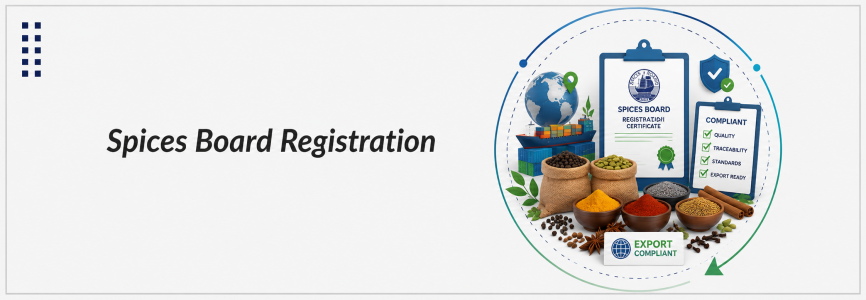



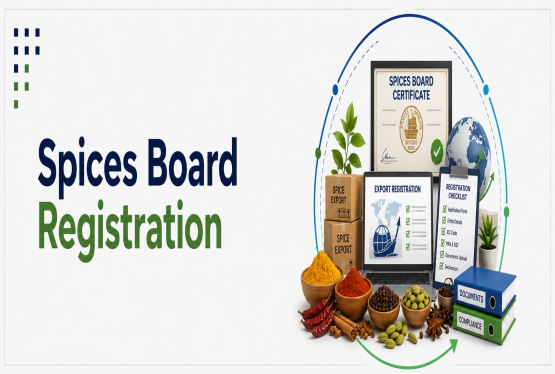
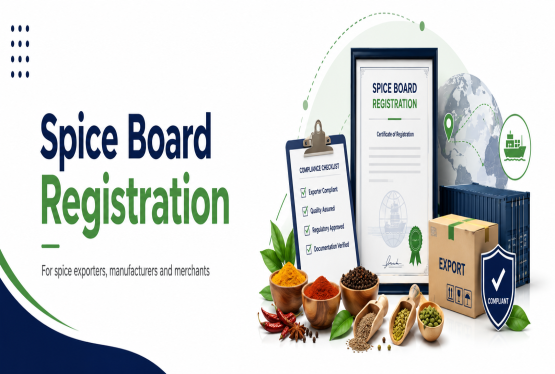
India is one of the world’s leading producers and exporters of spices. However, starting a spice-export business involves more than finding overseas buyers, arranging products and completing shipping documentation. An exporter must first establish the correct legal identity, obtain an Importer Exporter Code, secure food-safety approvals and obtain registration from the Spices Board.
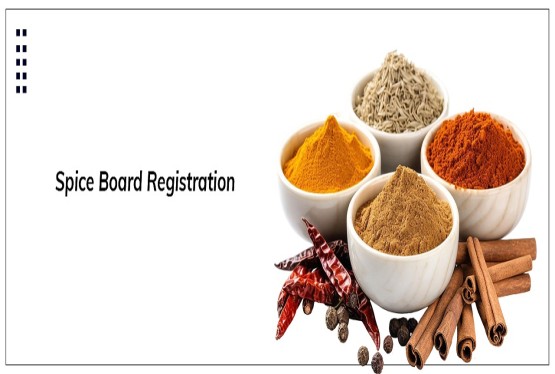
What is commonly called “Spices Board Registration” is legally known as the Certificate of Registration as Exporter of Spices, or CRES. The registration is issued by the Spices Board under the Spices Board Act, 1986 and the Spices Board (Registration of Exporters) Regulations, 1989.
The documents required depend mainly on whether the applicant is registering as a merchant exporter or a manufacturer exporter. Manufacturer exporters face additional documentation and inspection requirements because they process, manufacture, pack or add value to spices at their own facilities.
Meaning of Spices Board Registration
The Spices Board is a statutory body functioning under the Ministry of Commerce and Industry. Section 7 of the Spices Board Act authorises the Board to develop, promote and regulate spice exports, grant export certificates, control quality, improve processing and packaging practices and issue licences to manufacturers of spices for export.
Section 11 of the Act contains the main legal requirement. It provides that no person may commence or carry on the business of exporting spices except under and in accordance with a valid certificate. Therefore, CRES is not merely a voluntary membership document; it is the statutory registration that permits a person or business entity to operate as an exporter of scheduled spices from India.
CRES also serves another important purpose. Under paragraph 2.57 of the Foreign Trade Policy 2023, a CRES issued by the Spices Board is treated as a Registration-cum-Membership Certificate for foreign-trade purposes. A spice exporter holding CRES is therefore not ordinarily required to obtain a separate RCMC for the same spice-export activity.
Merchant Exporter and Manufacturer Exporter
Before preparing documents, the applicant must choose the correct exporter category. This decision affects the documents, government fee, scrutiny procedure and whether the premises will be inspected.
A merchant exporter generally purchases spices or spice products from manufacturers, processors or suppliers and exports them in the same or commercially traded form. The merchant exporter does not claim to operate the spice-processing facility for which manufacturer registration is required.
A manufacturer exporter manufactures, processes, cleans, grades, grinds, blends, sterilises, packs or adds value to spices at its own processing unit or a unit controlled by it. Registration in this category requires proof that the processing unit is legally established and possesses suitable facilities.
Under Regulation 3, a manufacturer-exporter certificate cannot be granted unless the certificate-issuing authority is satisfied with the facilities available at the spice-processing plant or unit. The Spices Board’s operational guidelines provide for inspection of the manufacturing facility before approval.
Current Document Checklist for a Merchant Exporter
As of July 2026, the current Spices Board registration page directs applicants to submit CRES applications through the DGFT portal. The portal-facing checklist for a merchant exporter expressly identifies three principal documents: the GST registration certificate, the prescribed bank report and the Central FSSAI licence.
GST registration certificate
The applicant must provide a copy of the GST registration certificate. The legal name, trade name, principal place of business and constitution appearing on the GST certificate should correspond with the applicant’s IEC and entity records.
Applicants should not casually ignore differences such as “Private Limited” missing from one document, an old address appearing in the IEC, or the proprietor’s personal name appearing in one record and the trade name in another. Such differences may lead to clarification or resubmission.
Older Spices Board guidelines permitted a self-declaration where GST registration was unavailable. However, the current online checklist expressly asks for a GST copy. Therefore, applicants should follow the current DGFT and Spices Board portal requirements rather than relying only on an older checklist.
Bank report in Annexure II
A bank report in the prescribed Annexure II format is required. It must normally be issued on the bank’s letterhead and duly signed and sealed by the authorised bank official.
The purpose of this document is to establish the applicant’s banking relationship and financial standing. Regulation 3 specifically requires the CRES application to be accompanied by a bank reference or certificate concerning the applicant’s financial status.
The report should be obtained from the bank where the applicant maintains its operational account. The legal name in the bank report should match the IEC and business constitution. A bank statement, cancelled cheque or account-opening letter should not automatically be treated as a substitute for the prescribed bank report unless the Board accepts it.
Central FSSAI licence
The current checklist requires a copy of the applicant’s Central FSSAI licence. Since spices and spice products are food articles, the exporter must also comply with the food-safety framework administered by the Food Safety and Standards Authority of India.
The FSSAI licence should be valid on the date of application and should cover the relevant premises and activities. The applicant should ensure that the business name, processing or storage address, product category and nature of business are properly reflected.
A basic or state-level FSSAI registration should not be assumed to satisfy the CRES requirement where the current checklist specifically asks for a Central FSSAI licence.
Additional Documents for a Manufacturer Exporter
A manufacturer exporter must provide the documents required from a merchant exporter together with additional evidence relating to the processing unit.
The current Spices Board checklist requires the manufacturer exporter to submit its GST certificate, prescribed bank report, Central FSSAI licence, MSME registration, valid Consent to Operate from the Pollution Control Board and proof of ownership or legal occupation of the processing-unit building.
MSME or Udyam Registration Certificate
The manufacturer exporter must submit a copy of its MSME or Udyam Registration Certificate. The certificate should relate to the applicant entity and the manufacturing or processing activity should appropriately cover spices or spice products.
The Board’s earlier detailed guidelines specifically stated that the relevant spice should be mentioned in the MSME, Udyog Aadhaar or Udyam certificate. Therefore, a generic service activity or unrelated manufacturing activity may invite a clarification.
The enterprise name and plant address should also be consistent with the other licences. Where the unit has shifted, the Udyam details should preferably be updated before the CRES application is filed.
Consent to Operate from the Pollution Control Board
A valid Consent to Operate issued by the concerned State Pollution Control Board or Pollution Control Committee is required for a manufacturer exporter.
The consent should cover the actual processing facility from which manufacturing, grinding, blending, sterilisation or other processing operations are carried out. Its validity should not have expired, and the address should correspond with the address mentioned in the application.
Where the unit has only obtained a Consent to Establish but has not yet received Consent to Operate, the application may not satisfy the current checklist because the portal expressly asks for a valid Consent to Operate.
Proof of ownership or legal possession of the processing unit
The applicant must prove that it lawfully owns or occupies the building from which the processing unit operates. The current checklist accepts documents such as a valid lease agreement, rent agreement or recent property-tax receipt.
Where the premises are rented, the agreement should clearly identify the property, parties, duration and permitted commercial or industrial use. It should be properly executed and, where legally required, stamped or registered.
Where the premises are owned, a recent property-tax receipt or another acceptable ownership document should show the owner’s name and property address. Where the building belongs to a director, partner or family member rather than the applicant entity, the Board may require evidence authorising the entity to use the premises.
Unit-specific FSSAI and environmental documents
For a manufacturer exporter, the processing-unit address should appear correctly in the FSSAI licence and the Pollution Control Board permission. The earlier Board guidelines specifically required the processing address to be mentioned in these documents.
An applicant should avoid filing documents where the FSSAI licence mentions the registered office, the pollution consent mentions the factory and the lease agreement mentions a third address. All premises should be correctly disclosed and categorised.
IEC and DGFT Profile Documents
A valid IEC is fundamental to the application because the CRES process is now integrated with the DGFT e-RCMC system. The DGFT portal uses the IEC profile as the applicant’s primary trade identity.
The current DGFT system automatically draws or validates several details from the IEC profile, including entity information, PAN-linked information and, where applicable, MCA data. The DGFT e-RCMC user guide states that the platform incorporates IEC authentication and integration with CBDT and MCA databases.
For this reason, applicants should update the IEC profile before beginning the CRES application. The firm name, address, mobile number, email address, directors, partners, bank details and branch details should be current.
Earlier Spices Board guidelines separately required copies of the IEC certificate and PAN card. Although the current short checklist does not show them as separate merchant-exporter uploads, they should still be kept ready because they form the foundation of the DGFT profile and may be required during scrutiny or correction of mismatched data.
Constitution Documents Based on the Entity Type
The applicant must establish its legal constitution. The relevant documents vary depending on whether the business is a proprietorship, partnership firm, LLP, company, Hindu undivided family or cooperative society.
For a proprietorship, the proprietor’s PAN-linked IEC, GST certificate, bank records and other registrations establish the business identity. The trade name should be consistently reflected wherever applicable.
For a partnership firm, the partnership deed should identify the existing partners, business name, principal place of business, capital structure and authority to conduct export activities. The Board’s detailed guidelines expressly required the partnership deed containing particulars of the current partners.
For an LLP, the Certificate of Incorporation, LLP Agreement and current details of designated partners should be available. Any changes in partners or registered office should already have been filed with the Ministry of Corporate Affairs and updated in the IEC profile.
For a private or public company, the Certificate of Incorporation, Memorandum of Association and Articles of Association should be kept ready. The objects clause should permit trading, manufacturing, processing or exporting spices, food products or related goods, as applicable. The detailed Board checklist expressly referred to the MOA, AOA, Certificate of Incorporation and list of present directors.
A cooperative society should retain its registration certificate or document issued by the Registrar of Cooperative Societies. An HUF applicant should retain the HUF deed and details of the Karta.
Authorisation Letter
Where the CRES application is submitted by an employee, compliance officer, consultant or another person who is not the IEC holder, proprietor, partner or authorised director, an authorisation letter should be prepared. The authorisation should be issued by the proprietor, partner, designated partner or director, as applicable. It should expressly authorise the named individual to submit, sign, respond to queries and complete the CRES application. The Spices Board’s detailed guidelines specifically require an authorisation letter where an employee of the applicant company, other than the IEC holder, applies for CRES.
Optional Quality and Export Certifications
Certain documents may not be mandatory for initial registration but can strengthen the exporter’s profile and support access to additional facilities.
The Board’s guidelines identify quality certifications such as HACCP, ISO and BRC; DGFT recognition such as status-holder certification; Customs permissions relating to factory stuffing or self-sealing; Plant Quarantine warehouse certification; and Export Inspection Agency certification relating to in-process quality control.
These documents do not replace CRES, FSSAI or other statutory approvals. They demonstrate quality systems, export experience or approved infrastructure and may become commercially important depending on the product and destination country.
Application Procedure through the DGFT Portal
A significant procedural update is that fresh and renewal CRES applications are now submitted through the DGFT portal. The Spices Board’s current webpage expressly states that CRES applications must be filed through DGFT.
The applicant must log in to the DGFT portal and navigate to Services, e-RCMC and Apply for e-RCMC. The applicant then selects the appropriate commodity board, enters the membership details, selects the office, chooses the relevant product group and enters the ITC(HS) codes and descriptions of the products proposed to be exported.
The exporter should select the Spices Board as the registering authority and correctly choose merchant or manufacturer status. The supporting documents must then be uploaded and the prescribed fee paid through the online payment gateway.
The application is scrutinised by the Spices Board. A merchant-exporter application is primarily examined on its documents, while a manufacturer-exporter application is subject to verification of the processing facilities. Earlier operational guidelines indicated processing timelines of approximately five working days for merchant exporters and ten working days for manufacturer exporters after submission of complete documents, with the latter being subject to inspection. Actual processing may take longer where clarification, inspection or resubmission is required.
Registration Fees
The current fee for a new manufacturer-exporter CRES is ?17,700, comprising ?15,000 plus 18% GST. The fee for a new merchant-exporter CRES is ?11,800, comprising ?10,000 plus 18% GST. The current renewal fee is ?11,800 for a manufacturer exporter and ?8,850 for a merchant exporter. The amendment fee is ?5,900, representing ?5,000 plus GST. The Registration of Exporters Regulations state that the application fee is non-refundable. Therefore, the applicant should verify its category, documents and particulars before making payment.
Validity, Renewal and Amendment
CRES operates for a three-year period under the registration framework. The February 2024 Spices Board circular describes the certificate as valid for three years from its date of issue and requires exporters to apply for renewal before expiry.
An application received after expiry is not entertained as a renewal, and the exporter may have to apply for fresh registration. An exporter who has not undertaken export business during the validity period may also be required to submit a fresh application rather than seek renewal.
Any change in the exporter’s name or address must be reported to the certificate-issuing authority within 30 days, together with supporting documents and the amendment fee. Delay may be condoned for sufficient reasons for up to three months; otherwise, fresh registration may be required.
A CRES is personal to the registered holder and cannot be sold or transferred. A transfer of business, material change in ownership, change in constitution or formation of a new partnership may require fresh registration.
Quarterly Export Returns and Continuing Compliance
Obtaining CRES is not the end of compliance. Every registered exporter is required to submit quarterly returns relating to exports, purchases and imports of spices through the Spices Board portal.
The Board’s FAQ states that quarterly export returns are mandatory. The February 2024 circular further clarified that non-submission of quarterly returns constitutes a violation and that exporters with pending returns may not be permitted to renew their certificates.
Manufacturer exporters must also disclose every establishment or unit under their control involved in warehousing, processing or value addition of spices for export. Operating through an undisclosed facility can create problems during inspection, renewal or export certification.
The exporter must additionally comply with destination-specific quality requirements, mandatory sampling instructions, residue limits, microbiological standards, labelling rules and health-certificate requirements wherever applicable. CRES authorises the exporter as a registered spice exporter; it does not automatically certify every consignment as compliant with the importing country’s food-safety requirements.
Rejection, Suspension and Cancellation
Section 12 provides that an application must be submitted in the prescribed form, contain the required particulars and be accompanied by proof of payment. An incomplete application may be returned or rejected, while a compliant application may be granted subject to the conditions prescribed under the regulations.
Under Section 13, the Board may cancel a certificate where its terms and conditions have been violated or where the Central Government considers cancellation necessary in the public interest. Pending consideration of cancellation, the Board may suspend the certificate for up to 45 days and require the holder to show cause within 15 days. No final cancellation order can be made without giving the exporter a reasonable opportunity of being heard.
An exporter aggrieved by a cancellation order may appeal to the Central Government under Section 14. The appellate authority may confirm, modify or reverse the order after providing an opportunity of hearing.
Penalties and Recent Legal Update
A major recent legal development came through the Jan Vishwas (Amendment of Provisions) Act, 2023, with the relevant amendments to the Spices Board Act taking effect from 9 August 2024.
Following the amendment, failure to submit required returns, submission of knowingly false returns, obstruction of authorised officers, failure to produce records, exporting in contravention of Section 11 and other violations may attract monetary penalties extending to ?50,000 and, for subsequent contraventions, up to ?1 lakh.
The amended Section 30A provides for adjudication by an officer not below the rank of Director, after giving the concerned person an opportunity of hearing. An appeal against the adjudicating officer’s order may be filed before the Secretary to the Board within 60 days.
Section 31 also deals with violations committed by companies and firms. Persons responsible for the conduct of the business may face proceedings, subject to defences such as lack of knowledge and proof that due diligence was exercised.
Section 32 connects the registration requirement with Customs law by treating covered spices exported in contravention of the Act as goods subject to prohibition or restriction under the Customs Act, 1962. This means non-compliance may affect not only the CRES but also customs clearance and handling of the export consignment.
Recent Procedural Updates Applicants Should Note
The most important current procedural development is the integration of CRES with the DGFT e-RCMC platform. A February 2024 Spices Board circular instructed exporters to file fresh and renewal applications through DGFT, and the current Board webpage continues to direct applicants to that portal.
The DGFT e-RCMC User Guide Version 4.0, dated January 2025, confirms the continuing use of the common digital platform, IEC-based authentication, electronic applications and digitally issued certificates.
Applicants should therefore avoid following outdated instructions that refer to physical submission of forms, demand drafts or sending hard-copy files to a regional office. The current process is substantially online, although the Board may still seek clarification, additional documents or conduct physical inspection of a manufacturer’s unit.
Conclusion
The documents needed for Spices Board registration depend on the exporter’s category and business structure. A merchant exporter should principally arrange its GST certificate, prescribed bank report and Central FSSAI licence, supported by an updated IEC and DGFT profile.
A manufacturer exporter must additionally provide its MSME or Udyam certificate, valid Pollution Control Board Consent to Operate and evidence of ownership, lease or lawful possession of the processing premises. It must also be prepared for inspection of the spice-processing unit.
Entity documents such as the partnership deed, LLP incorporation records, MOA, AOA, Certificate of Incorporation, cooperative-society registration and authorisation letter should be kept ready according to the applicant’s constitution.
The strongest application is not simply one containing every possible document. It is an application in which the legal name, address, constitution, processing facility, bank account, IEC, GST registration, FSSAI licence and environmental approval all tell the same story. Careful preparation at this stage can reduce resubmissions, inspection objections and delays in obtaining the Certificate of Registration as Exporter of Spices.
Frequently Asked Questions (FAQs)
Q1. What is Spices Board Registration?
Ans: Spices Board Registration is officially called the Certificate of Registration as Exporter of Spices, or CRES.
It is generally required for businesses exporting spices and spice products from India.
The certificate is issued by the Spices Board under the Spices Board Act, 1986.
Q2. Who needs CRES registration?
Ans: Merchant exporters and manufacturer exporters dealing in scheduled spices generally need CRES registration.
Merchant exporters purchase and export spices, while manufacturer exporters process or manufacture them.
The applicant must select the correct category while filing the application.
Q3. What documents are required for a merchant exporter?
Ans: A merchant exporter generally needs a GST registration certificate, Central FSSAI licence and prescribed bank report.
The applicant should also maintain an updated IEC and DGFT profile.
Entity documents may be requested depending on the business structure.
Q4. What additional documents are required for a manufacturer exporter?
Ans: A manufacturer exporter must submit Udyam registration, valid Consent to Operate and premises proof.
The processing-unit address should match the FSSAI, pollution and ownership documents.
The Spices Board may also inspect the manufacturing facility before approval.
Q5. Is an IEC compulsory for Spices Board Registration?
Ans: Yes, a valid Importer Exporter Code is essential for applying through the DGFT portal.
The IEC profile provides the applicant’s legal identity and export-related details.
Any outdated name, address or bank information should be corrected before filing.
Q6. Is a Central FSSAI licence mandatory?
Ans: The current document checklist requires a valid Central FSSAI licence for CRES registration.
The licence should cover the relevant products, activity and business premises.
A basic or state licence may not be sufficient for the export application.
Q7. How is the CRES application filed?
Ans: The application is submitted online through the DGFT e-RCMC portal.
The applicant must select the Spices Board, exporter category and relevant spice products.
Documents are uploaded online, followed by payment and scrutiny by the authority.
Q8. How long is Spices Board Registration valid?
Ans: CRES is generally valid for three years from the date of issue.
The exporter should apply for renewal before the certificate expires.
Delay may result in the applicant having to submit a fresh registration application.
Q9. Are quarterly returns mandatory for registered exporters?
Ans: Yes, registered exporters are required to submit quarterly export-related returns.
Non-filing may create problems during renewal or regulatory verification.
Exporters should maintain accurate purchase, export and import records.
Q10. Can Spices Board Registration be cancelled?
Ans: The certificate may be suspended or cancelled for violating its conditions or applicable law.
The exporter must normally be given an opportunity to explain the alleged non-compliance.
Penalties may also apply for false returns, obstruction or exports without valid registration.


_crop10_thumb.jpg)


_crop10_thumb.jpg)


-Form_crop10_thumb.jpg)

_crop10_thumb.jpg)


_learn_crop10_thumb.jpeg)


_crop10_thumb.jpg)

_crop10_thumb.jpg)


_crop10_thumb.jpg)




_for_Foreign_Directors_learn_crop10_thumb.jpeg)


_Act,_2015_learn_crop10_thumb.jpg)










_learn_crop10_thumb.jpg)




































_crop10_thumb.jpg)

_crop10_thumb.jpg)
_(1)_crop10_thumb.jpg)








_crop10_thumb.png)






_crop10_thumb.jpg)


_crop10_thumb.jpg)






_crop10_thumb.png)
_crop10_thumb.jpg)








_crop10_thumb.png)








_crop10_thumb.jpg)
