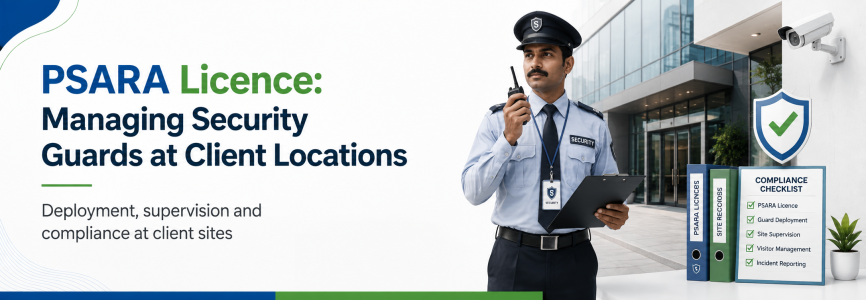



The private security industry plays an important role in protecting offices, factories, warehouses, shopping centres, hospitals, residential complexes, educational institutions, hotels and other commercial establishments across India. Once a private security agency obtains a PSARA Licence, however, regulatory responsibility does not end with the grant of the licence. One of the most important ongoing responsibilities is the proper management of security guards deployed at client locations. A security agency may deploy hundreds of guards across different client sites, but it continues to remain responsible for ensuring that guards are eligible, verified, trained, supervised, properly identified and deployed in accordance with the applicable regulatory framework.
The principal legislation governing private security agencies is the Private Security Agencies (Regulation) Act, 2005 (PSARA). Section 4 prohibits a person from carrying on or commencing the business of a private security agency without a licence issued under the Act. The Ministry of Home Affairs has also issued the Private Security Agencies Central Model Rules, 2020, replacing the earlier 2006 Model Rules. States and Union Territories frame or apply their own rules within this statutory framework, so operational requirements should always be checked for the particular State in which security services are provided. For security agencies, effective client-site management therefore requires a combination of PSARA compliance, trained manpower, proper supervision, documentation, site-specific procedures and coordination with the client.
Understanding Responsibility After Deployment
A common misconception is that once a security guard is deployed to a client's premises, responsibility for the guard effectively transfers to the client. From a regulatory perspective, this approach can create serious compliance risks. The security agency remains responsible for ensuring that persons engaged as private security guards meet the eligibility requirements under PSARA. Section 10 provides that a security guard must satisfy prescribed requirements relating to age, character and antecedents, training, physical standards and other applicable conditions. A person who has been convicted by a competent court, or dismissed or removed on specified misconduct or moral-turpitude grounds from certain services, cannot be employed or engaged as a security guard or supervisor in the circumstances specified under the Act. Therefore, agencies should maintain proper control over recruitment, verification, training, deployment and supervision even when operational instructions at the site are coordinated with the client.
Pre-Deployment Verification of Security Guards
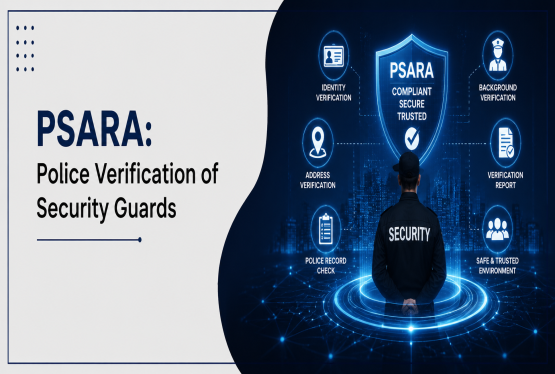
An agency should ensure that every guard has undergone the prescribed character and antecedent verification process. Under the Central Model Rules, 2020, the agency must satisfy itself about the character and antecedents of a person before employing or engaging that person as a security guard or supervisor. Verification can involve an appropriate character and antecedent verification certificate or access to prescribed criminal databases through the Controlling Authority or police, according to the applicable procedure. The agency should maintain a complete personnel file containing relevant information such as identity documents, address details, photographs, verification records, training certificates, employee number and applicable employment records. Deploying guards before completing mandatory verification can expose the agency and client to significant operational risks. Security personnel often have access to restricted premises, valuable assets, employee areas, visitor information and sensitive business locations, making background verification particularly important.
Training Before Client-Site Deployment
Section 9 of PSARA requires private security agencies to ensure prescribed training and skills for their guards and supervisors. The Central Model Rules, 2020 provide a detailed training framework. Entry-level training under the Model Rules consists of a minimum of 100 hours of classroom instruction and 60 hours of field training spread over at least 20 working days. Ex-servicemen and former police personnel are provided a condensed training course of at least 40 classroom hours and 16 hours of field training over at least seven working days. Training covers subjects including public conduct, uniform discipline, physical fitness, protection of assets and buildings, fire fighting, crowd control, checking identification documents, first aid, crisis response, security equipment and other prescribed subjects. Supervisors are also trained in leadership and management.
However, statutory training should not be treated as the final stage of preparation. Before deployment, the agency should also provide site-specific induction. A guard working at a hospital has different responsibilities from one deployed at a warehouse or corporate office. Site induction should explain entry and exit procedures, restricted areas, emergency contacts, visitor-management procedures, fire exits, evacuation protocols, material movement, vehicle control and client-specific security requirements.
Preparing Clear Post Instructions
Every client site should ideally have clearly documented post instructions or Standard Operating Procedures (SOPs). These instructions define what the security guard is expected to do at a particular location and reduce confusion between the agency, client and deployed personnel.
Post instructions may cover:
-
Entry and exit control
-
Visitor verification
-
Employee identification
-
Material gate passes
-
Vehicle movement
-
CCTV monitoring
-
Key management
-
Patrol schedules
-
Opening and closing procedures
-
Emergency response
-
Fire or accident reporting
-
Incident escalation
-
Restricted-area access
-
Handling suspicious persons or objects
Guards should understand that their authority is limited to their lawful security functions. Private security personnel are not police officers and should not be presented or managed in a manner that creates such an impression.
Maintaining Adequate Supervisory Control
Proper supervision is one of the central requirements of professional security operations.
Section 9 of PSARA requires agencies to engage the prescribed number of supervisors. Under Rule 10 of the Central Model Rules, 2020, there should generally be one supervisor for not more than fifteen private security guards. Where guards are posted at different premises and supervision by one supervisor is impractical, the Model Rules provide for additional supervision so that at least one supervisor is available for every six guards for assistance, advice and supervision. State-specific rules should be checked because PSARA implementation is administered through State or UT Controlling Authorities.
Supervisors should not exist merely on payroll records. Their role should include:
-
Conducting site visits
-
Checking attendance and alertness
-
Inspecting uniforms and identity cards
-
Reviewing duty registers
-
Confirming completion of patrols
-
Addressing client complaints
-
Conducting briefings
-
Reviewing incident reports
-
Arranging guard replacements
-
Ensuring SOP compliance
Proper supervisory records can also help demonstrate that the agency is actively managing its deployed workforce.
Duty Rosters and Shift Management
An agency should maintain an accurate duty roster for guards and supervisors posted at each client location.
The Central Model Rules prescribe electronic maintenance of registers in Form X. The prescribed records include information relating to security guards and supervisors, customers, locations where services are provided and duty rosters. The duty-roster format captures the name of the guard or supervisor, place of duty, whether arms or ammunition have been provided, and the date and time when duty begins and ends.
Good roster management helps prevent:
-
Unapproved substitutions
-
Excessive consecutive duties
-
Unmanned security posts
-
Attendance disputes
-
Deployment of unverified personnel
-
Confusion during emergencies
Where a guard does not report for duty, the agency should have a replacement mechanism rather than leaving responsibility entirely to the client.
Identity Cards and Identification at Client Sites
Every private security guard must be issued a photo identity card by the private security agency. Section 17 requires guards and supervisors to carry their agency-issued identity cards and produce them for inspection when required by the authorised authorities. The Central Model Rules prescribe details including the guard's full-face colour photograph, name, agency name, employee number, position and validity information. While on active security duty, the Model Rules require the photo identity card to be displayed conspicuously on the outermost garment above waist level. Agencies should immediately update or recover identity cards when guards leave employment, and loss or theft of an identity card should be dealt with through the prescribed process. This protects both the client and agency against unauthorized persons falsely presenting themselves as security personnel.
Uniform and Professional Appearance
Uniforms are an important part of professional security management because they allow clients, visitors and employees to identify authorised security personnel. The Central Model Rules specify items such as an agency-distinguishing arm badge, a position badge, prescribed footwear, headgear and certain other equipment. Guards are also required to carry a notebook and writing instrument while on active duty. At the same time, private security uniforms must not imitate the uniforms of the Army, Navy, Air Force, other armed forces or police in a prohibited manner. PSARA contains penalties relating to wearing uniforms with the appearance or distinctive marks of such forces. An agency should therefore maintain a standardized uniform policy and periodically inspect guards for compliance.
Managing Attendance, Wages and Employment Records
Guard deployment also requires proper employment administration. Section 15 requires private security agencies to maintain registers containing prescribed information about management personnel, guards and supervisors, clients and other particulars. The Central Model Rules' Form X includes details such as salary, ESI and EPF numbers and the bank or branch through which salary is paid.
Agencies should therefore maintain accurate records of:
-
Attendance
-
Salary and wage payments
-
Overtime, where applicable
-
Leave
-
ESI and EPF details, where applicable
-
Deployment history
-
Joining and relieving dates
-
Client-site postings
Separate labour, wage and social-security laws may also apply depending on the establishment, employee strength, location and nature of the contractual arrangement. PSARA compliance does not replace these obligations.
Annual Medical Fitness and Physical Standards
Security duties can involve long periods of standing, patrols, emergency response and physical intervention. The Central Model Rules prescribe physical-fitness standards for entry-level guards and require the agency to ensure that every private security guard undergoes a medical examination every twelve months from the last examination to confirm continued maintenance of the prescribed physical standards. Agencies should therefore maintain medical examination records and avoid deploying guards for duties they are medically incapable of performing safely.
Incident Reporting and Escalation
Every client site should have a clear incident-reporting structure.
Guards may encounter theft, unauthorized access, fights, suspicious persons, fire, workplace accidents, damage to property or other security events. The guard should know whom to contact immediately and when the matter must be escalated to the supervisor, client management, police, fire services or another competent authority. Section 18 of PSARA imposes confidentiality obligations regarding information acquired during employment. It also requires security guards to assist police or competent authorities in investigations relating to the agency's activities. Where a guard notices a violation of law while performing duties, the matter is to be reported through the prescribed chain so that police can be informed.
Confidentiality at Client Premises
Security guards often become aware of confidential information simply because of where they work. They may see visitor records, employee movement, delivery schedules, CCTV footage, key locations, alarm systems or sensitive areas of a client's premises. Section 18 restricts unauthorized disclosure of information acquired by a guard during employment, except where disclosure is authorised or legally required. Agencies should reinforce confidentiality through training and client-specific instructions. Guards should not photograph restricted areas, share CCTV footage, reveal access procedures or discuss client security arrangements without authorization.
Maintaining Client-Specific Records
The Central Model Rules require an electronic register that includes a separate customer register containing information such as the customer's name and contact details, the address where security is provided, the number and ranks of guards provided, and the commencement and discontinuation dates of services. Accordingly, each deployment should be supported by appropriate documentation.
The security services agreement should clearly identify matters such as:
-
Number and category of security personnel
-
Deployment locations
-
Shift pattern
-
Scope of security duties
-
Equipment provided
-
Reporting hierarchy
-
Replacement arrangements
-
Supervisor responsibilities
-
Billing and wage-related obligations
-
Incident-reporting procedure
-
Client responsibilities
This helps avoid situations where guards are informally assigned duties that were never contemplated by the security arrangement.
Managing Deployment Across Multiple States
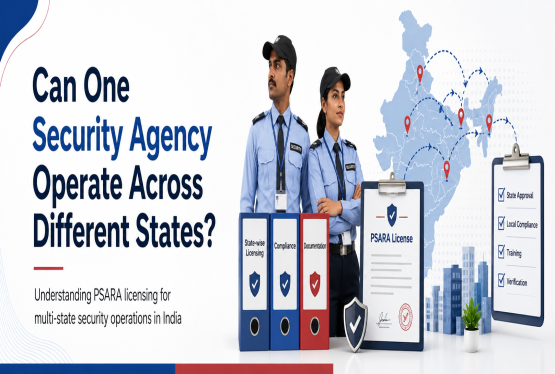
Security agencies operating across India must pay particular attention to territorial licensing requirements. PSARA is implemented by State and Union Territory Controlling Authorities, and agencies should not assume that obtaining a licence in one State automatically authorises deployment everywhere in India. The licence and State-specific PSARA rules applicable to the location where the agency proposes to provide services must be reviewed. Before accepting a client contract in another State, the agency should confirm that it possesses the required licence and satisfies the applicable local compliance conditions. This is particularly important for security companies expanding through corporate contracts covering branches, warehouses or offices located in several States.
Special Rules for Cash Transportation Security
Security services involving transportation of cash require additional attention. The Central Government has separately notified the Private Security Agencies (Private Security to Cash Transportation Activities) Rules, 2018, which prescribe specific requirements for personnel, vehicles, antecedent verification and cash-transport operations. An agency undertaking cash transportation should therefore not rely solely on general guard-deployment procedures.
Internal Audits of Client Locations
Periodic compliance audits are one of the best ways to manage PSARA obligations after deployment.
An agency should periodically verify whether each client location has:
-
Only approved and verified guards
-
Valid training records
-
Updated photo identity cards
-
Proper uniforms
-
Correct duty rosters
-
Required supervisors
-
Site-specific SOPs
-
Incident registers
-
Attendance records
-
Emergency contact lists
-
Applicable employment records
The Controlling Authority is empowered under Section 16 of PSARA to inspect an agency's premises and examine records, accounts and documents connected with the licence. Maintaining organized records therefore helps an agency respond effectively during regulatory inspection.
Consequences of Poor Guard Management
Failure to properly manage guards at client locations can result in more than a dissatisfied customer. Depending upon the violation, consequences may include client disputes, regulatory scrutiny, suspension or cancellation proceedings relating to the PSARA licence, inability to renew the licence, employment disputes and reputational damage. A compliant security agency should therefore treat guard deployment as an ongoing regulated activity rather than simply a manpower-supply arrangement.
Conclusion
Obtaining a PSARA Licence is only the first step in operating a professional private security agency. The larger responsibility begins when guards are recruited, trained and deployed at client locations. The agency must maintain control over verification, training, identity cards, uniforms, supervision, duty rosters, documentation, physical fitness and incident management. At the same time, each client location should have clearly defined security procedures, reporting mechanisms and site-specific instructions.
The Private Security Agencies (Regulation) Act, 2005 and applicable State rules create a framework intended to ensure that private security services are professional, accountable and properly regulated. Agencies that maintain strong client-site management systems are better positioned to protect their licences, strengthen customer confidence and build sustainable security-service businesses. Because PSARA administration is State-specific, agencies should also review the rules and directions of the relevant State or Union Territory Controlling Authority before deploying personnel.
FAQs
Q1. Does a PSARA Licence allow an agency to deploy security guards anywhere in India?
Ans. Not automatically. PSARA is administered through State and Union Territory Controlling Authorities. An agency should ensure that its licence covers the jurisdiction where services will be provided and comply with the applicable State-specific rules before deploying guards at a client location.
Q2. Who is responsible for a security guard after deployment at a client's premises?
Ans. The client may issue site-specific operational instructions, but the private security agency continues to have important regulatory responsibilities relating to recruitment, verification, training, identity cards, supervision and prescribed records. Deployment at a customer's premises does not eliminate the agency's obligations under PSARA.
Q3. Is police or antecedent verification required before deployment?
Ans. A private security agency must satisfy itself regarding the character and antecedents of guards and supervisors according to the applicable PSARA rules. Under the Central Model Rules, 2020, prescribed verification mechanisms include valid antecedent certificates and specified database verification through competent authorities.
Q4. How much training is required for a private security guard?
Ans. Under the Central Model Rules, 2020, entry-level training consists of at least 100 hours of classroom instruction and 60 hours of field training spread over at least 20 working days. A shorter prescribed programme applies to eligible ex-servicemen and former police personnel. State-specific rules should also be checked.
Q5. How many guards can one supervisor manage?
Ans. Under the Central Model Rules, one supervisor should generally supervise not more than 15 guards. Where guards are deployed at separate premises and such supervision is impractical, additional supervisors are contemplated so that one supervisor is available for every six guards for assistance and supervision.
Q6. Must security guards carry PSARA-related identity cards at client locations?
Ans. Every guard must be issued a photo identity card by the security agency. Guards and supervisors must carry their identity cards and produce them when required by an authorised authority. Under the Central Model Rules, guards on active duty must display the card conspicuously.
Q7. What records should an agency maintain for guards deployed at client sites?
Ans. Records should include guard and supervisor details, photographs, salary information, customer details and duty rosters. The Central Model Rules prescribe electronic Form X registers covering management, personnel, customers and deployment information, including duty commencement and ending times.
Q8. Is annual medical examination required for security guards?
Ans. Under the Central Model Rules, an agency should ensure that every security guard undergoes medical examination every twelve months from the previous examination so that continued compliance with prescribed physical standards can be assessed. Applicable State rules should also be reviewed.
Q9. Can a security guard disclose information obtained while working at a client location?
Ans. Generally, no. Section 18 of PSARA restricts unauthorized disclosure of information acquired during employment. Disclosure may be made where authorised or required by law, including in connection with police investigations or directions from competent authorities.
Q10. What is the best way to maintain PSARA compliance across multiple client locations?
Ans. Agencies should maintain centralized employee records, verified deployment lists, electronic duty rosters, supervisor visit records, training and medical records, valid identity cards, site SOPs and incident reports. Periodic internal audits should be conducted to confirm that every client site continues to comply with applicable PSARA and State requirements.


_crop10_thumb.jpg)


_crop10_thumb.jpg)


-Form_crop10_thumb.jpg)

_crop10_thumb.jpg)


_learn_crop10_thumb.jpeg)


_crop10_thumb.jpg)

_crop10_thumb.jpg)


_crop10_thumb.jpg)




_for_Foreign_Directors_learn_crop10_thumb.jpeg)


_Act,_2015_learn_crop10_thumb.jpg)










_learn_crop10_thumb.jpg)






































_crop10_thumb.jpg)


_crop10_thumb.jpg)

_(1)_crop10_thumb.jpg)











_crop10_thumb.png)















_crop10_thumb.jpg)


_crop10_thumb.jpg)






_crop10_thumb.png)

_crop10_thumb.jpg)









_crop10_thumb.png)