




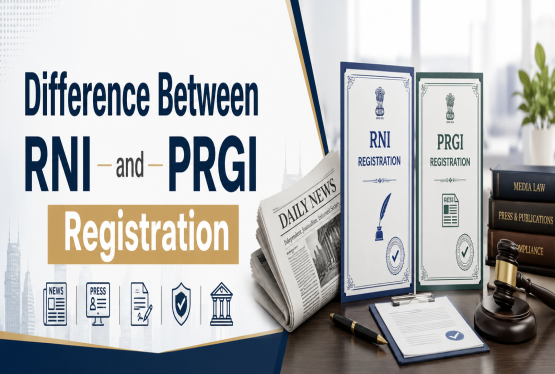
Newspaper Registration under RNI is one of the most important legal requirements for starting a newspaper, magazine or periodical in India. Earlier, this process was handled under the Press and Registration of Books Act, 1867 by the Registrar of Newspapers for India, commonly known as RNI. However, the legal framework has now changed. The old law has been replaced by the Press and Registration of Periodicals Act, 2023, and the office of RNI is now known as the Press Registrar General of India, or PRGI.
Even though people still commonly use the term “RNI Registration,” the correct legal term under the new law is registration of periodicals with PRGI. A newspaper cannot be legally printed or published in India unless it is registered as per the provisions of the Press and Registration of Periodicals Act, 2023. The purpose of newspaper registration is to regulate the publication of newspapers and periodicals, maintain proper records of publications, prevent duplicate or confusing titles, ensure accountability of publishers, and create a legal identity for printed news publications in India.
Meaning of Newspaper Registration under RNI / PRGI
Newspaper Registration means obtaining a certificate of registration for a newspaper or periodical from the Press Registrar General of India. This certificate gives legal recognition to the newspaper title, language, periodicity, owner, publisher and place of publication. Under the Press and Registration of Periodicals Act, 2023, a newspaper is treated as a type of periodical. A newspaper means a periodical consisting of loose-folded sheets, usually printed on newsprint, published daily or at least once a week, and containing current events, public news or comments on public news.
A periodical means any publication, including a newspaper, which is printed and published at regular intervals and contains public news or comments on public news. However, books and scientific, technical or academic journals are not covered in the same way. This means that if a person wants to start a publication that carries public news, comments on public news, local updates, political news, business news, social news or current affairs, registration is generally required.
Recent Legal Update: RNI is now PRGI
The biggest recent update is that the old Press and Registration of Books Act, 1867 has been repealed. The Press and Registration of Periodicals Act, 2023 and the Press and Registration of Periodicals Rules, 2024 came into effect from 1 March 2024. After this change, the Registrar of Newspapers for India has been renamed as the Press Registrar General of India. The registration process has also been shifted to the online Press Sewa Portal. Applications for new registration, revision of registration, ownership transfer, annual statement filing, penalty payment and circulation verification are now processed digitally. This is a major change because the earlier process involved more physical paperwork, manual follow-up and delay. The new system aims to make the registration process more transparent, online and time-bound.
Regulations for Newspaper Registration
-
The main laws and rules governing newspaper registration in India are:
-
The Press and Registration of Periodicals Act, 2023
-
The Press and Registration of Periodicals Rules, 2024
-
Guidelines for Admissibility and Availability of Titles
-
Press Sewa Portal procedures issued by PRGI
Directions, advisories and circulars issued by the Ministry of Information and Broadcasting and PRGI from time to time The Act applies to the whole of India. It provides the legal rules for printing presses, publication of periodicals, title verification, registration, annual statement, delivery of copies, suspension, cancellation, penalties and appeals.
Important Definitions under the Act
The Act contains several important definitions that every applicant should understand before applying for newspaper registration.
-
Newspaper: A newspaper is a periodical printed on loose-folded sheets, usually on newsprint, published daily or at least once a week and containing current events, public news or comments on public news.
-
Periodical: A periodical is any publication, including a newspaper, that is published and printed at regular intervals and contains public news or comments on public news. Books and scientific, technical or academic journals are excluded.
-
Owner: The owner means an individual, firm or legal entity that owns the periodical.
-
Publisher: The publisher is the person responsible for publishing the periodical. The publisher must obtain the certificate of registration with the authorisation of the owner.
-
Printer: The printer means the owner or keeper of the printing press.
-
Editor: The editor is the person who decides the matter that is to be published in the periodical.
-
Title: The title means the name of the newspaper or periodical that is verified by PRGI and printed prominently as the masthead on the front page.
-
Specified Authority: The specified authority usually means the District Magistrate, Collector or any other officer notified by the State Government or Union Territory Administration.
Eligibility for Newspaper Registration
The eligibility criteria for newspaper registration are simple but important.
-
The applicant may be an Indian citizen.
-
A company, LLP, partnership firm, society, trust or any entity registered in India may also apply.
-
The owner must be legally capable of owning and publishing a periodical.
-
The proposed publication must contain public news or comments on public news.
-
The publication must be printed and published at regular intervals.
-
The proposed title must not be identical or similar to an already registered title.
-
The title must follow the title admissibility guidelines issued by PRGI.
-
The owner must appoint a publisher through the Press Sewa Portal.
-
The publisher must be authorised by the owner.
-
The printing press must furnish intimation on the Press Sewa Portal.
-
The applicant must not be convicted by any court for an offence involving terrorist activity, unlawful activity or anything against the security of the State.
-
The publication must clearly mention the name of printer, place of printing, name of editor, publisher and place of publication.
-
A foreign periodical facsimile edition can be printed in India only with prior approval of the Central Government.
Process for Newspaper Registration
Step 1: Create Profile on Press Sewa Portal
The owner has to create an account on the Press Sewa Portal. The portal is used for filing applications, appointing publishers, selecting title preferences, tracking status and completing registration-related formalities.
Step 2: Select the Proposed Newspaper Title
The applicant must select a suitable title for the newspaper. The title is the identity of the newspaper and is printed on the masthead. It should be unique, meaningful and not similar to an existing title. PRGI has issued guidelines for title admissibility. Generic or common titles may not be accepted. Titles should preferably contain more than one word and should not mislead the public.
Step 3: Provide Language, Periodicity and Place of Publication
The applicant must mention the language of the newspaper, place of publication and periodicity. Periodicity means how often the newspaper will be published, such as daily, weekly, fortnightly or monthly. The place of publication is important because the application is also processed through the concerned specified authority.
Step 4: Appointment of Publisher
The owner appoints the publisher on the portal. The publisher is responsible for publishing the newspaper and filing the main registration application. The publisher has to create or use his own account on the Press Sewa Portal and complete the details required for registration.
Step 5: Selection of Printing Press
The publisher must select the printing press where the newspaper will be printed. The printing press must also be registered or have an account on the Press Sewa Portal. Every printer of a periodical must furnish intimation online to PRGI and the specified authority within whose jurisdiction the printing press is situated.
Step 6: Filing of Online Application
The publisher files the application for registration on the Press Sewa Portal. The application includes details of owner, publisher, printer, editor, title, language, periodicity, place of publication and other required information. A processing fee is paid online. After submission, an Application Reference Number is generated.
Step 7: Correction Window
After submitting the application, a limited correction window is available. As per PRGI portal guidance, the publisher gets a short period to correct submitted information. Once this period is over, no correction is allowed in the submitted application.
Step 8: Review by Specified Authority
The application is forwarded to the specified authority, such as the District Magistrate or Collector. The specified authority may give no-objection or comments within the prescribed time. Under the new Act, the specified authority is expected to provide comments or no-objection within 60 days. If the application is by the Central Government, State Government or an authority under such government, no-objection from the specified authority is not required.
Step 9: Examination by PRGI
PRGI examines whether the application is complete, whether the title is available and admissible, whether the applicant is eligible, and whether the legal requirements have been followed. If PRGI is satisfied, it issues the certificate of registration. If PRGI finds defects or legal issues, it may refuse registration after giving an opportunity of being heard and recording reasons in writing.
Step 10: Issue of Certificate of Registration
Once approved, PRGI issues the certificate of registration. The certificate contains important details such as title, owner, language, periodicity, place of publication and other particulars. After receiving the certificate, the publisher must start publication. If the publisher fails to start publication within twelve months from the end of the month in which the certificate was issued, PRGI may cancel the certificate and withdraw the title.
Documents Required for Newspaper Registration
The documents may vary depending on the type of applicant and portal requirements. Common documents include:
-
Identity proof of owner and publisher
-
Address proof of owner and publisher
-
Business registration proof, if the owner is a company, LLP, firm, society or trust
-
Authorisation from owner in favour of publisher
-
Details of editor
-
Details of printing press
-
Printing press intimation
-
Proof of place of publication
-
Proposed title details
-
Language and periodicity details
-
Declaration or undertaking as required on the portal
-
Board resolution or authority letter, if applicant is a company or LLP
Applicants should ensure that all details are consistent across documents. Difference in name, address, title, language or ownership details may lead to objection or delay.
Title Guidelines for Newspaper Registration
Title approval is one of the most important parts of newspaper registration. A title should not be the same or similar to an already registered title in the same language anywhere in India or in any other language in the same State or Union Territory.
PRGI may reject titles that are generic, misleading, offensive, confusing, identical, similar or against title guidelines. Applicants should avoid single common words, government-sounding names, names that suggest false official recognition, and titles that may create confusion with existing newspapers.
Before applying, it is advisable to search the registered titles database available on the PRGI website.
-
Legal Duties After Registration: Registration is not the end of compliance. After receiving registration, the publisher and owner must follow several ongoing duties.
-
Printing of Mandatory Details: Every periodical printed in India must clearly print the name of printer, place of printing, name of editor, publisher and place of publication.
-
Commencement of Publication: The publisher must start publication after receiving the certificate. Failure to commence publication within the prescribed period may result in cancellation.
-
Annual Statement: Every publisher must file an annual statement with PRGI for the preceding financial year. As per portal requirements, the annual statement has to be filed through the Press Sewa Portal by the prescribed date.
-
Upload of E-Copies: The publisher must upload scanned copies of the printed periodical on the Press Sewa Portal within the prescribed time. This helps PRGI maintain digital records of publications.
-
Delivery of Physical Copies: The publisher must deliver physical copies of newspaper issues as required under the Act and Rules. Generally, copies are required to be delivered to the designated PRGI, PIB or government office depending on the place of publication.
-
Intimation of Discontinuation: If the owner decides to discontinue publication, online intimation must be given to PRGI and the specified authority within six months of discontinuation.
-
Transfer of Ownership: Transfer of ownership of a registered periodical must be done as per the Act. The owner has to apply to PRGI with required documents and fees. PRGI may permit or refuse transfer after considering the application and comments, if any.
In the case of a company, any change in shareholding pattern must be intimated within the required time after such change is informed to the Registrar of Companies.
Suspension and Cancellation of Registration
PRGI may suspend or cancel registration in certain cases. Registration may be suspended if it was obtained by false representation, concealment of material fact, failure to publish continuously, false particulars in annual statement or failure to furnish annual statement within the required period.
A periodical may be treated as not publishing continuously if it publishes less than half of the required issues in a calendar year according to the declared periodicity. PRGI may cancel registration if defects are not removed during suspension, if the title is same or similar to another title, if title guidelines are violated, or if the owner or publisher is convicted for terrorist activity, unlawful activity or an offence against security of the State.
Penalties under the Act
The Act gives PRGI power to impose penalties. If a periodical is published without a certificate of registration, PRGI may impose a penalty up to five lakh rupees and direct the publisher to stop publication. If the publisher fails to file the annual statement within one year from the end of the financial year, penalty may be imposed. For the first default, the penalty may be between ten thousand rupees and twenty thousand rupees. For later defaults, the penalty may be doubled, subject to the maximum limit provided under the Act. If a publisher continues publication even after direction to stop, or publishes another periodical without registration, imprisonment may extend up to six months.
Appeal Against PRGI Order
A person aggrieved by refusal of registration, suspension, cancellation or penalty order may file an appeal before the Press and Registration Appellate Board. The appeal should generally be filed within 60 days from the date of communication of the order. Delay may be condoned if sufficient cause is shown.
Latest Practical Update on Online System
The Press Sewa Portal has become the main platform for registration and compliance. New registration, revision, ownership transfer, annual statement, penalty payment and circulation verification are now processed online. More than 1.5 lakh old newspaper records created under the earlier law have been digitised and added to the portal. Specified authorities from hundreds of districts have also been onboarded. This means applicants should now treat Press Sewa Portal as the primary platform for newspaper registration and post-registration compliance.
Common Mistakes to Avoid
Many applications get delayed because of basic mistakes. Applicants should avoid choosing a title that is too generic or similar to an existing title. They should also avoid mismatch in owner details, publisher details, address, language, periodicity or printer information. Another common mistake is starting publication before registration. Under the new law, publication without registration may attract penalty. Similarly, ignoring annual statement filing, e-copy upload, physical copy submission or change intimation may lead to penalty, suspension or cancellation.
Conclusion
Newspaper Registration under RNI, now legally handled by PRGI, is mandatory for starting a newspaper or periodical in India. The new Press and Registration of Periodicals Act, 2023 has changed the old system and introduced a more digital, transparent and organised process through the Press Sewa Portal.
Anyone planning to start a newspaper must first check eligibility, choose a proper title, appoint a publisher, select a compliant printing press, file the online application, cooperate with the specified authority and obtain the certificate of registration before publication. After registration, the publisher must continue to follow annual statement filing, e-copy upload, physical copy delivery, publication regularity and change intimation requirements. Newspaper registration is not only a legal formality; it is the foundation of lawful publishing in India.
FAQs
Q1: Is RNI Registration still required for newspapers in India?
Ans. Yes. Newspaper registration is still required, but the old RNI system has now been replaced by PRGI under the Press and Registration of Periodicals Act, 2023. People still commonly call it RNI Registration, but legally it is PRGI registration.
Q2: Which law governs newspaper registration in India?
Ans. Newspaper registration is governed by the Press and Registration of Periodicals Act, 2023 and the Press and Registration of Periodicals Rules, 2024.
Q3: Can a newspaper be published without registration?
Ans. No. A newspaper or periodical cannot be legally printed or published in India unless it is registered as per the Act. Publishing without registration may attract penalty.
Q4: Who can apply for newspaper registration?
Ans. An Indian citizen or an entity registered in India, such as a company, LLP, firm, society or trust, can apply, subject to legal eligibility and title availability.
Q5: What is the first step in newspaper registration?
Ans. The first step is to create an account on the Press Sewa Portal and apply for the proposed title, language, periodicity and place of publication.
Q6: What is title verification?
Ans. Title verification means checking whether the proposed newspaper name is available, admissible and not similar to any existing registered title.
Q7: Who is the specified authority?
Ans. The specified authority is generally the District Magistrate, Collector or any officer notified by the State Government or Union Territory Administration for processing applications in that area.
Q8: Is annual statement filing mandatory after registration?
Yes. The publisher has to file an annual statement with PRGI for the registered periodical as per the prescribed timeline and portal requirements.
Q9: Can ownership of a registered newspaper be transferred?
Ans. Yes. Ownership can be transferred, but it must be done through the process prescribed under the Act and with permission from PRGI.
Q10: What happens if a registered newspaper stops publication?
Ans. If the owner decides to discontinue the newspaper, online intimation must be given to PRGI and the specified authority within the prescribed time. PRGI may then cancel the certificate and remove the title from the register.


_crop10_thumb.jpg)


_crop10_thumb.jpg)


-Form_crop10_thumb.jpg)

_crop10_thumb.jpg)


_learn_crop10_thumb.jpeg)


_crop10_thumb.jpg)

_crop10_thumb.jpg)


_crop10_thumb.jpg)





_for_Foreign_Directors_learn_crop10_thumb.jpeg)


_Act,_2015_learn_crop10_thumb.jpg)









_learn_crop10_thumb.jpg)

































_crop10_thumb.jpg)

_crop10_thumb.jpg)

_(1)_crop10_thumb.jpg)









_crop10_thumb.png)














_crop10_thumb.jpg)


_crop10_thumb.jpg)








_crop10_thumb.png)

_crop10_thumb.jpg)









_crop10_thumb.png)