
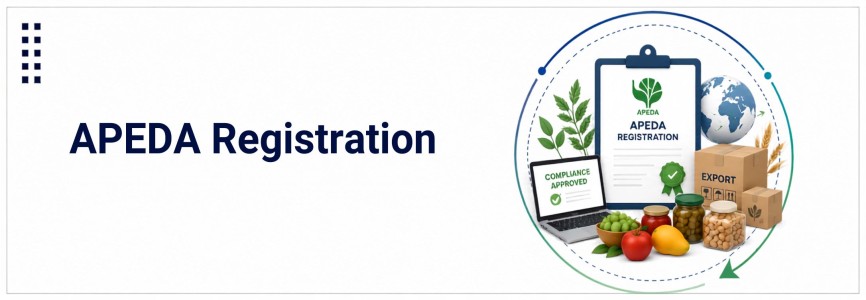



Exporting agricultural or processed food products from India involves much more than finding an overseas buyer and arranging shipment. Before entering the international market, an exporter must identify the correct product category, obtain an Importer Exporter Code, understand the applicable export policy and complete product-specific registrations.
For businesses dealing in products regulated by the Agricultural and Processed Food Products Export Development Authority, APEDA Registration is one of the most important requirements. It establishes the exporter’s association with APEDA and enables the business to obtain a Registration-cum-Membership Certificate, commonly known as RCMC.
The process is now completed online through the Directorate General of Foreign Trade portal. However, a successful application requires correct selection of the registering authority, accurate product classification, valid manufacturing proof and consistency between the exporter’s legal documents.
This guide explains the complete online APEDA Registration process, applicable legal provisions, fees, validity, cancellation grounds and recent regulatory developments as of July 2026.
What Is APEDA Registration?
APEDA Registration refers to the process through which an exporter dealing in APEDA Scheduled Products obtains an e-RCMC. The certificate establishes that the exporter is registered with the competent export promotion authority for its principal line of business.APEDA is a statutory authority constituted under the Agricultural and Processed Food Products Export Development Authority Act, 1985. The Act came into force on 13 February 1986, and APEDA functions under the Department of Commerce, Ministry of Commerce and Industry.
The Authority is responsible for promoting and developing the export of agricultural and processed food products specified in the Schedules to the Act. Its functions include exporter registration, development of industries, improvement of packaging and marketing, quality-related measures, inspection and collection of export information.
Although businesses commonly use the expression “APEDA Certificate,” the document issued to an exporter is legally and administratively an electronic Registration-cum-Membership Certificate.
Legal Provisions Governing APEDA Registration
APEDA Registration is governed by a combination of the APEDA Act, APEDA Rules, Foreign Trade Policy and directions issued by APEDA and DGFT.
APEDA Act, 1985
Section 10 of the APEDA Act describes the functions of the Authority. These include promoting exports, registering exporters, improving product quality, encouraging better packaging and marketing, collecting statistics and supporting the development of Scheduled Products.
Section 12 deals specifically with registration of exporters. It requires persons exporting one or more Scheduled Products to apply for registration with the Authority in the prescribed manner. The provision also allows the prescribed authority to extend the application period where sufficient reasons exist.
Section 13 empowers the prescribed authority to process registration applications, collect the applicable fee and maintain the register of exporters. It also provides the statutory basis for cancellation of registration in circumstances prescribed under the Act and Rules.
Section 14 requires registered exporters to furnish prescribed information and returns. APEDA may also authorise inspection of processing plants or other establishments to verify the correctness of information supplied by an exporter.
Section 19 empowers the Central Government to prohibit, restrict or otherwise control the export or import of Scheduled Products in the public interest. Sections 22 to 25 deal with contraventions, offences and company-related liability, while Section 31 clarifies that the APEDA Act operates in addition to other applicable laws.
This means obtaining APEDA Registration does not replace compliance under customs law, food safety law, plant quarantine requirements, foreign-exchange regulations or destination-country standards.
APEDA Rules, 1986
Rules 9, 10 and 11 of the APEDA Rules are particularly relevant to registration. Rule 9 concerns the form and manner of applying, while Rule 10 deals with grant or refusal of registration.
Where an application is rejected, the authority must record the reasons in writing. The Rules also provide for the issuance of a registration certificate where the application is accepted.
Rule 11 permits cancellation where the registration was obtained by furnishing incorrect information, where the exporter violates applicable conditions or where the exporter fails to export the registered Scheduled Products for a continuous period prescribed under the Rules. A reasonable opportunity to present objections must ordinarily be provided before cancellation.
Foreign Trade Policy, 2023
Paragraph 2.57 of the Foreign Trade Policy provides the broader RCMC provision. An exporter seeking an authorisation, benefit or concession under the Foreign Trade Policy may be required to provide an RCMC from the concerned Export Promotion Council, Commodity Board or Development Authority unless specifically exempted.
The exporter is expected to obtain the certificate from the registering authority connected with its principal line of business. Therefore, a food exporter should not select APEDA merely because some agricultural product appears in its business objects. The main export product must fall within APEDA’s statutory coverage.
Which Products Are Covered by APEDA?
APEDA Registration applies to exporters dealing in products included in the First and Second Schedules to the APEDA Act.
The product coverage includes fruits, vegetables and their products; meat and meat products; poultry and poultry products; dairy products; confectionery, biscuits and bakery products; honey, jaggery and sugar products; cocoa and chocolate products; alcoholic and non-alcoholic beverages; cereals and cereal products; groundnuts, peanuts and walnuts; pickles, papads and chutneys; guar gum; floriculture products; herbal and medicinal plants; de-oiled rice bran; cashew nuts and cashew products.
Basmati rice is separately covered under the Second Schedule. De-oiled rice bran was added to the First Schedule in May 2022, while cashew nuts and their products were added in July 2022.
Exporters should confirm the applicable HS code and product description before applying. A product may appear to be agricultural in nature but may legally fall under another commodity board or export promotion council.
Who Can Apply for APEDA Registration?
A proprietorship firm, partnership firm, Limited Liability Partnership, private limited company, public company, cooperative society, trust or other legally recognised business entity may apply, provided it holds an active IEC and proposes to export APEDA Scheduled Products.
Both merchant exporters and manufacturer exporters may obtain registration. However, their documentary requirements are different.
A merchant exporter generally purchases products from manufacturers, processors or farmers and exports them in its own name. A manufacturer exporter manufactures or processes the goods at its own facility before export. A manufacturer-cum-merchant exporter may manufacture some products while procuring others from third parties.
The exporter type selected in the application must reflect the actual business model. Selecting “manufacturer exporter” without valid manufacturing proof is one of the most common reasons for a deficiency or resubmission.
Prerequisites Before Starting the Online Application
The applicant must obtain an Importer Exporter Code from DGFT before applying for APEDA e-RCMC. Since the RCMC is linked to the IEC, the legal name, PAN, registered address, constitution and contact details appearing in the IEC profile must be accurate and updated.
The DGFT portal requires an active IEC, an updated IEC profile and a valid method of electronic authentication. The application may be signed using a Digital Signature Certificate or Aadhaar-based electronic signing, subject to the portal’s current functionality and the applicant’s constitution.
The business should also decide its main line of business before starting. Where multiple products are exported, the principal product category should be selected carefully so that the correct registering authority is chosen.
Documents Required for APEDA Registration
The documents required for APEDA Registration depend on whether the applicant is a merchant exporter, manufacturer exporter or manufacturer-cum-merchant exporter. A merchant exporter is generally required to submit a signed and stamped copy of the Importer Exporter Code. Manufacturers must additionally provide valid proof of their manufacturing or processing facility. The acceptable document may vary according to the product category, and all details should match the applicant’s IEC and business records.
Basic Documents
- Signed and stamped copy of the Importer Exporter Code
- PAN details of the applicant entity
- Registered or business address details
- Valid email address and mobile number
- Bank account details
- Details of the authorised signatory
Documents for Fresh Fruits and Vegetables
Manufacturer exporters dealing in fresh fruits and vegetables may be required to provide proof of their manufacturing, processing or handling activity.
- FSSAI licence
- Udyam Registration or MSME certificate
- Certificate from the Department of Horticulture
- Other applicable manufacturing or processing proof
Documents for Processed Food Products
Exporters dealing in processed food products must provide documents establishing that the business is authorised to manufacture or process the relevant products.
- FSSAI licence
- Udyam Registration
- MSME certificate
- Valid manufacturing or processing licence
- Other product-specific approval, where applicable
This category may include cereal preparations, meat products, dairy products, poultry products, honey, groundnut products, pulses and guar gum.
Documents for Floriculture Products and Seeds
For floriculture products and seeds, the applicant may be required to submit certification from the relevant horticulture or agriculture authority.
- Certificate from the Department of Horticulture
- Nursery or seed-related registration, where applicable
- Proof of cultivation, processing or handling facility
- Other approval required for the specific product
Documents for Alcoholic Beverages
Applicants exporting alcoholic beverages may need approval or documentary proof from the relevant excise authority.
- Licence issued by the State Excise Department
- Certificate from the concerned Excise Commissioner
- Manufacturing or bottling licence
- Other product-specific permission, where required
Important Points to Remember
The APEDA circular dated 27 March 2026 provides category-specific document requirements for merchant exporters, manufacturer exporters and manufacturer-cum-merchant exporters. Applicants should ensure that the legal name, PAN, address, business constitution and authorised signatory details are consistent across the IEC, FSSAI licence, Udyam Registration and other supporting documents. Although some information may be fetched automatically from the IEC profile, incorrect or outdated details can lead to objections, deficiencies or delays in processing the APEDA Registration application.
Step-by-Step Process to Apply for APEDA Registration Online
Step 1: Obtain and Update the IEC
The first step is to obtain an IEC in the name of the applicant entity. The legal name and PAN used for APEDA Registration must match the IEC database.
Where the business address, partner details, director details, email address or mobile number has changed, the IEC profile should be updated before the RCMC application is started. An outdated IEC often leads to conflicting information across the application and uploaded documents.
Step 2: Create or Access the DGFT Account
The applicant must access the DGFT portal using the credentials connected with its IEC. The IEC should be linked to the user profile before an e-RCMC application can be submitted. APEDA began processing and issuing RCMCs through the DGFT portal from 17 July 2023 in accordance with the centralised e-RCMC . Exporters no longer use the earlier standalone APEDA registration filing system for new e-RCMC applications.
Step 3: Open the e-RCMC Application Service
After signing in, the applicant must navigate to the e-RCMC section under the relevant DGFT services and select the option to apply for an e-RCMC. The portal also provides separate services for renewal, amendment and viewing previously issued certificates. The exact placement of menus may change as the portal is updated, but the e-RCMC service remains the central filing route.
Step 4: Select APEDA as the Registering Authority
The applicant must select the Agricultural and Processed Food Products Export Development Authority as the registering authority. This selection should be based on the principal export product. Choosing an incorrect Export Promotion Council or commodity board can result in rejection or the need to file a fresh application with the appropriate authority.
Step 5: Enter Exporter and Product Details
The applicant must provide its constitution, exporter category, main line of business and product details. The information should clearly identify whether the entity is a merchant exporter, manufacturer exporter or manufacturer-cum-merchant exporter. The product description should be consistent with the IEC profile, manufacturing licence, FSSAI licence and proposed export activities. Broad or unrelated product selections should be avoided.
Step 6: Upload the Supporting Documents
The applicant must upload a signed and stamped copy of the IEC and the prescribed manufacturing proof, wherever applicable. Documents should be clear, valid and issued in the same name as the applicant. If a manufacturing facility operates from a different address, the connection between the applicant and the facility should be properly established. A licence belonging to an unrelated entity should not be uploaded as the applicant’s manufacturing proof unless a legally valid arrangement and the relevant authority’s requirements permit such reliance.
Step 7: Pay the Government Fee
The present APEDA e-RCMC fee is ?5,000 plus 18% GST of ?900, making the total online payment ?5,900. The same amount is presently prescribed for renewal. Amendment or modification after issuance is stated to be free under the current APEDA procedure. The applicant should preserve the payment receipt and application acknowledgement. Payment alone does not result in automatic issuance; the application remains subject to examination by APEDA.
Step 8: Sign and Submit the Application
After reviewing all information, the applicant must electronically sign the application through the available DSC or Aadhaar e-sign facility and submit it. Before signing, the applicant should verify the legal name, IEC, product category, exporter type, registered address and uploaded documents. Incorrect declarations can lead to refusal, cancellation or further legal consequences.
Step 9: Track the Application and Respond to Deficiencies
APEDA may approve the application or raise a deficiency where clarification or additional documentation is required. The applicant should monitor its DGFT dashboard and registered email regularly. Any deficiency should be answered with a clear explanation and relevant supporting documents instead of merely uploading the same document again. Once approved, the electronic RCMC can be downloaded from the DGFT portal.
Validity and Renewal of APEDA Registration
An e-RCMC is generally issued for five financial years. The validity is linked to financial years rather than merely five calendar years from the date of approval. Exporters should check the exact validity dates printed on the certificate and apply for renewal before expiry. Continuing to rely on an expired certificate can affect applications for export benefits, authorisations or APEDA-linked services. Renewal is also completed through the DGFT e-RCMC module. The exporter should ensure that its IEC remains active and that its business, product and manufacturing information is updated at the time of renewal.
Amendment of an Existing Certificate
An exporter may need amendment where there is a change in business address, constitution, product category, contact details, authorised person or manufacturing status. The amendment application should be filed promptly through the DGFT portal. APEDA’s March 2026 procedure states that amendments or modifications after issuance are presently processed without an additional fee. A major constitutional change, such as conversion of a proprietorship into a company, may not always be treated as a simple amendment because the PAN and legal entity may change. In such cases, a fresh IEC and fresh registration may be necessary.
Post-Registration Legal Responsibilities
Receiving the RCMC is not the end of compliance. Registered exporters must furnish returns and information required by APEDA under Section 14 of the Act. Exporters should maintain proper records of products exported, quantities, destination countries, invoices, shipping bills, certificates and processing facilities. APEDA may seek information or conduct inspections to verify compliance.
Product-specific requirements may also apply. For example, exports of organic products may require certification under the National Programme for Organic Production. Meat, dairy, fresh produce, groundnut and Basmati rice exports may involve separate establishment approval, traceability, residue-monitoring, health certification or consignment-level documentation.
An APEDA RCMC does not by itself certify that the product is safe, organic, residue-free or compliant with the importing country’s standards.
Refusal or Cancellation of Registration
APEDA may refuse an application where the applicant does not meet the documentary requirements, selects an incorrect product category, provides inconsistent information or fails to establish eligibility. Registration may be cancelled where it was obtained through false or incorrect information, where the exporter violates statutory conditions or where the circumstances specified under Rule 11 arise.
Before cancellation, the exporter must ordinarily be given a reasonable opportunity to submit objections. However, the opportunity should be used to provide documentary evidence and a legally supported explanation, not merely a general request for continuation.
False declarations may also attract consequences under other laws, including the Foreign Trade Development and Regulation Act, customs law, food safety law and the penal framework applicable to fraudulent documentation.
Recent APEDA and DGFT Updates
APEDA issued a fresh general circular on the procedure for e-RCMC on 27 March 2026. The circular clarifies the documents required from merchant exporters and manufacturer exporters, product-specific manufacturing proof, current fee, renewal amount and amendment process.
Another significant development is the Jan Vishwas amendment framework effective from 26 June 2026. It updated the enforcement and adjudication architecture under several commercial laws, including APEDA-related provisions, and introduced a structured adjudication and appeal mechanism under Section 25A. Businesses should therefore refer to the latest consolidated Act instead of relying on penalty figures reproduced in older articles or legacy copies of the law.
On 20 July 2026, DGFT issued Trade Notice No. 14/2026-27 seeking stakeholder comments on a proposed amendment to Paragraph 2.57 of the Foreign Trade Policy. The draft proposal considers exempting export consignments having an FOB value of up to ?10,000 from the RCMC requirement for specified FTP benefits, except exports of restricted items.
As of 21 July 2026, this is a consultation proposal and should not be treated as an operational exemption unless a final notification or amendment is issued by DGFT. Exporters should continue following the existing requirements until the proposal is formally adopted.
Common Mistakes to Avoid
Many applications are delayed because the applicant selects APEDA without first confirming whether the product is covered under its Schedule. Others incorrectly apply as manufacturer exporters while possessing only trading documents.
Mismatch between the IEC, PAN, FSSAI licence, Udyam Registration and manufacturing address is another common issue. Expired licences, unclear scans and missing signatures can also lead to deficiencies.
Exporters should not assume that obtaining an RCMC automatically provides permission to export every product selected in the application. Restricted products, quota-controlled goods and products subject to health, quarantine or quality conditions require separate compliance.
Conclusion
Applying for APEDA Registration online is a structured process, but it requires more than completing an electronic form. The exporter must first establish that its products fall within APEDA’s jurisdiction, obtain an active IEC, select the correct exporter category and arrange valid supporting documents.
The application is submitted through the DGFT e-RCMC portal by selecting APEDA as the registering authority, entering product and business information, uploading the required documents, paying the prescribed fee and completing electronic authentication.
Once issued, the certificate is generally valid for five financial years. During this period, the exporter must keep its information updated, furnish applicable returns, maintain records and follow all product-specific export requirements.
A properly prepared application reduces the risk of objections and creates a reliable foundation for accessing export benefits, participating in APEDA programmes and building a compliant agricultural or processed food export business.
Disclaimer: This article is intended for general informational purposes and does not constitute legal, tax, customs or export-policy advice. Requirements may vary depending on the product, HS code, exporter category, destination country and applicable government notification. Applicants should review the latest APEDA and DGFT instructions before submitting an application.
Frequently Asked Questions (FAQs)
Q1. Who is required to obtain APEDA Registration?
Ans: Exporters dealing in agricultural and processed food products covered under the APEDA Act may need registration.
It is applicable to merchant exporters, manufacturer exporters and manufacturer-cum-merchant exporters.
The applicant must also hold a valid Importer Exporter Code issued by DGFT.
Q2. Is APEDA Registration mandatory for all exporters?
Ans: No, APEDA Registration is required only for exporters dealing in products falling under APEDA’s jurisdiction.
Products regulated by another Commodity Board or Export Promotion Council may require registration elsewhere.
The product category and HS code should be checked before filing the application.
Q3. How can I apply for APEDA Registration online?
Ans: The application is filed through the DGFT e-RCMC portal by selecting APEDA as the registering authority.
The applicant must enter business details, select products, upload documents and pay the prescribed fee.
After verification and approval, the electronic RCMC can be downloaded from the portal.
Q4. What documents are required for APEDA Registration?
Ans: A signed copy of the IEC and basic business details are generally required for merchant exporters.
Manufacturer exporters must also provide valid manufacturing or processing proof, such as an FSSAI licence or Udyam Registration.
Additional documents may be required depending on the nature of the exported product.
Q5. What is the government fee for APEDA Registration?
Ans: The current registration fee is ?5,000 plus 18% GST, making the total payable amount ?5,900.
The fee is paid online while submitting the e-RCMC application through the DGFT portal.
Applicants should preserve the payment receipt and application acknowledgement for future reference.
Q6. What is the validity of APEDA Registration?
Ans: An APEDA e-RCMC is generally valid for five financial years from the relevant licensing period.
The exact validity dates are mentioned on the certificate issued through the DGFT portal.
The exporter should apply for renewal before expiry to maintain uninterrupted registration status.
Q7. Can a merchant exporter apply for APEDA Registration?
Ans: Yes, a merchant exporter dealing in APEDA Scheduled Products can apply for registration.
Such an exporter usually purchases products from manufacturers, processors or farmers and exports them in its own name.
The applicant must select the merchant exporter category correctly in the online application.
Q8. Can APEDA Registration be amended after issuance?
Ans: Yes, an exporter may apply for amendment where business details, address, product category or contact information changes.
The amendment request must be submitted through the DGFT e-RCMC portal with supporting documents.
A major change in the legal entity or PAN may require a fresh registration instead of amendment.
Q9. Can APEDA Registration be cancelled?
Ans: Yes, APEDA may cancel the registration if it was obtained using false information or documents.
Cancellation may also occur for violation of applicable conditions or continued non-compliance with statutory requirements.
The exporter is ordinarily given an opportunity to explain its position before cancellation.
Q10. Does APEDA Registration allow immediate export of all products?
Ans: No, APEDA Registration only establishes membership with the relevant export development authority.
Separate compliance may be required under FSSAI, Customs, Plant Quarantine, organic certification or destination-country laws.
The exporter must verify all product-specific approvals before dispatching the shipment.


_crop10_thumb.jpg)


_crop10_thumb.jpg)


-Form_crop10_thumb.jpg)

_crop10_thumb.jpg)


_learn_crop10_thumb.jpeg)


_crop10_thumb.jpg)

_crop10_thumb.jpg)


_crop10_thumb.jpg)





_for_Foreign_Directors_learn_crop10_thumb.jpeg)


_Act,_2015_learn_crop10_thumb.jpg)










_learn_crop10_thumb.jpg)











































_crop10_thumb.jpg)


_crop10_thumb.jpg)


_(1)_crop10_thumb.jpg)












_crop10_thumb.png)












_crop10_thumb.jpg)


_crop10_thumb.jpg)







_crop10_thumb.png)

_crop10_thumb.jpg)









_crop10_thumb.png)









_crop10_thumb.jpg)
