


Gold has always been one of the most trusted and valuable precious metals in India. For centuries, gold jewellery has been associated with cultural traditions, financial security, and personal wealth. However, the value of gold depends largely on one important factor — purity. A customer purchasing gold jewellery expects that the product contains the purity of gold claimed by the seller. This is where hallmarking plays a crucial role.
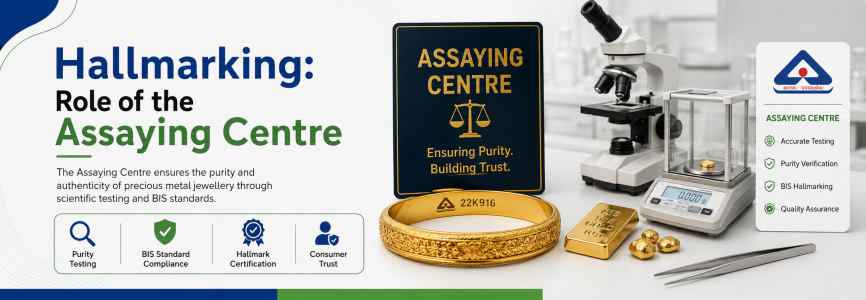
Hallmarking provides an official assurance that a precious metal article has been tested and meets the required purity standards. At the centre of this process are Assaying and Hallmarking Centres (AHCs), which perform scientific testing and certify the purity of gold and silver articles. The role of an assaying centre goes beyond simply testing jewellery. These centres act as an important link between jewellers, consumers, and the regulatory system by ensuring transparency, accuracy, and trust in the precious metals market.
Understanding Hallmarking
Hallmarking is the official recording and certification of the proportionate content of precious metal in an article. It confirms that the jewellery or artefact meets the declared purity standard. In India, hallmarking of gold and silver jewellery is regulated by the Bureau of Indian Standards (BIS).
The purpose of hallmarking is to:
- Protect consumers from purchasing impure jewellery
- Ensure accuracy in purity claims
- Promote transparency in the jewellery industry
- Build confidence in precious metal transactions
A hallmarked gold article carries specific identification marks that indicate its authenticity and purity.
These marks generally include:
- BIS Standard Mark
- Purity/Fineness grade
- Hallmark Unique Identification (HUID) number
What Is an Assaying and Hallmarking Centre?
An Assaying and Hallmarking Centre (AHC) is a facility recognised by BIS for testing and hallmarking precious metal articles. These centres are responsible for scientifically examining jewellery and determining whether it conforms to the required purity standards. Assaying centres use specialised testing methods and equipment to analyse the composition of gold and silver articles.
Their primary responsibilities include:
- Receiving jewellery articles from registered jewellers
- Testing the purity of precious metals
- Conducting accurate assaying procedures
- Applying hallmark identification
- Maintaining testing records
The reliability of the entire hallmarking system depends significantly on the accuracy and integrity of these centres.
Importance of Assaying Centres in the Hallmarking System
Assaying centres serve as the backbone of the hallmarking process. A jeweller may manufacture or sell gold jewellery, but the purity claim must be independently verified. Assaying centres provide this independent verification.
Their role is important because they:
Ensure Accurate Purity Testing
Gold jewellery may contain alloys and other metals mixed with gold to improve strength and durability. The actual gold content needs to be scientifically measured before certification. Assaying centres conduct tests to determine the exact purity level of the article.
For example, gold jewellery marked as 22 karat must meet the required purity level associated with that standard. Accurate testing prevents incorrect purity claims and protects buyers.
Scientific Testing Methods Used by Assaying Centres
Assaying centres use advanced testing techniques to determine gold purity. Some commonly used methods include:
Fire Assay Method
Fire assay is considered one of the most accurate methods for determining precious metal content. In this process, the sample is tested through controlled heating and chemical analysis to determine the actual gold percentage.
X-Ray Fluorescence (XRF) Testing
XRF testing is a modern non-destructive method used for analysing the composition of metals. It helps identify the percentage of gold and other elements present in the jewellery article without significantly damaging the product.
Other Laboratory Procedures
Depending on requirements, assaying centres may use additional laboratory techniques to ensure accurate results. The objective is always to provide reliable purity assessment.
Role of Assaying Centres in Consumer Protection
Consumers often purchase gold jewellery as a long-term investment. A small difference in purity can significantly impact the value of the product.
Assaying centres help protect consumers by ensuring that:
- Purity claims are verified
- Jewellery meets declared standards
- Buyers receive value for their money
Without independent testing facilities, consumers would have to rely only on the claims made by sellers. Hallmarking creates a system where quality is verified through scientific testing rather than only market reputation.
Supporting Trust in the Jewellery Industry
Trust is one of the most important factors in jewellery retail. Customers often choose jewellers based on reputation, but independent hallmarking provides an additional layer of confidence. Assaying centres contribute to building trust by ensuring that jewellery sold in the market follows recognised purity standards.
For jewellery businesses, this creates opportunities to:
- Strengthen customer relationships
- Improve brand reputation
- Build credibility
- Encourage repeat purchases
A transparent hallmarking system benefits both consumers and honest businesses.
Process Followed by an Assaying Centre
The hallmarking process generally involves multiple steps:
Step 1: Submission of Jewellery
Registered jewellers submit jewellery articles to an authorised assaying and hallmarking centre. The centre receives details of the articles and records necessary information.
Step 2: Preliminary Examination
The articles are examined to ensure they are suitable for testing. Details such as weight, identification, and other relevant information are recorded.
Step 3: Purity Testing
The jewellery undergoes scientific testing to determine the actual gold content. The testing process verifies whether the article meets the declared purity standard.
Step 4: Approval for Hallmarking
If the article meets the required standard, the hallmark identification is applied. If the purity does not match the declared standard, the article is not approved for hallmarking.
Step 5: Record Maintenance
Assaying centres maintain records of tested articles to support traceability and verification.
Role of Assaying Centres in Digital Hallmarking
Technology has transformed the hallmarking system in India. The introduction of the Hallmark Unique Identification (HUID) system has improved transparency and traceability. Assaying centres play an important role in this digital system by ensuring that hallmark details are correctly recorded.
Digital systems help:
- Track jewellery articles
- Reduce chances of misuse
- Improve verification
- Increase consumer confidence
Customers can verify hallmark details using official digital platforms, making the purchasing process more transparent.
Importance of Quality Management at Assaying Centres
Since assaying centres directly influence consumer trust, maintaining quality standards is extremely important.
These centres must ensure:
- Accurate testing procedures
- Proper equipment maintenance
- Skilled technical staff
- Reliable record keeping
- Compliance with BIS requirements
Even a small error in testing can affect the value of expensive jewellery. Therefore, quality management is a critical part of assaying operations.
Challenges Faced by Assaying Centres
Although assaying centres play an important role, they also face several challenges.
Increasing Testing Demand
With the growth of the jewellery market, the demand for hallmarking services has increased. Assaying centres need adequate infrastructure and capacity to manage higher volumes.
Maintaining Testing Accuracy
Precious metal testing requires precision. Regular calibration of equipment and trained professionals are necessary to maintain accuracy.
Technology Adoption
As hallmarking becomes more digital, centres must continuously upgrade their systems and processes.
Handling Diverse Jewellery Designs
Modern jewellery includes complex designs, stones, and mixed materials, making testing procedures more challenging.
Role of Assaying Centres in Organised Gold Retail
The jewellery industry is gradually becoming more organised, with customers demanding greater transparency. Assaying centres support this transformation by creating a reliable quality verification system.
Organised jewellery businesses benefit from hallmarking because it helps them demonstrate:
- Product authenticity
- Quality commitment
- Ethical business practices
As competition increases, certified quality can become a major differentiating factor.
Future of Assaying Centres in India
The future of assaying centres will be closely connected with technology, automation, and increasing consumer awareness.
Future developments may include:
- Advanced testing equipment
- Faster digital verification systems
- Improved traceability mechanisms
- Greater integration with online jewellery platforms
As gold purchases become more informed and technology-driven, assaying centres will continue to play a critical role in maintaining trust.
Why Jewellers Should Work With Recognised Assaying Centres
For jewellers, selecting a reliable assaying centre is important because it directly affects their reputation.
Working with recognised centres helps businesses:
- Ensure accurate hallmarking
- Maintain compliance
- Avoid customer disputes
- Improve market credibility
A proper hallmarking process strengthens the relationship between jewellers and customers.
Conclusion
Assaying centres are the foundation of India’s hallmarking system. Their scientific testing, accuracy, and quality control processes ensure that consumers receive genuine value when purchasing gold jewellery. As the jewellery industry continues to grow, the importance of transparency and trust will become even greater. Hallmarking, supported by reliable assaying centres, provides a strong framework for protecting consumers and encouraging responsible jewellery practices.
The future of gold retail depends not only on attractive designs but also on confidence, authenticity, and verified purity. Assaying centres will continue to play a vital role in making the gold market more transparent, organised, and trustworthy.
FAQs
Q1. What is the role of an Assaying and Hallmarking Centre?
Ans. An Assaying and Hallmarking Centre tests precious metal articles for purity and applies hallmark identification after confirming compliance with applicable standards.
Q2. Who authorises Assaying and Hallmarking Centres?
Ans. Assaying and Hallmarking Centres operate under the recognition and regulatory framework of the Bureau of Indian Standards (BIS).
Q3. Why is purity testing important before hallmarking?
Ans. Purity testing ensures that the gold or silver article contains the actual precious metal content claimed by the jeweller.
Q4. Can every jewellery article receive a hallmark?
Ans. A jewellery article can receive a hallmark only after it is tested and found compliant with the required purity standards.
Q5. What is HUID in gold hallmarking?
Ans. HUID (Hallmark Unique Identification) is a unique identification number assigned to hallmarked jewellery articles to improve traceability and verification.
Q6. What testing methods are used by assaying centres?
Ans. Assaying centres may use methods such as fire assay and X-ray fluorescence (XRF) testing to determine precious metal purity.
Q7. How do assaying centres help consumers?
Ans. They provide independent verification of jewellery purity, helping consumers avoid purchasing products with incorrect purity claims.
Q8. Why are assaying centres important for jewellers?
Ans. They help jewellers ensure compliance, maintain customer trust, and provide certified quality assurance for their products.
Q9. Can consumers verify hallmark details?
Ans. Yes, consumers can verify hallmark information, including HUID details, through official BIS verification platforms.
Q10. How will technology impact the future of assaying centres?
Ans. Technology will improve testing accuracy, digital traceability, record management, and transparency in the hallmarking ecosystem.


_crop10_thumb.jpg)


_crop10_thumb.jpg)


-Form_crop10_thumb.jpg)

_crop10_thumb.jpg)


_learn_crop10_thumb.jpeg)


_crop10_thumb.jpg)

_crop10_thumb.jpg)


_crop10_thumb.jpg)





_for_Foreign_Directors_learn_crop10_thumb.jpeg)


_Act,_2015_learn_crop10_thumb.jpg)











_learn_crop10_thumb.jpg)








































_crop10_thumb.jpg)


_crop10_thumb.jpg)


_(1)_crop10_thumb.jpg)












_crop10_thumb.png)













_crop10_thumb.jpg)

_crop10_thumb.jpg)






_crop10_thumb.png)

_crop10_thumb.jpg)







_crop10_thumb.png)