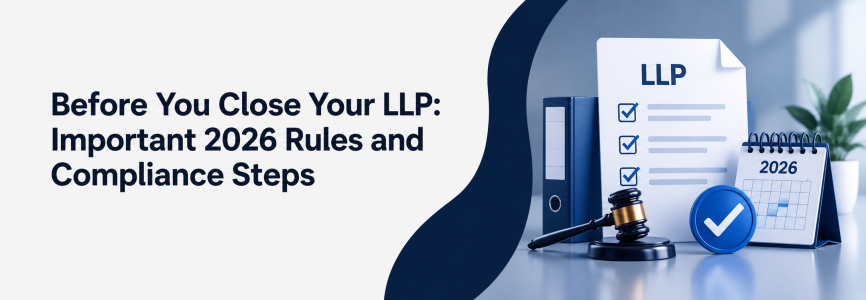



Closing a Limited Liability Partnership (LLP) is not simply a matter of stopping business operations. An LLP continues to exist in the records of the Ministry of Corporate Affairs until its name is formally struck off or it is dissolved through the applicable legal process.
For LLPs that have become inactive, the strike-off mechanism provides a relatively straightforward route to closure. However, partners should first clear applicable filings, liabilities and documentation requirements. In 2026, LLP closure continues to be governed primarily by the Limited Liability Partnership Act, 2008 and the Limited Liability Partnership Rules, 2009.
When Can an LLP Apply for Closure?
Section 75 of the LLP Act, 2008 empowers the Registrar to strike the name of a defunct LLP from the register. Under Rule 37 of the LLP Rules, an LLP that has not carried on any business or operation for one year or more may apply to the Registrar for removal of its name from the register. The application is generally made through LLP Form No. 24 with the consent of all partners. Therefore, businesses should not treat Form 24 as an immediate closure option merely because they have decided to discontinue operations. The LLP must satisfy the prescribed conditions before filing.
Stop Business Operations Before Applying
An LLP seeking strike-off should have genuinely discontinued its business or commercial operations.
Partners should review whether the LLP is still:
- raising invoices,
- entering into contracts,
- maintaining active commercial transactions,
- employing staff,
- carrying significant business assets or liabilities, or
- undertaking activities inconsistent with a defunct LLP.
The closure records should be consistent with the actual financial and operational position of the LLP.
Clear Assets and Liabilities
One of the most important conditions before filing Form 24 is that the LLP should ordinarily have nil assets and nil liabilities. The LLP is required to submit a statement of account showing nil assets and liabilities. Under the applicable rules, this statement must be certified by a Chartered Accountant in practice and prepared up to a date not earlier than 30 days before filing Form 24.
Before initiating closure, partners should therefore settle outstanding:
- creditor balances,
- employee dues,
- statutory payments,
- bank liabilities,
- vendor payments,
- partner advances, and
- other financial obligations.
Assets should also be appropriately realised, distributed or otherwise dealt with in accordance with law and the LLP agreement.
Complete Pending Form 8 and Form 11 Filings
An LLP should carefully review its MCA filing history before closure.
Rule 37 requires the LLP to file overdue Form 8 and Form 11 up to the end of the financial year in which the LLP ceased carrying on its business or commercial operations before filing Form 24.
Form 11 is the annual return of an LLP. MCA's filing guidance states that it is ordinarily due within 60 days from the close of the financial year.
Partners should check the LLP's master data and ensure that the applicable historical filings have been completed rather than assuming that inactive status automatically removes filing obligations.
Check for Pending MCA Forms
Form 24 may face difficulty where other forms are awaiting approval or payment.
MCA's Form 24 guidance specifically notes that filing may not be permitted where another form, except the permitted exceptions, is pending for approval or payment. A pending request for correction of LLP master data can also prevent filing.
Therefore, before starting closure, businesses should review all existing SRNs and pending filings on the MCA portal.
Ensure There Are No Unsatisfied Charges
The LLP should also check whether any charge remains open or unsatisfied in MCA records.
According to MCA's Form 24 instruction kit, Form 24 cannot be filed where there are open or unsatisfied charges against the LLP.
If a loan or secured liability has already been discharged but the corresponding record has not been updated, appropriate corrective compliance should generally be completed first.
Resolve Partner Disputes Before Closure
An LLP marked as having a partner dispute may not be able to proceed with Form 24 filing. This is especially important in LLPs where one partner wishes to close the entity while another partner disagrees. The voluntary strike-off application requires proper consent and supporting declarations. MCA guidance states that Form 24 filing is not permitted where the LLP is marked as having a partner dispute. Any internal disagreements should therefore be resolved before commencing the closure process.
Check Investigation and Legal Proceedings
Partners should confirm whether any inspection, investigation or prosecution is pending against the LLP.
The MCA instruction kit requires applicants to ensure that no inspection, investigation or prosecution is pending as reflected in the LLP's master data. Closure should not be viewed as a mechanism to avoid existing legal or regulatory responsibilities.
Prepare the Statement of Account
A key attachment to Form 24 is the statement of account. It should generally disclose that there are no remaining assets and liabilities and must satisfy the prescribed certification and timing requirements. Businesses should ensure that the figures in the statement match their books of account, bank position and statutory records. Any unexplained balance may lead to clarification or resubmission requirements.
Obtain the Required Affidavit and Declarations
The designated partners are required to provide prescribed declarations and affidavits as part of the strike-off process. The documentation generally confirms matters relating to cessation of business, liabilities and the information submitted to the Registrar.
Because these declarations carry legal significance, partners should verify every statement carefully before digitally signing the filing.
Review Income Tax Compliance
Before LLP closure, income-tax records should also be reviewed.
Applicable income-tax returns should be checked, and outstanding tax demands, assessments or proceedings should be appropriately addressed. The tax position should be consistent with the LLP's financial records and closure documents.
Closing the LLP on the MCA portal does not automatically eliminate liabilities that arose while the entity was operational.
Check GST and Other Registrations Separately
An LLP may hold several registrations apart from its MCA registration, such as:
- GST Registration,
- Import Export Code,
- professional tax registration,
- Shops and Establishments registration,
- EPFO or ESIC registration, or
- sector-specific licences.
These registrations generally require their own cancellation, surrender or closure procedures.
Filing Form 24 does not automatically cancel every registration obtained by the LLP. Businesses should prepare a separate regulatory closure checklist.
Confirm DSC and Designated Partner Details
The Form 24 process involves digital authentication.
MCA guidance requires the relevant Digital Signature Certificate to be valid and properly associated with the appropriate designated partner or authorised signatory on the MCA portal.
Expired DSCs, incorrect DPIN information or association issues should be corrected before filing to avoid technical delays.
File LLP Form 24
Once the eligibility conditions and pre-closure compliance requirements are satisfied, the LLP may proceed with Form 24 – Application for Strike-off.
The form is filed with the Registrar of Companies through the MCA portal along with the prescribed attachments and applicable filing fee. The Registrar may examine the information submitted and may seek clarification, additional documentation or resubmission where required.
Notice and Final Strike-Off
Rule 37 provides for notice before the LLP's name is removed from the register. The notice may also be placed on the MCA website for information of the public.
After the applicable period and subject to the Registrar being satisfied that there is no sufficient reason against strike-off, the LLP's name may be removed from the register. Notice of the strike-off is published in the Official Gazette, following which the LLP stands dissolved.
Businesses should therefore remember that merely filing Form 24 does not itself mean that the LLP has been immediately dissolved.
Important 2026 MCA Considerations
Businesses filing in 2026 should also pay attention to the current MCA V3 environment and their jurisdictional Registrar mapping. MCA announced restructuring and remapping of certain Registrar of Companies jurisdictions effective from February 2026, including changes affecting Delhi, Haryana, Uttar Pradesh, Mumbai and Nagpur jurisdictions. Businesses should therefore verify the current master data and jurisdiction displayed on the MCA portal before filing. Portal requirements and filing utilities can also change, so applicants should use the latest version of the applicable webform and instruction kit at the time of filing.
Pre-Closure Compliance Checklist
Before applying to close an LLP in 2026, partners should generally confirm that the LLP has stopped business operations for the required period, cleared assets and liabilities, reviewed Form 8 and Form 11 filings, resolved pending MCA forms, closed outstanding charges and checked tax and regulatory registrations. They should also ensure that designated partner details, DSCs, financial records, affidavits and supporting documents are accurate before Form 24 is submitted. A properly planned closure reduces the likelihood of resubmission, objections and continued compliance costs.
Conclusion
Closing an LLP requires more than simply discontinuing the business. Until the LLP is formally struck off, it remains a legal entity and its statutory responsibilities may continue. For a smooth closure in 2026, partners should first examine the LLP's operational status, financial position, annual filings, statutory registrations, pending forms and legal proceedings. Once the required conditions are fulfilled, Form 24 may be filed for strike-off under Section 75 of the LLP Act read with Rule 37 of the LLP Rules.
Maintaining proper documentation throughout the process can make the closure more efficient and help avoid future regulatory complications.
FAQs
Q1. What is the main form used to close an inactive LLP?
Ans. An inactive LLP generally applies for voluntary strike-off through LLP Form No. 24. The application is made to the Registrar of Companies subject to compliance with Section 75 of the LLP Act and Rule 37 of the LLP Rules.
Q2. How long must an LLP remain inactive before applying for strike-off?
Ans. An LLP generally needs to have stopped carrying on business or operations for one year or more to apply for removal of its name under Rule 37.
Q3. Can an LLP with liabilities file Form 24?
Ans. The LLP should generally clear its liabilities before applying. A certified statement of account showing nil assets and nil liabilities is required as part of the prescribed closure documentation.
Q4. Are Form 8 and Form 11 required before LLP closure?
Ans. Applicable overdue Form 8 and Form 11 filings must be completed up to the end of the financial year in which the LLP ceased carrying on business or commercial operations before filing Form 24.
Q5. Can Form 24 be filed if another MCA form is pending?
Ans. Generally, pending forms or unpaid SRNs may prevent Form 24 filing. Businesses should first review and complete outstanding MCA filings before proceeding with the strike-off application.
Q6. Can an LLP be closed if it has an outstanding charge?
Ans. MCA's Form 24 guidance states that filing is not permitted where an open or unsatisfied charge exists against the LLP. The charge position should therefore be regularised before filing.
Q7. Does closing an LLP automatically cancel its GST registration?
Ans. No. GST and other regulatory registrations generally have separate cancellation or surrender procedures. Businesses should independently close registrations that are no longer required.
Q8. Is the LLP dissolved immediately after filing Form 24?
Ans. No. Filing Form 24 starts the strike-off process. The Registrar examines the application and follows the prescribed notice procedure before the LLP's name is finally struck off and dissolution takes effect.
Q9. Can an LLP with a partner dispute apply for strike-off?
Ans. MCA guidance provides that Form 24 filing is not allowed where the LLP is marked as having a partner dispute. Such issues should ordinarily be resolved before applying for closure.
Q10. What is the most important step before closing an LLP in 2026?
Ans. Businesses should conduct a complete pre-closure compliance review covering MCA filings, assets and liabilities, charges, tax matters, registrations, legal proceedings and partner consent. This helps ensure that Form 24 is supported by accurate and complete records.


_crop10_thumb.jpg)


_crop10_thumb.jpg)


-Form_crop10_thumb.jpg)

_crop10_thumb.jpg)


_learn_crop10_thumb.jpeg)


_crop10_thumb.jpg)

_crop10_thumb.jpg)


_crop10_thumb.jpg)




_for_Foreign_Directors_learn_crop10_thumb.jpeg)


_Act,_2015_learn_crop10_thumb.jpg)









_learn_crop10_thumb.jpg)

























_crop10_thumb.jpg)

_crop10_thumb.jpg)
_(1)_crop10_thumb.jpg)





_crop10_thumb.png)




_crop10_thumb.jpg)


_crop10_thumb.jpg)






_crop10_thumb.png)
_crop10_thumb.jpg)






_crop10_thumb.png)