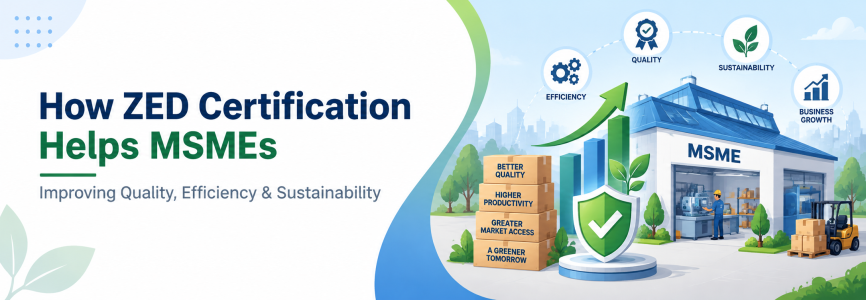



For Micro, Small and Medium Enterprises (MSMEs), growth is no longer determined only by how much they manufacture. Buyers, supply-chain partners and larger companies increasingly look at product quality, process reliability, resource efficiency and responsible manufacturing practices. For smaller businesses, building all these capabilities at the same time can be challenging.
This is where ZED Certification becomes relevant.
ZED stands for Zero Defect Zero Effect. The idea is simple: manufacture products with minimum defects while reducing the negative impact of manufacturing activities on the environment. The Ministry of MSME's Sustainable (ZED) Certification initiative encourages MSMEs to improve their processes, adopt better technologies, reduce waste, increase productivity and become more environmentally conscious. Rather than treating certification as only a certificate to display, businesses can use the ZED journey as a structured way to understand weaknesses in their operations and gradually build a stronger manufacturing system.
What Is ZED Certification?
MSME Sustainable (ZED) Certification is an initiative of the Ministry of Micro, Small and Medium Enterprises designed to promote Zero Defect Zero Effect practices among Indian MSMEs. The programme focuses on helping enterprises manufacture quality products, improve productivity, adopt better systems and use natural resources more efficiently while reducing environmental impact. The government's stated objectives also include improving competitiveness, encouraging exports and developing an ecosystem of sustainable manufacturing among MSMEs.
The programme therefore connects two areas that businesses sometimes consider separately—quality management and sustainability.
"Zero Defect" focuses on creating processes that reduce defects, rejections, rework and quality failures.
"Zero Effect" focuses on reducing adverse environmental effects through better use of energy, materials and natural resources.
Together, these principles can help an MSME become more efficient and sustainable without compromising commercial performance.
Why Quality Improvement Matters for MSMEs
A defective product costs a business much more than its raw material value. It can result in rework, additional labour, customer complaints, replacement costs, delays and damage to business reputation. For an MSME working with limited margins, frequent defects can become a serious operational problem. ZED encourages enterprises to examine how their production processes are managed rather than relying only on final-product inspection. This shift can help identify problems earlier.
For example, if a manufacturer consistently experiences variations in product dimensions, the issue may come from equipment condition, measurement systems, raw-material variation, operator practices or weak process controls. A structured quality system helps the business investigate such causes instead of repeatedly correcting defective finished products. This approach can gradually lead to more consistent production and better customer confidence.
How ZED Certification Improves Product Quality
ZED Certification encourages MSMEs to build quality into the manufacturing process itself. Instead of asking only whether the final product passed inspection, an enterprise begins examining whether the complete production system is capable of consistently delivering acceptable output. Processes may therefore become more organised through documented procedures, defined responsibilities, quality checks, measurement and analysis. Greater consistency can result in fewer manufacturing errors and lower rejection rates. For businesses supplying components to larger manufacturers or corporate customers, process consistency can be especially important because buyers often expect suppliers to meet defined quality specifications continuously.
Reduction in Waste and Rework
Waste affects both profitability and sustainability.
Every rejected component may involve wasted raw material, machine time, electricity, labour and production capacity. If the same product then has to be manufactured again, the environmental and financial cost increases further. The Ministry of MSME specifically highlights substantial waste reduction, productivity improvement, energy saving and optimal use of natural resources as intended outcomes of the ZED journey.
By identifying inefficient operations and reducing repeated errors, MSMEs can potentially use their available resources more effectively. This makes waste reduction one of the areas where the "Zero Defect" and "Zero Effect" philosophies directly support each other.
Better Production Efficiency
Quality problems often create hidden inefficiencies. Employees spend time correcting mistakes. Machines are used for rework instead of fresh production. Production schedules become disrupted and delivery commitments become harder to maintain. ZED practices encourage businesses to examine operational systems in a more organised manner. Once unnecessary activities, recurring defects and poorly controlled processes are identified, management can introduce improvements. The result can be shorter production cycles, more effective utilisation of equipment and better overall productivity. This is important for MSMEs because increasing production does not always require purchasing additional machinery. In some cases, significant capacity can be released simply by improving existing processes.
Improving Energy Management
Energy is a major operational cost for many manufacturing units. The revised ZED guidelines also incorporated Energy Management among the assessment parameters at the Bronze level, reflecting the programme's increasing emphasis on resource efficiency. A business adopting ZED practices may begin evaluating where energy is consumed, where unnecessary consumption occurs and what improvements are practical. Better maintenance of machinery, efficient operating schedules, improved production planning and energy-conscious practices can all contribute to lower resource consumption. Even small savings repeated throughout the year can create meaningful operational benefits for an MSME.
Supporting Sustainable Manufacturing
Sustainability is increasingly becoming a business requirement rather than only an environmental consideration. Large companies are placing greater attention on sustainable supply chains. International buyers may also expect suppliers to demonstrate responsible production practices. ZED helps MSMEs begin incorporating environmental considerations into routine operational decisions. Businesses are encouraged to use resources efficiently, reduce waste and improve environmental consciousness while maintaining productivity and quality. This provides MSMEs with a practical way of connecting sustainability with everyday manufacturing operations rather than treating it as an independent activity.
Better Use of Raw Materials
Raw materials often represent one of the largest expenses for a manufacturing business. Poor handling, inaccurate measurements, inefficient production methods or high rejection rates can increase material consumption unnecessarily. By strengthening process control and reducing defects, ZED practices can help businesses obtain more usable output from the same quantity of material. Suppose a manufacturing company normally experiences a 7% rejection rate. If better process controls reduce that percentage, the company simultaneously improves profitability and reduces material waste. That demonstrates why quality improvement and environmental sustainability can reinforce each other.
Building a Quality-Oriented Work Culture
Sustainable improvement cannot depend entirely on the owner or quality manager. Employees working on machines, inspection, maintenance, packaging and production planning all influence the final outcome. One purpose of the ZED initiative is to encourage MSMEs to adopt improved work culture, standardisation of products, processes and systems. When employees understand why a procedure matters, quality becomes part of everyday production instead of an activity performed only before dispatch. Over time, this can create a culture in which problems are identified and corrected earlier.
Strengthening Customer Confidence
Customers expect products to meet agreed specifications consistently. Repeated defects or delayed deliveries can quickly weaken confidence, particularly when an MSME supplies another manufacturer. A structured quality and sustainability programme can demonstrate that the organisation is actively improving its manufacturing practices. ZED Certification can therefore support an MSME's effort to present itself as a more organised and quality-conscious supplier. Certification should not, however, be treated as a guarantee that every commercial contract or tender will be awarded. Procurement requirements differ between organisations. Its real value lies in strengthening the underlying manufacturing systems that buyers evaluate.
Supporting Market and Export Competitiveness
One of the objectives of the ZED initiative is to develop an ecosystem that improves MSME competitiveness and facilitates exports. Export customers usually expect strong consistency, documentation and reliable quality standards. MSMEs that improve these areas can be better prepared to participate in more demanding supply chains. Improved product quality also helps reduce the risk of customer complaints, rejected consignments and rework—issues that become significantly more expensive when goods are shipped over long distances.
ZED Certification Levels
The ZED Certification structure provides a progressive improvement journey through three certification levels:
Bronze serves as the entry level and helps MSMEs establish essential quality, safety, environmental and operational practices.
Silver requires businesses to demonstrate a higher level of process maturity and management practices.
Gold represents a more advanced level of ZED implementation and organisational capability.
This graded system allows enterprises to improve gradually rather than attempting to transform every process at once. Under the current amended guidelines, the certification costs before applicable subsidy are ?8,000 for Bronze, ?32,000 for Silver and ?72,000 for Gold. These amounts cover verification, assessment, certification and monitoring as specified in the guidelines. Businesses should check the ZED portal for the latest applicable incentives and conditions before applying because scheme provisions may be revised.
Financial Support for MSMEs
Government support is an important part of the scheme because implementation costs can otherwise discourage smaller enterprises. The scheme provides subsidies toward certification costs, with support differing according to the MSME category and applicable eligibility conditions. Government scheme materials have also provided a joining reward to encourage participation. MSMEs should verify current benefits directly through the official ZED platform while applying, particularly because incentive structures may be updated from time to time.
ZED Certification Is More Than a Certificate
One important feature of the ZED programme is that it does not present certification as the end of the process. Government scheme documentation describes the ZED journey as involving assessment, guidance, handholding and managerial or technological intervention aimed at enhancing competitiveness.
This distinction matters.
A business can display a certificate on its wall, but lasting value comes from the improvements made during the journey—better production control, fewer defects, lower wastage, improved employee practices and more efficient resource utilisation.
How MSMEs Can Start Their ZED Journey
Eligible MSMEs can apply through the official ZED online portal. Government scheme material directs applicants to the zed.msme.gov.in platform for registration and certification. Before beginning, an MSME should examine its existing manufacturing systems and organise relevant information relating to production, quality, safety, energy, environment and other assessment parameters. Management should also involve responsible employees early in the process. ZED implementation becomes significantly more effective when it is treated as an organisation-wide improvement exercise rather than the responsibility of one person.
Growing Adoption of ZED Certification
ZED has developed into a significant MSME quality and sustainability initiative. According to the Ministry of MSME dashboard, as of 31 July 2026, around 9.91 lakh MSMEs were registered under ZED and approximately 7.03 lakh certifications had been recorded. The scale of participation reflects the increasing attention being given to quality systems, productivity and sustainable manufacturing among Indian MSMEs.
How ZED Supports Long-Term Business Growth
The strongest advantage of ZED Certification is the connection it creates between quality, cost efficiency and sustainability. A reduction in defects can save raw materials. Less rework saves electricity and labour. Better maintenance can improve equipment performance. Efficient production can lower delivery delays. Stronger process controls can improve customer satisfaction. These improvements reinforce one another. Therefore, an MSME pursuing ZED Certification is not simply working toward regulatory or documentary recognition. It is building systems that can make the organisation more efficient, competitive and prepared for future market expectations.
Conclusion
MSMEs play a crucial role in India's manufacturing and economic ecosystem, but competing in modern markets requires more than increasing production capacity. Businesses must consistently deliver quality while controlling costs and reducing their environmental impact.
ZED Certification gives MSMEs a structured path for achieving these goals.
Through the principles of Zero Defect and Zero Effect, businesses can reduce rejection and wastage, improve productivity, strengthen quality controls, conserve resources and develop more sustainable manufacturing practices. For MSMEs willing to treat ZED as a continuous improvement journey rather than simply another certification requirement, it can become an important tool for building a stronger, more efficient and future-ready enterprise.
FAQs
Q1. What is ZED Certification?
Ans. ZED Certification is the Zero Defect Zero Effect Certification initiative of the Ministry of MSME. It encourages MSMEs to improve product quality, productivity, resource efficiency and environmental performance through structured assessment and improvement practices.
Q2. What does Zero Defect Zero Effect mean?
Ans. Zero Defect refers to reducing defects and improving product and process quality. Zero Effect focuses on reducing the adverse environmental effects of manufacturing through better energy, material and resource utilisation.
Q3. Who can apply for ZED Certification?
Ans. Eligible MSMEs can participate in the MSME Sustainable (ZED) Certification programme through the official ZED portal. Applicants should ensure that their MSME details and relevant registrations are valid before beginning the process.
Q4. What are the levels of ZED Certification?
Ans. The certification programme follows three levels: Bronze, Silver and Gold. MSMEs can progressively improve their systems and move toward higher certification levels as their processes mature.
Q5. How does ZED Certification help improve quality?
Ans. ZED promotes standardisation, process control, measurement, monitoring and continuous improvement. These practices can help MSMEs identify causes of defects, reduce rework and maintain more consistent product quality.
Q6. How does ZED Certification support sustainability?
Ans. ZED encourages MSMEs to reduce waste, improve environmental consciousness, save energy and optimise the use of natural resources. These measures help businesses reduce environmental impact while improving operational efficiency.
Q7. Is there any government subsidy for ZED Certification?
Ans. Yes. The ZED scheme includes financial support toward certification costs subject to the applicable MSME category, scheme conditions and prevailing guidelines. Applicants should check the current subsidy available on the official ZED portal before applying.
Q8. What is the cost of ZED Certification?
Ans. Under the amended scheme guidelines, the stated certification costs are ?8,000 for Bronze, ?32,000 for Silver and ?72,000 for Gold, before applicable subsidies. These costs include verification, assessment, certification and monitoring as specified by the scheme.
Q9. Can ZED Certification help an MSME expand its market?
Ans. ZED can strengthen production systems, quality consistency and sustainability practices, which may help MSMEs become better prepared for demanding customers, supply chains and export opportunities. Market access ultimately depends on buyer and procurement requirements.
Q10. Where can an MSME apply for ZED Certification?
Ans. Eligible MSMEs can apply online through the official MSME ZED portal at zed.msme.gov.in. Applicants should use the portal to check the latest eligibility requirements, certification process, assessment parameters and available incentives.


_crop10_thumb.jpg)


_crop10_thumb.jpg)


-Form_crop10_thumb.jpg)

_crop10_thumb.jpg)


_learn_crop10_thumb.jpeg)


_crop10_thumb.jpg)

_crop10_thumb.jpg)


_crop10_thumb.jpg)




_for_Foreign_Directors_learn_crop10_thumb.jpeg)


_Act,_2015_learn_crop10_thumb.jpg)








_learn_crop10_thumb.jpg)











_crop10_thumb.jpg)
_crop10_thumb.jpg)
_(1)_crop10_thumb.jpg)




_crop10_thumb.png)

_crop10_thumb.jpg)

_crop10_thumb.jpg)



_crop10_thumb.png)
_crop10_thumb.jpg)




_crop10_thumb.png)