


Adjustable wrenches are among the most commonly used hand tools in India. Whether someone is repairing a water pipe at home, maintaining factory machinery or working at a construction site, an adjustable wrench helps tighten and loosen nuts and bolts of different sizes. Unlike a regular spanner, an adjustable wrench has a movable jaw that can be adjusted according to the size of the fastener. However, if the jaw becomes loose, the handle bends or the adjustment mechanism fails, the tool may slip and cause injuries.
To improve the quality and reliability of these tools, the Bureau of Indian Standards (BIS) has prescribed technical requirements for adjustable wrenches. Important 2026 Update: The earlier IS 6149:1984 has been revised to IS 6149:2025. The revised standard is referenced in the Hand Tools (Quality Control) Order, 2026, with mandatory certification dates beginning in April 2027.
What is BIS ISI Certification for Adjustable Wrenches?
BIS ISI Certification is a product certification process through which manufacturers demonstrate that their adjustable wrenches meet the applicable Indian Standard. For adjustable wrenches, BIS examines requirements relating to material quality, dimensions, hardness, jaw movement, strength, workmanship and marking.
For example, consider a manufacturer producing adjustable wrenches for automobile repair workshops. Even if the tools look strong, the manufacturer must ensure that their jaws grip properly, the adjustment mechanism works correctly and the product withstands the required torque. After successfully completing the certification process, the manufacturer can obtain a BIS licence under Scheme-I of the BIS (Conformity Assessment) Regulations, 2018.
The ISI Mark can then be applied to products covered by the approved licence.
What is IS 6149:2025?
IS 6149:2025 is the Indian Standard titled Single-Ended Open-Jaw Adjustable Wrenches — Specification (Second Revision).
It covers adjustable wrenches that have one fixed jaw and one movable jaw. The movable jaw can be adjusted using a worm mechanism to grip nuts and bolts of different sizes. The standard specifies requirements for important product characteristics, including dimensions, materials, hardness, manufacture, workmanship, jaw movement and torque performance.
These requirements help manufacturers maintain consistent quality across their product range.
Latest BIS Updates and Amendments for Adjustable Wrenches in 2026
The biggest recent change is the revision of IS 6149:1984 to IS 6149:2025.
|
Year/Date |
Important update |
|---|---|
|
1984 |
IS 6149:1984 established the earlier product specifications |
|
15 October 2025 |
IS 6149:2025 established as the second revision |
|
15 April 2026 |
Withdrawal date for IS 6149:1984 specified in the BIS Gazette notification |
|
9 October 2026 |
Hand Tools (Quality Control) Order, 2026 notified |
|
2027 |
Revised mandatory certification deadlines apply |
The Gazette notification published on 11 November 2025 recorded the establishment of IS 6149:2025 and the scheduled withdrawal of the earlier standard.
Major Changes Under IS 6149:2025
The revised standard makes it important for manufacturers to review their existing specifications and testing arrangements.
The key areas to check include:
| Material specifications | Verify that the steel and other components used for manufacturing meet the current material requirements. |
| Dimensional requirements | Check the wrench length, jaw opening and prescribed tolerances against the revised standard. |
| Hardness requirements | Ensure that the fixed jaw, movable jaw, worm mechanism and other relevant parts satisfy applicable hardness requirements. |
| Jaw movement | Check longitudinal and transverse play to ensure the movable jaw functions correctly. |
| Torque performance | Verify that the wrench can withstand the specified torque test. |
| Workmanship and marking | Review surface finishing, product identification and applicable marking requirements. |
These are important compliance areas reflected in the current testing requirements. Manufacturers should consult the complete revised standard for the exact technical values and identify which provisions changed from the 1984 edition.
Are There Any Amendments to IS 6149:2025?
As of 5 November 2026, I could verify the 2025 revision but could not confirm a separately notified amendment to IS 6149:2025.
Manufacturers should therefore follow the latest published edition and check the BIS standards catalogue for any subsequent amendments or corrections.
Hand Tools (Quality Control) Order, 2026
The Government of India issued the Hand Tools (Quality Control) Order, 2026 through notification S.O. 5561(E), dated 9 October 2026. This order replaced the previous Hand Tools (Quality Control) Order, 2025, except concerning earlier acts or omissions covered by the supersession provision.
The order requires covered hand tools, including adjustable wrenches, to comply with their applicable Indian Standards and carry the BIS Standard Mark under a valid licence from the prescribed implementation dates. It specifically references IS 6149:2025 for single-ended open-jaw adjustable wrenches.
BIS Certification Mandatory Dates for Adjustable Wrenches
The government has introduced different compliance deadlines depending on the enterprise category.
|
Enterprise category |
Mandatory BIS certification date |
|---|---|
|
General enterprises (other than micro and small) |
1 April 2027 |
|
Small enterprises |
1 July 2027 |
|
Micro enterprises |
1 October 2027 |
These dates give manufacturers time to prepare for certification, complete necessary testing and improve their quality-control arrangements.
Businesses should follow the latest 2026 notification instead of older implementation schedules.
Who Needs BIS ISI Certification for Adjustable Wrenches?
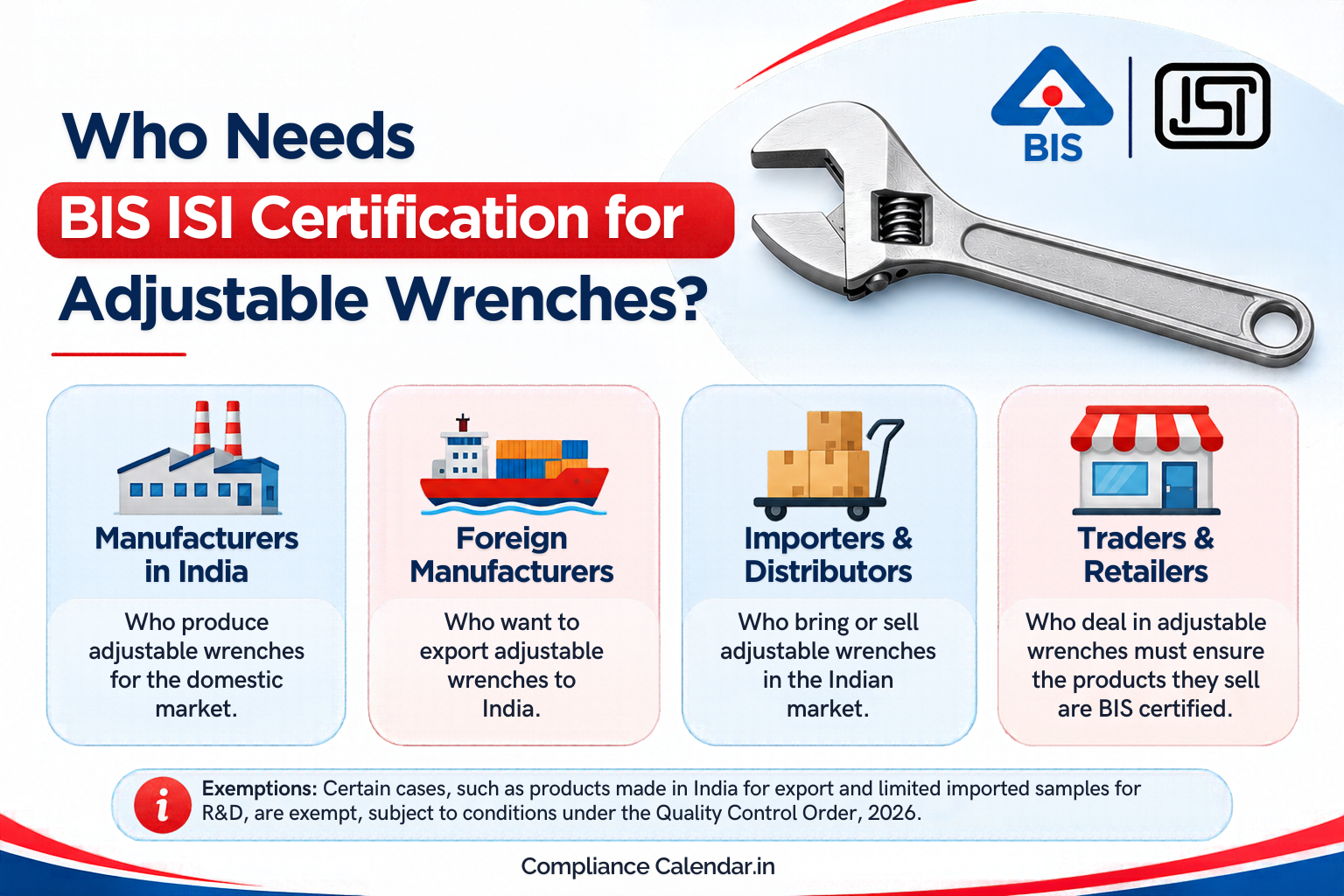
BIS certification requirements apply to manufacturers producing single-ended open-jaw adjustable wrenches covered under the Quality Control Order. Indian manufacturers must obtain the applicable BIS licence before supplying covered products to the domestic market once their implementation date takes effect. Foreign manufacturers supplying adjustable wrenches to India must also meet the applicable certification requirements.
Importers and distributors should check whether the products they purchase have the required certification and markings. The 2026 order provides certain exemptions, including domestically manufactured products intended for export and limited imported samples for research and development, subject to conditions.
Technical Requirements Under IS 6149:2025
Manufacturers must ensure that their adjustable wrenches meet the applicable product specifications.
|
Requirement |
What BIS checks |
|---|---|
|
Material quality |
Suitable materials for wrench components |
|
Dimensions |
Wrench length, jaw dimensions and tolerances |
|
Hardness |
Hardness of jaws and adjustment components |
|
Jaw movement |
Longitudinal and transverse play |
|
Torque test |
Ability to withstand the prescribed torque |
|
Workmanship |
Manufacturing quality and surface finish |
|
Marking |
Required product identification and markings |
For example, even a wrench manufactured using good-quality steel may fail testing if its movable jaw has excessive play or cannot withstand the required torque.
That is why product testing and consistent manufacturing controls are important.
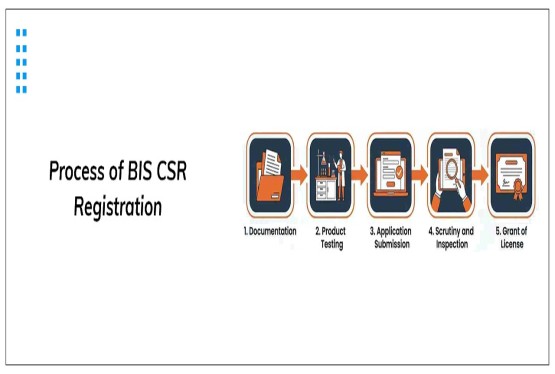
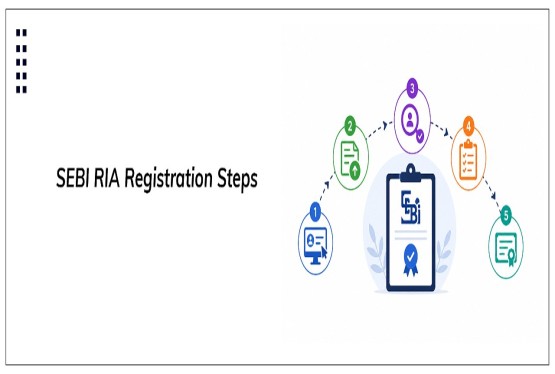
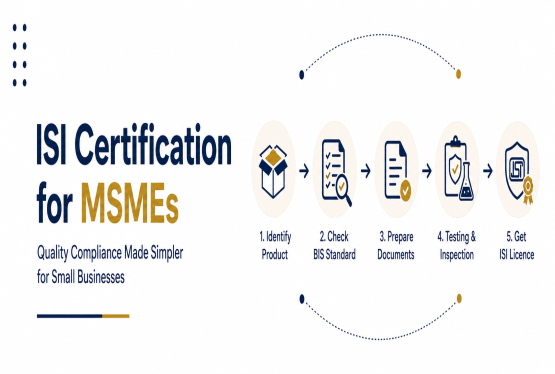
BIS ISI Certification Process for Adjustable Wrenches
Manufacturers can follow these steps to obtain BIS certification.
Step 1: Identify the Applicable Indian Standard
Confirm that the product falls under IS 6149:2025 and review the latest specifications.
Step 2: Prepare the Manufacturing Facility
Ensure that the factory has suitable machinery, testing equipment and quality-control arrangements.
Step 3: Submit the BIS Application
Apply through the BIS Manak Online portal with the required manufacturing details and documents.
Step 4: Product Testing
Adjustable wrenches are tested for applicable requirements such as dimensions, hardness, jaw movement, torque performance and workmanship.
Step 5: Factory Inspection
BIS evaluates the factory, manufacturing process and quality-control arrangements according to the applicable certification procedure.
Step 6: Grant of BIS Licence
After successful assessment, BIS may grant a licence allowing the manufacturer to use the ISI Mark on approved products.
Documents Required for BIS ISI Certification
Manufacturers generally need the following documents:
-
Business registration and factory address proof.
-
Manufacturing process flow chart.
-
List of manufacturing machinery.
-
Details of testing equipment.
-
Product specifications and technical drawings.
-
Raw material information.
-
Quality-control personnel details.
-
Product test reports, where applicable.
-
Authorisation documents and prescribed declarations.
Additional documents may be required depending on the manufacturing facility and certification procedure.
BIS Certification Fees and Timeline
The total cost of BIS ISI Certification for Adjustable Wrenches depends on the application fee, factory inspection charges, laboratory testing, marking fees and applicable licence charges.
Testing expenses can vary depending on the laboratory, product varieties and testing requirements.
The certification timeline also depends on application completeness, testing results and factory inspection arrangements. Manufacturers should confirm the latest fees and processing requirements through BIS before applying.
Benefits of BIS ISI Certification for Adjustable Wrenches
BIS certification offers several practical benefits:
| Improved product quality | Helps establish that products meet prescribed Indian Standards. |
| Better workplace safety | Supports reliable performance of tools used in industrial and repair activities. |
| Customer confidence | Helps buyers identify products manufactured under BIS certification requirements. |
| Regulatory compliance | Helps businesses meet the requirements of the Hand Tools Quality Control Order. |
| Market credibility | May support participation in supply contracts that require BIS-certified products. |
Manufacturers must continue maintaining product conformity after certification.
Penalties for Non-Compliance
Once mandatory certification becomes applicable, supplying covered adjustable wrenches without complying with the Quality Control Order may result in enforcement action.
Violations can attract penalties under the Bureau of Indian Standards Act, 2016. Manufacturers must also ensure that the ISI Mark is not used without a valid BIS licence.
How Compliance Calendar LLP Can Help
Compliance Calendar LLP assists manufacturers with BIS ISI Certification for Adjustable Wrenches under IS 6149:2025.
Our assistance includes identifying applicable requirements, reviewing documents, preparing BIS applications, coordinating product testing and providing compliance-related support during the certification process. Manufacturers can also seek guidance on revised standards, inspection preparation and ongoing BIS compliance.
Frequently Asked Questions (FAQs)
Q1. What is BIS ISI Certification for Adjustable Wrenches?
Ans. It is a product certification process that confirms conformity with the applicable Indian Standard for adjustable wrenches.
Q2. What is the latest BIS Standard for Adjustable Wrenches?
Ans. The revised standard is IS 6149:2025, which replaced the earlier IS 6149:1984.
Q3. Is BIS Certification mandatory for Adjustable Wrenches?
Ans. Yes. Covered single-ended open-jaw adjustable wrenches require certification from the applicable dates under the Hand Tools (Quality Control) Order, 2026.
Q4. What is the difference between IS 6149:1984 and IS 6149:2025?
Ans. IS 6149:2025 is the second revision. Manufacturers should compare its current specifications and testing requirements with the withdrawn 1984 edition.
Q5. When does BIS Certification become mandatory for Adjustable Wrenches?
Ans. The deadlines are 1 April 2027 for general enterprises, 1 July 2027 for small enterprises and 1 October 2027 for micro enterprises.
Q6. Who can apply for BIS ISI Certification?
Ans. Indian and foreign manufacturers producing covered adjustable wrenches can apply through the applicable BIS certification procedure.
Q7. What tests are required under IS 6149:2025?
Ans. Applicable tests include dimensions, material conformity, hardness, jaw movement, torque performance and workmanship.
Q8. How much does BIS Certification for Adjustable Wrenches cost?
Ans. The cost depends on application fees, testing charges, inspections, marking fees and other applicable licence expenses.
Q9. Can manufacturers use the ISI Mark without BIS Certification?
Ans. No. Manufacturers can use the ISI Mark only under a valid BIS licence covering the relevant products.
Q10. How can manufacturers apply for BIS ISI Certification online?
Ans. Manufacturers can apply through the BIS Manak Online portal with the required factory information and supporting documents.
Article last updated on : 05 Nov 2026.