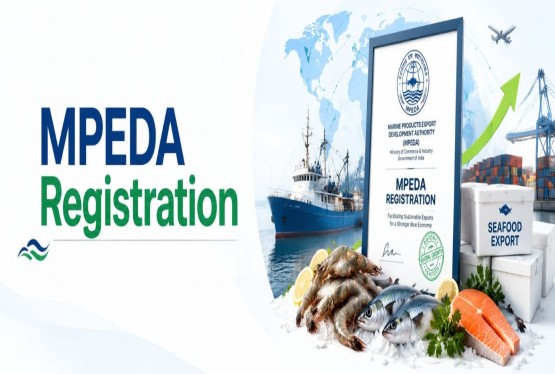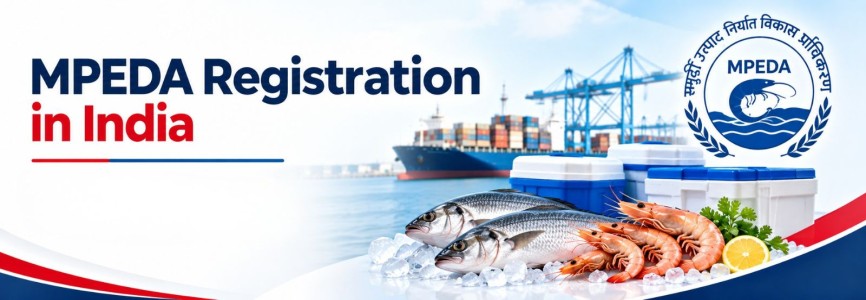



MPEDA Registration in India is an important legal requirement for businesses planning to export seafood and other covered marine products from India. Whether a business exports frozen shrimp, fish, crabs, squid, chilled seafood or ornamental fish, it must understand the registration requirements prescribed by the Marine Products Export Development Authority (MPEDA).
India has established itself as a major seafood exporter, supplying marine products to countries including the United States, China, Japan and members of the European Union. According to MPEDA's export performance report released in June 2026, India exported approximately Rs 19.72 lakh metric tonnes of seafood worth Rs 73,890.46 crore (US$8.46 billion) during FY 2025–26. This represented a record level in both export volume and value.
However, starting a seafood export business involves more than identifying international buyers. Exporters must obtain the required registrations, follow food safety and quality standards, maintain proper processing and storage arrangements, and comply with Indian customs and foreign trade regulations.
Businesses planning to export marine products should obtain the applicable MPEDA License Registration before commencing regulated export activities. This article explains MPEDA Registration eligibility, required documents, online application process, government fees, validity, renewal, RCMC requirements and the latest developments applicable in 2026.
What is MPEDA Registration in India?
MPEDA Registration is the statutory registration granted by the Marine Products Export Development Authority to eligible exporters and other specified entities involved in India's marine products export industry. MPEDA was established under the Marine Products Export Development Authority Act, 1972 and functions under the Ministry of Commerce and Industry, Government of India.
The authority works towards the development of India's marine products industry, including export promotion, quality improvement, processing infrastructure and market development. Under Section 9(2)(h) of the MPEDA Act, 1972, read with Rules 40–42 of the MPEDA Rules, 1972, MPEDA registers exporters of marine products.
Businesses involved in seafood exports must distinguish between registration as an exporter and registration of facilities such as processing plants, storage premises and fishing vessels. These approvals apply to different activities and may be required together. After obtaining exporter registration, eligible businesses can also apply for a Registration-cum-Membership Certificate (RCMC Registration) from MPEDA under the applicable Foreign Trade Policy provisions.
Is MPEDA Registration Mandatory in India?
Yes. Businesses undertaking commercial exports of marine products covered by MPEDA requirements generally need exporter registration under the MPEDA Act and Rules. This requirement applies to eligible manufacturer exporters, merchant exporters and other recognised exporter categories. However, MPEDA exporter registration is not automatically required for every business selling seafood in the domestic market.
|
Business activity |
MPEDA registration requirement |
|
Export of frozen shrimp or prawns |
Exporter registration generally required |
|
Export of fish and other covered seafood |
Exporter registration generally required |
|
Export of chilled or dried marine products |
Exporter registration generally required |
|
Export of ornamental fish |
Applicable ornamental fish exporter registration |
|
Seafood processing for export |
Applicable processing facility and exporter registrations |
|
Domestic seafood retail shop |
Exporter registration not required solely for domestic retail |
|
Domestic seafood restaurant |
Exporter registration not required solely for restaurant operations |
|
Fishing vessel supplying export markets |
Applicable vessel and related regulatory registrations may be required |
For example, a company exporting frozen shrimp from Andhra Pradesh to Japan generally needs MPEDA exporter registration, an Import Export Code (IEC), approved processing arrangements and applicable quality and customs documentation. On the other hand, a seafood retailer supplying only domestic customers is not automatically required to register as a marine products exporter. The MPEDA Rules also provide limited exceptions for specified non-commercial exports, samples and other permitted categories, subject to prescribed conditions and value limits.
Legal Provisions Governing MPEDA Registration in India
MPEDA Registration is governed by specific legislation concerning marine products exports, along with India's general foreign trade, customs and food safety laws.
Marine Products Export Development Authority Act, 1972
The MPEDA Act, 1972 establishes the authority and empowers it to regulate specified activities connected with the marine products export industry. Section 9(2)(b) concerns registration-related functions for fishing vessels and processing-related entities, while Section 9(2)(h) provides the statutory basis for registration of exporters. The Act also supports the authority's broader responsibilities relating to export development, quality improvement and promotion of marine products.
MPEDA Rules, 1972
Rules 40–42 are particularly relevant to exporter registration. These rules cover the requirement for exporter registration, applications and the issue of registration certificates. The competent authority may require additional information or supporting documents before approving an application.
Foreign Trade (Development and Regulation) Act, 1992
This legislation governs India's foreign trade system, including the requirement to obtain an Import Export Code from the Directorate General of Foreign Trade (DGFT), subject to statutory exceptions. An IEC is a prerequisite for obtaining MPEDA exporter registration.
Foreign Trade Policy, 2023
The Foreign Trade Policy, 2023, together with subsequent amendments and the applicable Handbook of Procedures, regulates RCMC-related requirements and other aspects of international trade. MPEDA is the designated authority for issuing RCMC to seafood exporters.
Other Applicable Laws
Depending on the business activity, marine products exporters may also need to comply with:
-
Customs Act, 1962
-
Applicable environmental and pollution control laws
-
Regulations of the importing country
The need for each approval depends on the exporter category, products, processing arrangements and destination market.
Who is Eligible for MPEDA Registration?
Businesses legally established in India and intending to export covered marine products may apply for MPEDA Registration, subject to meeting the applicable eligibility conditions. MPEDA recognises four principal categories of exporters.
Manufacturer Exporter
A manufacturer exporter owns an approved processing plant, an approved vessel with onboard processing facilities or another recognised handling facility. Such applicants must have the necessary registered infrastructure and comply with applicable food safety, inspection and environmental requirements.
Merchant Exporter
A merchant exporter does not own a seafood processing plant but uses the surplus capacity of an approved processing plant or handling facility. Merchant exporters are required to comply with specific conditions concerning processing agreements, joint undertakings and endorsement of their details on the relevant facility registrations.
Route Through Merchant Exporter
This category applies to eligible recognised export or trading houses holding the relevant DGFT approval or status certificate, as specified in MPEDA's registration guidelines. Applicants must establish their eligibility under the applicable category.
Ornamental Fish Exporter
This category applies to exporters dealing in ornamental fish and applicable aquarium-related products rather than live marine products intended for human consumption. Ornamental fish exporters must comply with the relevant handling facility registration or approved tie-up requirements.
Important: Having an IEC does not automatically make a business eligible for all four exporter categories. The applicant must satisfy the specific conditions for the category selected.
Which Marine Products Are Covered Under MPEDA Registration?
MPEDA classifies marine products into eight principal export categories.
|
Marine product category |
Examples |
|
Frozen marine products |
Frozen shrimp, prawns, fish and squid |
|
Canned marine products |
Canned fish and other processed seafood |
|
Freeze-dried marine products |
Applicable freeze-dried seafood products |
|
Live marine products |
Live fish, crabs and other eligible species |
|
Dried marine products |
Dried fish and other dried seafood |
|
Chilled marine products |
Fresh chilled fish and seafood |
|
Ornamental fish |
Aquarium and ornamental fish |
|
Other edible and non-edible products |
Specified fish-based, aquatic and marine-derived products |
Businesses must identify the appropriate product category before applying. For example, an exporter dealing in frozen shrimp may require different facility approvals and inspection procedures from an ornamental fish exporter. Correct classification is important for registration, customs documentation, product quality requirements and export approvals.
Documents Required for MPEDA Registration in India
Applicants must submit the documents prescribed for their exporter category. MPEDA may require additional records depending on the applicant's business structure, processing arrangements and the marine products proposed for export. The principal documents are listed below.
|
Document |
Purpose |
|
Import Export Code (IEC) |
Mandatory exporter identification |
|
PAN card |
Tax and applicant identification |
|
Business registration certificate |
Proof of legal establishment |
|
GST registration certificate, where applicable |
Tax registration information |
|
Address proof |
Verification of registered or head office |
|
Passport-size photograph |
Identification of applicant |
|
Scheduled bank certificate |
Evidence of financial soundness |
|
Purchase order, where required |
Supporting export transaction information |
|
Processing plant registration certificate |
Verification of approved processing facilities |
|
Storage premises registration certificate |
Verification of approved storage arrangements |
|
Processing facility agreement |
Required for applicable merchant exporter registrations |
|
Joint undertaking |
Responsibility shared by merchant exporter and facility owner |
|
Bank guarantee, where applicable |
Financial security for specified merchant exporter categories |
|
DGFT recognition certificate |
Applicable to route-through merchant exporters |
The MPEDA exporter registration guidance specifically identifies IEC, banking certification, processing facility documents, purchase orders and other category-specific records.
Additional Documents for Merchant Exporters
Merchant exporters generally require a written agreement with an approved processing or handling facility. They must also provide the prescribed joint undertaking and arrange the necessary endorsement of their details on the facility's registration certificate.
For new merchant exporters of frozen marine products, MPEDA's published guidelines specify a bank guarantee of Rs15 lakh for five years. An additional Rs10 lakh guarantee may apply where a second processing agreement is made with a facility in another state. Applicants should ensure that their business name, IEC, registered address and supporting records are consistent before submitting the application.
MPEDA Registration Process Online in India (2026)
MPEDA provides an online application system for exporter registration. Applicants should select the appropriate exporter category and submit the required documents through the official portal.
|
Step |
Registration process |
Description |
|
Step 1 |
Obtain IEC |
Apply for an Import Export Code through DGFT and verify business details. |
|
Step 2 |
Identify exporter category |
Select manufacturer, merchant, route-through merchant or ornamental fish exporter, as applicable. |
|
Step 3 |
Visit MPEDA portal |
Access the official MPEDA online registration system. |
|
Step 4 |
Complete application |
Enter business information, IEC, contact details and proposed export products. |
|
Step 5 |
Upload documents |
Submit required business, banking and processing facility records. |
|
Step 6 |
Pay registration fees |
Pay the applicable government registration charges online. |
|
Step 7 |
Application scrutiny |
MPEDA examines documents and may request clarification or verification. |
|
Step 8 |
Obtain registration certificate |
After approval, the relevant MPEDA registration certificate is issued. |
|
Step 9 |
Complete additional approvals |
Obtain applicable EIA approval, RCMC and other export-related permissions. |
Important Points During Application
Applications are ordinarily processed by the MPEDA office having jurisdiction over the applicant's registered or head office. For manufacturer exporters, relevant processing and storage facilities must first have the required registrations. For new merchant exporters, the MPEDA Secretary grants the online approval following scrutiny.
Where processing establishments are involved, applicants may also need local body approvals, Pollution Control Board consent and applicable Export Inspection Agency approval. There is no universally guaranteed approval time. Processing depends on the applicant category, completeness of documents, facility verification and any deficiencies identified by the authority.
MPEDA Registration Fees in India (2026)
MPEDA's published fee schedule specifies the following charges for exporters and selected processing-related entities.
|
Registration or service |
Published fee |
|
Exporter registration |
Rs 5,000 |
|
Exporter registration revalidation endorsement |
Rs 1,000 |
|
Application form fee, where applicable |
Rs 200 |
|
Processing plant up to 5 tonnes per eight-hour shift |
Rs 2,500 |
|
Processing plant above 5 tonnes per eight-hour shift |
Rs 5,000 |
|
Pre-processing centre up to 5 tonnes per eight-hour shift |
Rs 1,500 |
|
Pre-processing centre above 5 tonnes per eight-hour shift |
Rs 3,000 |
MPEDA's published registration documents also provide separate charges for storage premises, fishing vessels, handling centres and other eligible establishments. The fees above reflect MPEDA's published guidance available for review in 2026. Applicants should confirm the exact payable amount on the official portal because application-form, endorsement and facility-specific charges may differ.
MPEDA Registration Validity and Renewal
According to MPEDA's official FAQ and registration manual, MPEDA exporter registration is valid for three years, unless otherwise specified. Exporters should apply for renewal or revalidation before the certificate expires. MPEDA's published guidelines prescribe a Rs 1,000 endorsement fee for revalidation.
During renewal, the authority may examine the applicant's current business status, registration particulars and compliance with applicable conditions. A separate facility registration may have different verification or revalidation requirements. It is important not to confuse exporter registration validity with MPEDA RCMC validity, which follows a different period.
Difference Between MPEDA Registration and MPEDA RCMC
MPEDA Registration and MPEDA RCMC are related, but they serve different purposes.
|
Basis |
MPEDA Exporter Registration |
MPEDA RCMC |
|
Purpose |
Statutory registration of seafood exporter |
Registration-cum-membership certification |
|
Issuing authority |
MPEDA |
MPEDA |
|
Legal basis |
MPEDA Act and Rules |
Foreign Trade Policy and applicable procedures |
|
Published validity |
Three years unless otherwise specified |
Generally five licensing years |
|
Main function |
Compliance with exporter registration requirements |
Relevant export promotion and FTP membership purposes |
MPEDA explains that an exporter can apply for RCMC after obtaining exporter registration. Its RCMC guidance generally provides validity from 1 April of the licensing year of issue until 31 March of the fifth licensing year, unless otherwise specified. Exporters should maintain both certificates where applicable and track their respective expiry dates.
Compliance Requirements After MPEDA Registration
MPEDA registration is not the final regulatory step. Seafood exporters must maintain compliance throughout processing, storage, transportation and shipment.
Export Inspection and Quality Control
Food-grade seafood products may require approval and inspection under the Export Inspection Council and Export Inspection Agency system. Processing establishments must satisfy applicable hygiene, quality assurance and sanitary requirements.
Processing and Storage Compliance
Exporters should use facilities registered and approved for the relevant operations. For merchant exporters, processing must be carried out through the approved facility identified in the registration and related agreements.
Customs and Banking Compliance
Businesses must comply with applicable customs procedures, including shipping bills and relevant export banking arrangements. AD Code Registration is an important related requirement for exporters using customs systems. The Learn article Documents Required for AD Code Registration explains the common banking and identification records required for the process.
Traceability and Importing-Country Requirements
Exporters may need to maintain records showing the source of marine products, processing history, handling conditions and shipment information. Requirements can be different for the United States, European Union, Japan and other destination markets. Certain consignments may require catch certificates, health certificates or other product-specific documents.
Reporting Business Changes
Changes in business constitution, processing facility arrangements, product categories or registered particulars should be reported and endorsed wherever required. Failure to comply with registration conditions can lead to suspension, cancellation or other regulatory consequences.
Latest MPEDA Registration Updates in 2026
The marine products export industry continued to develop during 2026, with increasing attention to product quality, digital registration, traceability and international market requirements.
Record Seafood Exports in FY 2025–26
MPEDA's June 2026 export performance announcement reported record seafood exports worth US$8.46 billion. Frozen shrimp remained India's leading seafood export product. The United States and China continued to be major markets, demonstrating the importance of meeting international quality and regulatory requirements.
Online Exporter Registration Continues
MPEDA continues to provide online registration facilities for exporters and relevant processing entities. Applicants should use the official MPEDA portal and follow the applicable registration category, rather than relying on outdated manual application instructions.
Continued Focus on Quality and Traceability
Exporters supplying regulated international markets must meet relevant quality, traceability, sanitary and documentation requirements. The MPEDA exporter's portal provides access to services involving catch certificates, certificates of origin and other export-related facilities. These requirements depend on the product and destination.
Validity and Fee Clarification for 2026
MPEDA's official published guidance continues to specify a three-year validity period for exporter registration and ?5,000 as the standard exporter registration fee. As of 4 November 2026, no separately verified notification replacing these core published terms was identified during this review. Exporters should still check the current portal for revised charges, category-specific conditions and subsequent circulars.
Benefits of MPEDA Registration in India
MPEDA Registration provides important legal and commercial advantages for businesses entering the international seafood industry.
Statutory Compliance
Registration helps exporters meet the applicable requirements of the MPEDA Act, 1972 and MPEDA Rules, 1972. It establishes the business as a registered marine products exporter and reduces the risk of operating without the prescribed authorisation.
Access to International Seafood Markets
Registration is an important step towards exporting seafood to international markets. However, approval to supply a particular country may also require additional establishment approvals, health certifications, product testing and compliance with importing-country rules.
Access to Export Promotion Programmes
MPEDA undertakes promotional activities, including participation in international seafood exhibitions, buyer interactions and market development programmes. Eligible exporters may participate in relevant activities according to applicable programme conditions.
Better Product Quality and Documentation
The registration system encourages exporters to maintain proper processing arrangements, traceability records and documentation. This can help businesses respond to quality inspections and buyer verification requirements.
Business Credibility
A valid MPEDA Registration Certificate establishes that the exporter is registered with the competent Indian authority. This can support commercial verification by international buyers, although it does not guarantee orders, contracts or market access. Businesses can also read MPEDA Registration Online: Process and Benefits for additional information about the registration system.
Common Mistakes to Avoid During MPEDA Registration
Businesses sometimes face delays because they apply under the wrong exporter category or overlook infrastructure-related requirements.
Common mistakes include:
-
Applying without obtaining an IEC.
-
Selecting manufacturer exporter status without the required approved facilities.
-
Entering incorrect or inconsistent business details.
-
Submitting incomplete processing plant agreements.
-
Overlooking merchant exporter bank guarantee requirements.
-
Assuming MPEDA Registration automatically provides EIA approval.
-
Confusing MPEDA exporter registration validity with RCMC validity.
-
Failing to renew certificates or update business particulars.
For example, a merchant exporter intending to export frozen seafood cannot simply submit its IEC and business incorporation documents. It must also satisfy the applicable approved processing facility, agreement, endorsement and financial security requirements. Proper preparation helps reduce avoidable objections and registration delays.
Conclusion
MPEDA Registration in India is an important legal requirement for businesses planning to export seafood and other covered marine products. It helps establish the exporter within the statutory registration system and supports compliance with the rules governing India's marine products export industry.
Before applying, businesses should identify the correct exporter category, obtain an IEC, prepare the required documents and verify their processing and storage arrangements. Manufacturer exporters, merchant exporters and ornamental fish exporters must satisfy different requirements.
For businesses entering international seafood markets in 2026, maintaining valid MPEDA registration, applicable RCMC, facility approvals and export documentation is essential for smooth operations. Understanding these requirements early can help reduce application errors, minimise regulatory delays and support sustainable growth in the seafood export business.
Frequently Asked Questions (FAQs)
Q1. Is MPEDA Registration mandatory for seafood exporters in India?
Ans: Yes. Businesses exporting covered marine products commercially from India generally require registration with MPEDA under the MPEDA Act, 1972 and applicable rules. Limited statutory exceptions may apply to specified non-commercial transactions.
Q2. How can I apply for MPEDA Registration online in 2026?
Ans: Applicants can apply through the official MPEDA online registration portal. They must select the relevant exporter category, provide business details, upload the required documents and pay the applicable fees. MPEDA scrutinises the application before issuing the registration certificate.
Q3. What is the government fee for MPEDA Registration in 2026?
Ans: MPEDA's published government fee for exporter registration is ?5,000. Additional application, endorsement, facility registration and other charges may apply depending on the business category. Applicants should confirm the latest payable fees on the official portal.
Q4. What documents are required for MPEDA Registration?
Ans: The principal documents include IEC, address proof, applicant photograph, banking certification and prescribed business records. Merchant exporters additionally require processing facility agreements, joint undertakings and other category-specific documents.
Q5. Can I export seafood from India with only an IEC?
Ans: No. IEC alone does not satisfy the statutory registration requirements for commercial exports of covered marine products. Exporters must also obtain applicable MPEDA registration and comply with relevant quality, customs and destination-country requirements.
Q6. Can a merchant exporter apply for MPEDA Registration without owning a processing plant?
Ans: Yes. A merchant exporter can apply without owning a processing plant if it has access to approved surplus processing or handling capacity and satisfies the applicable agreement, endorsement, financial security and other registration conditions.
Q7. What is the validity of MPEDA Registration in 2026?
Ans: MPEDA's published rules and guidance specify a three-year validity period for exporter registration, unless otherwise stated. Exporters should apply for renewal or revalidation before the certificate expires.
Q8. Is a bank guarantee mandatory for MPEDA merchant exporters?
Ans: MPEDA's published guidelines require a ?15 lakh bank guarantee for five years from specified new merchant exporters of frozen marine products. Additional security may apply in certain circumstances. The requirement should be checked against the applicant's category and current guidelines.
Q9. Is MPEDA Registration the same as RCMC?
Ans: No. MPEDA exporter registration is issued under the MPEDA Act and Rules, while MPEDA RCMC is a separate membership certificate relevant to Foreign Trade Policy requirements. Their validity periods also differ.
Q10. Can MPEDA Registration be cancelled?
Ans: Yes. MPEDA may take action for incorrect information, breaches of registration conditions or other applicable violations. The prescribed process includes an opportunity for the affected party to make representations before cancellation.
Article last updated on : 04 Nov 2026.