


India’s handmade carpet industry has a strong presence in international markets, but entering the export business involves more than finding overseas buyers and arranging shipments. Exporters must understand the Importer Exporter Code (IEC), ITC(HS) classification, Foreign Trade Policy requirements, Registration-cum-Membership Certificate (RCMC), Customs procedures and product-specific conditions applicable to their goods.
For exporters dealing in handmade carpets, rugs, durries and specified floor coverings, the Carpet Export Promotion Council (CEPC) is one of the most important industry bodies. CEPC facilitates membership and issues the Registration-cum-Membership Certificate through the DGFT e-RCMC system.
The answer requires an important legal distinction. CEPC RCMC is not, by itself, an export licence for every carpet shipment. Many carpets and textile floor coverings are freely exportable under India’s export policy, subject to the applicable ITC(HS) classification and policy conditions. However, an RCMC from the appropriate Export Promotion Council becomes important—and in specified cases legally required—when the exporter seeks an authorisation, benefit or concession under the Foreign Trade Policy.
What Is CEPC?
The Carpet Export Promotion Council (CEPC) was established in 1982 as a non-profit organisation for promoting and developing exports of handmade carpets, rugs and other floor coverings from India. It functions as an official industry body representing the handmade carpet export sector and is recognised within India’s export-promotion framework.
Under the Foreign Trade Policy, Export Promotion Councils are organisations created to promote particular groups of products, projects or services. Paragraph 2.56 of the current Foreign Trade Policy recognises EPCs as Registering Authorities capable of issuing Registration-cum-Membership Certificates to their members. CEPC therefore performs two connected roles: it promotes India’s carpet-export industry and acts as the relevant RCMC authority for products falling within its assigned jurisdiction.
What Is CEPC Registration?
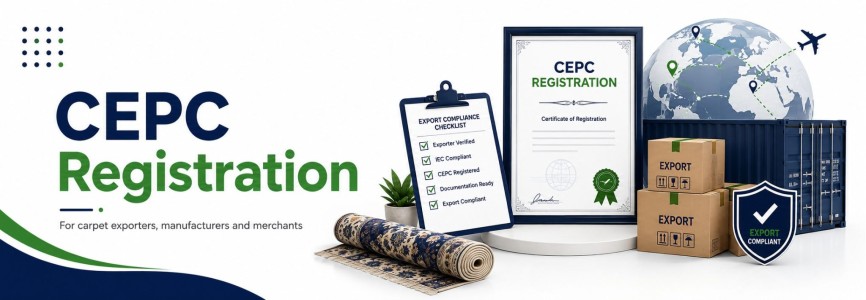
CEPC Registration generally refers to obtaining membership and a Registration-cum-Membership Certificate (RCMC) from the Carpet Export Promotion Council. An RCMC confirms that the exporter is registered with a government-recognised Export Promotion Council or another competent Registering Authority for the products forming its main line of business. DGFT currently describes an RCMC as a certificate validating that an exporter deals in products registered with an authorised agency or organisation. The current DGFT system is electronic. CEPC specifically directs applicants to log into the DGFT portal, go to Services → Apply for e-RCMC, and select the Carpet Export Promotion Council as the concerned EPC.
Legal Basis of CEPC RCMC
The RCMC system derives its legal and regulatory foundation from the Foreign Trade (Development and Regulation) Act, 1992, the Foreign Trade Policy 2023, the Handbook of Procedures, and the Appendices and Aayat Niryat Forms issued by DGFT.
Section 5 of the Foreign Trade (Development and Regulation) Act authorises the Central Government to formulate and amend the Foreign Trade Policy. Section 6 empowers the Director General of Foreign Trade to advise the Government and carry out that policy. Section 7 separately deals with the Importer Exporter Code, while Section 11 deals with contravention of the Act, rules, orders and Foreign Trade Policy.
This distinction is important because IEC and RCMC are different compliances. IEC is the basic identification requirement for commercial imports and exports, while RCMC connects the exporter with the appropriate sectoral Export Promotion Council.
Paragraph 2.56 – Recognition of Export Promotion Councils
Paragraph 2.56 of the Foreign Trade Policy states that EPCs are organisations of exporters established to promote and develop Indian exports. Each council is responsible for a specified group of products, projects or services set out in Appendix 2T. The same provision permits recognised EPCs to function as Registering Authorities for issuing RCMC to their members. This is the policy provision under which CEPC operates as a Registering Authority for the carpet products allocated to it.
Paragraph 2.57 – When Is RCMC Required?
Paragraph 2.57(a) is one of the most important legal provisions for a carpet exporter.
It provides that a person applying for an authorisation to import or export under the Foreign Trade Policy—subject to the treatment specified for restricted products—or applying for another benefit or concession under the FTP must provide an RCMC issued by the competent authority, unless specifically exempted.
This means RCMC should not be described inaccurately as a universal “licence to export carpets.” Rather, it is a registration certificate required in connection with the FTP circumstances specified under Paragraph 2.57 and is also necessary to maintain CEPC membership and access Council-linked facilities.
Can You Export Carpets Without CEPC Registration?
In certain circumstances, a carpet that is freely exportable under its applicable ITC(HS) classification may be exported without CEPC RCMC where the transaction does not independently require RCMC under the FTP or another applicable condition.
India’s export policy has historically classified handmade woollen carpets and specified floor coverings as “Free,” although conditions may apply to particular modes of payment, product descriptions or export situations. Exporters should always check the live ITC(HS) policy against the precise eight-digit HS code before shipment.
Therefore, the correct answer is not “CEPC Registration is mandatory before Customs can clear every carpet shipment.” The correct approach is to determine the product’s export policy, its correct RCMC authority, and whether the exporter wants to use an FTP authorisation, benefit or concession for which RCMC is prescribed. For a business intending to export carpets regularly, however, obtaining the correct RCMC is commercially and legally advisable because it removes uncertainty around access to the broader Foreign Trade Policy and CEPC membership ecosystem.
Important 2026 Update: ?10,000 RCMC Exemption
The current Foreign Trade Policy contains an important de minimis exemption. Paragraph 2.57(c) provides that RCMC or a Certificate of Registration is not required when applying for the relevant FTP authorisation, benefit or concession for an export consignment whose FOB value is ?10,000 or less, except where the item is classified as restricted in the ITC(HS).
This provision is particularly useful for very small exporters, low-value consignments and certain sample transactions. However, exporters should understand the scope carefully. The provision does not state that a business exporting consignments below ?10,000 is permanently exempt from every CEPC membership condition or every other requirement applicable to exports. It specifically relaxes the RCMC requirement for the FTP purposes described in Paragraph 2.57.
Which Products Fall Under CEPC?
Appendix 2T identifies the products falling within the jurisdiction of each Export Promotion Council. The current Appendix identifies CEPC with products including handmade and hand-knotted woollen carpets, rugs, druggets, durries, handmade tufted carpets, handmade silk carpets, handmade staple or synthetic carpets, Kelem, Schumacks, Namdhas and other floor coverings.
This product jurisdiction is important because an exporter should not choose an EPC merely because its name appears relevant.
For example, Appendix 2T also assigns certain handloom products, including carpets and floor coverings, to the Handloom Export Promotion Council, while natural silk and silk-blend products including carpets appear within the jurisdiction of the Indian Silk Export Promotion Council. The appropriate authority therefore depends on the actual product and the exporter’s main line of business.
Paragraph 2.77 – Registering Authority
Paragraph 2.77 of the Handbook of Procedures defines a Registering Authority as a body notified by DGFT to register exporters and importers as members by issuing an RCMC. It further states that the list of notified Registering Authorities is contained in Appendix 2T. For a business whose main export activity falls within CEPC’s recognised carpet jurisdiction, CEPC is therefore the appropriate sectoral authority.
Paragraph 2.79 – Registration-cum-Membership Certificate
Paragraph 2.79 states that an exporter may apply in ANF 2C to register and become a member of the relevant EPC. Once admitted to membership, the applicant is granted an RCMC in the format contained in Appendix 2R. The provision also specifically states that an exporter seeking registration as a manufacturer exporter must provide evidence of manufacturing status. Prospective or potential exporters may also apply and become associate members. This means CEPC Registration is not restricted to large established exporters. A business preparing to enter the export market can also come within the membership system.
Paragraph 2.80 – Main Line of Business
Paragraph 2.80 requires an exporter applying for RCMC to declare its main line of business. The exporter is then required to obtain RCMC from the council responsible for products falling within that main line. Where an export product is not covered by any EPC or Commodity Board, RCMC is generally obtained from FIEO. Multi-product exporters whose main business is yet to be settled may also have the FIEO option in the circumstances specified by the Handbook. For carpet businesses, this provision is particularly important because product descriptions can overlap across textile, handloom, silk and carpet councils.
Is IEC Mandatory Before CEPC Registration?
Yes, for an ordinary commercial exporter, an active IEC is a fundamental prerequisite. DGFT’s current e-RCMC portal specifically states that applicants need an active IEC, updated IEC profile, and a linked Digital Signature Certificate or Aadhaar e-Signature before submitting an RCMC application.
The July 2026 Handbook also confirms that IEC is compulsory for imports and exports except for specifically exempted categories. An IEC generally has permanent validity unless suspended, cancelled or deactivated according to the applicable provisions. Therefore, a carpet exporter should normally complete IEC compliance before applying for CEPC RCMC.
Documents Required for CEPC Registration
To apply for CEPC Registration, exporters need to submit documents that establish their business identity, IEC status, manufacturing or merchant-exporter category, and legal constitution. The exact documents may vary depending on whether the applicant is a Merchant Exporter, Manufacturer Exporter, or Merchant-cum-Manufacturer.
The commonly required documents include:
- Importer Exporter Code (IEC) – A valid IEC issued by DGFT is required for the CEPC registration process.
- GST Registration Certificate – The GST Registration should contain the correct legal name, address, and business details of the applicant.
- PAN Card – PAN of the proprietorship, partnership, LLP, company, or other applicant entity must be submitted.
- Udyam Registration Certificate – Manufacturers and Merchant-cum-Manufacturers generally need to provide an Udyam Certificate mentioning the relevant NIC Code 1393.
- Manufacturing Proof for Non-MSMEs – Where the manufacturer is not registered as an MSME, its manufacturing activity should be clearly reflected in the GST Registration Certificate or other applicable records.
- Partnership Deed – Partnership firms are required to provide a copy of their Partnership Deed as proof of constitution.
- LLP Incorporation Documents – LLP applicants should submit their incorporation and other relevant LLP-related documents.
- MOA and AOA – Private Limited Company Registration should provide their Memorandum of Association and Articles of Association, along with the required director details.
- Affidavit for CEPC Code of Conduct – Applicants are required to submit the prescribed affidavit confirming acceptance of the CEPC Code of Conduct.
- Bank Soundness Certificate – A Bank Soundness Certificate may be required to establish the applicant’s banking and financial credentials.
- Star Export House Certificate – Applicants claiming Star Export House status should provide the relevant certificate as supporting evidence.
- MSME Certificate – Where the applicant wants to claim MSME status or related benefits, the applicable MSME/Udyam certificate should be uploaded.
A Merchant Exporter generally does not have to provide additional manufacturing proof under the specific manufacturing-document requirement. However, all applicants should ensure that details such as the legal name, address, PAN, GST and IEC are consistent across their documents to avoid queries or delays during CEPC registration.
How to Apply for CEPC RCMC Online
The application for CEPC RCMC is completed online through the DGFT Common Digital Platform. Before applying, exporters should ensure that their IEC profile, business details, contact information and other registration particulars are updated correctly on the DGFT portal.
The online application process generally involves the following steps:
- Login to the DGFT Portal – Access the DGFT portal using the credentials linked with the exporter’s IEC profile.
- Open the e-RCMC Service – Navigate to the relevant e-RCMC section and select the option to apply for a new Registration-cum-Membership Certificate.
- Select CEPC – Choose the Carpet Export Promotion Council (CEPC) as the appropriate Export Promotion Council for the applicable carpet and floor-covering products.
- Verify Business Details – Review the legal name, address, constitution, IEC and other business information available in the DGFT profile.
- Enter Membership Details – Provide the required information relating to CEPC membership and the exporter’s business category.
- Select Export Products – Choose the relevant carpets, rugs, durries or other eligible products forming the applicant’s main line of export business.
- Provide Authorised Representative Details – Enter the details of the person authorised to handle the application and represent the business, wherever required.
- Upload Supporting Documents – Upload the prescribed documents such as IEC, GST Certificate, PAN, Udyam Certificate, constitution documents, Bank Soundness Certificate and other applicable records.
- Complete the Declaration – Review the information entered in the application and accept the prescribed declarations regarding the accuracy of the details provided.
- Sign and Submit the Application – Complete the application using the applicable Digital Signature Certificate or e-Sign facility and submit it through the DGFT portal.
After submission, CEPC reviews the application and supporting documents. If any information is incomplete or inconsistent, clarification or additional documents may be requested through the DGFT system. Once the application is found complete and approved, the CEPC RCMC is issued electronically and becomes available through the exporter’s DGFT profile.
Physical Document Requirement After RCMC
A notable CEPC-specific requirement appears in its current new-membership guidance. CEPC states that after issuance of the RCMC, applicants must submit the required self-attested physical documents and originals as prescribed to CEPC within 15 days from the date of issuance. Failure to complete this verification can lead to suspension of the RCMC until verification is completed. Businesses should therefore not assume that successful electronic issuance necessarily ends the CEPC onboarding process.
Validity of CEPC RCMC
Paragraph 2.81 of the Handbook of Procedures provides the general rule that RCMC is deemed valid from 1 April of the licensing year in which it is issued and remains valid for five years ending on 31 March, unless otherwise specified. DGFT’s e-RCMC service page repeats this five-financial-year rule. However, carpet exporters need to distinguish RCMC certificate validity from CEPC’s annual membership-subscription requirements.
Annual CEPC Membership Renewal in 2026-27
CEPC’s current 2026-27 Annual Membership Renewal circular states that annual membership subscription became due from 1 April 2026. For FY 2026-27, the Council has fixed the annual membership subscription for all categories at ?6,000 plus ?1,080 GST, totalling ?7,080 for one year. CEPC also permits members to pay the prescribed subscription for up to three years in advance.
The last date without late fee was 30 June 2026. Payments made from 1 July to 30 September 2026 attract a late fee of ?500 plus GST, while failure to renew by 30 September can result in suspension of membership under the applicable Articles of Association. Therefore, exporters should not assume that possessing an RCMC showing a longer validity period means that annual CEPC membership dues can simply be ignored.
Changes in Business Details – Paragraph 2.82
An RCMC holder has an ongoing obligation to keep registration particulars updated.Paragraph 2.82 provides that where there is a change in the exporter’s ownership, constitution, name or address, the change must be intimated to the Registering Authority within one month. The authority may condone delay on merits.
This becomes relevant during conversions from proprietorship to company, LLP restructuring, change of registered office, merger, acquisition or business-name modification. The IEC itself should also be updated where applicable, because the current Handbook requires changes in constitution, address, bank details or other primary IEC information to be updated within 30 days.
De-registration Under Paragraph 2.83
RCMC is not an unconditional right once issued.Paragraph 2.83 authorises the Registering Authority to de-register an RCMC holder for a specified period where the conditions of registration are violated. However, procedural fairness is built into the provision: before de-registration, the exporter must receive a show-cause notice and an adequate and reasonable opportunity to make a representation against the proposed action. Upon de-registration, the concerned EPC is required to intimate the DGFT Regional Authorities.
Appeal Under Paragraph 2.84
An exporter who is aggrieved by a decision connected with the issuance or de-registration of RCMC is not left without a remedy. Paragraph 2.84 provides that the exporter may prefer an appeal to DGFT or an officer designated for that purpose within 45 days from the decision. The decision of the appellate authority is final under this RCMC mechanism. This provision becomes particularly important where CEPC registration affects an exporter’s ability to access FTP-linked benefits or sectoral facilities.
Recent 2026 Update: CEPC Membership Categories
CEPC’s membership structure has also recently changed. According to its FY 2026-27 guidance, the revised Articles of Association adopted on 5 June 2025 classify members into Ordinary Members, Associate Members and Associate Members with Voting Rights. Membership category and associated privileges are determined using factors such as average export performance, MSME classification and years of membership where applicable.
For FY 2026-27, CEPC required members to submit a Chartered Accountant-certified export-performance certificate to determine their correct category and privileges. Non-submission could result in categorisation based on Council records, including classification as an Associate Member. This illustrates that CEPC membership is now more closely connected with verified export-performance information.
Recent 2026 Update: 75% RCMC Fee Reimbursement for Eligible MSEs
A particularly useful development for new exporters is the Capacity Building of First Time MSE Exporters (CBFTE) Scheme. CEPC states that it signed an MoU with the Ministry of MSME on 20 April 2026 to implement the scheme. Eligible Micro and Small Enterprises can receive reimbursement of 75% of the RCMC fee, subject to prescribed conditions.
Among other requirements, the applicant must hold valid Udyam Registration and IEC, the IEC must generally not be older than three years on the date of shipment, the exporter must hold a valid CEPC RCMC issued on or after the relevant scheme date, and an export shipment must have been completed during the same financial year for which reimbursement is claimed. For first-time carpet exporters, this can materially reduce the initial cost of joining the formal export ecosystem.
Benefits of CEPC Registration
CEPC membership has value beyond the RCMC certificate itself. As the sectoral Export Promotion Council, CEPC organises trade fairs, buyer-seller interactions, export-awareness programmes and international marketing initiatives. It also provides members with trade-related support and representation before government authorities. CEPC’s current trade-issues facility is specifically available to members seeking Council assistance with export-related challenges.
The Council’s 2026 circulars show continuing programmes relating to international carpet exhibitions, FTAs, export financing, AEO awareness, government trade delegations and market-access opportunities. For exporters trying to move from occasional orders to a structured international business, these services can be commercially significant.
CEPC Registration vs IEC
This distinction is worth repeating because it causes frequent confusion. An IEC identifies the exporter within India’s foreign-trade system and is generally necessary for commercial imports and exports. An RCMC establishes membership with the appropriate product-specific Export Promotion Council and supports access to circumstances covered by the Foreign Trade Policy. A carpet exporter may therefore require both, but for different legal reasons.
What Should New Carpet Exporters Do Before Their First Shipment?
The most practical approach is to begin with the product rather than the certificate. First identify exactly what you are exporting—hand-knotted wool carpet, tufted carpet, silk carpet, durrie, synthetic carpet or another floor covering—and determine its correct eight-digit ITC(HS) code. Then verify whether the product is “Free,” “Restricted,” “Prohibited” or subject to a specific policy condition.
Next, determine the correct RCMC authority using Appendix 2T and the main-line-of-business rule under Paragraph 2.80. If CEPC is the appropriate authority, complete the e-RCMC process through DGFT before relying on CEPC membership or applying for an FTP benefit requiring RCMC. Businesses should also keep their IEC, GST, PAN, Udyam and constitutional documents consistent. Differences in names, addresses or entity details are among the issues most likely to create unnecessary registration queries.
Can Small Carpet Exporters Avoid CEPC Registration?
Being a small business or MSME does not by itself create a universal exemption from RCMC. The significant current relaxation is Paragraph 2.57(c), under which export consignments with FOB value of ?10,000 or less can obtain the specified FTP authorisation, benefit or concession without RCMC, except for restricted items.
At the same time, the policy direction is actually encouraging small exporters to enter the formal membership system: the 2026 CBFTE programme can reimburse 75% of the RCMC fee to qualifying first-time Micro and Small Enterprise exporters. For a business planning repeated or scalable carpet exports, remaining outside the relevant EPC system solely to save the membership cost may therefore provide little long-term advantage.
Conclusion
CEPC Registration refers principally to membership with the Carpet Export Promotion Council and issuance of an RCMC under the DGFT framework. CEPC is the notified sectoral body for specified handmade carpets, rugs, durries, druggets, handmade tufted and silk carpets, synthetic carpets and other covered floor coverings.
Legally, however, RCMC should not be confused with the export policy of the product itself. A carpet classified as freely exportable may, depending on the transaction, be exported without CEPC RCMC where no other rule requires it. But Paragraph 2.57 of the Foreign Trade Policy requires RCMC when an exporter applies for specified FTP authorisations, benefits or concessions unless an exemption applies. The current policy also contains a limited ?10,000 FOB exemption for qualifying low-value consignments.
For regular handmade carpet exporters, CEPC registration remains commercially important because it establishes formal membership with the sectoral Council, supports access to policy-linked facilities and creates opportunities through trade fairs, market-development initiatives, government representation and exporter-support programmes.
The current 2026 position also brings several developments exporters should know: CEPC’s annual membership subscription for FY 2026-27 is ?7,080 including GST; late renewal rules can lead to suspension; revised membership categories use export-performance and MSME criteria; and qualifying first-time MSE exporters may receive 75% reimbursement of their RCMC fee under the CBFTE scheme.
Frequently Asked Questions (FAQs)
Q1. What is CEPC Registration?
Ans: CEPC Registration refers to membership with the Carpet Export Promotion Council and obtaining an RCMC.
It is mainly relevant for exporters of handmade carpets, rugs, durries and specified floor coverings.
The RCMC is issued through the DGFT e-RCMC system.
Q2. Can you export carpets without CEPC Registration?
Ans: In some cases, freely exportable carpets may be exported without CEPC RCMC.
However, RCMC is required when an exporter applies for specified benefits, concessions or authorisations under the Foreign Trade Policy.
The exact requirement depends on the product, ITC(HS) classification and nature of the transaction.
Q3. Is CEPC Registration mandatory for every carpet exporter?
Ans: CEPC Registration is not a universal export licence for every carpet shipment.
It becomes important where CEPC is the appropriate council for the exporter’s main line of business.
It may also be required for accessing specified FTP benefits and export-promotion facilities.
Q4. What is the validity of CEPC RCMC?
Ans: RCMC is generally valid for five financial years under the DGFT Handbook of Procedures.
Its validity normally runs from 1 April of the licensing year to 31 March of the fifth year.
CEPC annual membership subscription requirements must still be complied with separately.
Q5. What documents are required for CEPC Registration?
Ans: Common documents include IEC, PAN, GST Registration and applicable business-constitution documents.
Manufacturer exporters may also need Udyam Registration or other proof of manufacturing activity.
CEPC may additionally require an affidavit and Bank Soundness Certificate.
Q6. How can I apply for CEPC Registration online?
Ans: The application is filed through the DGFT Common Digital Platform under the e-RCMC service.
The exporter must select the Carpet Export Promotion Council and provide the required business and product details.
Supporting documents are uploaded and the application is submitted electronically.
Q7. Is IEC compulsory before applying for CEPC RCMC?
Ans: Yes, an active IEC is generally required before applying for CEPC RCMC.
The exporter’s IEC profile should also be properly updated on the DGFT portal.
IEC and RCMC are separate compliances and serve different purposes.
Q8. Is there any RCMC exemption for low-value exports?
Ans: Yes, the current Foreign Trade Policy provides a limited exemption for qualifying export consignments with FOB value up to ?10,000.
The exemption applies to the RCMC requirement for specified FTP authorisations, benefits or concessions.
It does not automatically remove every other export or CEPC-related compliance obligation.
Q9. Can CEPC RCMC be suspended or cancelled?
Ans: Yes, an exporter can be de-registered for violation of applicable registration conditions.
Before de-registration, the exporter must generally be given a show-cause notice and an opportunity to respond.
An appeal may also be filed under the DGFT framework within the prescribed period.
Q10. Is CEPC RCMC enough to start exporting carpets?
Ans: No, CEPC RCMC is only one part of the overall export compliance process.
Exporters must also check IEC, Customs requirements, ITC(HS) classification, GST procedures and applicable export-policy conditions.
Destination-country standards and buyer-specific requirements may also apply.


_crop10_thumb.jpg)


_crop10_thumb.jpg)


-Form_crop10_thumb.jpg)

_crop10_thumb.jpg)


_learn_crop10_thumb.jpeg)


_crop10_thumb.jpg)

_crop10_thumb.jpg)


_crop10_thumb.jpg)





_for_Foreign_Directors_learn_crop10_thumb.jpeg)


_Act,_2015_learn_crop10_thumb.jpg)










_learn_crop10_thumb.jpg)









































_crop10_thumb.jpg)


_crop10_thumb.jpg)

_(1)_crop10_thumb.jpg)











_crop10_thumb.png)













_crop10_thumb.jpg)


_crop10_thumb.jpg)







_crop10_thumb.png)


_crop10_thumb.jpg)









_crop10_thumb.png)