


For anyone planning to enter India’s spice-export business, one question comes up frequently: Can spices be exported without Spices Board Registration?
In most cases, the legal answer is no. The requirement does not arise merely from an administrative guideline or an export-promotion scheme. It is expressly contained in the Spices Board Act, 1986. Section 11 states that a person cannot commence or carry on the business of exporting a spice covered by the Act except under and in accordance with the prescribed certificate. The certificate used for this purpose is commonly known as the Certificate of Registration as Exporter of Spices (CRES).
This makes spice exports different from several product categories where membership of an Export Promotion Council may become relevant mainly for Foreign Trade Policy benefits. In the case of spices, registration with the Spices Board has a specific statutory basis. Exporters should therefore understand the distinction between IEC, CRES, RCMC, FSSAI compliance, product testing and destination-country requirements before executing their first shipment.
What Is Spices Board Registration?
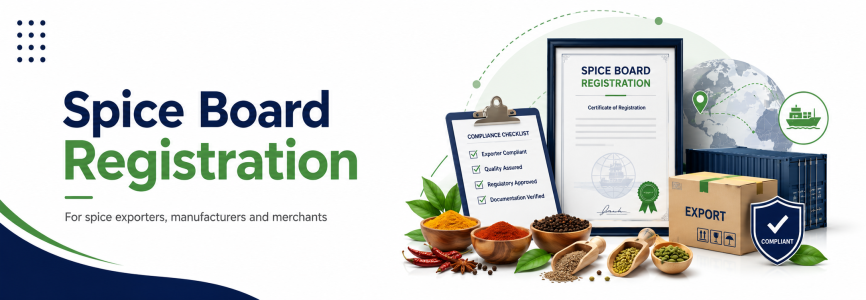
Spice Board Registration for exporters generally refers to obtaining a Certificate of Registration as Exporter of Spices, commonly abbreviated as CRES, from the Spices Board of India. The Spices Board functions under the Ministry of Commerce and Industry, Government of India. Section 3 of the Spices Board Act provides for constitution of the Board, while Section 7 assigns it important functions relating to development, promotion and regulation of spice exports. These functions include granting certificates for export, controlling the quality of spices intended for export and undertaking programmes for export promotion. CRES therefore performs both a regulatory and trade-registration role. It identifies the exporter as an entity authorised to carry on the business of exporting spices in accordance with the Act, Rules, Regulations and instructions issued by the Board.
Can You Legally Export Spices Without CRES?
As a general rule, you cannot legally carry on the business of exporting spices covered by the Spices Board Act without a valid CRES. Section 11 of the Spices Board Act, 1986 is titled “No person to export spices without certificate.” It provides that no person shall commence or carry on the business of export of any spice except under and in accordance with a certificate.
This wording is significant. CRES is therefore not merely an optional membership certificate that an exporter obtains only to participate in trade fairs or claim government incentives. The registration forms part of the legal authority to operate as a spice exporter.
What Is the Exception Under Section 15?
The Act contains a narrow statutory exception. Under Section 15 of the Spices Board Act, 1986, the Central Government may, where it considers it necessary or expedient in the public interest, issue a notification in the Official Gazette permitting a body or agency to commence or carry on the business of exporting spices without a certificate.
This is not a general exemption available to an exporter simply because the shipment is small, occasional or made for a particular customer. Unless an exporter clearly falls within a valid exemption notified by the Central Government, the safer legal position is that CRES must be obtained before carrying on spice-export business.
Which Law Governs Spice Exporter Registration?
The principal legislation is the Spices Board Act, 1986. Exporter registration is further governed by the Spices Board Rules, 1987 and the Spices Board (Registration of Exporters) Regulations, 1989, as subsequently amended. The Regulations were substantially updated through the Spices Board (Registration of Exporters) Amendment Regulations, 2017, notified in January 2018. These provisions deal with fresh registration, renewal, changes in the exporter’s particulars and continuing obligations after CRES is granted. Together, these provisions create the statutory compliance structure for entities engaged in exporting spices from India.
Section 7 – Powers and Functions of the Spices Board
Section 7 is important because it explains why exporter registration is connected with the Board. Among its statutory functions, the Spices Board may develop, promote and regulate spice exports, grant certificates for export of spices, promote export programmes, improve processing and packaging, introduce quality standards and control the quality of spices intended for export.
The Board therefore performs a broader role than simply issuing a registration certificate. Its functions extend into export quality, market development, certification, statistical information and regulatory supervision of spice exporters.
Section 11 – Mandatory Certificate for Export
Section 11 is the central provision for exporters. It prohibits a person from commencing or carrying on the business of exporting spices except under and in accordance with a certificate. Accordingly, merely possessing an IEC does not satisfy the requirement of Section 11. IEC and CRES operate under different legal systems and perform different functions. A business planning regular commercial exports of spices should obtain the required exporter registration before making shipments.
Section 12 – Grant of Certificate
Section 12 deals with the procedure for obtaining the exporter certificate. The application must be made to the Spices Board in the prescribed form, contain the prescribed particulars and be accompanied by evidence of payment of the prescribed fee. Where an application is incomplete or does not contain the required particulars, the Board may return it. If it complies with the prescribed requirements, the Board may grant the certificate subject to the applicable terms and conditions. This makes correct documentation important at the application stage itself.
Merchant Exporter and Manufacturer Exporter
CRES applicants are broadly classified as Merchant Exporters and Manufacturer Exporters. A merchant exporter generally procures spices or spice products from manufacturers or suppliers and exports them in its own name. A manufacturer exporter processes or manufactures spice products and exports or intends to export those products. The Spices Board currently recognises this distinction in its exporter-registration guidance and FAQs.
The category selected affects the documentation, inspection requirements and applicable registration fee. For a manufacturer exporter, the certificate-issuing authority must also be satisfied regarding the facilities available in the processing plant or manufacturing unit before granting registration.
CRES Registration Fees
The 2017 amendment to the Registration of Exporters Regulations prescribed a fresh-registration fee of ?15,000 for a Manufacturer Exporter and ?10,000 for a Merchant Exporter, plus applicable tax. The Spices Board’s current Citizens’ Charter displays the corresponding charges inclusive of 18% GST as approximately ?17,700 for Manufacturer Exporter registration and ?11,800 for Merchant Exporter registration. Exporters should nevertheless verify the fee shown on the live application system before payment because the Regulations permit the Board to revise fees for subsequent block periods.
How Long Does CRES Registration Take?
The Spices Board’s Citizens’ Charter currently indicates a minimum processing timeframe of around 10 days from receipt of the application for a Certificate of Registration as Exporter of Spices. This should be treated as a published service benchmark rather than an absolute guarantee. Applications involving incomplete documentation, incorrect particulars, manufacturer-unit verification or clarification can take longer.
How to Apply for CRES in 2026
The registration process has become increasingly digital. The Spices Board’s current CRES portal expressly states that CRES applications must be submitted through the DGFT portal. Accordingly, an exporter should first ensure that its IEC and DGFT profile contain correct business details. The applicant can then proceed through the applicable e-RCMC/CRES functionality, select the Spices Board as the appropriate Registering Authority, complete the prescribed information, upload documents and pay the applicable fee. The shift towards the DGFT platform is important for businesses relying on older articles or offline application procedures.
Is IEC Enough to Export Spices?
No. An Importer Exporter Code (IEC) and CRES should not be treated as the same registration. IEC is the basic import-export identification issued through DGFT. CRES, by contrast, is the statutory exporter certificate issued under the Spices Board regulatory system.
The updated DGFT Appendix 2T dated 26 June 2025 also states that in the case of spices, units are required to obtain registration with the Spices Board. Therefore, having a valid IEC does not by itself remove the requirement to comply with Section 11 of the Spices Board Act.
Is a Separate RCMC Required After CRES?
Ordinarily, a spice exporter holding CRES does not need to obtain a second RCMC merely for the same purpose. Spices Board guidance states that the Certificate of Registration as Exporter of Spices is treated as a Registration-cum-Membership Certificate (RCMC) for Foreign Trade Policy purposes. This simplification means that where an RCMC is required for the relevant foreign-trade purpose, the spice exporter can generally use its valid CRES rather than obtaining a duplicate membership certificate for the same spice-export activity.
Validity of CRES
The amended Registration of Exporters Regulations provide for grant of CRES for a block period of three years or part thereof. This specific Spices Board rule is important because generic information concerning e-RCMC certificates may refer to different validity periods. Spice exporters should therefore rely on the validity stated on their CRES and the specific Spices Board Regulations applicable to them.
Renewal of CRES
The Regulations require an exporter seeking renewal to apply on or before expiry of the existing certificate. The 2017 amendment prescribes renewal fees of ?10,000 for Manufacturer Exporters and ?7,500 for Merchant Exporters, plus applicable tax, subject to revision by the Board.
A particularly important rule is that an application received after expiry is not entertained as renewal of the existing certificate. In that situation, the exporter may have to apply for fresh registration. This is why CRES renewal should be included in the exporter’s compliance calendar.
What Happens If No Export Is Made During the Validity Period?
The Regulations also deal with inactivity. Where an exporter does not carry on any export business during the period for which it holds a valid certificate, the exporter may be debarred from renewal for the next three years. However, where the exporter subsequently enters into an export contract, it may apply for a fresh exporter certificate in accordance with the Regulations. Therefore, businesses should not obtain CRES merely as a dormant certificate without considering the continuing regulatory requirements.
CRES Is Not Transferable
A CRES is personal to the certificate holder. Regulation 5 provides that the certificate cannot be sold or otherwise transferred. If the certificate holder sells or transfers its business to another person, the purchaser or transferee must obtain a fresh certificate. This is particularly important during acquisitions, business transfers and restructuring transactions. The buyer should not assume that it can continue exports under the previous owner’s CRES.
Change in Name or Address
An exporter holding CRES must also keep its registration particulars updated. Under Regulation 5, a change in the exporter’s name or address must generally be intimated to the certificate-issuing authority within 30 days along with supporting documents and the prescribed amendment fee. The notified amendment fee is ?5,000, subject to the applicable tax and later fee revisions. The authority may, for sufficient reasons, condone delay for the specified period. If the change is not properly reported and delay is not condoned, fresh registration may become necessary.
Change in Ownership or Constitution
Changes involving ownership or constitution require even greater attention. The amended Regulations provide that where there is a change in ownership, constitution, partnership or power-of-attorney holder of a certificate holder, the certificate may be treated as expired and a fresh CRES can become necessary, subject to the specific exceptions provided in the Regulations. Therefore, partnership conversions, transfers and restructuring should be examined from a CRES-compliance perspective before exports continue.
Quarterly Export Returns Are Mandatory
Registration does not end the exporter’s obligations. Regulation 5 requires certificate holders to submit quarterly returns relating to exports and imports of spices in the form specified by the Board. Non-submission is expressly treated as a violation of the Regulations.
The Spices Board’s current FAQ also confirms that quarterly export returns are mandatory and can be submitted electronically. Exporters should therefore maintain accurate shipment-level records rather than preparing export data only at the time of renewal.
Quality Compliance Is Part of CRES
A valid CRES does not mean the exporter can ship any spice product without quality checks. The amended Regulations state that the certificate holder must not contract to export or export spices that fail to conform to applicable destination-country standards, standards under the Food Safety and Standards Act, 2006, and quality standards prescribed by the Spices Board.
The Board can also require exporters to allow authorised officers or agencies to draw samples from spices being processed, packed, stored, warehoused, container-stuffed or transported for export. Where analysis shows that the spice does not meet prescribed standards, the exporter may be required to refrain from exporting it or, where applicable, recall the product at its own expense.
FSSAI Compliance and Spice Export
CRES should therefore not be confused with food-safety compliance. Where the exporter is manufacturing, processing, packing, storing or otherwise operating a food business covered by the Food Safety and Standards Act and applicable FSSAI regulations, the relevant FSSAI licence or registration must also be examined. Regulation 5 specifically connects spice exports with standards under the Food Safety and Standards Act. Therefore, obtaining Spices Board Registration does not automatically replace FSSAI requirements.
Geographical Indication and Other Legal Requirements
The Registration of Exporters Regulations also prohibit exports contrary to the Geographical Indications of Goods (Registration and Protection) Act, 1999, the Agricultural Produce (Grading and Marking) Act, 1937, and the Export (Quality Control and Inspection) Act, 1963, together with their applicable rules.
This is particularly relevant where an exporter uses a protected geographical name, grading claim, certification mark or regulated product representation. Exporters should therefore treat CRES as one part of a larger legal-compliance system rather than as a substitute for every other approval.
Mandatory Sampling and Testing
Some spices and destination markets are subject to additional mandatory sampling, laboratory testing or official certification requirements. The Spices Board operates Quality Evaluation Laboratories and mandatory testing programmes for specified products and destinations. Its current FAQ advises exporters to check whether their spice falls under mandatory sampling and testing before shipment. Consequently, two exporters holding identical CRES certificates may still face different shipment-level requirements depending on the spice, form of product and destination country.
Recent 2025 Update for Exports to Switzerland
One important recent compliance development concerns Switzerland. Spices Board Circular No. 02/2025-26 introduced mandatory sampling and testing for specified spices and spice products intended for export from India to Switzerland, with effect from 9 June 2025. The circular states that an official certificate from the Spices Board is required for specified products to comply with applicable pesticide-residue and ethylene-oxide requirements. This development demonstrates why obtaining CRES is only the first layer of compliance. Exporters must continue to monitor destination-specific food-safety and certification requirements before every shipment.
Recent UK Quality Compliance Development
The Spices Board also issued a trade advisory dated 25 November 2025 addressing pesticide-residue and ethylene-oxide testing in relation to specified spice consignments for the UK market. Pending implementation of the wider mandatory testing mechanism referred to in the advisory, the Board outlined an interim process involving testing requests and facilitation of official certificates for relevant consignments. Exporters shipping to highly regulated markets should therefore review the latest Spices Board circulars immediately before dispatch rather than relying solely on their registration certificate.
Recent Penalty Change Under the Jan Vishwas Act
A particularly important legal update concerns penalties for exporting spices without the required certificate. The Jan Vishwas (Amendment of Provisions) Act, 2023 amended provisions of the Spices Board Act with effect from 9 August 2024. Under the current Section 29, contravention of Section 11 can attract a monetary penalty of up to ?50,000, and a subsequent contravention can attract a penalty of up to ?1 lakh, without prejudice to confiscation or other consequences that may arise under the Customs Act, 1962. The amendment reflects the broader decriminalisation and adjudication approach introduced by the Jan Vishwas legislation, but it does not make CRES optional.= The underlying prohibition in Section 11 continues.
Adjudication Under Section 30A
The amended Act also contains Section 30A, dealing with adjudication of monetary penalties. An adjudicating officer may conduct an inquiry and impose penalties after providing the person concerned a reasonable opportunity of being heard. A person aggrieved by the adjudicating officer’s order may appeal to the Secretary to the Board within 60 days from receipt of the order, subject to the statutory provisions permitting delayed appeals where sufficient cause is shown. This provides a formal adjudicatory mechanism for contraventions.
Customs Consequences of Exporting Without CRES
The implications may extend beyond the Spices Board penalty. Section 32 of the Spices Board Act provides that spices to which Section 11 applies are to be treated as goods whose export is prohibited or restricted under Section 11 of the Customs Act, 1962, with the Customs Act applying accordingly. This is an important reason exporters should not attempt to ship first and obtain CRES later. A registration problem can potentially become a customs-clearance problem.
Cancellation or Suspension of CRES
Section 13 permits the Spices Board to cancel a certificate where the holder violates its terms and conditions or where cancellation is considered necessary in the public interest in accordance with the statutory provision. The Board can also temporarily suspend a certificate while considering cancellation. The Act requires reasons to be recorded and gives the certificate holder an opportunity to show cause. A final cancellation cannot be made without giving the affected person a reasonable opportunity of being heard. The process therefore incorporates principles of natural justice.
Appeal Against Cancellation
Section 14 gives an aggrieved person a right to appeal against an order under Section 13 to the Central Government within the prescribed period. The appellate process also requires an opportunity of hearing, and the Central Government may confirm, modify or reverse the order appealed against. This is an important remedy where a CRES has been suspended or cancelled.
So, What Should a New Spice Exporter Do?
A new exporter should not begin with the assumption that IEC alone is sufficient. The business should first determine whether the proposed product falls within the spices covered by the statutory regime, obtain and update its IEC, select the appropriate CRES category, submit the exporter-registration application through the current DGFT-linked process and obtain the certificate before beginning commercial spice exports. The updated DGFT Appendix 2T continues to identify Spices Board registration as mandatory in the case of spices.
After registration, the exporter should maintain quarterly returns, monitor CRES validity, update changes in business particulars and check whether the specific product and destination require testing, sampling, official certification or additional food-safety compliance.
Conclusion
As a general legal rule, no. Section 11 of the Spices Board Act, 1986 expressly prohibits a person from commencing or carrying on the business of exporting spices covered by the Act except under and in accordance with the prescribed certificate. The principal statutory exception is Section 15, under which the Central Government may grant a specific public-interest exemption through an Official Gazette notification.
For exporters, the relevant certificate is the Certificate of Registration as Exporter of Spices (CRES). CRES also serves as RCMC for the applicable Foreign Trade Policy purpose, but it remains distinct from IEC, FSSAI licensing and shipment-specific quality certifications.
The compliance burden also continues after registration. Exporters must file quarterly returns, comply with applicable quality standards, report changes to the Board, renew registration within time and follow mandatory sampling or destination-country certification requirements where applicable.
The recent regulatory position makes this even more important. DGFT’s updated Appendix 2T continues to state that registration with the Spices Board is mandatory for spices, while the Jan Vishwas amendments effective from August 2024 now provide monetary penalties for violation of Section 11. In addition, destination-specific requirements such as the 2025 Switzerland testing and certification rules demonstrate that spice-export compliance is becoming increasingly quality- and market-specific.
Frequently Asked Questions (FAQs)
Q1. Is Spices Board Registration mandatory for exporters?
Ans: Yes, exporters of spices covered under the Spices Board Act generally need a valid CRES.
Section 11 restricts spice export business without the prescribed certificate.
Only specific exemptions notified by the Central Government may apply.
Q2. What is CRES in spice export?
Ans: CRES means Certificate of Registration as Exporter of Spices.
It is issued by the Spices Board to eligible merchant and manufacturer exporters.
It also serves as RCMC for relevant Foreign Trade Policy purposes.
Q3. Is IEC enough to export spices from India?
Ans: No, IEC and CRES are separate registrations with different legal purposes.
IEC identifies the exporter under DGFT, while CRES is required under the Spices Board framework.
A spice exporter should generally maintain both where applicable.
Q4. Who can apply for Spices Board Registration?
Ans: Merchant exporters and manufacturer exporters can apply for CRES.
The documentation and verification requirements depend on the exporter category.
Manufacturer exporters may also need to establish adequate processing facilities.
Q5. How long does Spices Board Registration take?
Ans: The Spices Board indicates a processing benchmark of around 10 days for complete applications.
Incomplete documents, clarification or manufacturing-unit verification may increase the timeline.
Applicants should therefore submit accurate and complete information.
Q6. How long is CRES valid?
Ans: CRES is generally issued for a block period of three years or part thereof.
The exporter should check the exact validity mentioned on the issued certificate.
Renewal should be completed before the existing registration expires.
Q7. What happens if CRES expires?
Ans: An exporter should apply for renewal before the certificate expires.
A delayed application may not be treated as renewal and fresh registration may be required.
This can interrupt the exporter’s ability to continue compliant spice exports.
Q8. Is FSSAI registration required along with CRES?
Ans: CRES does not replace applicable food-safety registrations or licences.
Manufacturers, processors, packers or other food businesses may separately need FSSAI compliance.
The exact requirement depends on the nature of operations.
Q9. Are quarterly export returns mandatory?
Ans: Yes, CRES holders are required to submit prescribed quarterly export and import returns.
Failure to submit them can be treated as non-compliance with the registration regulations.
Exporters should maintain proper shipment and product records.
Q10. What happens if spices are exported without CRES?
Ans: Exporting spices without the required certificate can attract legal consequences.
Current law provides monetary penalties and customs-related action may also arise.
Exporters should obtain valid registration before commencing spice export business.


_crop10_thumb.jpg)


_crop10_thumb.jpg)


-Form_crop10_thumb.jpg)

_crop10_thumb.jpg)


_learn_crop10_thumb.jpeg)


_crop10_thumb.jpg)

_crop10_thumb.jpg)


_crop10_thumb.jpg)





_for_Foreign_Directors_learn_crop10_thumb.jpeg)


_Act,_2015_learn_crop10_thumb.jpg)










_learn_crop10_thumb.jpg)

































_crop10_thumb.jpg)

_crop10_thumb.jpg)
_(1)_crop10_thumb.jpg)









_crop10_thumb.png)








_crop10_thumb.jpg)


_crop10_thumb.jpg)






_crop10_thumb.png)
_crop10_thumb.jpg)







_crop10_thumb.png)