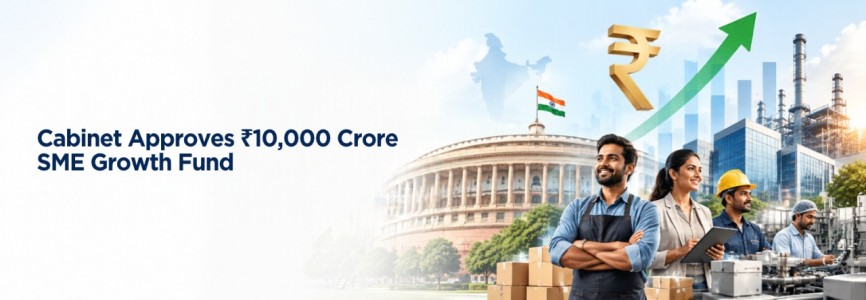



India’s Small and Medium Enterprises are often described as the backbone of the economy. They create jobs, support exports, strengthen manufacturing, bring innovation into traditional industries, and keep thousands of local supply chains moving. Yet, despite their importance, many promising SMEs reach a stage where bank loans alone are no longer enough to support their next phase of growth. To address this challenge, the Union Cabinet, chaired by Prime Minister Shri Narendra Modi, has approved the Government of India’s commitment of ?10,000 crore towards the establishment of the SME Growth Fund, or SGF.
The initiative is aimed at providing long-term growth-oriented equity capital to high-potential Small and Medium Enterprises that have already demonstrated business viability but need larger and more patient capital to scale their operations. The SME Growth Fund forms part of the broader MSME-focused measures announced under the Union Budget 2026-27 and is intended to support the Government’s long-term vision of developing globally competitive Indian enterprises under Viksit Bharat 2047. What makes this initiative important is that it goes beyond conventional credit support. Instead of merely helping businesses borrow more, the Fund seeks to provide equity capital that can help SMEs invest, innovate, expand and compete at a much larger scale.
Why Was the SME Growth Fund Needed?
Over the years, India has introduced several schemes to improve the availability of finance for MSMEs. Banks, financial institutions, credit guarantee programmes, startup funding schemes and government-backed initiatives have all helped enterprises access debt and early-stage capital. However, a significant gap continued to exist. Many existing equity funds are largely focused on startups, early-stage businesses or Micro enterprises. Businesses that have already crossed the startup stage and are now looking to expand manufacturing capacity, enter international markets, acquire technology or make strategic investments often find themselves in a difficult position.
At this stage, these enterprises may be profitable and operationally stable, but they may require substantial capital that cannot always be comfortably serviced through debt. For example, an SME may want to establish a larger manufacturing facility, acquire another company, automate its production line or enter a new international market. These plans may require significant capital upfront while generating returns only over the medium or long term. Traditional bank loans may create repayment pressure during this phase. This is where growth equity becomes important. The SME Growth Fund is designed to bridge this structural gap by providing patient, long-term risk capital to businesses that have the potential to scale significantly.
What Is the SME Growth Fund?
The SME Growth Fund is proposed as a growth-focused investment vehicle intended to provide direct equity support to eligible Small and Medium Enterprises. Under the approved framework, the Government of India will make an aggregate commitment of ?10,000 crore to an Alternative Investment Fund, or AIF, established under the SME Growth Fund framework. The Fund is expected to invest in SMEs with strong business potential, demonstrated viability and the ability to scale. Unlike a traditional business loan, equity funding involves investment in the ownership of a business. Investors participate in the future growth and value creation of the company rather than simply receiving fixed interest repayments. This structure can give businesses greater financial flexibility while they invest in expansion. The objective is not simply to provide funding, but to create a strong pipeline of Indian enterprises that can become leaders in their respective sectors.
Major Focus on Manufacturing SMEs
One of the most important features of the SME Growth Fund is its strong emphasis on manufacturing. Most of the allocation under the SGF is expected to be directed towards Small and Medium manufacturing enterprises. This focus is significant because manufacturing businesses generally require higher capital investment than many service-based businesses. Building plants, acquiring machinery, upgrading production technology, meeting quality standards and expanding manufacturing capacity can require substantial long-term investment.
For many SMEs, depending only on loans for such expansion may create excessive financial pressure. Equity capital can provide these enterprises with the financial breathing room required to invest confidently in long-term growth. The Fund can therefore play an important role in helping Indian manufacturers increase production capacity, improve productivity, adopt new technologies and compete with larger domestic and global players.
Support for Businesses in Tier-II and Tier-III Cities
Another important aspect of the initiative is its focus on industrial clusters located beyond major metropolitan cities. The SME Growth Fund is expected to consider enterprises operating in Tier-II and Tier-III cities, particularly those forming part of established industrial clusters. This could have a meaningful impact on regional economic development. India has several highly specialised manufacturing clusters outside major metros. These include enterprises involved in engineering, textiles, auto components, chemicals, food processing, pharmaceuticals, electronics, handicrafts and industrial manufacturing. Many such businesses have strong technical expertise and established customer relationships but often struggle to access large pools of institutional capital. By encouraging investment into these clusters, the SGF can help capital reach businesses that may otherwise remain overlooked by traditional private equity and venture capital investors. This can also strengthen regional supply chains, generate local employment and create new industrial growth centres across the country.
Helping SMEs Scale Beyond Their Existing Limits
One of the central purposes of the SME Growth Fund is to help businesses cross the difficult transition from being a successful small or medium enterprise to becoming a large, professionally managed and internationally competitive company. Many SMEs face a common challenge. Their business model works. Customers exist. Revenues are growing. Demand is visible. But the company lacks sufficient capital to expand at the speed required. The SME Growth Fund seeks to provide capital at exactly this stage. The capital may enable enterprises to increase manufacturing capacity, establish new facilities, strengthen distribution networks, improve working infrastructure, enter new product categories or build stronger management systems. This can allow businesses to move beyond incremental growth and pursue transformational expansion.
Encouraging Technology Adoption
Technology is rapidly reshaping the way businesses operate. Automation, artificial intelligence, data analytics, advanced manufacturing systems, digital supply chains, robotics, cloud platforms and smart machinery are increasingly becoming essential for productivity and competitiveness. However, adopting such technologies requires investment. Many SMEs delay technology upgrades because immediate operational requirements take priority over long-term capital expenditure. The SME Growth Fund can help change this situation. By providing long-term equity support, businesses may be able to invest in advanced technologies without putting excessive pressure on their day-to-day cash flows. Technology investment can improve productivity, reduce production costs, increase consistency, improve quality control and help businesses compete in international markets. For Indian SMEs, this could be one of the most important long-term benefits of the initiative.
Supporting Global Expansion
A business that performs well in India may eventually want to expand internationally. However, entering foreign markets requires more than simply finding overseas customers. Businesses may need international certifications, stronger logistics networks, compliance systems, local partnerships, marketing investments, distribution arrangements and working capital to support larger order volumes. These requirements can be expensive. Growth equity under the SME Growth Fund may help capable enterprises take this next step. By supporting international expansion, the Fund could help more Indian companies become recognised suppliers, manufacturers and service providers in global markets. This could also contribute to India’s export growth over the long term.
Integration with Global Value Chains
Global manufacturing is increasingly organised through interconnected supply chains. Large multinational companies often depend on networks of specialised suppliers located across different countries. For Indian SMEs, becoming part of these global value chains can create significant opportunities. However, international buyers generally expect suppliers to maintain high standards of production quality, technology, compliance, delivery timelines and financial stability. Meeting these expectations often requires investment. The SME Growth Fund can provide capital that enables businesses to upgrade facilities, obtain certifications, strengthen quality control and increase production capacity. This can improve the ability of Indian SMEs to become long-term suppliers to global corporations.
Enabling Strategic Acquisitions
Growth does not always happen organically. Sometimes, acquiring another business, technology platform, manufacturing facility or specialised product line can help an enterprise scale much faster. However, acquisitions often require large amounts of capital. For SMEs, financing such transactions entirely through debt can be difficult. Growth equity funding can create greater flexibility for strategic acquisitions. A well-managed SME may use this opportunity to acquire complementary businesses, access new markets, obtain intellectual property or expand into related product categories. This can accelerate the transformation of medium-sized enterprises into larger industry leaders.
Building Indian Champion Enterprises
The broader ambition behind the SME Growth Fund goes beyond individual companies. The Government wants to create a new generation of Indian enterprises capable of becoming champions in their sectors. These businesses may begin as regional or mid-sized enterprises but eventually develop the scale, governance, technology and competitiveness required to become national and global leaders. India has already seen several businesses grow from modest beginnings into internationally recognised companies. The SME Growth Fund aims to create an environment in which more such success stories can emerge. Businesses that receive the right combination of capital, professional management and market opportunity may be able to grow far beyond their current size.
Creating Quality Employment
When SMEs expand, employment generally grows along with them. A manufacturing unit that adds a new production line may require engineers, technicians, supervisors, logistics workers, quality-control professionals, accountants and administrative staff. A technology business expanding internationally may require developers, analysts, sales professionals and customer-support teams. Therefore, the impact of the SME Growth Fund could extend well beyond the businesses receiving investment. Successful investments may lead to the creation of thousands of direct and indirect employment opportunities across manufacturing clusters and service sectors. The emphasis on Tier-II and Tier-III cities is particularly important because it can create more high-quality employment opportunities outside the largest metropolitan centres.
Strengthening Domestic Capital Markets
Another important long-term objective of the initiative is to deepen India’s domestic capital ecosystem. For many years, early-stage startups have attracted significant attention from venture capital investors. Growth-stage SMEs, however, have often had fewer financing options. The SME Growth Fund can help create a more developed institutional investment market for such enterprises. Government participation may also encourage private investors, institutional investors and other capital providers to explore opportunities in the SME segment. If this ecosystem develops successfully, businesses may have access to multiple funding options throughout their lifecycle, from startup funding and credit support to growth equity and eventually public markets.
Improving Productivity and Competitiveness
For an enterprise, access to capital is ultimately valuable only if it improves business performance. The Government expects the SME Growth Fund to improve the scale and productivity of participating enterprises. Businesses may use the capital to modernise manufacturing systems, implement technology, strengthen governance and expand production. Larger scale can help companies reduce unit costs and improve operational efficiency. Improved productivity can then enable businesses to offer better pricing while maintaining quality. This becomes particularly important in export markets, where Indian companies compete with suppliers from several countries. By enabling SMEs to operate at greater scale and efficiency, the Fund could help improve India's overall manufacturing and export competitiveness.
Complementing Existing MSME Initiatives
The SME Growth Fund is not intended to function in isolation. It complements several existing initiatives aimed at strengthening the MSME ecosystem. Over the years, government policy has focused on digitalisation, easier business registration, improved credit access, credit guarantee mechanisms, startup promotion, public procurement reforms and initiatives designed to improve the ease of doing business. Production-linked incentive programmes have also encouraged expansion in strategic manufacturing sectors. The SME Growth Fund adds another important piece to this ecosystem by addressing the availability of growth-stage equity capital. Together, these measures aim to create a more supportive environment in which businesses can start, survive, expand and eventually become large enterprises.
A Shift from Credit Support to Growth Capital
One of the most significant aspects of this policy is the shift in approach. Traditionally, MSME policy discussions have focused heavily on loans, interest rates and credit availability. Credit will continue to remain important, but it cannot meet every financing requirement. A business seeking rapid expansion may require capital that does not immediately create repayment obligations.
Equity funding can provide exactly that. The SME Growth Fund therefore represents an important evolution in how the financial needs of growing enterprises are being addressed. Instead of viewing SMEs only as businesses needing easier credit, the policy recognises that some SMEs are potential future industry leaders that require growth capital. That distinction is important.
Potential Impact on India's Industrial Ecosystem
If implemented effectively, the SME Growth Fund can have a wider impact on India's industrial landscape. Growing businesses purchase more raw materials, hire more employees, use more logistics services and engage more professional service providers. This creates a multiplier effect. A single manufacturing company that expands its capacity may generate business for dozens of smaller suppliers, transport companies, technology providers and service firms. Industrial clusters can become stronger, local economies can become more diversified, and regional employment opportunities can improve. The Fund may therefore influence not just individual enterprises but entire business ecosystems.
What This Means for Indian SMEs
For ambitious SMEs, the announcement represents an important opportunity. Businesses that have established operations, strong management, sustainable revenues and a clear expansion strategy may eventually find new funding opportunities through the SGF framework. However, equity investors generally evaluate businesses differently from lenders. While banks often focus heavily on repayment capacity and collateral, equity investors examine growth potential, profitability, governance, market opportunity, scalability and long-term value creation. This means SMEs seeking institutional equity investment may need to strengthen their financial reporting, corporate governance, legal compliance and strategic planning. Well-managed businesses that maintain transparent records and demonstrate a clear growth plan are likely to be better positioned to attract investment.
Governance and Professionalisation Could Become More Important
Institutional investment often brings more than capital. Investors may expect stronger governance systems, professional management practices, detailed financial reporting and clear accountability. For many family-owned or promoter-driven SMEs, this can represent an important transition. Businesses may need to establish professional boards, improve management information systems, strengthen internal controls and introduce formal decision-making processes. Although these changes can initially require effort, they can also prepare enterprises for larger investments, strategic partnerships and future public listings. Therefore, the SME Growth Fund could indirectly accelerate the professionalisation of India's SME sector.
Role in Achieving Viksit Bharat 2047
The Government has positioned the initiative within the wider vision of Viksit Bharat 2047. For India to become a developed economy, it will need significantly more businesses that operate at global scale.
Large companies will play an important role, but the future growth pipeline will largely emerge from today's SMEs. Many of tomorrow's large manufacturers, technology companies, exporters and service providers are likely to be businesses that are currently operating in the SME segment. Providing growth capital at the right stage can therefore have long-term economic consequences. The SME Growth Fund is designed to identify and support precisely these businesses.
Conclusion
The approval of the Government of India's ?10,000 crore commitment towards the SME Growth Fund marks an important development in India's MSME policy framework. The initiative recognises a challenge that has existed for years: many strong Small and Medium Enterprises have access to credit but still struggle to obtain the long-term equity capital required for transformational growth. By creating a dedicated framework for growth-stage investment, the Government is attempting to bridge this gap.
The Fund is expected to support businesses seeking to expand manufacturing capacity, adopt advanced technologies, enter international markets, integrate into global value chains and pursue strategic growth opportunities. Its focus on manufacturing enterprises and industrial clusters in Tier-II and Tier-III cities could also help promote more balanced regional development. However, the true success of the SME Growth Fund will ultimately depend on how effectively the capital is deployed, how promising enterprises are identified and how efficiently investments are managed.
For Indian SMEs with strong fundamentals and ambitious growth plans, the initiative could represent more than just another funding scheme. It could become an important pathway for transforming successful medium-sized businesses into nationally and globally competitive enterprises. If implemented effectively, the SME Growth Fund can strengthen India's manufacturing ecosystem, deepen domestic capital markets, encourage innovation, create quality employment and help build the next generation of Indian business champions. In that sense, the ?10,000 crore commitment is not simply an investment in SMEs. It is an investment in the future scale, competitiveness and entrepreneurial strength of the Indian economy.
Frequently Asked Questions (FAQs)
Q1. What is the ?10,000 Crore SME Growth Fund?
Ans: The SME Growth Fund is a government-backed initiative approved by the Cabinet with a commitment of ?10,000 crore. It is intended to support the growth and expansion of Small and Medium Enterprises through direct equity investments. The fund aims to help promising SMEs scale their operations and become future industry champions.
Q2. What is the main objective of the SME Growth Fund?
Ans: The primary objective is to provide growth capital to eligible SMEs that have strong business potential. It seeks to improve access to equity funding, support innovation, enhance competitiveness, and encourage business expansion. The initiative is also expected to strengthen India’s overall SME ecosystem.
Q3. Who can benefit from the ?10,000 Crore SME Growth Fund?
Ans: The fund is expected to benefit eligible Small and Medium Enterprises that meet the prescribed investment and selection criteria. Businesses with scalable models, strong growth potential, and sound financial performance may receive preference. Detailed eligibility conditions are expected to be governed by the applicable framework and fund guidelines.
Q4. Will the SME Growth Fund provide loans to businesses?
The fund is primarily designed for direct equity investment rather than conventional business loans. This means eligible SMEs may receive capital in exchange for an equity stake instead of taking on additional debt. It can therefore provide long-term growth capital without creating the same repayment burden as a traditional loan.
Q5. How will the SME Growth Fund help Indian SMEs?
Ans: The fund can help SMEs obtain capital for expansion, technology adoption, capacity building, market development, and other growth requirements. It may also improve the ability of businesses to attract additional institutional investors. Better access to capital can enable SMEs to compete more effectively in domestic and international markets.
Q6. Is the ?10,000 Crore SME Growth Fund available to all MSMEs?
Ans: Not necessarily. The initiative is specifically focused on eligible Small and Medium Enterprises, and investment is likely to depend on prescribed criteria and commercial evaluation. Micro enterprises or businesses that do not satisfy the eligibility requirements may not automatically qualify merely because they are registered as MSMEs.
Q7. How can SMEs apply for funding under the scheme?
Ans: The detailed application, evaluation, and investment process will depend on the operational guidelines issued for the fund. Eligible enterprises may be required to submit financial information, business plans, growth projections, corporate documents, and other supporting records. Businesses should monitor official notifications for the final application mechanism.
Q8. What type of businesses may be preferred for investment?
Ans: SMEs with strong growth prospects, scalable operations, sound governance, and the potential to become market leaders may be considered attractive investment candidates. Businesses operating in manufacturing, innovation-driven sectors, technology, exports, or other strategic areas may also benefit depending on the final investment strategy.
Q9. What documents may be required for SME Growth Fund investment?
Ans: Although final requirements will depend on the applicable guidelines, SMEs may need incorporation documents, financial statements, tax records, MSME or Udyam details, shareholding information, business plans, and growth projections. Legal, financial, and compliance due diligence may also be carried out before any investment decision.
Q10. Why is the ?10,000 Crore SME Growth Fund important for India?
Ans: SMEs play an important role in employment generation, manufacturing, exports, and economic development. By providing equity capital, the fund can help promising enterprises overcome financing constraints and scale faster. The initiative is intended to create stronger, more competitive Indian businesses capable of becoming future champions.


_crop10_thumb.jpg)


_crop10_thumb.jpg)


-Form_crop10_thumb.jpg)

_crop10_thumb.jpg)


_learn_crop10_thumb.jpeg)


_crop10_thumb.jpg)

_crop10_thumb.jpg)


_crop10_thumb.jpg)





_for_Foreign_Directors_learn_crop10_thumb.jpeg)


_Act,_2015_learn_crop10_thumb.jpg)










_learn_crop10_thumb.jpg)






































_crop10_thumb.jpg)

_crop10_thumb.jpg)


_(1)_crop10_thumb.jpg)














_crop10_thumb.png)















_crop10_thumb.jpg)


_crop10_thumb.jpg)








_crop10_thumb.png)


_crop10_thumb.jpg)









_crop10_thumb.png)