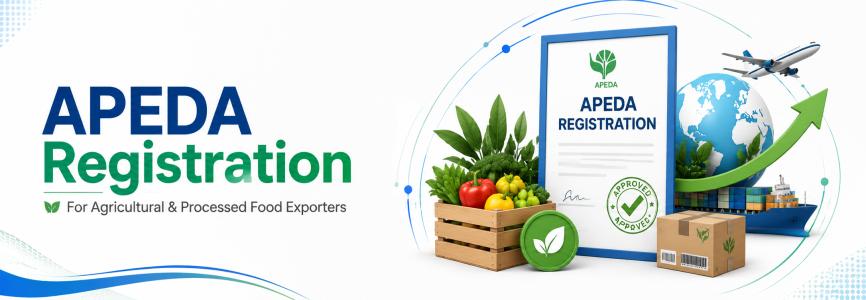



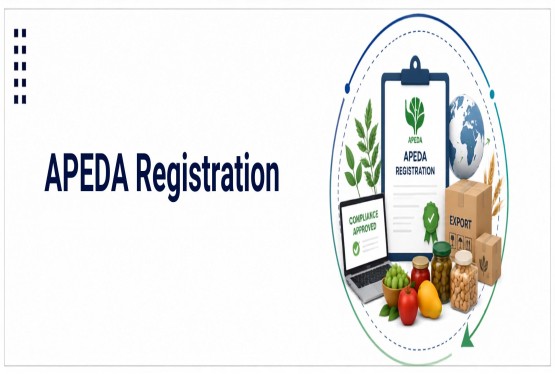
Exporting agricultural and processed food products from India involves more than obtaining an Importer Exporter Code (IEC) and finding an overseas buyer. Where the goods fall within the products assigned to the Agricultural and Processed Food Products Export Development Authority (APEDA), exporters must carefully examine the APEDA registration, the Registration-cum-Membership Certificate (RCMC) requirements under the Foreign Trade Policy, and product-specific export conditions.
APEDA was constituted under the Agricultural and Processed Food Products Export Development Authority Act, 1985, which came into force in 1986. Its statutory functions include registration of exporters, development and promotion of scheduled-product exports, fixation of standards, inspection in specified sectors, improvement of packaging and overseas marketing, and collection of export-related information.
A seemingly small mistake while applying for APEDA registration can result in deficiencies, delays, incorrect categorisation or difficulties when the exporter later seeks an authorisation, export benefit, contract registration, traceability approval or other APEDA service. The following are some of the most important APEDA Registration mistakes exporters should avoid, along with the applicable legal provisions and recent regulatory developments.
Understanding APEDA Registration Before Applying
APEDA registration is commonly represented through an APEDA Registration-cum-Membership Certificate (RCMC). It establishes the exporter’s registration with APEDA for products falling within APEDA’s jurisdiction. Since 17 July 2023, APEDA has been using the DGFT electronic RCMC platform for issuance of its RCMC, and exporters are directed to apply through the DGFT portal after obtaining an IEC.
The registration framework must be read together with the APEDA Act, the Foreign Trade Policy 2023, the Handbook of Procedures 2023, APEDA Rules and Regulations, and product-specific directions issued from time to time.
Mistake 1: Assuming APEDA Registration Applies to Every Export Product
One of the most common mistakes is assuming that APEDA is the registration authority for every agricultural or food-related export. APEDA has jurisdiction over products assigned to it under the APEDA Act and related notifications. Exporters should first determine whether their product actually falls within an APEDA scheduled category before applying.
APEDA presently monitors categories including fruits and vegetables and their products, meat products, poultry products, dairy products, confectionery and bakery products, honey and sugar products, cocoa and chocolates, alcoholic and non-alcoholic beverages, cereals and cereal products, groundnuts, pickles and chutneys, guar gum, floriculture products, herbal and medicinal plants and other products assigned to it. APEDA also identifies Basmati rice under the Second Schedule of the Act.
The statutory basis comes from Sections 2 and 3 of the APEDA Act. Section 2 defines scheduled products, while Section 3 enables amendment of the schedules through notification. An exporter should therefore check the latest product coverage instead of relying on an old list obtained from a blog, agent or previous exporter.
Mistake 2: Confusing APEDA Registration With IEC
Another major mistake is treating the Importer Exporter Code and APEDA RCMC as the same registration. They serve different legal purposes.
IEC is issued through the Directorate General of Foreign Trade and operates as the primary import-export identification of the business. APEDA RCMC, on the other hand, establishes the exporter’s registration with APEDA for products under its jurisdiction.
APEDA's current procedure specifically states that exporters can apply for e-RCMC for APEDA scheduled products after obtaining IEC from DGFT.
Therefore, merely holding IEC does not automatically make the entity an APEDA-registered exporter, and obtaining APEDA RCMC does not replace the requirement for a valid IEC wherever IEC is legally required.
Mistake 3: Ignoring Section 12 of the APEDA Act
Exporters should not treat APEDA registration as an entirely optional industry membership. Section 12 of the APEDA Act, 1985 specifically deals with registration of exporters.
Section 12(1) provides that every person exporting one or more Scheduled Products shall apply to APEDA for registration within the statutory period prescribed by the section. The provision refers to application within one month from undertaking such export, subject to APEDA's power to extend the period for sufficient reasons. Section 12(2) further provides that registration once made continues until cancelled by the Authority.
For practical compliance, businesses planning regular exports of APEDA-controlled products should deal with the registration requirement before commercial exports rather than relying on the statutory extension mechanism after exports have already begun.
Mistake 4: Using an Outdated APEDA Registration Process
Exporters sometimes follow old online guides that instruct them to complete the entire registration through the legacy APEDA membership portal. That may cause confusion because the operational procedure has changed.
APEDA officially announced that, in compliance with DGFT's electronic RCMC framework, it began using the DGFT portal for RCMC issuance with effect from 17 July 2023. APEDA's March 2026 announcements also contain a fresh circular relating to the e-RCMC procedure.
Exporters should therefore work with the current DGFT e-RCMC system and latest APEDA circular instead of relying exclusively on screenshots or registration instructions prepared under the earlier portal structure.
Mistake 5: Choosing the Wrong Exporter Category
An exporter must correctly identify whether the business is applying as a merchant exporter, manufacturer exporter or manufacturer-cum-merchant exporter, as applicable.
This distinction is important because the documentary burden is different. APEDA's circular dated 27 March 2026 states that a merchant exporter is required to provide the prescribed IEC documentation, while a manufacturer or manufacturer-cum-merchant exporter must additionally provide manufacturing proof for the relevant products.
Similarly, Paragraph 2.79 of the Handbook of Procedures states that where an exporter wants registration as a manufacturer exporter, evidence of such status must be furnished. Claiming manufacturer status without adequate manufacturing evidence can therefore create deficiencies or questions during examination.
Mistake 6: Uploading Incorrect Manufacturing Proof
Manufacturers should not assume that any business registration will automatically qualify as sufficient manufacturing proof.
Under APEDA's 2026 e-RCMC circular, supporting authorities vary according to the product. For fresh fruits and vegetables, for example, prescribed evidence may include FSSAI, Udyam registration or specified horticulture-related certification. For processed foods and certain cereal or animal products, FSSAI or Udyam-related evidence may apply, while alcoholic beverages involve documentation connected with the Excise Commissioner.
The safest approach is to review the current APEDA product-specific document requirement before filing rather than uploading unrelated certificates merely because they contain the business name.
Mistake 7: Providing Details That Do Not Match the IEC
Data inconsistency is another frequent cause of difficulties. The legal name, constitution, PAN-linked particulars, address and other primary information used in the RCMC application should correspond with the current IEC profile.
The Handbook of Procedures requires IEC holders to update changes in constitution, address, bank details and other primary particulars online. It also provides that where a change in constitution results in a new PAN, a new IEC against that PAN may be required.
An exporter should therefore correct outdated IEC information before filing APEDA RCMC rather than creating conflicting records between DGFT and APEDA.
Mistake 8: Selecting the Wrong Product or Main Line of Business
RCMC applications are closely connected with the exporter’s main line of business. Under Paragraph 2.80 of the Handbook of Procedures, an exporter must declare the main line of business and obtain the RCMC from the authority dealing with that product.
For an exporter dealing primarily in products under APEDA's jurisdiction, selecting an unrelated council merely because its membership process appears easier can create problems when the RCMC is later used for DGFT or commodity-specific purposes.
The exporter should carefully identify its HS classification, actual products, proposed exports and appropriate registering authority before filing.
Mistake 9: Assuming APEDA RCMC Has Lifetime Validity
This area can be confusing because Section 12(2) of the APEDA Act states that registration once made continues until cancelled, while the operational RCMC framework prescribes a defined certificate validity.
Paragraph 2.81 of the Handbook of Procedures provides that RCMC is ordinarily valid for five years, beginning from 1 April of the licensing year in which it is issued and ending on 31 March of the relevant fifth licensing year, unless otherwise specified.
APEDA's March 2026 circular likewise states that its e-RCMC has a five-year validity, with an online renewal fee currently stated as ?5,000 plus 18% GST, amounting to ?5,900. Accordingly, exporters should not interpret Section 12(2) as meaning that an electronic RCMC certificate never needs renewal under the current procedural framework.
Mistake 10: Not Updating Changes in the Business
A particularly important compliance requirement appears in Paragraph 2.82 of the Handbook of Procedures.
Where there is a change in the ownership, constitution, name or address of the exporter, the RCMC holder is required to intimate the registering authority within one month of the change. The registering authority can condone a delay on merits.
APEDA's 2026 circular also indicates that amendment or modification of an issued RCMC can currently be applied for without an amendment fee. Exporters should therefore update the certificate immediately after changes such as company name alteration, conversion of constitution, registered-office change or similar restructuring.
Mistake 11: Believing APEDA RCMC Is the Only Licence Needed for Export
An APEDA RCMC is not a universal food-export licence and should never be marketed or understood that way.
Depending upon the product and destination country, an exporter may separately need FSSAI licensing, phytosanitary certification, plant quarantine compliance, establishment approval, packhouse recognition, health certification, testing, residue monitoring, organic certification, traceability registration, import-country approvals or contract registration.
APEDA currently maintains separate export procedures and traceability systems including HortiNet, Peanut.Net, TraceNet, Meat.Net and Basmati.Net, and regularly issues commodity and destination-specific export procedures.
Thus, obtaining RCMC should be treated as one component of the overall export compliance structure.
Mistake 12: Assuming RCMC Is Required for Every FTP Remission Benefit
Exporters should also avoid making overly broad claims that RCMC is necessary for every DGFT-linked export incentive. Under Paragraph 2.57 of FTP 2023, RCMC is generally relevant where a person applies for an import/export authorisation under the FTP, subject to stated exceptions, or seeks other benefits or concessions under FTP.
However, DGFT clarified in 2024 that the RCMC requirement does not apply merely for claiming specified post-export remission schemes such as Duty Drawback, RoSCTL and RoDTEP. Therefore, the exact scheme should always be examined before telling an exporter that RCMC is compulsory solely to receive a particular remission benefit.
Mistake 13: Giving False or Unsupported Information
Applicants should never inflate product coverage, falsely claim manufacturing status, submit altered documents or make declarations that cannot be supported by records.
The APEDA Act contains a broader compliance and penalty framework. Section 22 deals with false reports, Section 23 covers obstruction and failure relating to production of records, Section 24 contains other penalty provisions, and Section 25 addresses offences involving companies. India Code also reflects the newly inserted Section 25A relating to adjudication of penalties.
Apart from APEDA law, fraudulent or forged documents can also have consequences under foreign trade, customs, food safety and general penal laws depending on the nature of the conduct.
Mistake 14: Ignoring Post-Registration Returns and Inspection Powers
Obtaining the certificate is not the end of APEDA compliance. Section 14 of the APEDA Act requires prescribed returns to be furnished by exporters and also enables authorised inspection of processing plants or establishments for verification of the accuracy of returns.
Businesses should therefore retain proper records of exported products, quantities, invoices, shipping bills, destinations, manufacturing or processing facilities and other documentation relevant to their statutory reporting obligations. An exporter who focuses only on obtaining the certificate but does not maintain records can face difficulties when APEDA later seeks information or verification.
Mistake 15: Ignoring a Show-Cause Notice or De-registration Proceeding
Under Paragraph 2.83 of the Handbook of Procedures, a registering authority can de-register an RCMC holder for a specified period where the conditions of registration are violated. Importantly, the exporter must be given a show-cause notice and a reasonable opportunity to make a representation before such de-registration. An exporter receiving such a notice should therefore respond within the prescribed period with supporting documentation instead of assuming that the registration will continue automatically.
Mistake 16: Missing the 45-Day Appeal Period
Where an exporter is aggrieved by a decision connected with the issue of RCMC, the Handbook of Procedures provides an appellate remedy. Under Paragraph 2.84, an appeal can be preferred to DGFT or the designated officer within 45 days against the decision of the registering authority. The decision of the appellate authority is stated to be final under this provision. Missing this deadline can materially affect an exporter’s remedies. Any adverse RCMC order should therefore be reviewed immediately.
APEDA Registration Fee and Renewal: Current 2026 Position
A further mistake is relying on outdated fee figures.
APEDA's circular announced on 27 March 2026 states an online registration fee of ?5,000 plus GST at 18%, totalling ?5,900. It states the validity as five years and gives the online renewal fee at the same ?5,900 amount. The circular further states that amendment or modification after issuance of RCMC can presently be applied for without an amendment fee.
Because fee schedules and procedures can change, exporters should verify the amount displayed on the DGFT/APEDA portal on the actual filing date.
Recent APEDA and RCMC Legal Updates in 2026
Several developments make it especially important to rely on current law rather than old APEDA articles.
First, APEDA published a Circular on Procedure for e-RCMC on 27 March 2026. The circular specifies documentation for merchant exporters and manufacturer/manufacturer-cum-merchant exporters, product-wise manufacturing evidence, the present ?5,900 registration and renewal charges, five-year validity and the amendment process.
Second, the Jan Vishwas (Amendment of Provisions) Act, 2026 changed the compliance and enforcement framework of the APEDA Act. India Code's updated consolidated legislation reflects amendments made by Act 8 of 2026 and the insertion of Section 25A on adjudication. Government material describing the reform notes a move toward a warning-and-penalty approach for procedural defaults such as failure to furnish returns rather than automatically treating every procedural lapse through the older punitive model.
Third, on 20 July 2026, DGFT issued Trade Notice No. 14/2026-27 seeking stakeholder comments on a proposed amendment to the RCMC provisions of FTP 2023. The proposal contemplates a de minimis exemption for export consignments having FOB value up to ?10,000, particularly to facilitate low-value postal, courier and emerging-channel exports.
This July 2026 document is important, but exporters should distinguish a consultation proposal from a final operative amendment. The Trade Notice invited comments before finalisation. Therefore, businesses should not automatically assume that every export up to ?10,000 is presently outside APEDA's independent statutory registration framework merely because the draft FTP relaxation was circulated. Separate requirements under the APEDA Act and commodity-specific law must also be examined.
Another important recent development concerns rice. APEDA's current guidance states that a valid APEDA RCMC is a prerequisite for applying for a Registration-cum-Allocation Certificate (RCAC) for relevant rice exports, and the online RCAC system is integrated with the exporter’s membership profile.
How Exporters Can Avoid APEDA Registration Problems
The safest approach is to begin by identifying the exact product and HS classification and checking whether it falls within APEDA jurisdiction. The exporter should then ensure that its PAN, IEC, business constitution, address and manufacturing records are current and consistent.
The appropriate exporter category should be selected carefully, and manufacturer exporters should collect the precise manufacturing proof required for their commodity. The application should then be filed through the current DGFT e-RCMC system, with all declarations supported by genuine records.
After issuance, businesses should monitor the five-year RCMC period, update changes within the prescribed one-month period, maintain export and production records, comply with product and destination-specific standards, and respond promptly to any APEDA or DGFT communication.
Conclusion
APEDA Registration is not merely a certificate-generation exercise. It forms part of a wider statutory and foreign-trade compliance framework involving the APEDA Act, 1985, Foreign Trade Policy 2023, Handbook of Procedures, DGFT e-RCMC system and commodity-specific APEDA directions.
The most serious mistakes arise when exporters apply under the wrong category, select products outside APEDA's jurisdiction, submit inconsistent IEC data, claim manufacturer status without proof, ignore renewal or amendment requirements, or assume that obtaining RCMC automatically satisfies every food-export regulation.
Exporters should also be particularly careful with recent changes. The March 2026 APEDA e-RCMC circular, the 2026 amendments to APEDA's enforcement framework, and the July 2026 proposal for low-value RCMC relaxation demonstrate that export compliance continues to evolve.
A properly filed and maintained APEDA RCMC can support smoother access to APEDA services, applicable FTP authorisations and benefits, product-specific systems and India's organised agricultural export ecosystem. But the certificate should always be maintained alongside other licences, quality standards, customs requirements and importing-country regulations applicable to the particular product and destination.
Frequently Asked Questions (FAQs)
Q1. What is APEDA Registration?
Ans: APEDA Registration is registration with the Agricultural and Processed Food Products Export Development Authority.
It is mainly relevant for exporters dealing in products covered under APEDA’s jurisdiction.
The registration is generally issued in the form of an RCMC through the DGFT e-RCMC system.
It helps exporters establish registration with the concerned export promotion authority.
Q2. Is APEDA Registration mandatory for exporters?
Ans: APEDA registration is required for exporters dealing with scheduled products covered under the APEDA Act.
Its applicability depends on the nature of the product and the relevant export requirements.
Exporters should verify whether their goods fall within APEDA’s notified product categories.
Obtaining registration before regular commercial exports helps avoid compliance issues.
Q3. Is IEC required before applying for APEDA Registration?
Ans: Yes, an active Importer Exporter Code is generally required before applying for APEDA e-RCMC.
IEC is issued by the Directorate General of Foreign Trade and identifies the exporter.
The IEC details should be updated and consistent with the APEDA application information.
Exporters normally obtain IEC first and then proceed with APEDA registration.
Q4. How long is APEDA RCMC valid?
Ans: APEDA e-RCMC is generally issued with a validity of five financial years.
Its validity is governed by the applicable DGFT and APEDA registration framework.
Exporters should check the expiry date mentioned on their issued RCMC certificate.
Renewal should be completed in time to avoid interruption in registration status.
Q5. What are the common APEDA Registration mistakes?
Ans: Common mistakes include selecting the wrong product category and submitting outdated IEC details.
Applicants may also incorrectly declare themselves as manufacturer exporters without proper evidence.
Uploading incomplete documents or choosing the wrong registering authority can delay approval.
Exporters should verify all details and supporting documents before submission.
Q6. Can a merchant exporter apply for APEDA Registration?
Ans: Yes, merchant exporters dealing in eligible APEDA scheduled products can apply for registration.
They should hold a valid IEC and provide the required business and export-related information.
Manufacturer exporters may need additional documents proving their manufacturing activities.
The correct exporter category must be selected while submitting the e-RCMC application.
Q7. What documents are required for APEDA Registration?
Ans: The applicant generally needs an active IEC and updated business information for registration.
Manufacturer exporters may also need FSSAI, Udyam or other product-specific manufacturing proof.
Exact document requirements can differ according to the commodity and exporter category.
Applicants should check the latest APEDA requirements before submitting the application.
Q8. Can APEDA Registration details be amended?
Ans: Yes, exporters can apply for amendment when their registered particulars change.
Changes may include the business name, address, constitution, ownership or product details.
Such changes should be reported to the concerned registering authority within the prescribed period.
Keeping the RCMC updated helps maintain consistency with IEC and other regulatory records.
Q9. Is APEDA Registration enough to export food products?
Ans: No, APEDA registration alone may not satisfy every requirement for exporting food products.
Exporters may additionally require FSSAI licences, testing, health certificates or phytosanitary approvals.
Destination-country requirements and product-specific APEDA procedures may also apply.
Every export consignment should therefore be checked for all applicable legal compliances.
Q10. What happens if incorrect information is submitted?
Ans: Incorrect or unsupported information can lead to queries, rejection or action by the registering authority.
False declarations or fabricated documents can also attract consequences under applicable laws.
Exporters should ensure that every declaration is supported by valid and current records.
Any mistake discovered after issuance should be corrected through the appropriate amendment process.


_crop10_thumb.jpg)


_crop10_thumb.jpg)


-Form_crop10_thumb.jpg)

_crop10_thumb.jpg)


_learn_crop10_thumb.jpeg)


_crop10_thumb.jpg)

_crop10_thumb.jpg)


_crop10_thumb.jpg)





_for_Foreign_Directors_learn_crop10_thumb.jpeg)


_Act,_2015_learn_crop10_thumb.jpg)










_learn_crop10_thumb.jpg)














































_crop10_thumb.jpg)


_crop10_thumb.jpg)


_(1)_crop10_thumb.jpg)















_crop10_thumb.png)













_crop10_thumb.jpg)


_crop10_thumb.jpg)








_crop10_thumb.png)

_crop10_thumb.jpg)










_crop10_thumb.png)