
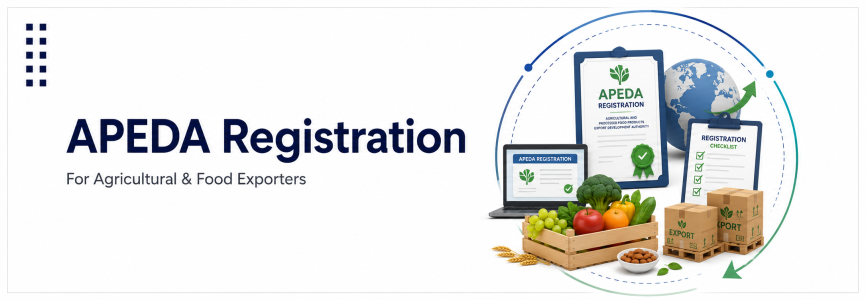



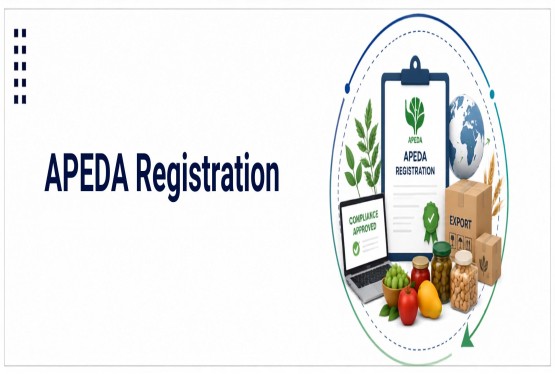
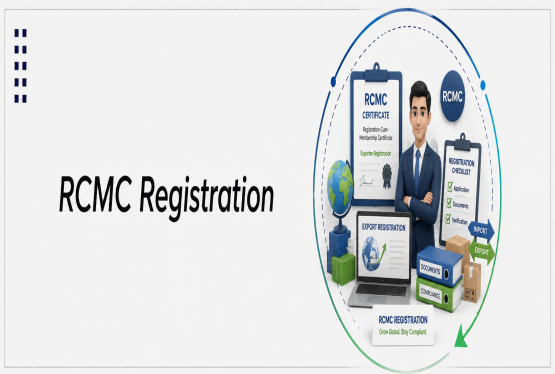
Businesses exporting agricultural and processed food products from India may need registration with the Agricultural and Processed Food Products Export Development Authority, commonly known as APEDA. The registration is issued as a Registration-cum-Membership Certificate, or RCMC, for products covered under the APEDA Act.
The documents required for APEDA registration depend mainly on whether the applicant is a merchant exporter, manufacturer exporter or manufacturer-cum-merchant exporter. The product category is equally important because manufacturing proof for fresh produce may differ from the document required for alcoholic beverages, meat products or processed foods.
APEDA began issuing RCMC through the Directorate General of Foreign Trade portal from 17 July 2023. Therefore, applicants must now use their active IEC-linked DGFT account and follow the document checklist displayed in the e-RCMC application.
What Is APEDA Registration?
APEDA registration is the process through which an exporter dealing in APEDA-scheduled products obtains an RCMC from the Authority. APEDA is responsible for developing and promoting exports of scheduled agricultural and processed food products, registering exporters, fixing standards, improving packaging and marketing, collecting export information and supporting export-oriented production.
An RCMC confirms that the exporter is registered with the commodity authority responsible for its main line of export business. The DGFT’s e-RCMC framework requires exporters to obtain registration from the Export Promotion Council, Commodity Board or Development Authority concerned with their primary export product.
Legal Provisions Governing APEDA Registration in India
APEDA registration is principally governed by the Agricultural and Processed Food Products Export Development Authority Act, 1985, the APEDA Rules, 1986, subsequent amendments, APEDA circulars and the DGFT’s electronic RCMC procedure.
Section 10 of the APEDA Act
Section 10 authorises APEDA to take measures for the development and promotion of exports of scheduled products. Its functions include registering exporters, prescribing export standards, inspecting specified establishments, improving packaging, promoting international marketing, collecting statistics and organising training connected with scheduled products.
Section 12 – Registration of Exporters
Section 12 states that every person exporting one or more scheduled products must apply to APEDA for registration. The statutory wording requires the application to be made within one month from the date on which the person undertakes such export. APEDA may extend this period where sufficient reasons are provided.
The Act also states that registration, once made, continues until it is cancelled by the Authority. In practice, however, the currently issued electronic RCMC carries a five-year validity, after which renewal is processed through the DGFT portal.
Although the Act provides a one-month period, exporters should preferably obtain RCMC before beginning regular commercial shipments. Prior registration helps avoid difficulties in claiming Foreign Trade Policy benefits, submitting export documents and proving registration with the appropriate commodity authority.
Section 13 – Application, Fee and Cancellation
Section 13 empowers the Central Government to prescribe the form of application, particulars to be furnished, applicable fees, procedure for granting or cancelling registration and the registers to be maintained by APEDA. The detailed documentary and procedural requirements are consequently found in the APEDA Rules and operational circulars.
Section 14 – Returns and Inspection
Section 14 requires registered exporters to furnish prescribed returns to APEDA. It also authorises APEDA officers to inspect a processing plant or another establishment of an exporter to verify the correctness of the submitted returns. This means that registration documents and post-registration records should accurately reflect the exporter’s actual business operations.
Basic Documents Required for APEDA Registration
The official APEDA circular for electronic RCMC provides separate document requirements for merchant exporters and manufacturer exporters. Applicants should upload clear and properly signed copies, and the details in every document should match their IEC and DGFT profile.
Documents Required for a Merchant Exporter
A merchant exporter purchases products from farmers, manufacturers, processors or suppliers and exports them in its own name. It does not necessarily own the facility where the goods are manufactured or processed.
Signed and Sealed IEC Copy
The current APEDA circular lists a signed and sealed copy of the Importer Exporter Code issued by DGFT as the requisite document for a merchant exporter.
The IEC copy should contain the exporter’s correct legal name, registered address, constitution and IEC number. The copy should be signed by the proprietor, partner, director or properly authorised signatory and should carry the organisation’s seal where applicable.
Applicants should not use an old IEC containing a previous address, former business name or outdated constitution. The DGFT e-RCMC system uses IEC information as the principal source of the exporter’s identity, and IEC details are electronically authenticated within the common trade platform.
Documents Required for a Manufacturer Exporter
A manufacturer exporter owns or operates the unit in which the relevant products are produced, processed, graded, packed or otherwise prepared for export. A manufacturer-cum-merchant exporter may export goods produced in its own facility as well as goods procured from other manufacturers.
The current APEDA checklist requires such applicants to provide a signed and sealed IEC copy along with manufacturing proof applicable to the particular product category.
Importer Exporter Code
A signed and sealed IEC copy is required for manufacturer exporters as well. The IEC should be active, and its legal name and principal place of business should be consistent with the information entered in the APEDA RCMC application.
A difference between the manufacturing-unit address and IEC address does not automatically make the application invalid, but the relationship between the exporter and the production facility must be clear. The applicant should select and provide the relevant branch or unit details in the DGFT application wherever required.
Manufacturing Proof
Manufacturing proof demonstrates that the applicant has a genuine and recognised facility or regulatory approval for producing the goods mentioned in the application. The required authority differs according to the nature of the product.
The applicant is ordinarily expected to provide the relevant proof accepted for its category. It does not necessarily need to obtain every certificate mentioned against a category where the APEDA checklist recognises alternative forms of evidence.
Product-Wise Manufacturing Documents
Floriculture and Seeds
For floriculture products and seeds, manufacturing or production proof issued by the Department of Horticulture may be submitted. The certificate should identify the applicant, unit or farm and should relate to the activities for which APEDA registration is sought.
Where the applicant operates through leased farms, contract growers or multiple production locations, additional records may be requested to establish its connection with those facilities. Such records are supporting documents and are separate from the minimum document expressly listed in the APEDA circular.
Fresh Fruits and Vegetables
A manufacturer exporter dealing in fresh fruits and vegetables may provide an FSSAI document, Udyam Registration, registration from the Department of Horticulture or an appropriate certificate issued under the Ministry of MSME .
The certificate selected should genuinely support the activity shown in the application. For example, an Udyam certificate should contain suitable activity details, while an FSSAI licence should reflect the appropriate food-business category and premises.
Groundnuts, Pulses and Guar Gum
For groundnuts, pulses and guar gum, the official checklist recognises an FSSAI certificate or Udyam Registration or the relevant MSME certificate as manufacturing proof.
The legal name, premises and activity shown in the selected proof should correspond with the exporter’s actual operations. An applicant applying as a manufacturer should not submit a certificate that only establishes trading activity and does not support processing or manufacturing.
Processed Fruits, Vegetables and Other Processed Foods
Businesses exporting processed fruits and vegetables, processed food products, meat products, cereal preparations or miscellaneous food preparations may submit an FSSAI document, Udyam Registration or a certificate recognised by the Ministry of MSME.
The document should cover the relevant processing or manufacturing unit. Where the FSSAI licence is nearing expiry, the exporter should renew it before filing or provide proof that renewal has been completed, because an expired supporting approval can result in a clarification or rejection.
Meat, Dairy, Poultry and Honey
For meat, dairy, poultry and honey products, APEDA’s RCMC checklist similarly recognises FSSAI or Udyam/MSME registration as manufacturing proof.
However, an APEDA RCMC by itself does not replace product-specific unit registration, plant approval, slaughterhouse approval, food-safety licensing, health certification or importing-country requirements. A meat or dairy exporter may therefore need several additional approvals before the goods can legally be exported, even after obtaining RCMC.
Alcoholic Beverages
For alcoholic beverages, manufacturing proof from the Department of the Excise Commissioner is required. The approval should authorise the applicant or its manufacturing unit to manufacture the relevant alcoholic beverage. A general company-registration document or GST certificate cannot ordinarily substitute for an excise approval because the production of alcoholic beverages is separately regulated under state excise laws.
Cereals and Cereal Products
Applicants manufacturing cereals and cereal products may submit an FSSAI document, Udyam Registration or an appropriate MSME certificate. The product description entered in the e-RCMC application should correspond with the ITC HS codes and activities reflected in the supporting records. Broad or incorrect product descriptions can lead to queries from the registering authority.
Documents Mentioned Under the APEDA Rules
Rule 9 of the APEDA Rules, as substituted in 1998, provides that an application for registration should be made in the prescribed form and accompanied by a copy of the Importer Code and a bank certificate supporting the applicant’s financial soundness. It also requires the application to be signed by an authorised person with the person’s name, designation and company seal.
The older prescribed Form I also asks for details relating to the registered office, head office, branches, legal constitution, proprietor, partners or directors, banker, business establishment, products, manufacturing arrangements and any registration held with another Export Promotion Council or Commodity Board.
However, APEDA’s current electronic RCMC circular lists only the signed IEC copy for merchant exporters and the IEC plus applicable manufacturing proof for manufacturer exporters. It does not include a bank certificate in its stated list of current requisite documents. Applicants should therefore follow the live DGFT portal checklist and respond to any additional APEDA clarification rather than relying only on an older physical application format.
Supporting Documents Applicants Should Keep Ready
Although the current APEDA circular gives a limited minimum list, applicants should keep their business-constitution and identity documents ready. These may include the certificate of incorporation, LLP incorporation certificate, partnership deed, proprietorship proof, PAN, GST registration, registered-office proof, authorised-signatory authority, FSSAI licence, Udyam Registration, branch details and applicable unit approval.
These records may be relevant for updating the IEC profile, answering a deficiency notice or establishing the relationship between the applicant and its manufacturing premises. They should not automatically be described as mandatory APEDA uploads unless they appear in the live application checklist or are specifically requested by APEDA.
Importance of Matching Details in Every Document
The legal name in the APEDA application should be the same as the name recorded against the IEC. Abbreviations, missing words, old company names and trade names should not be used in place of the legal entity’s registered name unless the form separately asks for a brand or trade name.
The registered address, branch address and manufacturing-unit address should also be entered in their correct fields. Where a company changes its name, ownership, constitution or address, Rule 13 requires the change to be intimated to APEDA within one month. Delay may be condoned in genuine cases, but exporters should use the electronic amendment facility without waiting for renewal.
Information Entered in the e-RCMC Application
The DGFT e-RCMC application requires more than document uploads. The applicant must select APEDA as the registering authority, choose the relevant product group, declare its exporter type and provide the ITC HS code and description of the products proposed to be exported.
The application may also require certification details, authorised representatives, countries of export, firm profile and website information. After completing the form, the exporter uploads the required attachments, accepts the declaration, signs the application electronically and pays the prescribed fee.
Applicants should ensure that each selected ITC HS code actually relates to an APEDA-scheduled product. Selecting APEDA only because the business is generally connected with agriculture may be incorrect where the specific export product falls under another Commodity Board or Export Promotion Council.
APEDA-Scheduled Products
The First Schedule to the APEDA Act includes categories such as fruits and vegetables, meat, poultry, dairy products, biscuits and bakery products, honey and sugar products, cocoa and chocolates, beverages, cereal products, nuts, pickles and papads, guar gum, floriculture products, herbal and medicinal plants and de-oiled rice bran. Basmati rice appears in the Second Schedule as a special product.
The Central Government has power under Section 3 to add or remove products from the schedules through an Official Gazette notification. Exporters should consequently check the current product classification and not rely only on an old list or informal description.
APEDA Registration Fee and Validity
The current APEDA RCMC circular states an online registration fee of ?5,900, comprising a registration fee of ?5,000 and GST of ?900 at 18%. It also states an online renewal fee of ?5,900.
The RCMC is issued with a validity of five years. After issuance, an exporter can apply for amendment or modification of the RCMC without an amendment fee under the stated circular. Applicants should nevertheless verify the amount generated on the DGFT portal before payment because fees may be revised through a subsequent notification or circular.
Procedure for Filing the Application
The applicant must first obtain an active IEC and create or access its DGFT importer-exporter account. It should then open the Services menu, select e-RCMC and choose the option to apply for a fresh RCMC.
The applicant must confirm that its IEC profile is updated, select APEDA as the relevant authority, choose the office or branch, enter product and exporter details, upload documents and complete the declaration. The application is electronically signed and submitted after successful payment. The status can later be checked through the submitted-applications section of the DGFT dashboard.
Refusal and Cancellation for Incorrect Documents
Rule 10 permits the authorised APEDA officer to conduct an inquiry before granting registration. The officer may grant or refuse the application. Where registration is refused, the reasons must be recorded in writing and communicated to the applicant.
Rule 11 permits cancellation where registration was obtained by furnishing incorrect information, the exporter violates the Rules or certificate conditions, fails to export scheduled products for 12 consecutive months or otherwise becomes disqualified. The certificate cannot ordinarily be cancelled without giving the exporter a reasonable opportunity to raise objections.
An exporter aggrieved by refusal or cancellation may appeal to the Chairman within 30 days from receiving the order under Rule 12. This makes the accuracy of application documents particularly important because a false or misleading record can affect both the initial application and the continued validity of the certificate.
Recent Legal Update – Jan Vishwas Amendments of 2026
A major recent change came through the Jan Vishwas (Amendment of Provisions) Act, 2026, which amended the APEDA Act with effect from 23 June 2026. The changes introduced a warning-first and civil-penalty framework for several contraventions and omitted certain earlier offence-related provisions.
Under the amended Section 22, the first failure to furnish a required return may result in a warning. A subsequent failure can attract a penalty ranging from ?10,000 to ?50,000. Furnishing a return containing information known to be false can attract a penalty ranging from ?10,000 to ?1 lakh.
Under the amended Section 24, a first contravention falling within that provision may result in a warning. A subsequent contravention can attract a penalty of at least ?10,000 and up to the value of the concerned goods. A continuing contravention may attract ?1,000 per day, subject to the statutory overall limit.
Section 25A now provides for an adjudicating officer, a reasonable opportunity of hearing and an appeal to the Chairman within 30 days. The appellate authority is expected to dispose of the appeal within 60 days, while unpaid penalties may be recovered as arrears of land revenue.
These amendments do not reduce the importance of truthful documentation. Incorrect information can still cause refusal or cancellation under the APEDA Rules, while inaccurate statutory returns and other violations can attract the amended penalties.
APEDA RCMC Does Not Replace Other Approvals
APEDA registration establishes the exporter’s registration with the relevant development authority, but it does not independently authorise every activity connected with food production or export.
Depending on the product, the exporter may separately require IEC, FSSAI licensing, GST registration, state excise approval, plant or unit registration, packhouse recognition, phytosanitary certification, health certificates, organic certification, laboratory testing, customs registration and importing-country approvals.
For example, submitting an FSSAI licence as manufacturing proof for RCMC does not mean that all export food-safety requirements have been completed. Each consignment and destination may have separate standards, labelling, traceability and certification requirements.
Common Documentation Mistakes
Applications are commonly delayed when the IEC contains an old address, the manufacturing certificate belongs to another entity, the uploaded document has expired or the applicant selects manufacturer-exporter status without providing manufacturing evidence.
Other difficulties arise when the applicant selects incorrect product groups, enters incomplete ITC HS codes, uploads unreadable files, uses an unauthorised person to sign the application or applies under a trade name instead of the legal name appearing in the IEC.
The best approach is to update the IEC profile first, identify the correct APEDA product category, select the correct exporter type and then upload the precise proof applicable to that category.
Conclusion
The principal document for a merchant exporter is a signed and sealed IEC copy. A manufacturer or manufacturer-cum-merchant exporter must submit the IEC copy together with product-specific manufacturing proof, such as FSSAI, Udyam/MSME, Department of Horticulture or Excise Commissioner approval.
Applicants should also keep their incorporation, address, tax, banking and authorisation records ready for DGFT profile validation or clarification, even though every such document may not form part of APEDA’s currently stated minimum upload list.
Accurate and consistent documents are necessary not only for securing the RCMC but also for protecting it from refusal or cancellation. Exporters should check the live DGFT checklist, current APEDA circulars and product-specific regulations at the time of filing because documentary requirements and procedural instructions may be revised.
Frequently Asked Questions (FAQs)
Q1. Is APEDA registration mandatory for agricultural exporters?
Ans: APEDA registration is required for exporters dealing in products listed under the APEDA Act.
It is issued in the form of a Registration-cum-Membership Certificate.
The registration also helps exporters access trade benefits and APEDA support schemes.
Q2. Which document is required for a merchant exporter?
Ans: A merchant exporter generally needs a signed and sealed copy of the IEC.
The IEC must be active and issued in the correct legal name of the business.
The details should match the information available on the DGFT portal.
Q3. What documents are required for a manufacturer exporter?
Ans: A manufacturer exporter must submit an IEC copy and valid manufacturing proof.
The proof may include FSSAI, Udyam, MSME, horticulture or excise approval.
The required document depends on the type of product being exported.
Q4. Is an FSSAI licence required for APEDA registration?
Ans: An FSSAI licence may be required as manufacturing proof for food products.
It is commonly used for processed foods, fruits, vegetables, dairy and cereals.
The licence should be valid and cover the relevant manufacturing premises.
Q5. Is a bank certificate mandatory for APEDA registration?
Ans: Older APEDA Rules mention a bank certificate regarding financial soundness.
However, the current online checklist mainly requires IEC and manufacturing proof.
Applicants should follow the documents shown on the live DGFT portal.
Q6. Can APEDA registration be obtained without an IEC?
Ans: No, an active Importer Exporter Code is generally required for APEDA registration.
The DGFT portal uses IEC details to identify and verify the exporter.
Any incorrect IEC information should be updated before filing the application.
Q7. What is the fee for APEDA registration?
Ans: The stated online registration fee is ?5,900, including applicable GST.
Payment is made electronically while submitting the e-RCMC application.
The applicant should verify the latest fee displayed on the DGFT portal.
Q8. How long is the APEDA RCMC valid?
Ans: The electronic APEDA RCMC is generally issued with five-year validity.
The exporter must apply for renewal before the certificate expires.
The validity period is clearly mentioned on the issued registration certificate.
Q9. Can APEDA registration be cancelled?
Ans: Yes, registration may be cancelled for false information or rule violations.
Cancellation may also occur if the exporter remains inactive for the prescribed period.
The exporter must generally be given an opportunity to present objections.
Q10. Does APEDA registration replace an FSSAI licence?
Ans: No, APEDA registration does not replace an FSSAI licence or other approvals.
It only registers the exporter with the relevant agricultural export authority.
Separate food safety, customs and product-specific approvals may still apply.


_crop10_thumb.jpg)


_crop10_thumb.jpg)


-Form_crop10_thumb.jpg)

_crop10_thumb.jpg)


_learn_crop10_thumb.jpeg)


_crop10_thumb.jpg)

_crop10_thumb.jpg)


_crop10_thumb.jpg)





_for_Foreign_Directors_learn_crop10_thumb.jpeg)


_Act,_2015_learn_crop10_thumb.jpg)










_learn_crop10_thumb.jpg)












































_crop10_thumb.jpg)


_crop10_thumb.jpg)


_(1)_crop10_thumb.jpg)













_crop10_thumb.png)













_crop10_thumb.jpg)


_crop10_thumb.jpg)








_crop10_thumb.png)

_crop10_thumb.jpg)










_crop10_thumb.png)









_crop10_thumb.jpg)
